
Are Tokenized Stocks Backed by Real Shares? What Holders Own

 Prefer us on Google


Are tokenized stocks backed by real shares? It depends on the structure. The major spot products, including Backed's xStocks, Ondo Global Markets tokens, Binance's bStocks and Bitget's rTokens, say each token is backed 1:1 by shares held with a regulated custodian. But holding the token does not make you a shareholder: you own a note, certificate or contract issued by a company that owns the shares. Stock perpetual futures are different again. They are derivatives with no shares behind them at all.
The gap between "backed by real shares" and "you own real shares" is where the risk sits. It decides what happens if an issuer fails, whether dividends arrive as cash or extra token units, why you get no vote, and why a token can trade away from the stock on a Sunday night.
This guide walks through how each major issuer holds the shares, what a holder can actually claim, how often the backing is checked and what can still go wrong. It closes with a checklist for a WEEX user choosing between a spot token like TSLAX or SPYON and a stock perpetual.
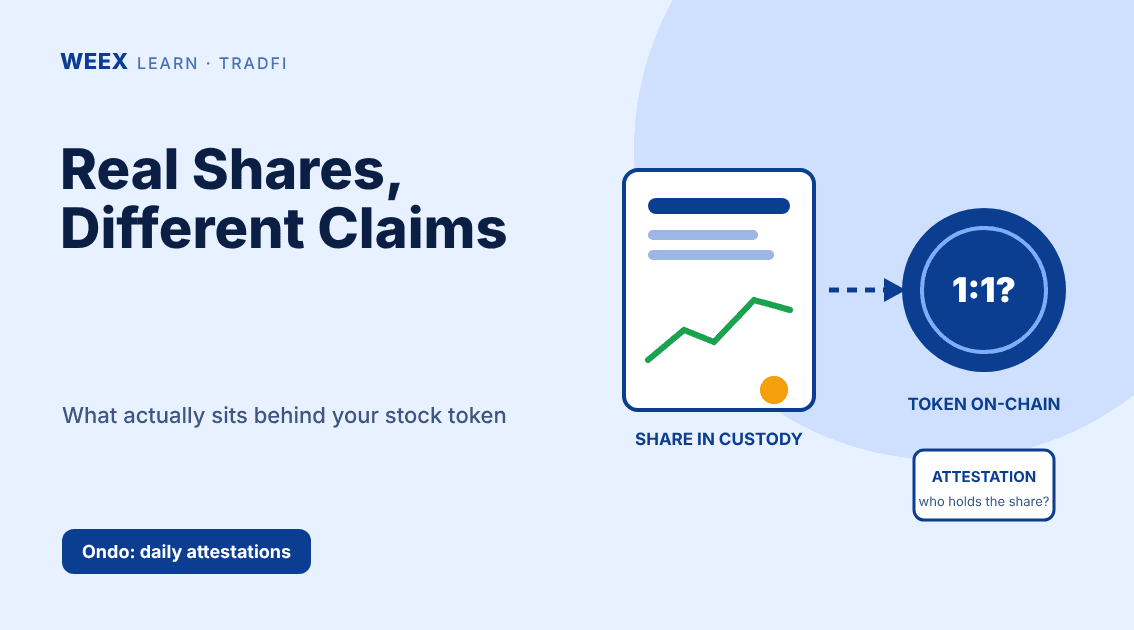
Legal Claim vs. Economic Exposure in Tokenized Stocks
Every spot tokenized stock answers two questions differently. Is there a share somewhere that matches my token? Usually yes. Do I have a legal right to that share? Usually not directly.
What issuers sell is economic exposure. The token tracks the stock price and passes through dividends, but the share is registered to an issuer or its custodian. Your claim runs against that issuer, typically a special purpose vehicle (SPV) kept separate from the parent company, with a security agent empowered to take over the collateral accounts if the issuer defaults.
That is meaningful backing. It is not the same as owning shares at a broker. If the structure works as designed, an issuer collapse ends with the shares being sold and cash paid to holders, not shares moved into your name.
How Each Major Issuer Holds the Shares
Issuer documentation and launch materials, checked on Oct. 20, 2026, describe these structures. Terms change.
xStocks (Backed, owned by Kraken). xStocks are tracker certificates, a debt instrument, issued by a Jersey SPV owned by Backed Finance AG under a prospectus approved by Liechtenstein's FMA. The xStocks FAQ says shares sit in segregated custody accounts under a three-party Account Control Agreement with an independent security agent, in what it calls a bankruptcy-remote structure. Collateral is published on the xStocks DeFi portal, though the docs give no update frequency. The FAQ says xStocks "do not convey shareholder rights, such as voting rights."
Ondo Global Markets. Ondo's "on" tokens are notes issued by a British Virgin Islands SPV and sold under Regulation S to non-US persons. Ondo's docs describe them as fully backed by the underlying asset plus cash in transit and overcollateralized, with a third-party security agent holding a first-priority security interest. Ondo lists daily attestations of assets held, monthly reconciliations and annual audits, the most frequent schedule among the products here.
Robinhood Stock Tokens. Robinhood runs two products, and they are not equally backed. The original EU tokens, launched June 30, 2025 and now called Classic Stock Tokens, are derivative contracts between the customer and Robinhood Europe under MiFID II. Robinhood's help page says the underlying assets are "held securely by a US-licensed institution," without naming it or calling it a broker-dealer, and says buyers are "not buying the actual stocks." The newer Stock Tokens, launched July 1, 2026 on Robinhood Chain, are debt securities issued by Robinhood Assets (Jersey) Limited, backed 1:1 by shares at a US custodian with an independent security agent.
Binance bStocks. Launched in June 2026 under a prospectus approved by Abu Dhabi Global Market's FSRA, bStocks are issued by Binance affiliate BTech Holdings. The launch release says each bStock is backed by one share held with an unnamed regulated custodian, and also that "bStocks are not stocks or shares."
Bitget rTokens. Issued by Reality, which Bitget launched in late May 2026, rTokens are described as backed 1:1 by shares held with a FINRA-registered, SIPC-member US broker-dealer, with third-party auditors behind a live proof-of-assets dashboard. Launch coverage named neither the broker-dealer nor a redemption route.
The pattern is consistent: the shares exist at a US custodian or broker, and the holder owns a claim on an offshore issuer. What differs is what only matters when something breaks, namely who the security agent is, how often collateral is verified and whether you can ever swap the token for the stock.
Why Stock Perpetual Futures Are Not Backed at All
A stock perpetual, such as a TSLA or NVDA contract on a crypto futures exchange, has no shares behind it by design. It is a USDT-settled contract between long and short traders that tracks an index price. No one buys a share when you open a long.
The price link comes from mechanics, not collateral. The mark price references the underlying index, and periodic funding pushes the contract toward it; WEEX's guide to how the crypto funding rate works covers who pays. Your protection is the exchange's margin system and insurance fund, not a custodian.
That makes a perp a different tool, not a worse token. It offers leverage, a short side and round-the-clock trading, but no dividend, and a losing position gets liquidated rather than held. Read up on how leverage changes a trade's risk before sizing one.
-- Price
Dividends, Voting and Redemption: The Fine Print
Dividends. Most spot tokens pass dividends through, rarely as cash. Ondo's tokens are total return trackers that reinvest dividends net of withholding tax, so one token can come to represent more than one share. xStocks rebase balances onchain. Robinhood's new Stock Tokens raise a multiplier, while Classic Stock Tokens credit a cash amount Robinhood says is not a dividend in the usual sense. Perps pay nothing; funding is their only recurring cash flow.
Voting. None of the offshore spot products above carry votes. The exception is separate: in July 2026 Ondo launched US tokens for IVV and Micron through its SEC-registered transfer agent, with proxy voting via Broadridge.
Redemption. Retail holders are usually shut out of the primary market. Ondo's docs say direct minting and redemption require KYC currently open only to institutional participants. xStocks allow retail redemption after KYC with a $5,000 minimum, though the FAQ concedes most users rely on secondary markets. Robinhood's Classic tokens cannot leave the app. For a typical exchange user, the exit is selling on the exchange, which makes venue liquidity as important as the collateral.
What Can Break Even When the Shares Are Real
Backing guards against one failure: an issuer minting tokens without buying shares. Other risks remain.
- Issuer insolvency. Recovery runs through the security agent and prospectus terms, meaning a cash payout after a legal process, on its timeline.
- Custodian failure. SIPC coverage at a US broker-dealer applies at the broker layer and only if statutory conditions are met.
- Gaps versus fair value. Issuers say they do not control secondary prices. xStocks issuance and redemption run 24/5 on US market days, while exchanges trade 24/7. On weekends nobody can arbitrage through the issuer, so a token can drift from where the stock will reopen.
- Thin liquidity. On Oct. 19, 2026, the WEEX tokenized stocks list put TSLAX's token market cap at about $69.4 million and SPYON's at about $46.5 million, a sliver of the underlying assets.
- Access. Every product here excludes US persons, and bStocks' terms let the issuer restrict access at its discretion.
In practice, 1:1 backing is necessary but not sufficient. The share is there; your route to it is the variable.
A Checklist for TSLAX, SPYON or a Stock Perp on WEEX
WEEX lists both channels: spot xStocks such as TSLAX/USDT and Ondo tokens such as SPYON/USDT, plus stock perpetual futures on names including TSLA, NVDA and QQQ. Before choosing:
- Name the issuer. TSLAX is a Backed xStock; SPYON is an Ondo Global Markets token. Read that issuer's legal page, not just the listing.
- Check collateral evidence and its date. For SPYON, find Ondo's latest daily attestation. For TSLAX, check the xStocks DeFi portal. Undated proof is not proof.
- Know what dividends do. SPYON reinvests; TSLAX rebases. Neither is a cash-income brokerage account.
- Plan your exit. You will almost certainly sell on the exchange, so check order book depth and spread first.
- Watch the clock. Fills outside US market hours carry more drift risk into Monday's open.
- If you pick the perp, accept that nothing backs it. You get leverage and a short side and you pay or receive funding. Know your liquidation price before entering.
So, are tokenized stocks backed by real shares? The leading spot tokens are, with collateral at US custodians and security agents behind holders. What they are not is shares. Judge the issuer, and the token, accordingly; for a months-long hold a backed spot token fits, while a short-term view or hedge belongs in the perp.
FAQ
1. Do tokenized stock holders own the underlying shares?
No. In the xStocks, Ondo, bStocks, rTokens and Robinhood structures, the issuer or its custodian holds the shares. You hold a note, certificate or contract with economic exposure and, in SPV structures, a secured claim on the collateral.
2. Are tokenized stocks 1:1 backed?
The major spot issuers say so, and Ondo says it overcollateralizes. Verification varies: Ondo documents daily attestations, while xStocks publish collateral without a stated update schedule. Stock perps have no backing.
3. What happens to my tokenized stock if the issuer goes bankrupt?
In SPV structures like xStocks and Ondo, an independent security agent can take control of the collateral, sell the shares and distribute proceeds to holders under the prospectus. Expect cash after a legal process, not shares.
4. Can I redeem a tokenized stock for the real share?
Rarely as a retail user. As of Oct. 20, 2026, Ondo limits direct redemption to KYC'd institutional participants, and xStocks require KYC and a $5,000 minimum. Most holders exit by selling on the exchange.
This content is provided for general informational purposes only and doesn't constitute financial, investment, legal, or tax advice. Any events, rewards, online promotions, or related information mentioned herein should not be considered a recommendation, solicitation, or invitation to purchase, sell, trade, or otherwise deal in any crypto assets. Crypto assets are highly volatile and may result in loss. The availability of WEEX services, products, and related events may vary by region. You are responsible for ensuring that your participation is in accordance with applicable local laws and regulations.
You may also like
Tokenized Stocks List 2026: Issuers, Sectors and What WEEX Lists
Tesla Roadster Performance, Thrust and Rocket Trims: Specs, Price and 2028 Production
Cybercab Launch: What It Means for TSLA and Tokenized TSLAX
TSLA vs SPCX: Musk's Two Public Companies Just Had Very Different Weeks
TSLA's Cybercab: What Actually Stands Between It and Commercial Operation?
Tesla Stock Jumps Nearly 7% as Cybercab Launches: But Wall Street Is Already Warning of a Selloff
What Is Leverage Trading in Crypto? A Beginner’s Guide With Simple Examples
What Is Crypto Margin Trading? How It Works, How It Differs From Futures and What Can Go Wrong
Crypto Leverage Trading Explained: How Perpetual Futures, Margin and Liquidation Work
Best Crypto Leverage Trading Platform: Things to Compare Before You Choose an Exchange
Nvidia Stock This Week: Why NVDA Fell Then Bounced and What AI Funding Worries Mean for Chip Stocks
Was My Qubic Wallet Exposed to Weak Seed Randomness? A QU Holder Checklist
WXT Staking When Supply Shrinks: What Burns Add to Your Yield
ETH Funding Rate Today: 0.0087% per 8h as Ether Longs Re-Lever
Bitcoin Margin Trading: BTC Liquidation Math at 3x, 10x and 25x
Crypto Leverage Trading Platform: 6 Checks Before You Deposit
What Is Margin Trading? A $1,000 Example at 3x and 10x Leverage

The 17 October 2026 DBR Unlock: Six Allocations and deBridge's Vesting Schedule
Fake Crypto Payments: What to Check Before Handing Over Goods
What Is Leverage in Trading? How Leverage Ratios Like 5x and 10x Work and What They Do to Your Risk
What Is Leverage Trading? A Beginner’s Guide to Margin, Liquidation and Funding Fees
Is RSI a Good Indicator? How the Relative Strength Index Works, Its Limits and How Traders Use It
CXMT Stock Explained: What Is ChangXin Memory, Why It Fell on October 19 and What to Watch Next

Why Is CoreWeave (CRWV) Stock Falling? Debt, Bond Yields and What Analysts Say

KOSPI Whipsaw Explained: Samsung, SK Hynix and the AI Spending Doubts Behind the Swing
Is Bitget Leaving Russia? What Account Holders Should Check
How to Day Trade Crypto for Beginners: The Math Behind One Trade
Trading Psychology for Beginners: Crypto Traps and Hard Rules
What Is a Bitcoin ETF? How Creation, Custody and Fees Work
What Is Blockchain and How Does It Work? One Transaction, Traced
Tokenized Stocks List 2026: Issuers, Sectors and What WEEX Lists
Tesla Roadster Performance, Thrust and Rocket Trims: Specs, Price and 2028 Production
Cybercab Launch: What It Means for TSLA and Tokenized TSLAX
TSLA vs SPCX: Musk's Two Public Companies Just Had Very Different Weeks
TSLA's Cybercab: What Actually Stands Between It and Commercial Operation?
Tesla Stock Jumps Nearly 7% as Cybercab Launches: But Wall Street Is Already Warning of a Selloff
Contents
Popular coins
Latest articles


