
What Is Margin Trading? A $1,000 Example at 3x and 10x Leverage

 Prefer us on Google

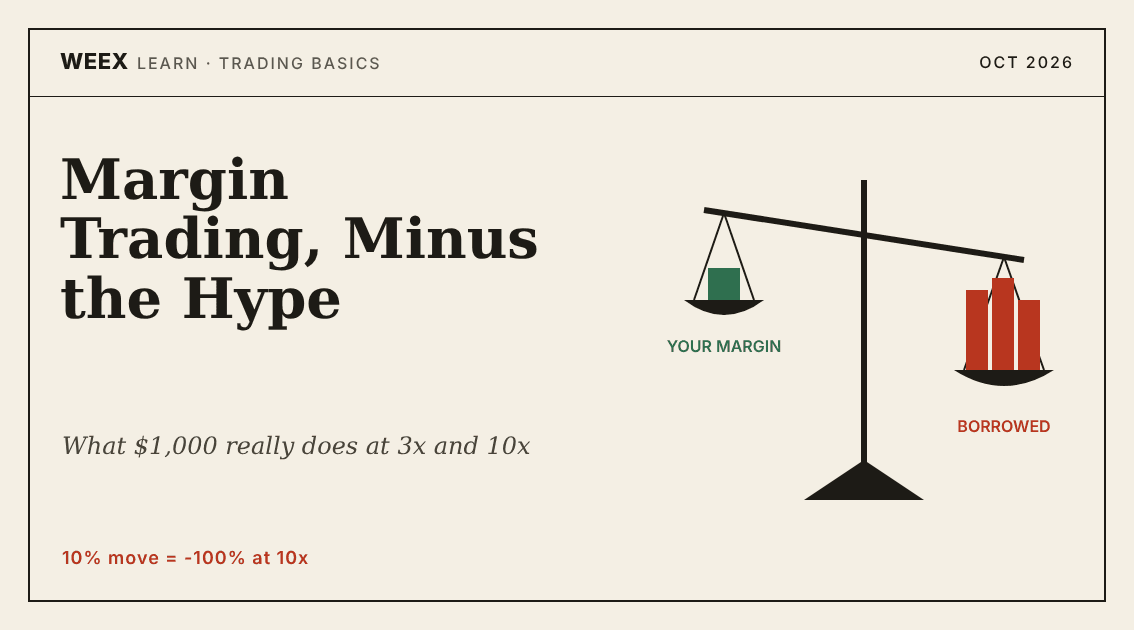
Margin trading is trading with borrowed money, or with collateral that stands in for borrowed money, so that a small deposit controls a larger position. The short answer to what is margin trading: you post a deposit called margin, the broker or exchange extends the rest, and every gain and loss is calculated on the full position size, not on your deposit.
That multiplier is the whole appeal and the whole problem. A stock that rises 10% earns a cash buyer 10%; bought with half borrowed money, it earns close to 20% before interest. The arithmetic runs in reverse too, and the account's rules can force a sale without asking you first.
This guide explains how margin works across markets, the difference between initial and maintenance margin, what actually happens at a margin call versus a liquidation, and how spot margin differs from futures margin. It then runs one $1,000 account through a 10% move at 3x and 10x, with real fees and funding priced in, so the numbers carry the argument.
How Margin Trading Works: Collateral, Loan, Equity
Every margin position has three parts. Your collateral is the cash or assets you deposit. The loan, or the leveraged exposure, is what the platform adds on top. Equity is what would be left if you closed everything right now: position value minus whatever you owe.
Leverage is position size divided by equity. Control $3,000 with $1,000 and you are at 3x, so a 1% price move becomes roughly 3% on your equity.
The platform holds your collateral as security and watches your equity continuously. When equity falls below a required minimum, the platform protects itself first, and that rule decides whether margin is a tool or a trap.
Accounts come in two designs. Cross margin pools your whole balance behind every open position, giving more buffer but letting one losing trade drain money meant for others. Isolated margin assigns fixed collateral to one position, so a failure stops there.
Initial Margin vs. Maintenance Margin
Initial margin is the deposit required to open a position. In US stock markets, the Federal Reserve's Regulation T lets you borrow up to 50% of the purchase price of marginable securities, which means a stock margin account tops out near 2x at entry. You also need at least $2,000, or the full purchase price if lower, before you can trade on margin, according to the SEC's investor bulletin on margin accounts.
Maintenance margin is the minimum equity you must keep after the trade is open. FINRA Rule 4210 sets that floor at 25% of the market value of the securities for long stock positions, and the SEC notes that many brokers set their own "house" requirement at 30% to 40%.
The gap between the two is your breathing room. Buy $2,000 of stock with $1,000 of your own money and $1,000 borrowed. Your equity starts at 50%. The account hits the 25% maintenance line when the position is worth about $1,333, a drop of roughly 33%. A broker with a 40% house rule would act much sooner, around a 17% drop.
Crypto derivatives use the same two concepts with different numbers. Initial margin is position size divided by leverage, so 10x needs 10% up front, and maintenance margin is a small percentage of position value that rises in tiers for larger positions. The distance to forced closure shrinks from a third of the position to single digits.
Margin Call vs. Liquidation: What Happens When Equity Runs Out
A margin call is a demand to restore equity, either by depositing cash or securities or by reducing the position. In stock accounts it is a request with a clock attached, and the clock is not guaranteed. The SEC is blunt on this point: a firm can sell some or all of your securities without consulting you, can choose which ones to sell, and can sell before any deadline it gave you.
Liquidation is the forced closing itself. In crypto futures there is usually no polite call at all. When the mark price reaches your liquidation price, the engine closes the position automatically, and in isolated mode the margin assigned to that trade is gone.
- Losses can exceed your deposit in stock margin. The SEC's example: buy a $50 stock with $25 of your money and $25 borrowed, watch it fall to $15, and you have lost your $25 and still owe $10 plus interest.
- Liquidation prices move with leverage, not with your opinion. At 10x, a move a little short of 10% against you is enough to close the trade. The exact point depends on the maintenance tier and fees, which our guide on how to calculate crypto liquidation price works through from 5x to 50x.
-- Price
Spot Margin vs. Futures Margin
Spot margin is a literal loan. You borrow cash or coins from the broker or exchange, buy or sell the real asset, and pay interest on the borrowed amount until you repay it. Stock margin accounts work this way, and the interest accrues whether the price moves or not.
Futures margin involves no loan at all. You post collateral against a contract that tracks the asset's price. Crypto perpetual futures replace interest with a funding rate, a periodic payment between longs and shorts that keeps the contract near the spot price. When funding is positive, longs pay shorts; when negative, the reverse. Our explainer on crypto funding rates covers who pays and why.
On WEEX, margin trading is done through USDT-margined perpetual futures, with cross and isolated modes available.
Margin Trading in Numbers: $1,000 at 3x and 10x Through a 10% Move
Most guides skip fees and holding costs. This example includes both, using WEEX data as of Oct. 20, 2026:
- Collateral: $1,000 in isolated margin, long position
- Fees: VIP0 taker rate of 0.08% to open and 0.08% to close, per the WEEX futures fee schedule (maker is 0.02%)
- Funding: 0.009131% per 8-hour interval, the BTCUSDT perpetual rate on Oct. 20, 2026, held for one day (three intervals) and assumed unchanged
- The asset moves 10%, up or down, over that day
At 3x ($3,000 position):
- Opening fee: $2.40. Funding for the day: about $0.82.
- Price up 10%: gross gain $300, closing fee $2.64, net about +$294, or +29.4% on your $1,000.
- Price down 10%: gross loss $300, closing fee $2.16, net about -$305, or -30.5%.
At 10x ($10,000 position):
- Opening fee: $8.00. Funding for the day: about $2.74.
- Price up 10%: gross gain $1,000, closing fee $8.80, net about +$980, or +98%.
- Price down 10%: the position never reaches -10%. It is liquidated a little before that point, and the $1,000 is effectively gone, a -100% result.
First, the outcomes are not symmetrical. At 3x a 10% swing costs or earns about 30%. At 10x the upside is about 98%, but the downside is total, because the liquidation line sits inside the move.
Second, fees are charged on the position, not on your deposit. A round trip at taker rates costs 0.16% of notional, which is about 0.5% of your collateral at 3x and about 1.6% at 10x.
Third, funding compounds into something like an interest rate. At 0.009131% every eight hours, a long pays roughly 10% of notional a year if the rate held constant. At 10x that is about 100% of your collateral a year, spent simply on holding the position. Funding rates change every interval and can flip negative, so treat this as today's reading, not a fixed price.
Who Margin Trading Suits, and Where It Goes Wrong
Margin suits narrow jobs: hedging a holding, expressing a short view, or adding modest exposure with a defined exit. It is a poor way to build a long-term position, because holding costs and forced-sale risk work against patience.
In practice, accounts rarely blow up from one bad idea; they blow up from a reasonable idea held at leverage that leaves no room for normal volatility. The useful question is not "how much can I borrow" but "how far can price move against me before I am out, and is that distance wider than the asset's ordinary daily range?" If not, the leverage is too high.
Habits that keep margin traders solvent:
- Choose leverage from the stop distance backward, not from the platform's maximum
- Use isolated margin for any position you would not want to drain the rest of the account
- Place a stop-loss above the liquidation price, so you choose the exit instead of the engine
- Price the holding cost before entering, especially if funding has been running high
For the mechanics behind leverage ratios and how funding fits into a full position plan, see the WEEX beginner's guide to leverage trading.
FAQ
1. Is margin trading the same as leverage trading?
They overlap. Leverage is the ratio of position size to equity; margin is the collateral that makes that ratio possible. Every margin trade is leveraged, but leverage also comes from futures and options that involve no loan.
2. Can you lose more than you invest with margin trading?
In a stock margin account, yes. If the price falls far enough, you can lose your entire deposit and still owe the broker the loan plus interest. In crypto futures using isolated margin, the loss on a position is normally limited to the margin assigned to it, though cross margin can pull in the rest of your account balance.
3. How much do you need to start margin trading?
For US stocks, FINRA and the SEC require at least $2,000, or the full purchase price if lower, and brokers may ask for more. Crypto futures platforms usually require only the initial margin for the position, which is why small accounts reach high leverage so easily.
4. Is margin trading good for beginners?
Usually not as a first step. Beginners underestimate how quickly maintenance requirements bite. Learn position sizing and stop placement unleveraged, then try 2x to 3x on small positions before going higher.
This content is provided for general informational purposes only and doesn't constitute financial, investment, legal, or tax advice. Any events, rewards, online promotions, or related information mentioned herein should not be considered a recommendation, solicitation, or invitation to purchase, sell, trade, or otherwise deal in any crypto assets. Crypto assets are highly volatile and may result in loss. The availability of WEEX services, products, and related events may vary by region. You are responsible for ensuring that your participation is in accordance with applicable local laws and regulations.
You may also like
Crypto Leverage Trading Explained: How Perpetual Futures, Margin and Liquidation Work
Bitcoin Margin Trading: BTC Liquidation Math at 3x, 10x and 25x
Crypto Leverage Trading Platform: 6 Checks Before You Deposit
How to Day Trade Crypto for Beginners: The Math Behind One Trade
Trading Psychology for Beginners: Crypto Traps and Hard Rules
What Is a Bitcoin ETF? How Creation, Custody and Fees Work
What Is Blockchain and How Does It Work? One Transaction, Traced
WEEX Convert Fees: What Zero-Fee Conversion Really Costs You
WEEX Convert Quote: How the 8-Second Price Lock Really Works
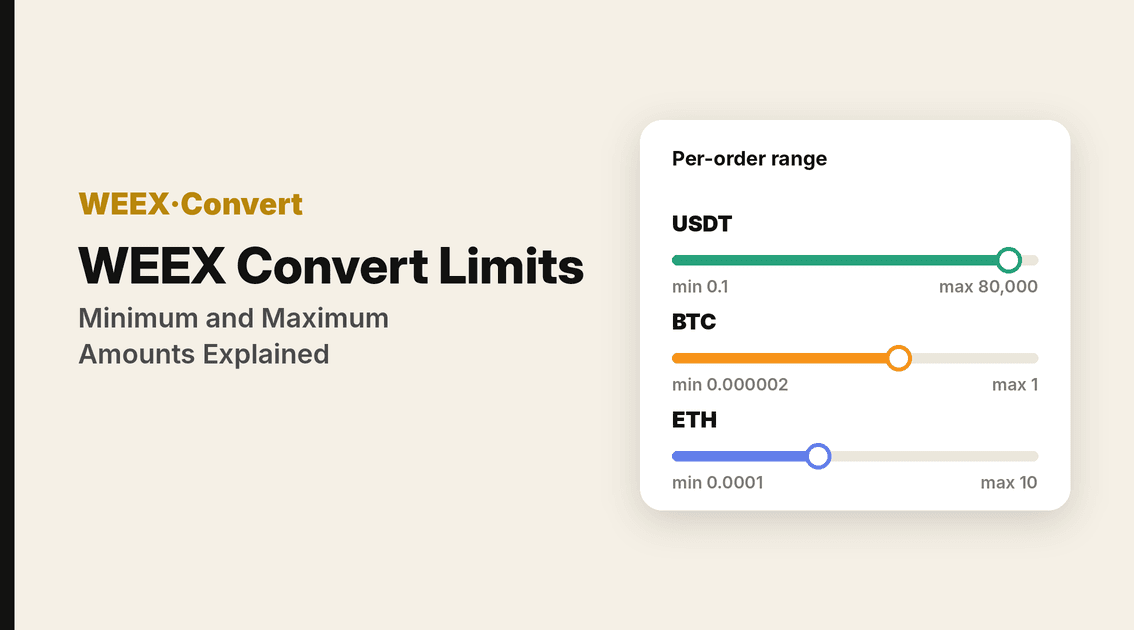
WEEX Convert Limits: Minimum and Maximum Amounts Explained
How to Check a WEEX Convert Order: History, Rate and Status

USDC Significant EMT Status in the EU: What Changes on November 12 Under MiCA
Walrus (WAL) Jumps 30%: Sui Storage Token Rallies on AI Data
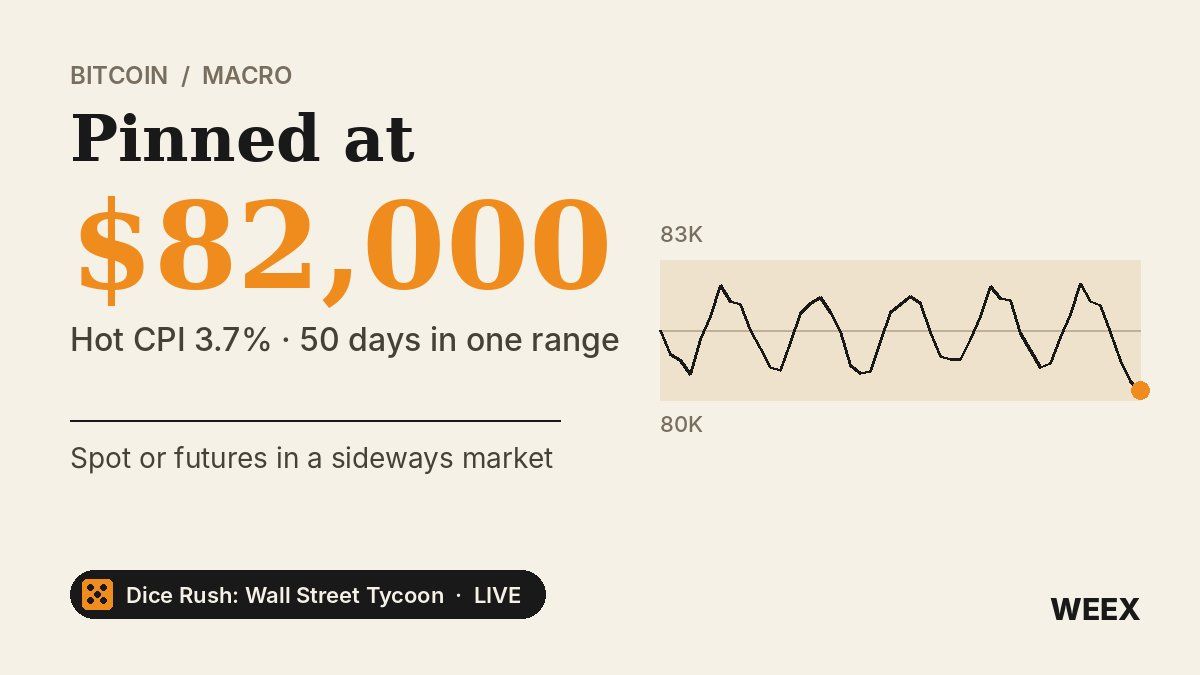
Bitcoin Price After Hot CPI: Why BTC Is Pinned Near $82,000
What Is a Limit Order? How It Works and When to Use It

Best Crypto Miner for Beginners: What to Check on Cost, Power, Hashprice and Profit Before You Buy
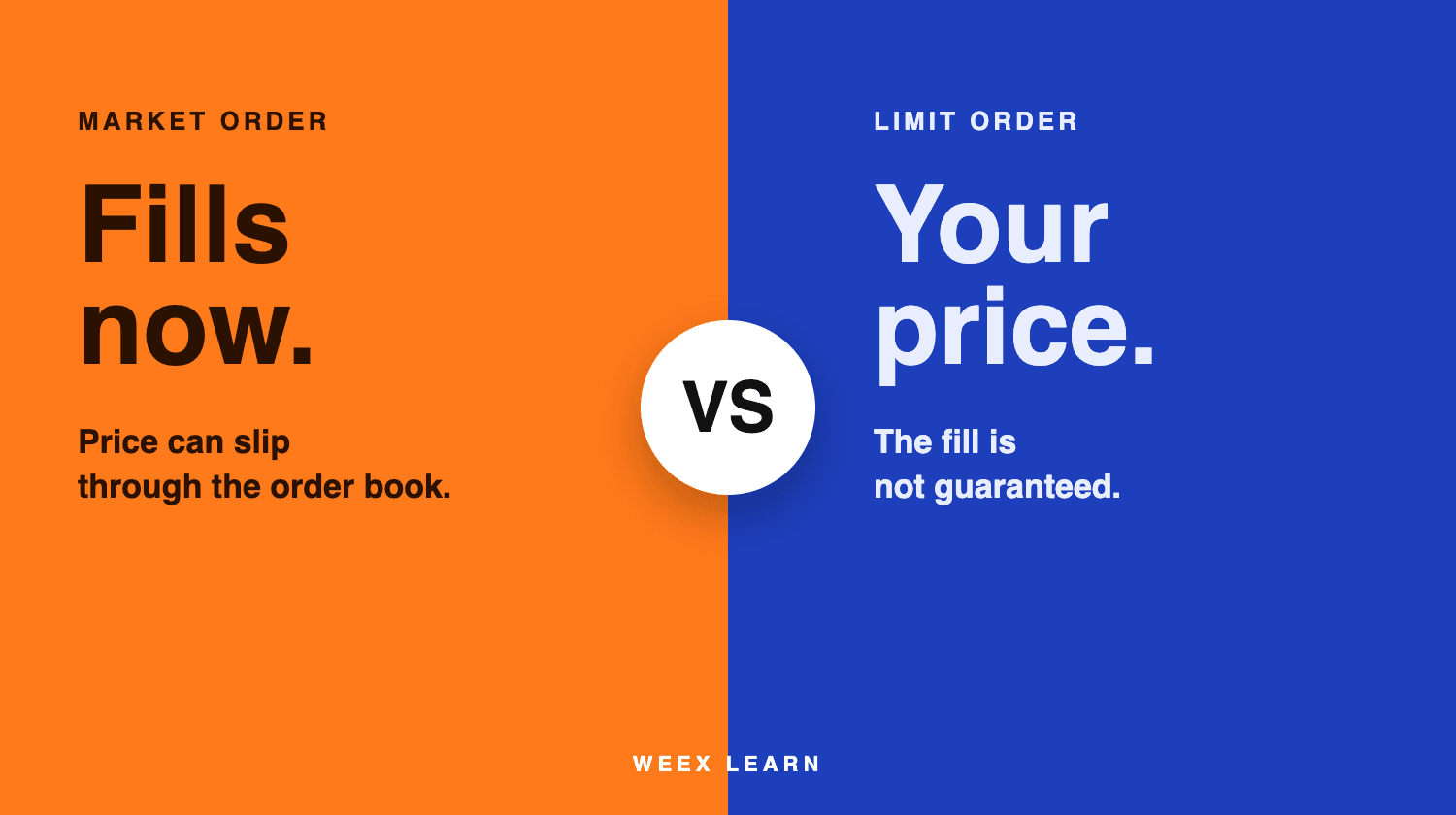
Limit Order vs Market Order: Which One to Use When Trading Crypto
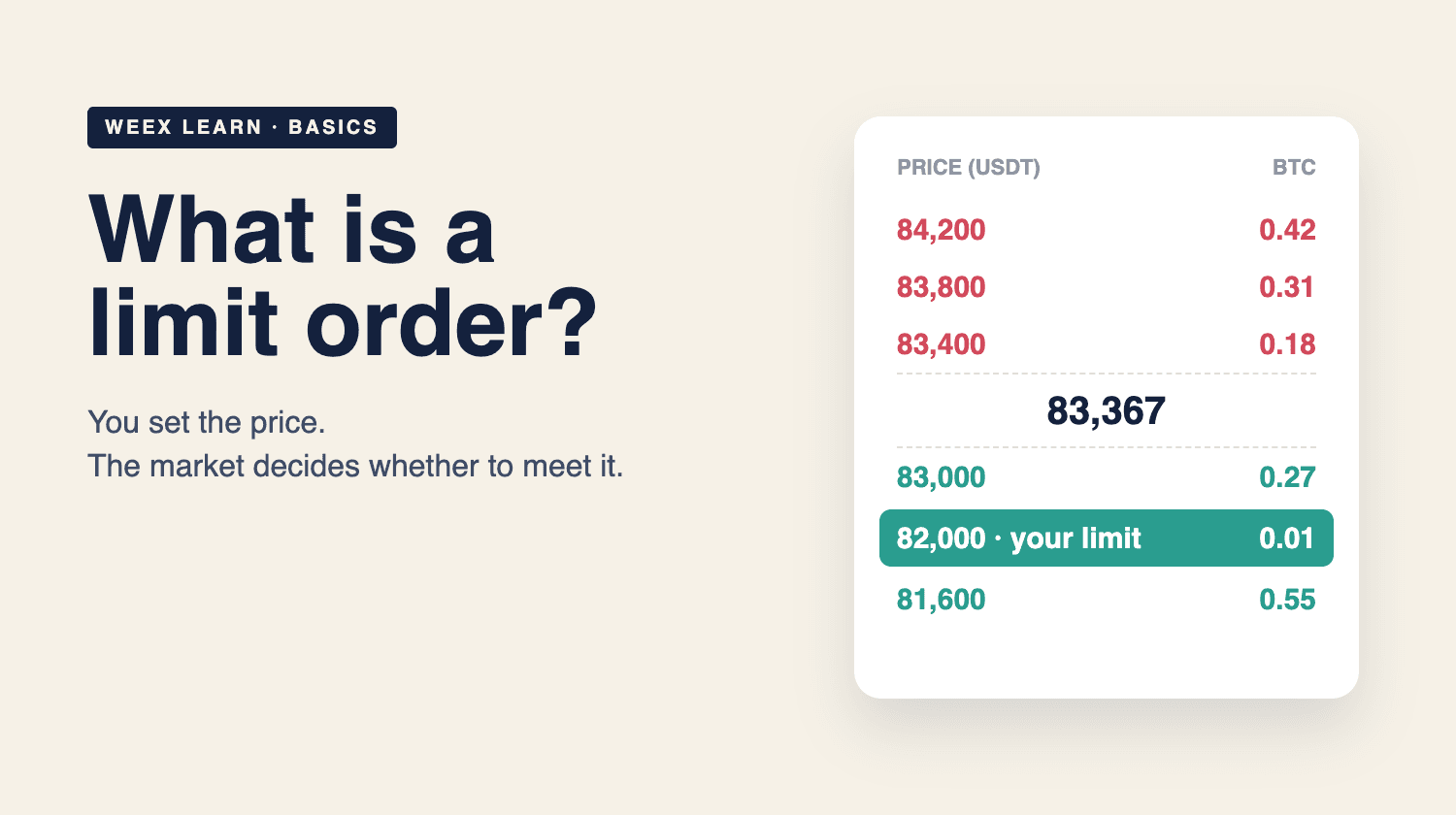
What Is a Limit Order? How It Works in Crypto With BTC Examples
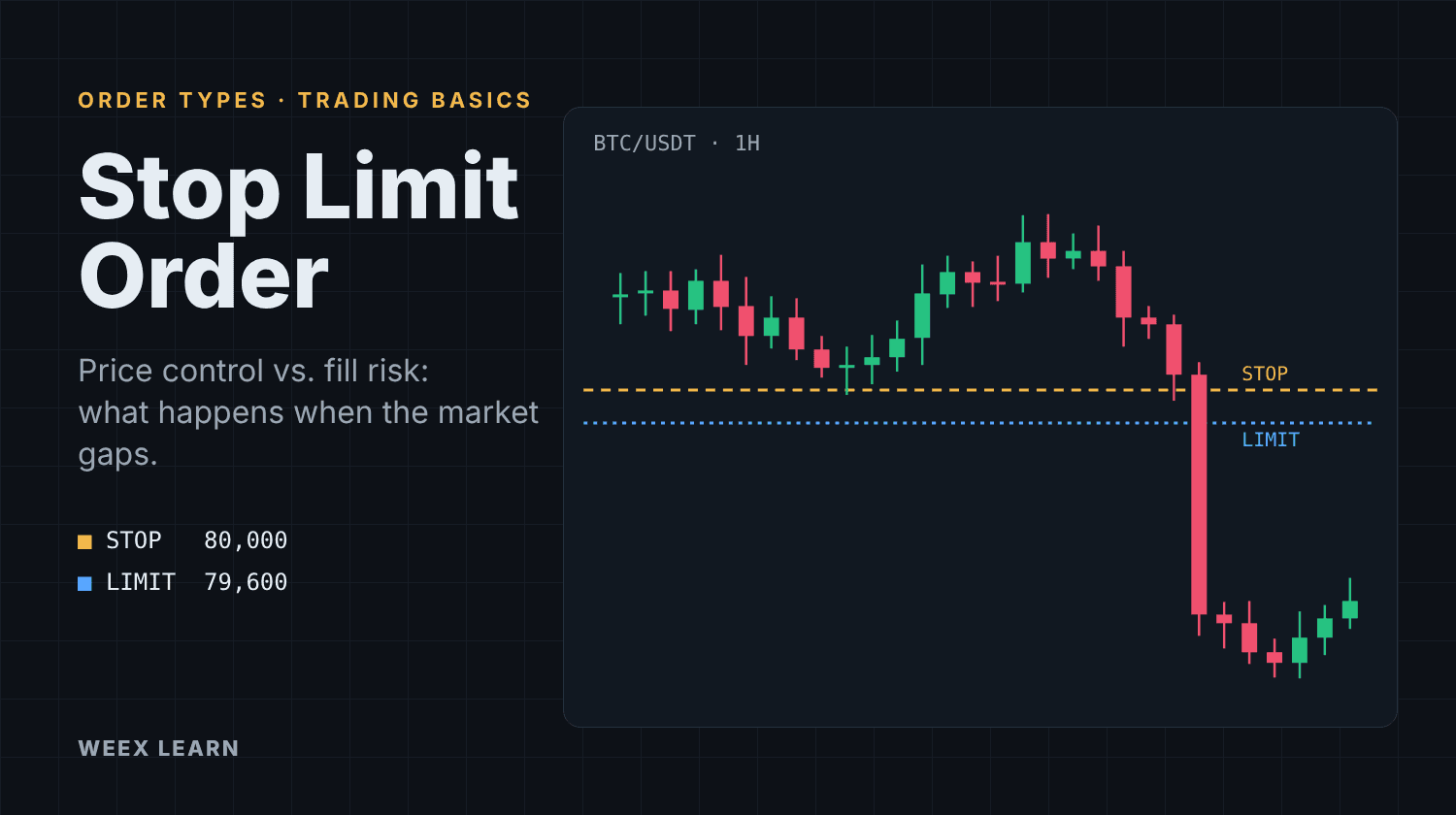
Stop Limit Order: How It Works and Why It Can Fail to Fill
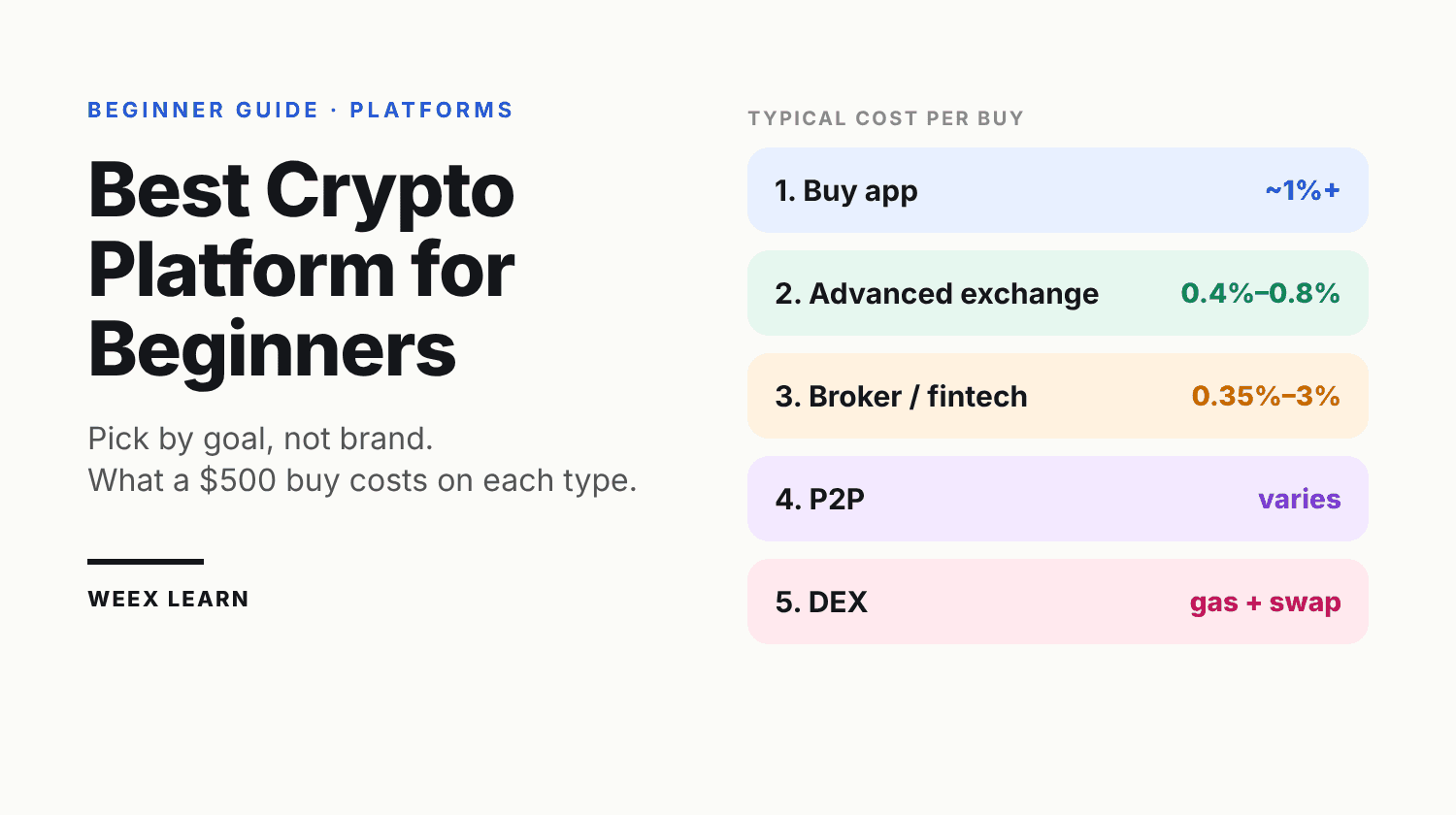
Best Crypto Platform for Beginners: Pick by Goal, Not Brand

Best Crypto Podcasts for Beginners: A 4-Week Listening Plan
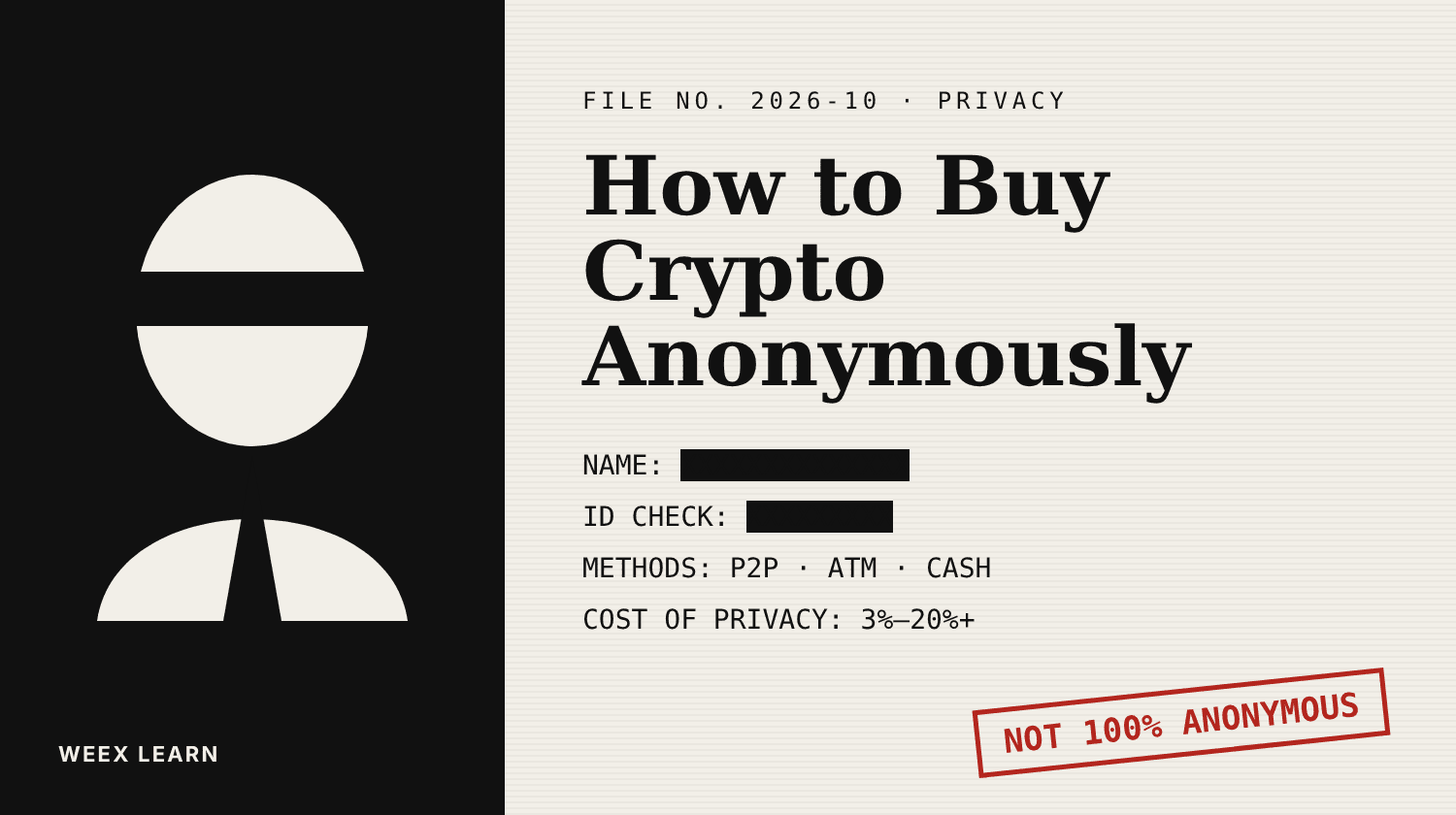
How to Buy Crypto Anonymously: 5 Methods, Real Costs and Limits

Will Bitcoin Break $87,000 This Week? CPI, Fed Speakers and ETF Outflows to Watch

Conflux (CFX) Price Jumps on China's National Blockchain Network Plan: Does the Policy Actually Name CFX?
BTC Futures Analysis: $80K Held, but Longs Are Still Paying Up
ETH Futures: Why Ether Is Falling Faster Than Bitcoin This Week
ENA Token Price Drops After October 5 Unlock: What Happened to Ethena?
What Is Blockchain and How Does It Work? One Real Payment Traced

How to Buy Crypto With a Prepaid Card: Step-by-Step Guide
Best Crypto Trading Strategies for Beginners: What to Know Before You Trade
Crypto Leverage Trading Explained: How Perpetual Futures, Margin and Liquidation Work
Bitcoin Margin Trading: BTC Liquidation Math at 3x, 10x and 25x
Crypto Leverage Trading Platform: 6 Checks Before You Deposit
How to Day Trade Crypto for Beginners: The Math Behind One Trade
Trading Psychology for Beginners: Crypto Traps and Hard Rules
What Is a Bitcoin ETF? How Creation, Custody and Fees Work


