
SpaceX Stock Price: Why SPCX Trades Below Its $135 IPO — and Which Price You're Actually Seeing

 Prefer us on Google


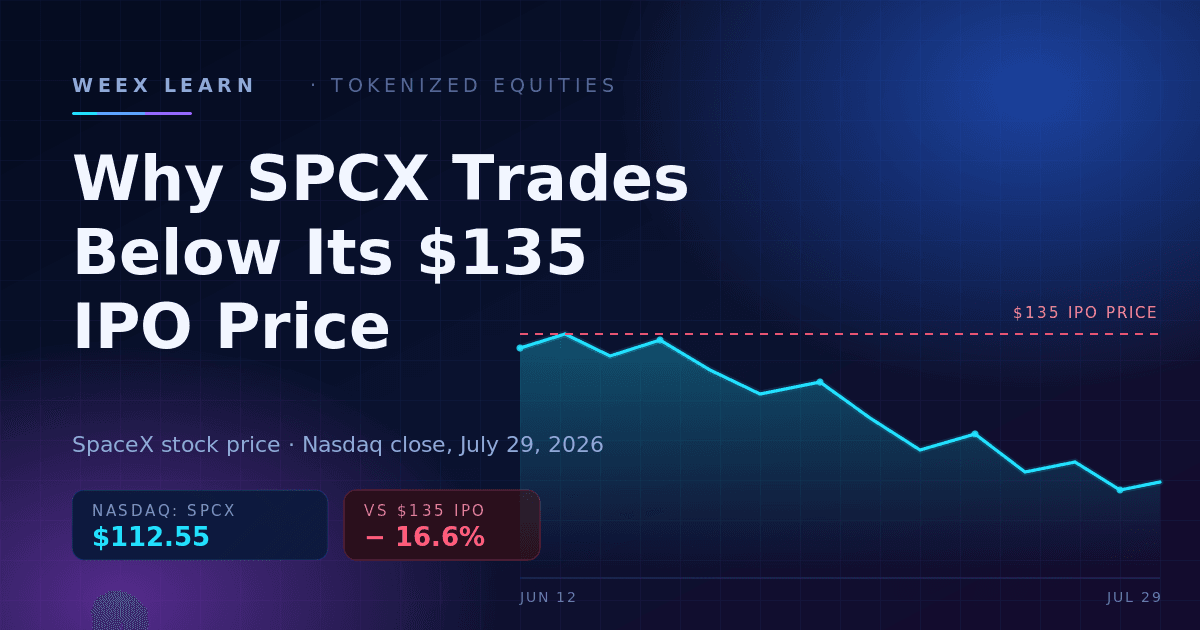
Seven weeks after the largest IPO ever recorded, SpaceX stock is worth less than the shares sold to institutions on day one. SPCX closed at $112.55 on July 29, 2026, against a $135 offer price — a 17% loss for anyone allocated at the IPO, and roughly 50% below the $225.64 intraday high the stock printed on June 16.
That is the answer to the price question. The more useful question is why, and the answer has almost nothing to do with rockets. It has to do with a public float of roughly 4%, an index inclusion that forced billions of dollars of buying into that float, an all-stock acquisition that dilutes it, and a lockup schedule that starts unwinding on August 6, 2026.
There is also a second complication that quote pages don't mention: since the IPO there is no longer one SpaceX stock price. There are several, they trade on different clocks, and they don't always agree.
SpaceX Stock Price Today: The Numbers That Matter
| Metric | Level | As of |
|---|---|---|
| Last close | $112.55 | July 29, 2026 |
| Previous close | $116.41 | July 28, 2026 |
| Day range | $110.35 – $117.59 | July 29, 2026 |
| 52-week range | $107.01 – $225.64 | July 2026 |
| IPO price | $135.00 (fixed) | Priced June 11, 2026 |
| First-day close | ~$160.95 (+19.2%) | June 12, 2026 |
| Post-IPO high | $225.64 | June 16, 2026 |
| Drawdown from high | ~-50% | July 29, 2026 |
| Ticker / venue | SPCX, Nasdaq & Nasdaq Texas | — |
For orientation on the share count: SpaceX executed a 5-for-1 split on May 4, 2026, before listing, and every per-share figure in the S-1 was restated on that basis. Any pre-May 2026 "SpaceX share price" you find — including the roughly $421 per share implied by the December 2025 tender offer at an $800 billion valuation — is not comparable to today's quote without adjusting for the split. This trips people up constantly when they compare a private-market number to the screen.
Why the SpaceX Stock Price Fell Below Its IPO Price
Three things happened in sequence, and they compound.
The float was never big enough to absorb real selling. SpaceX sold about 555.6 million shares to raise roughly $75 billion at a $1.75 trillion valuation — an enormous raise in dollar terms, but only about 4–5% of total shares outstanding. A tiny float amplifies moves in both directions. It is the mechanical reason the stock could run 67% above its offer price in four sessions, and the same reason it can fall 8% in a week on no company-specific news.
Index inclusion pulled the move forward. SpaceX joined the Nasdaq-100 on July 7, 2026, which forced an estimated $4.3 billion of index buying into that thin float. Forced buying is not the same as conviction buying. Once the tracking funds finished, the natural bid went with them, and the stock has fallen in four of the past five weeks.
Then came dilution. On June 16 — the same day SPCX peaked — SpaceX announced a $60 billion all-stock acquisition of Cursor, the AI coding company, expected to close in the third quarter. All-stock means new shares. At SpaceX's then-valuation that is roughly 3.4% dilution, landing weeks before insiders are first allowed to sell.
Notably, the operational news has been the good part. Starship Flight 13 launched on July 24, 2026, deployed 20 V3 Starlink satellites and splashed down intact, though the booster relit only 8 of 13 engines and came down harder than planned. The stock barely moved, holding near $114–116. When a successful test flight can't lift a stock, the marginal buyer is worried about share supply, not engineering.
The Supply Calendar Driving SpaceX Stock Into August
This is the part of the SpaceX stock price story that quote pages leave out entirely, and it is the single most important thing to have on a calendar right now. The lockup is staggered and event-linked rather than a single cliff.
| Date / trigger | What unlocks or lands |
|---|---|
| Aug 4, 2026 (after close) | First earnings as a public company — Q2 2026. Visible Alpha consensus revenue ~$6.9B |
| Aug 6, 2026 | First tranche opens: insiders may sell up to 20% of restricted holdings |
| 70 / 90 / 105 / 120 / 135 days post-offering | Five time-based tranches, ~7% of eligible shares each |
| Q3 2026 results | Further 28% releases |
| 180 days post-offering | Remaining restrictions lapse |
| Total potentially released | Up to ~911.5 million shares |
Read the last row against the float: the shares that can eventually come off restriction exceed the entire current public float by a wide margin. That does not mean 911.5 million shares will be sold, and it does not mean they hit at once. It does mean the supply/demand balance that produced a $225 print in June no longer exists in the same form, and the market has spent July repricing for it.
The better reading of the August 4 earnings date is that it matters less for the revenue number than for what it unlocks two days later. A strong print into an opening sell window is a genuinely awkward setup.
Which SpaceX Stock Price? Nasdaq SPCX vs Tokenized SPCX
Here is where crypto rails changed the question. On IPO day, four separate tokenized SpaceX products went live, and they are not interchangeable — a point that gets flattened in most coverage. Tokenized equity volume hit a record $3.86 billion in June 2026, with SpaceX as the single biggest driver.
| Wrapper | What it actually is | Redeemable for shares? | June 2026 volume |
|---|---|---|---|
| Backpack Securities SPCX (Solana) | Redeemable claim on a custodied share | Yes | ~$1.08B |
| xStocks SPCXx (Solana SPL) | Cash-settled tracking certificate; no shareholder rights | No | ~$852M |
| Ondo SPCXon | Tracker giving economic exposure, dividends reinvested | Mint/redeem, 24h × 5 days, non-US users | Not disclosed |
| Binance bStocks SPCX | Exchange-issued tokenized product | Varies by terms | Not disclosed |
Three practical consequences:
The clock differs. Nasdaq closes; tokenized SPCX and SPCX perpetuals do not. On a Saturday, a tokenized quote is price discovery with no reference market behind it and thinner liquidity — so gaps open more easily and correct more slowly. The Monday open is where the two clocks reconcile.
The peg is a peg, not an equivalence. These instruments are pegged to SPCX, not identical to it. Tracking error is normal, and depegging is possible in stress. Ahead of the IPO, aggregated SPCX perpetuals traded at a $155 VWAP against the eventual $135 offer price — a 15% premium to a price that didn't exist yet, with $2.2 billion in cumulative volume behind it.
Supply of the wrapper can fail. When SPCX surged post-listing, several crypto venues cancelled tokenized allocation campaigns because the underlying shares could not be sourced. Tokenized equity still depends on custody, sourcing and redemption plumbing that can break independently of the stock itself.
On WEEX, the two spot wrappers went live within a day of the listing: SPCXX/USDT (the xStocks tokenized certificate) opened June 12, 2026 at 15:00 UTC, and SPCXON/USDT (the Ondo tracker) followed on June 13, 2026 at 11:00 UTC. Note that xStocks SpaceX products are not tradable or withdrawable in China, and regional restrictions apply across all of these wrappers.
How to Track and Trade the SpaceX Stock Price Without a US Brokerage
If you can buy Nasdaq stocks, buy SPCX directly — you get the real share, voting rights and any future dividend, and you avoid every tracking and counterparty issue above. Fractional shares make the $112 price tag irrelevant.
If you can't, the realistic options are stablecoin-settled. WEEX lists SPCX-USDT perpetual futures with leverage up to 20x and continuous trading, alongside the two tokenized spot pairs. Order-type and access detail is in WEEX's guide to where and how to buy SPCX stock. Be blunt with yourself about what these are: price exposure only. No ownership, no vote, no dividend.
What traders usually miss about a 4% float
Thin float cuts both ways, and leverage is the wrong tool for it. Three failure modes recur on new mega-cap listings:
- Funding drains crowded positions. A consensus short into a lockup is still a crowded trade, and perpetual funding bills you daily for the privilege.
- Gaps ignore your stop. A single Starship headline, index rumour or unlock filing can move a low-float stock several percent in minutes. A stop-loss is a request, not a guarantee.
- The wrapper's price is not the stock's price. If you are trading a tokenized product over the weekend, you are trading a market with no reference price. Position size accordingly.
The disciplined version of this trade is small size, low or no leverage, and a predefined level — set before August 4, not during the earnings call.
Bottom Line
The SpaceX stock price as of July 29, 2026 is $112.55, roughly 17% below its IPO price and about half its June high. The company's 2025 numbers — approximately $18.7 billion revenue against a $4.9 billion net loss, with Starlink's 9.2 million subscribers and $10 billion-plus revenue carrying the profitable segment — did not deteriorate in July. The share supply outlook did.
What matters most between now and September is not valuation debate but plumbing: the August 4 print, the August 6 sell window, the staggered tranches after it, and the Cursor shares arriving in Q3. For a view on longer horizons, WEEX's SpaceX stock price prediction for 2026–2030 lays out bear, base and bull scenarios — though note it was written before the June 12 debut, so treat its starting assumptions as pre-IPO.
For context on the valuation argument itself: at $1.75 trillion the IPO priced SpaceX near 90–110x 2025 revenue, while Morningstar's fair value estimate sits near $780 billion. A gap that wide is not resolved by one earnings report.
FAQ
1. What is the SpaceX stock price right now?
SPCX closed at $112.55 on July 29, 2026, after a previous close of $116.41 and a day range of $110.35–$117.59. Its 52-week range is $107.01–$225.64. A newly listed low-float stock moves fast, so check a live quote before acting on any figure in an article.
2. Is SpaceX stock below its IPO price?
Yes. SPCX priced at $135 and has traded below that level since mid-July 2026 — roughly 17% under the offer as of the July 29 close, and about 50% below the $225.64 intraday high set on June 16.
3. Why did SpaceX stock drop so much in July 2026?
Three overlapping reasons: the August 6 lockup tranche that lets insiders sell up to 20% of restricted holdings; roughly 3.4% dilution from the $60 billion all-stock Cursor acquisition announced June 16; and the fading of the forced index buying that followed Nasdaq-100 inclusion on July 7. A 4–5% public float exaggerates all three.
4. When does the SpaceX lockup expire?
It is staggered, not a single date. The first window opens August 6, 2026, two full trading days after the August 4 earnings release, allowing up to 20% of restricted insider holdings to be sold. Additional ~7% tranches release at 70, 90, 105, 120 and 135 days post-offering, a further 28% at Q3 results, and the remainder at 180 days — up to roughly 911.5 million shares in total.
5. Is the tokenized SPCX price the same as the Nasdaq price?
No — it is pegged, not identical. Tokenized SPCX products track the share price but can trade at a premium or discount, especially outside Nasdaq hours when there is no live reference market. Before the IPO, SPCX perpetuals traded at a $155 VWAP against the $135 offer price.
6. What is the difference between SPCXX and SPCXON?
SPCXX is the xStocks tokenized certificate on Solana, cash-settled and conferring no shareholder rights. SPCXON is Ondo's tokenized version, designed to give economic exposure similar to holding SPCX with dividends reinvested. Both are wrappers, not shares.
7. What is SpaceX worth in 2026?
The IPO valued SpaceX at roughly $1.75 trillion. The market cap moved above $2 trillion in mid-June and has fallen back with the share price since. Morningstar's fair value estimate is near $780 billion, so the valuation range remains contested.
Risk Warning
SpaceX stock is a newly listed, low-float security and SPCX has already moved roughly 50% from high to low within seven weeks of trading. Specific risks are concentrated rather than general: a public float of about 4–5% amplifies moves in both directions; up to ~911.5 million shares can come off lockup restriction on a staggered schedule beginning August 6, 2026; the $60 billion all-stock Cursor acquisition dilutes existing holders in Q3 2026; the company reported a net loss near $4.9 billion in 2025; and a dual-class structure concentrates control with Elon Musk and a small group of insiders.
Crypto-settled SPCX exposure adds separate risks. Perpetual futures carry leverage, funding costs and liquidation risk, and a low-float underlying can gap through a stop-loss. Tokenized products such as SPCXX and SPCXON are pegged, not equivalent — tracking error and depegging are possible, redemption depends on custody and share-sourcing plumbing that has already failed once when venues cancelled tokenized allocations post-IPO, and counterparty risk applies. These instruments confer no share ownership, voting rights or dividends, and are unavailable in several jurisdictions, including xStocks SpaceX products in China. Crypto assets and leveraged products are volatile and can result in partial or total loss of capital. Nothing here is investment advice.
This content is provided for general informational purposes only and doesn't constitute financial, investment, legal, or tax advice. Any events, rewards, online promotions, or related information mentioned herein should not be considered a recommendation, solicitation, or invitation to purchase, sell, trade, or otherwise deal in any crypto assets. Crypto assets are highly volatile and may result in loss. The availability of WEEX services, products, and related events may vary by region. You are responsible for ensuring that your participation is in accordance with applicable local laws and regulations.
You may also like
USAR Stock and the 53% Share Count Jump Coming August 28
Arm Earnings Q1 FY2027: The $1 Billion Supply Gap to Watch
SK Hynix Stock and the KOSPI Record Two Day Crash: What a 40% Drop From Peak Means

SNDK Stock Price Prediction 2026-2027: Can SanDisk Recover to $2,000 After the 50% Crash?
SNDK Stock Has Crashed 50% in a Month: Is Now the Time to Trade the Volatility?
Is SK Hynix Stock a Buy After Falling to All Time Lows on Record Earnings?
Hyperliquid (HYPE) July 30 Unlock: What Time Does the $198M Unstake Hit and How Will It Impact Price?
SK Hynix Stock Price Prediction 2026-2027: Can SKHY Reach $250 After the Q2 Earnings Miss?
How Do Crypto Brokers Make Money From Fee Sharing? What the Economics Actually Look Like

SOXS Stock Analysis: The 3x Chip Bear Fund in a 25% Drawdown
How to Avoid Crypto Broker Scams: What Legitimate Brokers Actually Look Like
WEEX API Rate Limits Explained: The Numbers Beginners Miss

SK Hynix Stock Crash: Why Seoul, Nasdaq and Tokens Disagree
Sony Digital Ownership: What Blockchain Actually Fixes in 2028
Microsoft Stock Forecast After Q4 Earnings: Short and Long-Term Outlook

Nvidia Stock Price Is Up Only 5% While AMD Is Up 160%: What the Underperformance Actually Means
Nvidia Stock Price and the $250 Billion OpenAI Supply Deal: Opportunity or Red Flag?
SPCX Stock Price Has Fallen 43%: Is It a Buying Opportunity or Still Overvalued?
SPCX Stock Price Hits All Time Low After Starship Flight 13 Success: What Is Going On?

Is MU Stock a Buy After Falling 30% From Its Peak? What the Selloff Left Behind
Micron Stock Price Prediction 2026-2027: Can MU Reach $2,000 After the CXMT Threat?
MU Stock Falls as China's CXMT Surges 500% on Debut: Should Investors Worry?
AMD Stock Price Prediction 2026-2027: Can AMD Reach $700 After the Anthropic Deal?

AMD Stock Has 20% Upside According to Wall Street: Is Now the Time to Buy?
AMD Stock Falls 6% as Wedbush Raises Target to $600: What the Disconnect Means for Investors
How to Call an Exchange API: Keys, Signatures and Error Codes
TradFi Perpetual Futures API: 26 Symbols and How to Wire Them
Stock Market Today: Chip Rout Hits Asia as Fed Meeting Opens
Crypto Exchange API: What It Does and What Your Key Can Do
GOOG Stock After Q2 Earnings: Why a Record EPS Sank 7%
USAR Stock and the 53% Share Count Jump Coming August 28
Arm Earnings Q1 FY2027: The $1 Billion Supply Gap to Watch
SK Hynix Stock and the KOSPI Record Two Day Crash: What a 40% Drop From Peak Means
SNDK Stock Price Prediction 2026-2027: Can SanDisk Recover to $2,000 After the 50% Crash?
SNDK Stock Has Crashed 50% in a Month: Is Now the Time to Trade the Volatility?
Is SK Hynix Stock a Buy After Falling to All Time Lows on Record Earnings?
Contents
Popular coins
Latest articles






