
GOOG Stock After Q2 Earnings: Why a Record EPS Sank 7%

 Prefer us on Google

Alphabet posted the best quarter in its history on July 22, 2026 — $119.8 billion in revenue, up 24%, and $9.11 in diluted earnings per share — and the market sold GOOG stock down more than 7% the next session, the sharpest single-day drop in over a year. That reaction confused a lot of people who read only the headline numbers.
It should not have. Strip out one line item and the "record" beat becomes a small miss, and the cash flow statement shows something Alphabet has never printed as a public company. Here is what actually moved GOOG stock, what the $205 billion capital spending plan is paying for, and where the shares sit after a partial rebound.
GOOG stock price today after the Q2 selloff
GOOG — Alphabet's Class C share, the one without voting rights — closed at $319.09 on July 24, 2026, then recovered to $326.10 on July 27 after climbing 2.6% in morning trading to $328.06. It changes hands near $330 as of July 28, 2026.
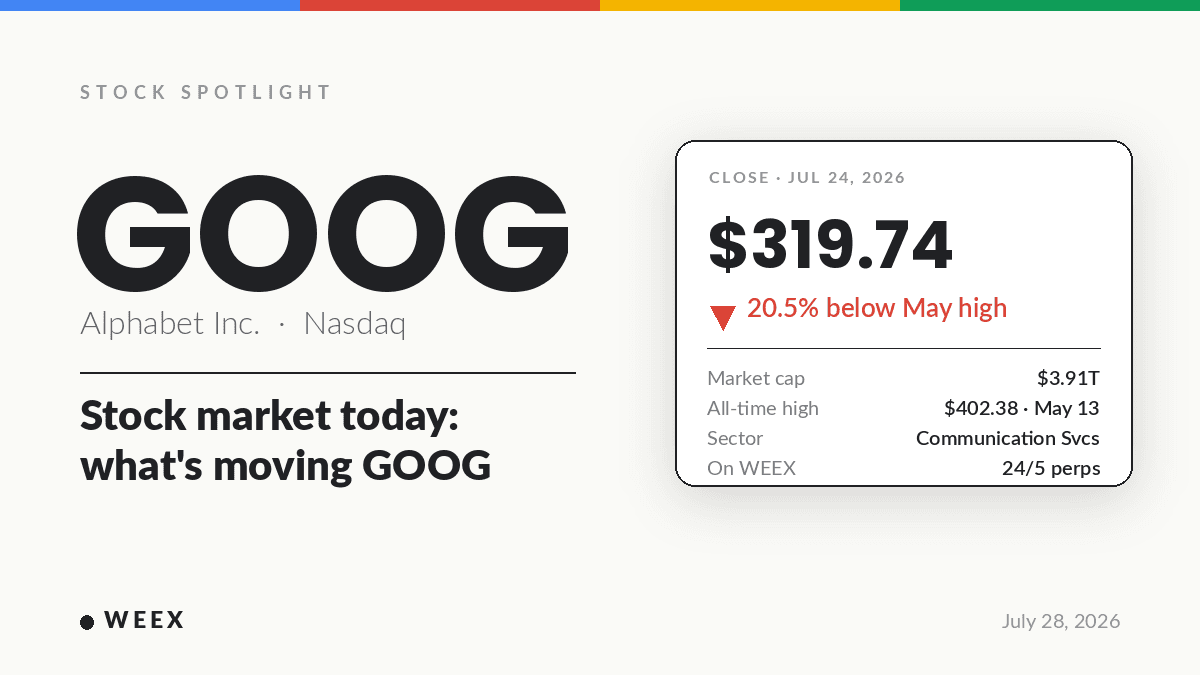
| GOOG snapshot | Value (as of July 27–28, 2026) |
|---|---|
| Share price | ~$330 |
| July 24 close (post-earnings) | $319.09 |
| 52-week range | $188.70 – $404.47 |
| Market capitalization | ~$3.97 trillion |
| Trailing P/E | 26.99 |
| Dividend yield | 0.24% |
Two things stand out. The stock is roughly 18% below its 52-week high but still up around 75% from the low, so this is a pullback inside an uptrend, not a broken chart. And at 27 times trailing earnings, Alphabet is not priced like a company the market expects to stumble — which is precisely why the capex guidance landed as hard as it did.
Source: exchange quote data, July 27–28, 2026. Prices for GOOGL (Class A) run within about a dollar of GOOG and typically carry a sub-1% premium for the voting right.
Why GOOG stock fell 7% on a record EPS
The $9.11 diluted EPS figure is real, and it is also mostly not from running Google. Alphabet booked $98.0 billion in other income, largely unrealized gains on equity securities holdings. That single non-operating line carried net income to $112.1 billion — a number larger than the quarter's entire revenue.
Back it out and the picture inverts:
| Q2 2026 earnings, two ways | Figure | Versus expectation |
|---|---|---|
| Reported diluted EPS | $9.11 | Record, no consensus comparison |
| Other income (equity gains) | $98.0B | Non-operating, non-cash |
| Operating income | $40.77B | Margin 34%, up 2pp YoY |
| Adjusted EPS (ex-gains) | $2.85 | Missed the $2.89 estimate |
| Quarterly free cash flow | –$5.9B | First negative quarter since the 2004 IPO |
That is the whole story in five rows. On the measure institutional investors actually model — operating earnings excluding mark-to-market gains — Alphabet came in four cents light. And free cash flow went negative for the first time in the company's public life, because the capital spending is now landing faster than the operating cash it generates.
The better reading of the selloff is not "the market punished a beat." The market repriced a quarter where the beat was optical and the cash burn was structural.
The operating business, to be fair, was genuinely strong. Google Cloud revenue hit $24.77 billion, up 82% year over year, with backlog at $514 billion. Google Services grew 15% to $94.54 billion. Nearly 90% of the Fortune 100 now use Gemini Enterprise. Nothing in the demand picture broke.
What Alphabet's $205 billion capex bill actually buys
Management raised 2026 capital expenditure guidance to $195–$205 billion, up from the $180–$190 billion range set three months earlier. That is a mid-point increase of more than $10 billion announced in a single quarter, and it is the number that reset the stock.
The bull framing: this is demand-driven, not speculative. The CFO said AI infrastructure demand continues to outpace Alphabet's capacity to build, and Cloud's first-ever TPU system deliveries to customer data centers landed in the quarter. A $514 billion backlog is hard to serve without steel and silicon. Spending against contracted demand is a different risk than spending against a hope.
The bear framing: the number has moved up twice in two quarters, one sell-side estimate now models roughly $350 billion of 2027 capex against a Street consensus near $265 billion, and Alphabet is leaning on third-party capacity to bridge the gap — which compresses margin on the incremental revenue. Depreciation from this build lands on the income statement for years regardless of whether the revenue shows up.
Both readings are defensible. What is not in dispute is that GOOG has changed character: for two decades it was a cash machine that returned capital, and it is now a capital-intensive infrastructure builder that happens to own a search engine. Investors who owned it for the former have a reason to re-underwrite.
-- Price
Is GOOG stock a buy after Q2 2026 earnings?
Wall Street mostly stayed bullish and trimmed the math. Several brokerages cut price targets in direct response to the capex raise while keeping buy-equivalent ratings, leaving a consensus that still reads as Strong Buy with an average 12-month target near $430 — roughly 30% above the current price.
It is worth being honest about what that consensus is and isn't. A price target is a model output, and the models were rebuilt after the guidance change, not before it. The July analyst average is already the post-selloff number.
The more useful comparison is against what the market believed before the print:
| Assumption | Before Q2 (early July 2026) | After Q2 (July 22–28, 2026) |
|---|---|---|
| 2026 capex guidance | $180B–$190B | $195B–$205B |
| Cloud growth | +63% (Q1) | +82% (Q2) |
| Cloud backlog | ~$460B | $514B |
| Quarterly free cash flow | Positive | –$5.9B |
| Share price | ~$350 | ~$330 |
| Consensus 12-month target | ~$433 | ~$430 |
Growth got better and the funding cost of that growth got worse. The stock fell about 6% while the target barely moved, which means the sell side is treating the drawdown as an entry rather than a downgrade. Whether that is right depends entirely on one question: does the 2027 capex number stabilize, or does it keep climbing? A third consecutive raise would make the current multiple much harder to defend. For a scenario-based view of where the shares could land, WEEX's GOOG stock price prediction for 2026 lays out bear, base, and bull ranges.
Trading GOOG exposure around the clock on WEEX
Earnings gaps are exactly when the mechanics of your instrument matter. Alphabet reported after the Nasdaq close, and the underlying repriced 7% before most holders could act — a familiar problem for anyone trading US equities from a different time zone.
One thing to know first: crypto venues almost universally list GOOGL, the Class A share, not GOOG. Because the two classes track within about a dollar, a GOOGL-referenced contract is a workable proxy for a GOOG view, but the ticker on your order screen will not say GOOG.
On WEEX, that instrument is the GOOGL/USDT perpetual, part of the TradFi product line. Practical parameters, observed July 28, 2026:
| Contract detail | GOOGL/USDT on WEEX |
|---|---|
| Instrument type | USDT-margined perpetual futures |
| Underlying reference | GOOGL (Alphabet Class A) price index |
| Maximum leverage | Up to 50× |
| Funding | Periodic funding payments, countdown shown on the pair page |
| Session | Extends beyond Nasdaq hours |
| Ownership rights | None — no shares, votes, or dividends |
The workflow is short: fund a USDT balance, open the TradFi tab, search GOOGL, set leverage deliberately low, size the position, attach a stop-loss and take-profit before you submit, then watch funding if you intend to hold across sessions. The contract mechanics — index construction, funding schedule, tracking behavior — are worth reading before your first order; WEEX's GOOGLUSDT explainer covers them, as does the broader Google stock trading guide.
What traders usually miss: a perpetual keeps trading when the stock does not, and that is a liability as often as a feature. This quarter is the demonstration — a 7% overnight gap on 10× leverage is a 70% move against margin, and the position liquidates while the Nasdaq is closed and you are asleep. Traders who survive earnings season cut size before the print rather than after it, keep a USDT buffer for funding and adverse swings, and accept that no stop-loss protects against a gap that jumps straight through it.
The bottom line on GOOG stock after Q2
GOOG stock is cheaper than it was three weeks ago and the operating business is measurably better, which is an unusual and interesting combination. The complication is that Alphabet financed that improvement by turning free cash flow negative for the first time since 2004 and committing to up to $205 billion of spending this year.
If you are holding GOOG stock for the long term, the honest position is that the AI thesis is intact and the cost of it just got explicit. If you are trading around it, the setup is a stock in a confirmed uptrend that has given back 18% from its high, with the next real catalyst being the Q3 print and whatever it says about 2027 capex. Long-term investors should buy real GOOG or GOOGL shares through a regulated broker. Active traders who want USDT-margined, two-way exposure can review the GOOGL/USDT perpetual on WEEX and its contract specs before opening a position.
FAQ
1. Why did GOOG stock drop after beating earnings in Q2 2026?
The headline $9.11 diluted EPS included $98.0 billion of other income from equity securities gains, which is non-operating and non-cash. Excluding it, adjusted EPS was $2.85 against a $2.89 estimate — a small miss. Combined with 2026 capex guidance rising to $195–$205 billion and free cash flow turning negative at –$5.9 billion, the market read the quarter as a beat on optics and a miss on economics.
2. What is Alphabet's Q2 2026 revenue and Cloud growth?
Revenue was $119.8 billion, up 24% year over year. Google Cloud grew 82% to $24.77 billion with a $514 billion backlog, and Google Services grew 15% to $94.54 billion. Operating income was $40.77 billion at a 34% margin, two percentage points wider than a year earlier.
3. What is the difference between GOOG and GOOGL?
GOOG is Alphabet's Class C share with no voting rights; GOOGL is the Class A share with one vote each. Both receive the same dividend and track within roughly a dollar of one another, with GOOGL usually carrying a premium under 1%. Class B shares carry 10 votes and are held by insiders, not traded publicly.
4. Is GOOG stock a buy right now?
The consensus rating remains buy-equivalent with an average 12-month target near $430, though several firms cut targets after the capex raise. That is a rating, not personal advice — a lot depends on whether 2027 capital spending stabilizes. Position size and time horizon matter more here than the target number.
5. Can I trade GOOG stock 24/7 on a crypto exchange?
Not GOOG specifically. Crypto venues list GOOGL-referenced instruments — tokenized shares such as GOOGLX and GOOGLON, and USDT-margined perpetuals like GOOGL/USDT on WEEX. These extend well beyond Nasdaq hours but grant no ownership, votes, or dividends, and the underlying stock can still gap while the regular session is closed.
6. What should I watch in GOOG stock before Q3 earnings?
Three things: whether 2027 capex guidance lands closer to the $265 billion consensus or the ~$350 billion bear case, whether Cloud growth holds above 60% now that capacity is being added, and whether free cash flow returns to positive. A second straight negative-FCF quarter would be a genuinely new problem.
Risk Warning
Equities are volatile and GOOG stock can fall sharply on earnings, capital-allocation, regulatory, or macro news — the July 2026 session that erased more than 7% in a day is a recent example, and past performance does not indicate future returns. Leveraged derivatives such as GOOGL/USDT perpetual futures carry additional and severe risk: overnight and weekend gaps in the underlying stock can move against a position while the exchange is open and the Nasdaq is not, stop-loss orders can be jumped rather than filled, funding costs accrue against held positions, and tracking differences between the contract index and the real share price can widen during fast markets. Liquidation can wipe out the full margin balance. Tokenized stock products add issuer, custody, and smart-contract risk. None of these instruments convey ownership of Alphabet shares, voting rights, or dividends. This article is general information, not investment advice. Trading may result in partial or total loss of capital — never risk more than you can afford to lose.
This content is provided for general informational purposes only and doesn't constitute financial, investment, legal, or tax advice. Any events, rewards, online promotions, or related information mentioned herein should not be considered a recommendation, solicitation, or invitation to purchase, sell, trade, or otherwise deal in any crypto assets. Crypto assets are highly volatile and may result in loss. The availability of WEEX services, products, and related events may vary by region. You are responsible for ensuring that your participation is in accordance with applicable local laws and regulations.
You may also like
What Is a Blockchain Node? Types, 2026 Counts, and Real Costs
What Is Blockchain Interoperability? How Cross-Chain Bridges and Messaging Work
Anonymous Crypto Wallet: 5 Privacy Levels and What Each Hides
Ethereum 2030 Roadmap: Vitalik's Cryptographic World Computer
WEEX Strategy Trading: 4 Ways to Automate Your Crypto Trades
What Is Pons Crypto (PONS), and How to Trade PONS on WEEX?

Pi Network vs Other Mobile Mining Projects: What's the Difference
Donald Trump Oil Stock Investments: 9 Names, 6 Tradable Now
Stealth XST Coin: The $1,806 Daily Volume Behind a $2.3M Cap

What Happened to Raini Studios Token? RST After the Game Shutdown
Why Is Raini Studios Token (RST) Up Today Despite Low Trading Volume?
Before You Buy CyberLeek: You Should Know CYBERLEEK Token Risks First
Crude Oil Price Holds Its Iran Premium as Hormuz Stays Shut
犇犇 Coin Explained: How Unitree Robot Dog Meme Is Going Viral

Eiffage Stock (FGR): The Two Engines, the Motorway Concession End Dates and the 26 August 2026 Half-Year Results
SPCX Stock Price and the $116 Billion Lockup Expiry Tomorrow: What Actually Happens on August 6
South Korea Apologizes for SK Hynix Leveraged ETFs: What It Means for SKHA SKHN Holders

STABLE Crypto Airdrop Guide: How to Claim 50,000 USDT Rewards on WEEX
What Is a Blockchain Node? Types, 2026 Counts, and Real Costs
What Is Blockchain Interoperability? How Cross-Chain Bridges and Messaging Work
Anonymous Crypto Wallet: 5 Privacy Levels and What Each Hides
Ethereum 2030 Roadmap: Vitalik's Cryptographic World Computer
WEEX Strategy Trading: 4 Ways to Automate Your Crypto Trades
What Is Pons Crypto (PONS), and How to Trade PONS on WEEX?
Contents
Popular coins
Latest articles