River Financial's lawsuit against Blockstream is worth $6.7 million

 Prefer us on Google


River Financial has filed a lawsuit against Blockstream Services Canada, accusing it of defaulting on a multi-million dollar payment agreement related to hosting services for Bitcoin mining.
Summary
- Key points
- River Financial sues Blockstream Services Canada for missed payment
- Details of the lawsuit and timeline of the default
- Allegations of breach of contract and unjust enrichment
- The context of Blockstream Services Canada and the terms of the contract
- The spin-off from Blockstream Corporation in mid-2024
- Early termination and payment plan
- Legal and procedural developments in the case
- Judge reassignment and court proceedings
- The background of the president of Blockstream Services Canada
- FAQ
- What is the reason for the lawsuit filed by River Financial against Blockstream Services Canada?
- How much money does Blockstream Services Canada owe River Financial?
- When did Blockstream Services Canada start defaulting on payments?
- What is the background of the president of Blockstream Services Canada involved in the contract?
Key points
- The River Financial lawsuit against Blockstream concerns a debt of approximately $6.7 million arising from prepaid hosting fees and an early termination penalty.
- Blockstream Services Canada stopped paying on March 31, 2026, and remained in default until September 11, 2026, the date the lawsuit was filed.
- The repayment plan included monthly installments of $239,389.40 starting August 1, 2025.
- A U.S. federal judge recused himself from the case, which was reassigned to a new magistrate on September 15, 2026.
- Christopher Cook, president of Blockstream Services Canada who signed the termination agreement, has a prior conviction for fraud.
River Financial sues Blockstream Services Canada for missed payment
River Financial, the Bitcoin-related financial services company led by CEO Alex Leishman and also backed by Peter Thiel, has taken legal action against its Canadian counterpart that emerged from the Blockstream spin-off, the company founded by Adam Back. The complaint contests a missed payment that has persisted for months.
Details of the lawsuit and timeline of the default
According to the complaint, Blockstream Services Canada stopped making the scheduled payments on March 31, 2026, remaining in default until September 11, 2026, the day River formally filed the lawsuit. In the meantime, River sent multiple demand letters starting April 10, warning that the overdue amounts would accrue interest at 9.75%. River also claims that Blockstream Services Canada acknowledged in writing the outstanding balance on May 27.
Allegations of breach of contract and unjust enrichment
In the lawsuit, River Financial accuses Blockstream Services Canada of a dual violation: breach of contract and unjust enrichment. Essentially, the company is alleged to have retained funds that, according to the agreement signed by both parties, it was supposed to return according to a precise payment schedule.
The context of Blockstream Services Canada and the terms of the contract
The dispute has its roots in a managed hosting agreement signed in December 2021, when River prepaid nearly $7.8 million for three orders of hosting services related to mining. At that time, Leishman was launching River Mining, a service to sell already hosted and managed Bitcoin miners.
The spin-off from Blockstream Corporation in mid-2024
Blockstream Services Canada was originally part of Blockstream Corporation, but after the spin-off that occurred in mid-2024, it became a separate entity that only uses the Blockstream brand under license. This corporate change is relevant as it helps to understand who is currently responsible for the contractual obligations contested by River.
Early Termination and Payment Plan
By December 13, 2024, Blockstream still held $4.3 million of River's prepayments, and the two companies had decided to close the initiative by signing an early termination agreement. Under that agreement, Blockstream owed River approximately $3.5 million as a refund for prepaid hosting fees and a $3.1 million early termination penalty, totaling about $6.6 million. Monthly payments of $239,389.40 were to start on August 1, 2025, but payments stopped after a few months.
-- Price
Legal and Procedural Developments in the Case
The proceedings have already encountered a procedural hiccup: a U.S. federal judge recused himself from the case, described as complex, and the court assigned the file to a new magistrate on September 15, 2026. This transition could extend the timeline before a substantive hearing takes place.
Judge Reassignment and Court Proceedings
The recusal and subsequent change of judge do not alter the charges brought by River, but indicate that the case will take longer than expected to reach a decision. Other outlets have confirmed the magnitude of the dispute, estimating the debt to be between $6.7 and $7 million, although they have not independently confirmed the identity of the Canadian counterpart publicly.
The Background of the President of Blockstream Services Canada
A detail that adds weight to the case concerns who signed the early termination agreement on behalf of Blockstream Services Canada: President Christopher Cook. According to two researchers cited in the case, Cook is a convicted fraudster who served over a year in prison for a case unrelated to this lawsuit. His role in signing the contested contract raises questions about the company's management at the time of the agreement with River.
For the mining hosting services sector, the case weighs more than the single amount at stake. A lawsuit like River Financial's against Blockstream highlights how fragile prepayment agreements are between institutional clients and mining operators, especially when a company changes ownership or corporate structure mid-course, as occurred with the 2024 spin-off.
FAQ
What is the reason for the lawsuit filed by River Financial against Blockstream Services Canada?
River Financial sued Blockstream Services Canada for defaulting on a multi-million dollar payment agreement related to prepaid hosting fees for Bitcoin mining.
How much money does Blockstream Services Canada owe River Financial?
Blockstream Services Canada owes River approximately $6.6 million, which includes the refund of prepaid hosting fees and a penalty for the early termination of the contract.
When did Blockstream Services Canada start defaulting on payments?
Payments stopped on March 31, 2026, and remained unpaid at least until September 11, 2026, the day River filed the lawsuit.
What is the background of the president of Blockstream Services Canada involved in the contract?
Christopher Cook, president of Blockstream Services Canada and signatory of the early termination agreement, has a prior conviction for fraud according to two researchers cited in the case.
Content created with the assistance of artificial intelligence and human editorial review.
This content is provided for general informational purposes only and doesn't constitute financial, investment, legal, or tax advice. Any events, rewards, online promotions, or related information mentioned herein should not be considered a recommendation, solicitation, or invitation to purchase, sell, trade, or otherwise deal in any crypto assets. Crypto assets are highly volatile and may result in loss. The availability of WEEX services, products, and related events may vary by region. You are responsible for ensuring that your participation is in accordance with applicable local laws and regulations.
You may also like

Value of Deposits in Cryptocurrency Vaults Exceeds $10 Billion

Sales of Bitcoin by Medium-Term Investors Decreased by 36%

Michael Saylor: "Bitcoin is returning to a bull market"

18 Bitcoin Mining Equipment Seized in Paraguay

Financial Repression and AI's Impact on National Security

Jeff Park Discusses AI Pain Trade Impact on Bitcoin

Metaplanet Enters US Stock Market Through SLE, Deal Approved by Shareholders

BingX, YouHodler and Santander’s Openbank join EU MiCA register

QCP: AI Credit Risk Heats Up, Bitcoin May Face Range Breakthrough

French National Assembly Passes Tax Amendment on Stablecoin Transactions, Effective 2027
Bitcoin miner stocks driven by AI sentiment, not BTC prices
Black Monday Posts Break Records
Bitcoin Recovery Faces Challenges as Exchange Reserves Rise and Spot Demand Turns Negative
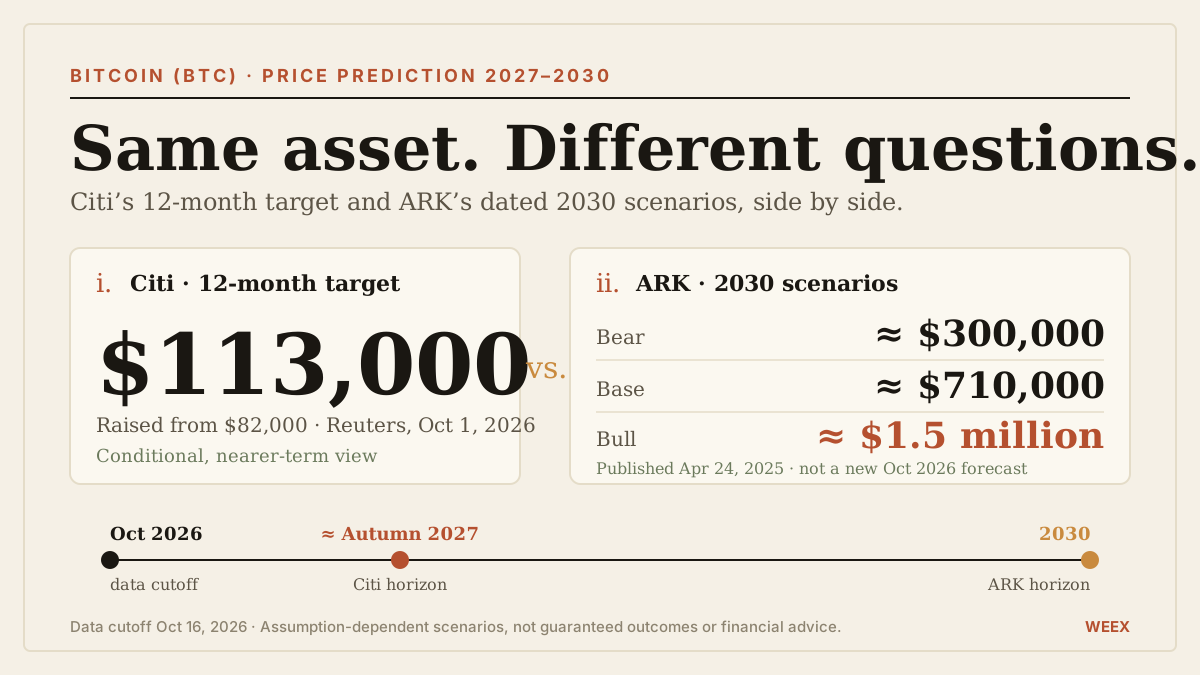
Bitcoin (BTC) Price Prediction 2027–2030: Citi’s $113,000 Target vs. Cathie Wood’s ARK Scenarios
Bitcoin price prediction for 2027–2030: compare Citi’s $113,000 target with ARK’s dated scenarios, demand assumptions, valuation math and key risks.

Mr&强 Analyzes BTC and ETH Short-Term Strategies

Bitcoin futures open interest declines, signaling weaker demand

Cathie Wood Predicts Long-Term Growth for Bitcoin Despite Dollar Strength

Peter Schiff Predicts Bitcoin Crash Over 99%
Liquidity in Cryptocurrency Market Approaches a Turning Point! Circle Aims to Enter 40 Emerging Markets

One dead, Qonto in flames, Nuñez resigns: why the streets worry crypto investors

Security Vulnerability Detected in ILITY Network, Cross-Chain Bridge Suspended

Bitcoin Spot ETF Sees Net Outflow of $229 Million Last Week, BlackRock's IBIT Leads with $165 Million Outflow

Morgan Stanley Recommends Up to 4% in Cryptocurrencies for Aggressive Portfolios

Deutsche Bank to Start Bitcoin and Ethereum Custody Within Weeks — Expansion to Asia by 2027

Bitcoin Ranges After Weekly Low Sweep| WEEX TradFi Daily(October 19, 2026)
Early on October 19, equity futures rebounded from last week’s chip selloff. Major indexes closed lower last week, the Nasdaq posted its worst week since June, the semiconductor ETF fell about 10%, and CoreWeave lost about 25%, while energy stocks were relatively resilient. Bitcoin traded near $82,000 after sweeping lows around $80,000, with markets watching the $79,800 and $83,600 zones.
WEEX Exclusive:Bitcoin Ranges After Weekly Low Sweep| WEEX TradFi Daily(October 19, 2026)

ECB: Lagarde defends rate hikes before the IMF and urges Brussels on digital euro

Sam Price Discusses Bitcoin Market Divergence

唐华斑竹 Analyzes Bitcoin Trends, Suggests Monitoring Support Levels

Saylor Envisions Bitcoin-Backed Stablecoin with Annual Yield of 6% to 8%
Value of Deposits in Cryptocurrency Vaults Exceeds $10 Billion
Sales of Bitcoin by Medium-Term Investors Decreased by 36%
Michael Saylor: "Bitcoin is returning to a bull market"
18 Bitcoin Mining Equipment Seized in Paraguay
Financial Repression and AI's Impact on National Security
Jeff Park Discusses AI Pain Trade Impact on Bitcoin