
Michael Saylor Compares Bitcoin and Gold, Explains Where Bitcoin Can Replace the Metal

 Prefer us on Google


Michael Saylor has once again compared Bitcoin and gold: in his assessment, the precious metal is valued for its rarity and durability, but the first cryptocurrency wins in mobility, transparency of rules, and independence from a central issuer.
The similarity between these assets is that they are often seen as a hedge against the devaluation of money. The difference lies in the format and infrastructure: gold exists physically, requires storage and authenticity verification, while Bitcoin is entirely digital and transferred over a network. Gold has a long history of use and more familiar regulation, while Bitcoin has an open protocol, limited issuance, and a different risk profile.
Why Gold Remains a Valuable but Inconvenient Asset
Saylor acknowledged the strengths of gold. It is limited in nature, does not degrade over time, and has been perceived for decades as a capital protection tool. In traditional markets, such an asset is often associated with the designation XAU, and investments in it are considered a classic way to weather periods of uncertainty.
However, gold also has weaknesses:
- It is difficult to transfer quickly.
- Transportation is expensive.
- Safe storage incurs costs.
- The owner has to think about auditing and verifying the authenticity of the metal.
Which Cryptocurrencies Are Tied to Gold
Gold-backed crypto assets include Tether Gold and PAX Gold. Typically, this tie works like this: a token is issued against a reserve of physical gold, and its price should follow the value of the corresponding share of the metal. For investors, this is a way to obtain a digital asset linked to gold without the need for self-transport and storage of bars.
How Bitcoin, According to Saylor, Is Stronger Than Fiat Money
Fiat currencies are more convenient to use than bars and coins, but Saylor sees another problem with them:
- The supply of such money is controlled by authorities.
- Governments can increase issuance.
- People's accounts can be frozen.
- Transfers can be blocked.
- The purchasing power of savings can decrease.
Saylor calls Bitcoin the first digital money network. It has no physical mass and no central issuer, and the maximum supply of 21 million coins is predetermined by an open protocol. This logic, in his view, does not depend on the decisions of individual politicians, whether it be Donald Trump, or the policies of specific countries like Japan.
This is why Bitcoin and gold can rise simultaneously: both assets are purchased as a hedge against inflation and economic instability. However, Bitcoin may not fully replace gold in all cases. It is more convenient when speed of transfer, transparent issuance rules, and self-storage are important, while gold is stronger where the investor needs a physical asset, familiar infrastructure, and a long history of use.
-- Price
What Influences the Price of Gold and Bitcoin
Gold typically reacts to the balance of supply and demand, inflation expectations, macroeconomics, and geopolitics. Bitcoin's set of influencing factors is different: demand for coins, limited supply, market news, regulation, and the activity of major players.
The future dynamics of both assets depend on the same factors: the higher the interest of investors in capital protection and the stronger the concerns about inflation or instability, the more noticeable the demand may be. At the same time, Bitcoin tends to move more sharply, while gold is usually perceived as a more stable instrument.
How Investors Should Compare Bitcoin and Gold
The choice between Bitcoin and gold depends on the investment goal, time horizon, and risk tolerance. Bitcoin may be convenient for those betting on digital infrastructure and accepting high volatility. Gold is more suitable for those who want to reduce dependence on financial markets and hold part of their capital in a physical asset.
Exchanging gold for Bitcoin and back can be done through crypto exchanges and specialized services that deal with precious metals. Before a transaction, it is important to consider fees, spreads, counterparty verification, asset storage, and the risk of operation blocking.
For traders, volatility is especially important. Bitcoin can offer more opportunities for short-term trades but can also quickly increase losses. Gold can also move significantly based on news, macroeconomics, and geopolitics, although its fluctuations are usually milder.
Saylor specifically highlighted the proof-of-work mechanism that underpins the Bitcoin network. According to him, rewriting the ledger is too costly, so participants are forced to act under common rules. They cannot bribe the network, force it to change past records, or impose a new history on it.
How Many Bitcoins Are Left with the Company Associated with Saylor
According to a specialized service, the company associated with Michael Saylor holds 840,447 Bitcoins on its balance sheet. Recently, it has been selling part of its coins more frequently.
In early August, the company sold 1,690 Bitcoins and received $108.6 million. These funds are planned to be used for the repurchase of its own preferred shares.
This content is provided for general informational purposes only and doesn't constitute financial, investment, legal, or tax advice. Any events, rewards, online promotions, or related information mentioned herein should not be considered a recommendation, solicitation, or invitation to purchase, sell, trade, or otherwise deal in any crypto assets. Crypto assets are highly volatile and may result in loss. The availability of WEEX services, products, and related events may vary by region. You are responsible for ensuring that your participation is in accordance with applicable local laws and regulations.
You may also like

Bitcoin ETF Funds Attract $2.26 Billion in Six Days

Coldcard hackers leave 87% of stolen Bitcoin unmoved after $114M theft

DeFi Vaults Concentrate 69% of Funds in Top 5 Operators

Bitcoin Transfer by Metaplanet: Sale or Just Custody on Coinbase?

Coinbase Premium Turns Positive Amid Concerns Over Domestic Market Slowdown

Cardano-based Bitcoin DeFi project secures 500 million in commitments

The Smarter Web Bitcoin Strategy Head to Retire in September

Analysis of Right-Side Trading Strategies After Bitcoin Surpasses $80,000

Strive CEO: The Bitcoin Bull Market Has Just Begun, ASST Has Passed Its Bottom
X Trade Buttons to Launch Soon, Bier Denies Crypto Shadowban

Bitgo CEO Emphasizes the Need for Regulation in the Cryptocurrency Industry

Ravencoin (RVN) Price Forecast for 2026–2050

The Development of AI Boosts Bitcoin Growth, the Next Cycle Will Be the Most Powerful

Tether Shuts Down Bitcoin Mining Project in Uruguay with an Investment of $120 Million

Trial for Assaulting the Mother of a Crypto Entrepreneur in Yvelines
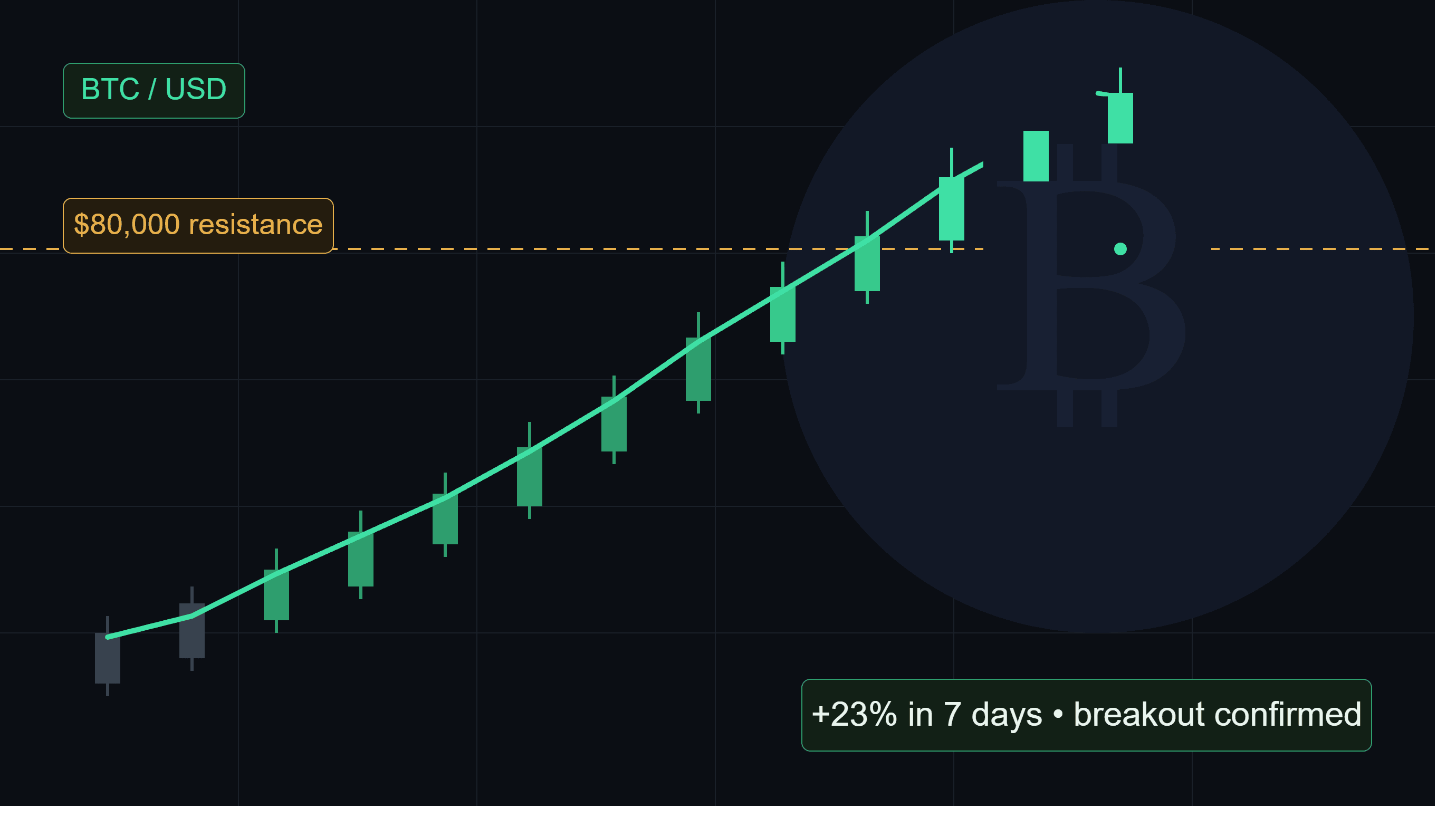
Bitcoin Just Hit $80,000: Last Week WEEX's Prediction Came True — What's Next?
Bitcoin hit $80,000 as WEEX predicted last week. See what drove the breakout, current key levels, and whether $90,000 is next.
WEEX Exclusive:Bitcoin break $80K!NVIDIA Extends Declines | WEEX TradFi Daily (Aug. 25, 2026)

Bitcoin break $80K!NVIDIA Extends Declines | WEEX TradFi Daily (Aug. 25, 2026)
Global markets delivered mixed signals. Bitcoin and Ethereum strengthened as institutional flows into spot ETFs supported a recovery in crypto risk appetite, while the Robinhood ecosystem and NFT sector also remained active. In technology, NVIDIA continued to weaken ahead of its earnings release, with investors focused on AI returns, customer capital expenditure, and order execution. PDD Holdings saw significant volatility after reporting results, while Applied Optoelectronics came under pressure following its large equity financing announcement. Investors are also awaiting new rate-path signals from the Jackson Hole Economic Symposium.

Bitcoin Sees Increased Interest from Long-term Investors

US Treasury May Tap $950 Billion Reserve to Calm Markets

Bitcoin is once again being 'buried' on social media: what this could mean for its price
Bitcoin Spot ETF Sees Net Inflow of $338 Million Yesterday, Continuing Six Days of Inflows

Bitcoin Spot ETF Sees Net Inflow of $338 Million Yesterday, Marking Six Consecutive Days of Growth

Bitcoin Surpasses $70,000 as Traders Analyze Market Rebound Reasons
Advertising Crypto Services in Russia: What is Now Allowed and What Remains Prohibited

Traffic Through the Strait of Hormuz Hits Lowest Level Since May
Cryptocurrency Trading at Bank Leumi: Israel's Largest Bank Partners with Galaxy
FalconX requests SEC to classify single-stock perpetuals as security-based swaps

Cypher Tank Opens Applications for 2026 Bitcoin Pitch Competition

U.S. Towns Resist Data Center Construction, Bitcoin Miners Become the Biggest Beneficiaries
Bitcoin ETF Funds Attract $2.26 Billion in Six Days
Coldcard hackers leave 87% of stolen Bitcoin unmoved after $114M theft
DeFi Vaults Concentrate 69% of Funds in Top 5 Operators
Bitcoin Transfer by Metaplanet: Sale or Just Custody on Coinbase?
Coinbase Premium Turns Positive Amid Concerns Over Domestic Market Slowdown
Cardano-based Bitcoin DeFi project secures 500 million in commitments

Contents
Latest articles


Latest coin listings on WEEX


