
How to Manage a Channel When Cryptocurrency Advertising is Banned in 2026

 Prefer us on Google


From September 1, 2026, cryptocurrency advertising in Russia will be subject to updated restrictions, making careful content presentation especially important for authors of thematic channels. Risks can arise not only from direct calls to purchase coins but also from commercial links, promo codes, referral programs, and promises of returns.
Discussing the digital currency market is still allowed: news, analytics, breakdowns of blockchain technologies, and fraudulent schemes are not prohibited in themselves. The key question is whether the publication transforms from informational material into promotion of a specific action, platform, or product.
What Restrictions Came into Effect on September 1, 2026
The updated rules prohibit advertising digital currencies and promoting their use as a means of payment for goods and services within Russia. Advertising illegal methods of acquiring digital currencies is also banned, as are offers directed at individuals who are legally prohibited from purchasing them.
Advertising services related to the organization of digital currency circulation is regulated separately. Such publications cannot mention specific digital currencies, promise or guarantee returns on investments, or provide forecasts for price changes.
However, merely mentioning Bitcoin, Ethereum, TRON, and other digital currencies is not a violation. The law does not prohibit the use of cryptocurrency names in informational and analytical materials. The risk arises when the material starts to push the audience towards purchasing, transitioning to a platform, or performing an operation.
An analysis of the reasons for Bitcoin or Ethereum price changes can remain analytical. But a publication urging to buy a specific digital currency or register on a particular platform may already look like promotion.
Where Analytics Turns into Advertising
The main criterion is the presence of motivation for a specific action. Phrases like "buy XXX now," "purchase XXX on this platform," "click the link and start trading," or "don’t miss the opportunity to earn" carry a direct advertising meaning.
The risk increases if such calls are accompanied by a link to a specific service, a promo code, or a referral link, through which the author can receive a reward for attracting a user.
The law "On Advertising" prohibits advertising digital currencies and sets special requirements for advertising services related to their circulation. Such restrictions are not new: they were previously in effect under Federal Law 259-FZ "On Digital Financial Assets, Digital Currency, and Amendments to Certain Legislative Acts of the Russian Federation."
Before publication, the author should evaluate the material as a whole: does it contain an offer to use a service, a recommendation to perform an operation, a promise of returns, a price forecast, or other promotional elements? It is the combination of such signs that can make a post problematic.
What Penalties Are Imposed for Violating the Rules
Administrative responsibility under Article 14.3 of the Administrative Offenses Code of the Russian Federation applies for violations of advertising legislation. For individuals, the fine ranges from 2,000 to 2,500 rubles; for officials, from 4,000 to 20,000 rubles; and for legal entities, from 100,000 to 500,000 rubles.
Responsibility may arise not only for the advertiser. The advertising producer and distributor may also be subject to sanctions if they participated in creating or placing the disputed material.
A notable case occurred in 2025 when the Krasnoyarsk FAS initiated a case against a company promoting an educational course on cryptocurrency trading on social media. Users were promised access to a trading platform of a cryptocurrency exchange, training, and a potential income of $400–600 in the first week with an investment of around $100.
The FAS classified such a publication as advertising services related to the circulation of digital currency. This example shows that promoting educational, trading, or investment products can become a violation if they effectively attract the audience to operations with digital currency.
-- Price
Should Old Publications Be Cleared?
Authors of cryptocurrency channels should review their archives and first find materials with obvious advertising signs. Posts with direct calls to buy digital currency, referral and affiliate links, transitions to specific crypto platforms and services, promises of profitability, or offers to use a specific product require special attention.
If such content remains publicly accessible, it is better to abandon it to reduce the risk of claims and administrative liability. Such violations can be considered ongoing, and the date of their commission will be the date identified by the supervisory authority.
There is no need to delete the entire archive on cryptocurrency topics. Market news, educational texts, analytical reviews, and analyses of fraudulent schemes do not themselves fall under prohibited content.
The optimal approach is not to delete everything indiscriminately but to selectively remove materials that promote specific digital currencies, platforms, services, or methods of conducting operations.
How Fraudsters Use the Format of Crypto Blogs
One popular scheme revolves around the image of a successful trader or crypto investor. On social media, photos of expensive cars, travels, and restaurants are published, screenshots of supposedly earned profits are shown, and stories about easy income from cryptocurrency are told.
When the audience develops trust, subscribers may be offered to invest in an investment project, buy training, or pay for access to a closed club. In reality, such an account often hides a financial pyramid, a fictitious investment project, or a service that shows the user non-existent profits.
Another scenario is that the blog is used as an entry point to a fraudulent platform. Subscribers are offered arbitration, the purchase of a new token, or trading on a supposedly profitable cryptocurrency platform, and then they are redirected to a phishing site, a fake exchange, or a service with a fictitious balance. On the screen, the user sees profits but cannot withdraw money.
There are also fake accounts of well-known traders, companies, and public figures. Moreover, criminals can hack the pages of real users: an already promoted account helps them quickly use the audience's trust to promote investment offers or third-party links.
When evaluating a cryptocurrency blog, it is important to look not at loud statements but at what action the author is urging subscribers to take. Promises of high profitability, demonstrations of easy earnings, urgent offers to invest money, and transitions to unknown platforms may indicate a fraudulent scheme.
Legal assessments and practical recommendations on this topic are provided by Ekaterina Belotserkovskaya, an AML/KYC investigations specialist at the "Shard" provider.
This content is provided for general informational purposes only and doesn't constitute financial, investment, legal, or tax advice. Any events, rewards, online promotions, or related information mentioned herein should not be considered a recommendation, solicitation, or invitation to purchase, sell, trade, or otherwise deal in any crypto assets. Crypto assets are highly volatile and may result in loss. The availability of WEEX services, products, and related events may vary by region. You are responsible for ensuring that your participation is in accordance with applicable local laws and regulations.
You may also like

Bitcoin at $100,000 in 2026: Bitwise Remains Optimistic Despite Inflation

Sam Price Analyzes Bitcoin Mid-term Holder Trends
CFTC argues CME lacks standing in perpetual futures lawsuit

Bitcoin Wallet Moves 411.45 BTC Worth 33400000 Dollars Amid Lawsuit

El Salvador’s National Bitcoin Office Hosts Five November Events Led By Herbert And Keiser

CNN Fear and Greed Index Falls to 18 Points

Charles Schwab Opens Bitcoin and Ethereum Trading to U.S. Retail Investors

Sparkassen Launches Bitcoin Trading via DekaBank

Sam Price Points Out Bitcoin Rebounds to $82,444

Elon Musk Offers a SpaceX Share to Every American Child: The American Dream at 140 Satoshis

White House Crypto Committee: Four People Departed in 14 Months

Echo Protocol Gradually Shuts Down, Halting New Deposits for Lending and LSD Services

Value of Deposits in Cryptocurrency Vaults Exceeds $10 Billion

Sales of Bitcoin by Medium-Term Investors Decreased by 36%

Michael Saylor: "Bitcoin is returning to a bull market"
18 Bitcoin Mining Equipment Seized in Paraguay
Financial Repression and AI's Impact on National Security

Jeff Park Discusses AI Pain Trade Impact on Bitcoin
Metaplanet Enters US Stock Market Through SLE, Deal Approved by Shareholders

BingX, YouHodler and Santander’s Openbank join EU MiCA register
QCP: AI Credit Risk Heats Up, Bitcoin May Face Range Breakthrough

French National Assembly Passes Tax Amendment on Stablecoin Transactions, Effective 2027
Bitcoin miner stocks driven by AI sentiment, not BTC prices
Black Monday Posts Break Records
Bitcoin Recovery Faces Challenges as Exchange Reserves Rise and Spot Demand Turns Negative
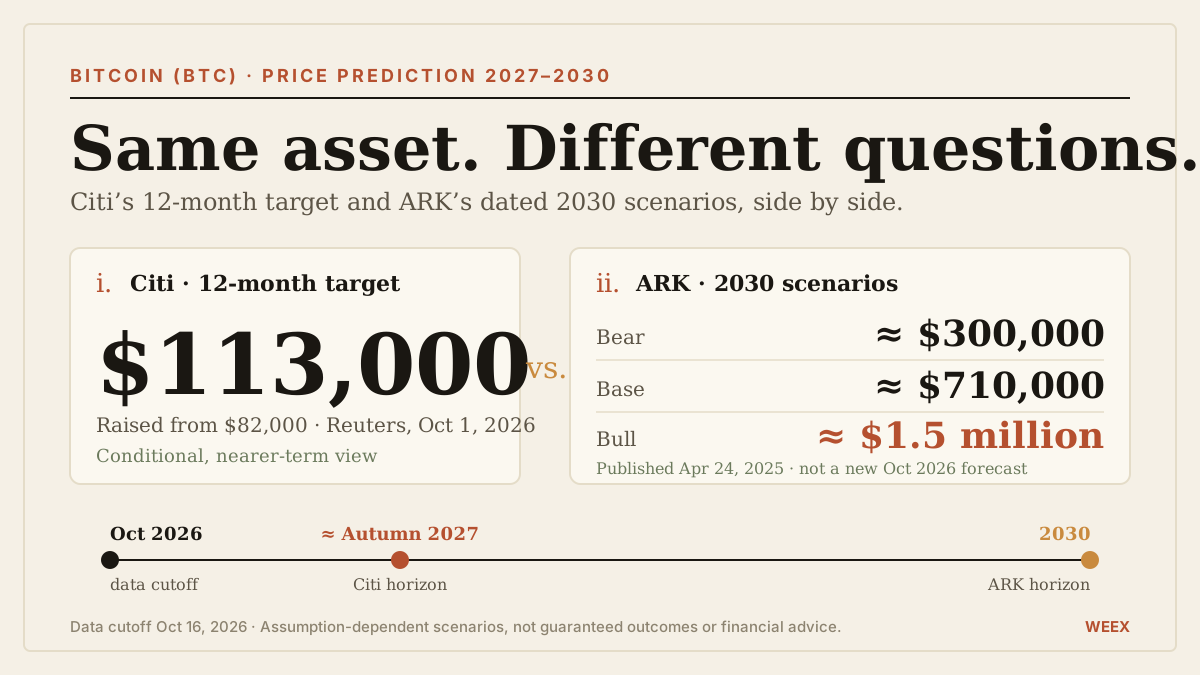
Bitcoin (BTC) Price Prediction 2027–2030: Citi’s $113,000 Target vs. Cathie Wood’s ARK Scenarios
Bitcoin price prediction for 2027–2030: compare Citi’s $113,000 target with ARK’s dated scenarios, demand assumptions, valuation math and key risks.

Mr&强 Analyzes BTC and ETH Short-Term Strategies

Bitcoin futures open interest declines, signaling weaker demand

Cathie Wood Predicts Long-Term Growth for Bitcoin Despite Dollar Strength
Peter Schiff Predicts Bitcoin Crash Over 99%
Bitcoin at $100,000 in 2026: Bitwise Remains Optimistic Despite Inflation
Sam Price Analyzes Bitcoin Mid-term Holder Trends
CFTC argues CME lacks standing in perpetual futures lawsuit
Bitcoin Wallet Moves 411.45 BTC Worth 33400000 Dollars Amid Lawsuit
El Salvador’s National Bitcoin Office Hosts Five November Events Led By Herbert And Keiser
CNN Fear and Greed Index Falls to 18 Points
Contents
Latest articles


Latest coin listings on WEEX


