
CryptoQuant CEO sees $30,000 Bitcoin floor even if ETFs and treasury firms exit

 Prefer us on Google


Bitcoin could find support near $30,000 even if institutional investors unwind their accumulated exposure, CryptoQuant's chief executive argues.
The scenario would require reversing roughly $58 billion in net inflows to US spot Bitcoin exchange-traded funds (ETFs) and selling the 1.3 million BTC publicly traded companies have accumulated. Yet CryptoQuant CEO Ki Young Ju believes Bitcoin's on-chain investor cost basis would still support prices about three times McGlone's $10,000 crash forecast.
"Even if all of it leaves, on-chain cost basis still puts the floor near $30k," Ju wrote on X on Oct. 16, responding to Bloomberg Intelligence strategist Mike McGlone.
The scale of that hypothetical retreat is substantial. US spot Bitcoin ETFs have attracted $56.95 billion in cumulative net inflows through Oct. 16, according to Farside Investors, while CoinGecko tracks 1.302 million BTC across 180 public-company treasuries. Those corporate holdings represent about 6.2% of Bitcoin's maximum supply and are worth approximately $106 billion at recent prices.
Michael Saylor-led Strategy alone owns 848,250 BTC, accounting for roughly 65% of the public-company total. Its position means any broad corporate retreat would be heavily shaped by the financing decisions of a single company, even as dozens of smaller treasury firms face their own market and liquidity pressures.
Bitcoin was trading near $82,000 over the weekend after slipping below $80,000 during the week's selloff. A fall to $30,000 would erase roughly 63% of its value from that level, making Ju's estimate a severe bear-market outcome despite its distance from McGlone's prediction.
Why Bitcoin at $10,000 would require a deeper historical break
Ju's assessment rests on Bitcoin's market-value-to-realized-value ratio, or MVRV, which compares its prevailing market capitalization with the aggregate value of coins at the prices they last moved on-chain. The latter measure produces a realized price often used as a gauge of investors' collective cost basis.
Bitcoin's realized price stood near $53,855 on Oct. 18, according to Perly's on-chain data. Using that realized price as a fixed reference, a $30,000 market price would put MVRV around 0.56, a reading associated with particularly deep capitulation. McGlone's $10,000 target would put the ratio near 0.19. Realized price would itself change as coins moved during a selloff.
Ju argued that Bitcoin's worst historical market bottom occurred around 0.6 MVRV. The longer record includes a reading near 0.55 at the January 2015 low and approximately 0.46 in November 2011. More recent major bottoms occurred around 0.69 in 2018 and 0.78 in 2022, leaving a potential move toward 0.2 well outside those precedents.
The CryptoQuant founder also pointed to investors who bought Bitcoin in 2019 and continued holding through successive collapses. For the cryptocurrency to revisit $10,000, he argued, that cohort would have to capitulate despite having already survived two drawdowns of roughly 75%.
That conviction faces a different kind of risk in the institutional era. A large holder need not lose faith in Bitcoin to sell: ETF redemptions can turn investor exits into spot-market selling, while corporate financing needs or balance-sheet pressures can drive treasury transactions. The market price itself depends on bids available when those sales occur, rather than the average historical cost of outstanding coins.
McGlone's warning begins with those broader financial conditions. In an Oct. 16 post titled "A Bitcoin $10,000 Reversion Path Could Trigger Tumbling Dominoes," he argued that Bitcoin's rise above $100,000 in 2025, gold's surge past $5,000, and rising government bond yields could signal a reversal across risk assets.
He sees support toward $10,000, especially if US equities suffer a 20% drawdown. Higher bond yields and restrictive monetary policy would add pressure by making cash and fixed-income assets more competitive as risk appetite weakens. A move from around $81,500 to his target would be a decline of nearly 88%.
Signs of institutional selling have already appeared, although on a much smaller scale. US spot Bitcoin ETFs recorded over $900 million in net outflows across the two weeks ending Oct. 16, according to Farside Investors.
The larger near-term test may emerge in equities. MSCI's new index eligibility criteria threaten to exclude Strategy from global benchmarks. A November 2025 JPMorgan scenario estimated about $2.8 billion in passive sales of its shares if MSCI removed it. Such index-driven selling would affect Strategy stock directly, and the consequences for its Bitcoin holdings would depend on the company's funding choices.
-- Price
This content is provided for general informational purposes only and doesn't constitute financial, investment, legal, or tax advice. Any events, rewards, online promotions, or related information mentioned herein should not be considered a recommendation, solicitation, or invitation to purchase, sell, trade, or otherwise deal in any crypto assets. Crypto assets are highly volatile and may result in loss. The availability of WEEX services, products, and related events may vary by region. You are responsible for ensuring that your participation is in accordance with applicable local laws and regulations.
You may also like

CNN Fear and Greed Index Falls to 18 Points

Charles Schwab Opens Bitcoin and Ethereum Trading to U.S. Retail Investors

Sparkassen Launches Bitcoin Trading via DekaBank

Sam Price Points Out Bitcoin Rebounds to $82,444

Elon Musk Offers a SpaceX Share to Every American Child: The American Dream at 140 Satoshis

White House Crypto Committee: Four People Departed in 14 Months

Echo Protocol Gradually Shuts Down, Halting New Deposits for Lending and LSD Services

Value of Deposits in Cryptocurrency Vaults Exceeds $10 Billion

Sales of Bitcoin by Medium-Term Investors Decreased by 36%

Michael Saylor: "Bitcoin is returning to a bull market"

18 Bitcoin Mining Equipment Seized in Paraguay
Financial Repression and AI's Impact on National Security

Jeff Park Discusses AI Pain Trade Impact on Bitcoin
Metaplanet Enters US Stock Market Through SLE, Deal Approved by Shareholders

BingX, YouHodler and Santander’s Openbank join EU MiCA register

QCP: AI Credit Risk Heats Up, Bitcoin May Face Range Breakthrough

French National Assembly Passes Tax Amendment on Stablecoin Transactions, Effective 2027
Bitcoin miner stocks driven by AI sentiment, not BTC prices
Black Monday Posts Break Records
Bitcoin Recovery Faces Challenges as Exchange Reserves Rise and Spot Demand Turns Negative
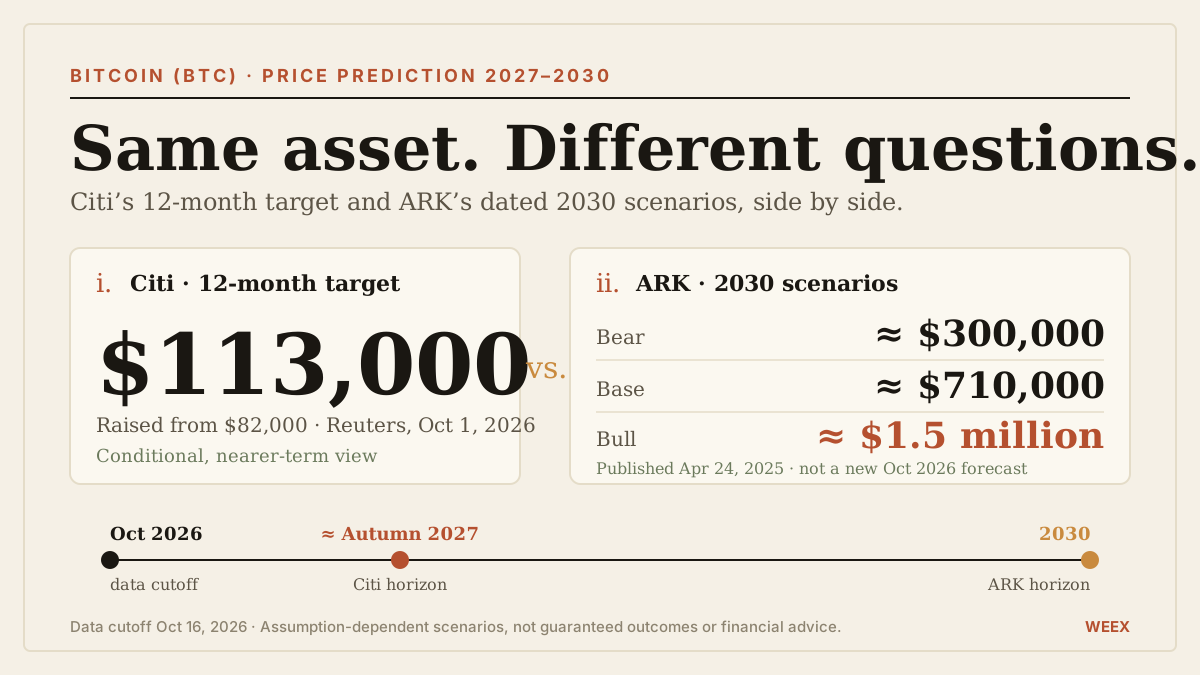
Bitcoin (BTC) Price Prediction 2027–2030: Citi’s $113,000 Target vs. Cathie Wood’s ARK Scenarios
Bitcoin price prediction for 2027–2030: compare Citi’s $113,000 target with ARK’s dated scenarios, demand assumptions, valuation math and key risks.

Mr&强 Analyzes BTC and ETH Short-Term Strategies

Bitcoin futures open interest declines, signaling weaker demand

Cathie Wood Predicts Long-Term Growth for Bitcoin Despite Dollar Strength

Peter Schiff Predicts Bitcoin Crash Over 99%
Liquidity in Cryptocurrency Market Approaches a Turning Point! Circle Aims to Enter 40 Emerging Markets
One dead, Qonto in flames, Nuñez resigns: why the streets worry crypto investors

Security Vulnerability Detected in ILITY Network, Cross-Chain Bridge Suspended

Bitcoin Spot ETF Sees Net Outflow of $229 Million Last Week, BlackRock's IBIT Leads with $165 Million Outflow
Morgan Stanley Recommends Up to 4% in Cryptocurrencies for Aggressive Portfolios
CNN Fear and Greed Index Falls to 18 Points
Charles Schwab Opens Bitcoin and Ethereum Trading to U.S. Retail Investors
Sparkassen Launches Bitcoin Trading via DekaBank
Sam Price Points Out Bitcoin Rebounds to $82,444
Elon Musk Offers a SpaceX Share to Every American Child: The American Dream at 140 Satoshis
White House Crypto Committee: Four People Departed in 14 Months


