
Bitcoin’s Quantum Transition Won’t Stop at Bitcoin

 Prefer us on Google


HONG KONG, October 18, 2026 -- As quantum computing advances, the challenge extends beyond Bitcoin's cryptography to the financial infrastructure built around it.
Quantum computing is emerging as one of Bitcoin's long-term security challenges. A sufficiently powerful quantum computer could theoretically compromise the digital signatures protecting Bitcoin transactions, potentially exposing funds associated with vulnerable public keys.
While no publicly demonstrated quantum computer is currently capable of such an attack at scale, the implications extend beyond Bitcoin itself. As Bitcoin becomes increasingly integrated into decentralized finance (DeFi) through tokenized assets such as Wrapped Bitcoin (WBTC), a future cryptographic transition would affect not only the Bitcoin network, but also the financial infrastructure built around it.
The question is no longer simply whether Bitcoin can become quantum-resistant, but whether the broader ecosystem can evolve alongside it.
Beyond the Bitcoin Network
Bitcoin's transition to quantum-resistant cryptography would require more than introducing new signature schemes. Wallets, exchanges, custodians and infrastructure providers would need to adapt their systems, potentially migrating existing BTC holdings to new security standards.
Proposals such as BIP-360 reflect ongoing efforts to explore Bitcoin's future cryptographic architecture. Yet coordinating adoption across a decentralized ecosystem could take years.
For tokenized Bitcoin, the challenge becomes more complex. Even if Bitcoin adopts quantum-resistant cryptography, the custody systems, smart contracts and networks supporting tokenized assets would still require independent security assessments.
Securing Bitcoin itself does not automatically secure everything built around it.
WBTC and the Next Generation of Bitcoin Infrastructure
As an established tokenized Bitcoin asset in DeFi, WBTC illustrates the scale and complexity of securing Bitcoin across multiple financial ecosystems.
With 116,000 WBTC in circulation, representing approximately $9.5 billion in Bitcoin-backed assets, WBTC's infrastructure supports Bitcoin liquidity across lending protocols, decentralized exchanges and multiple blockchain networks.
Backed 1:1 by BTC held in custody, WBTC's long-term resilience depends not only on Bitcoin's underlying cryptography, but also on reserve security, custody operations and the infrastructure supporting minting and redemption.
A future quantum-resistant transition could require custodians to evaluate their key-management systems, migrate underlying BTC reserves and maintain operational continuity throughout the process.
Against this backdrop, WBTC is preparing to migrate to new Custodian Bitcoin Deposit Addresses (CBDAs) as part of its custody infrastructure management. Bitcoin address management is relevant to long-term security because public-key exposure can influence vulnerability to potential quantum attacks. However, the security implications depend on address types and transaction histories, and address migration alone does not establish quantum resistance.
WBTC has also publicly announced its exploration of a multi-custodian reserve model, aimed at reducing custody concentration risk and strengthening operational resilience. While diversification does not directly address quantum vulnerabilities, it could provide greater flexibility as security standards evolve, depending on implementation.
Together, these initiatives highlight the importance of both reserve security and operational resilience as Bitcoin's financial ecosystem expands. Neither replaces the need for quantum-resistant cryptography, but both illustrate the infrastructure considerations involved in preparing for future changes.
Preparing for the Next Era
The timeline for quantum computing remains uncertain, but preparing for potential cryptographic changes is a long-term challenge for the entire Bitcoin ecosystem.
For WBTC, this means considering how custody arrangements, reserve management and supporting blockchain infrastructure could evolve alongside Bitcoin's security standards.
Bitcoin's quantum transition may begin with cryptography, but its success will depend on the resilience of the infrastructure connecting Bitcoin to the wider financial ecosystem.
Disclaimer: Information provided is for information purposes only and is not financial advice. No representation or warranty has been made as to the content, accuracy, timeliness, suitability or completeness of such information. Participation in DeFi carries risks, always do your own research.
-- Price
This content is provided for general informational purposes only and doesn't constitute financial, investment, legal, or tax advice. Any events, rewards, online promotions, or related information mentioned herein should not be considered a recommendation, solicitation, or invitation to purchase, sell, trade, or otherwise deal in any crypto assets. Crypto assets are highly volatile and may result in loss. The availability of WEEX services, products, and related events may vary by region. You are responsible for ensuring that your participation is in accordance with applicable local laws and regulations.
You may also like

CNN Fear and Greed Index Falls to 18 Points

Charles Schwab Opens Bitcoin and Ethereum Trading to U.S. Retail Investors

Sparkassen Launches Bitcoin Trading via DekaBank

Sam Price Points Out Bitcoin Rebounds to $82,444

Elon Musk Offers a SpaceX Share to Every American Child: The American Dream at 140 Satoshis

White House Crypto Committee: Four People Departed in 14 Months

Echo Protocol Gradually Shuts Down, Halting New Deposits for Lending and LSD Services

Value of Deposits in Cryptocurrency Vaults Exceeds $10 Billion

Sales of Bitcoin by Medium-Term Investors Decreased by 36%

Michael Saylor: "Bitcoin is returning to a bull market"
18 Bitcoin Mining Equipment Seized in Paraguay
Financial Repression and AI's Impact on National Security

Jeff Park Discusses AI Pain Trade Impact on Bitcoin
Metaplanet Enters US Stock Market Through SLE, Deal Approved by Shareholders

BingX, YouHodler and Santander’s Openbank join EU MiCA register

QCP: AI Credit Risk Heats Up, Bitcoin May Face Range Breakthrough

French National Assembly Passes Tax Amendment on Stablecoin Transactions, Effective 2027
Bitcoin miner stocks driven by AI sentiment, not BTC prices
Black Monday Posts Break Records
Bitcoin Recovery Faces Challenges as Exchange Reserves Rise and Spot Demand Turns Negative
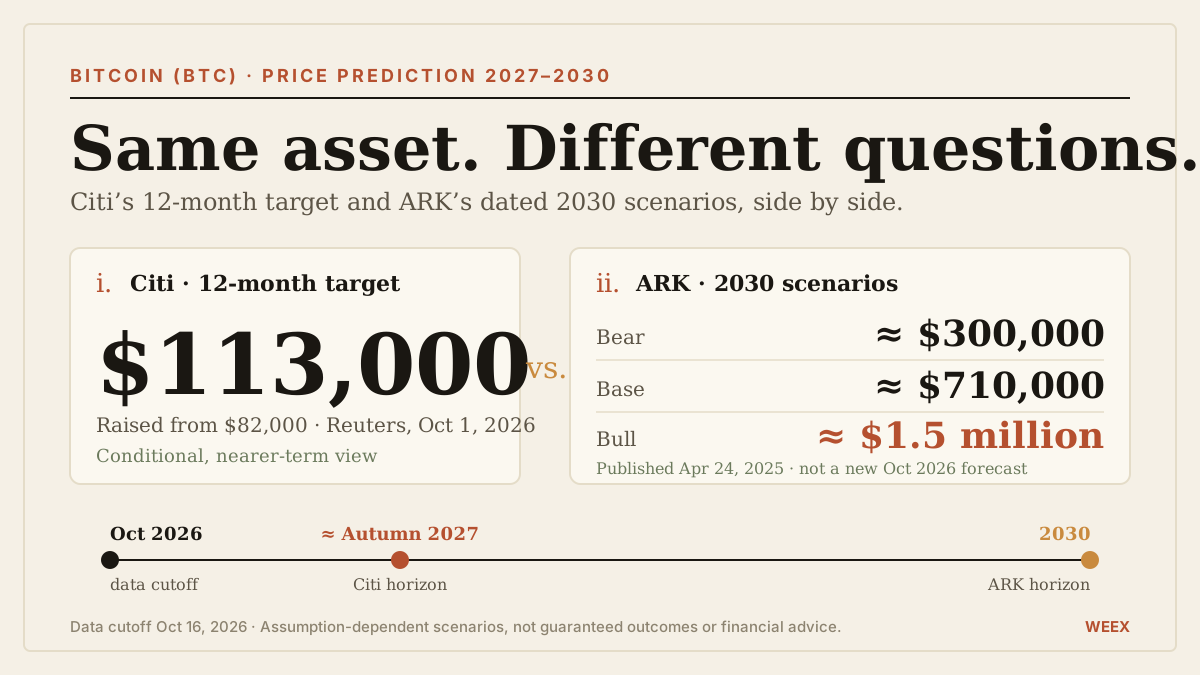
Bitcoin (BTC) Price Prediction 2027–2030: Citi’s $113,000 Target vs. Cathie Wood’s ARK Scenarios
Bitcoin price prediction for 2027–2030: compare Citi’s $113,000 target with ARK’s dated scenarios, demand assumptions, valuation math and key risks.

Mr&强 Analyzes BTC and ETH Short-Term Strategies

Bitcoin futures open interest declines, signaling weaker demand

Cathie Wood Predicts Long-Term Growth for Bitcoin Despite Dollar Strength
Peter Schiff Predicts Bitcoin Crash Over 99%
Liquidity in Cryptocurrency Market Approaches a Turning Point! Circle Aims to Enter 40 Emerging Markets
One dead, Qonto in flames, Nuñez resigns: why the streets worry crypto investors

Security Vulnerability Detected in ILITY Network, Cross-Chain Bridge Suspended

Bitcoin Spot ETF Sees Net Outflow of $229 Million Last Week, BlackRock's IBIT Leads with $165 Million Outflow
Morgan Stanley Recommends Up to 4% in Cryptocurrencies for Aggressive Portfolios
CNN Fear and Greed Index Falls to 18 Points
Charles Schwab Opens Bitcoin and Ethereum Trading to U.S. Retail Investors
Sparkassen Launches Bitcoin Trading via DekaBank
Sam Price Points Out Bitcoin Rebounds to $82,444
Elon Musk Offers a SpaceX Share to Every American Child: The American Dream at 140 Satoshis
White House Crypto Committee: Four People Departed in 14 Months


