
$1.8 Million Acquisition of Nasdaq Shell Company: Rune Aims to Explode Shorts with Meme Coin

 Prefer us on Google


Written by: Xiao Bing
On August 31, crypto trader Rune (@RuneCrypto_) posted on X with a bold claim: he spent $1.8 million to acquire 37.4% of a Nasdaq-listed company through over-the-counter trading. This company has a market capitalization of $4.8 million, a stock price of $0.12, annual recurring revenue of only $380,000, and carries $6.2 million in debt, leading many to believe it is on the brink of collapse.
Then comes the core of the plan: to tokenize the company's stock, deploy it on the Robinhood Chain, and issue a Meme coin paired with the stock token.
The flywheel he describes works like this: Meme coin traders buy tokens → funds flow into the "stock token/Meme coin" liquidity pool → demand for stock tokens rises → the issuer buys an equivalent amount of U.S. stocks for 1:1 collateral → real buying pressure emerges for the small-cap Nasdaq stock → 92.3% short ratio is triggered → short squeeze drives up stock price → rising stock price reinforces the Meme coin narrative.
In Rune's own words, this will be "the biggest cross-border event in financial history, Meme coin × Nasdaq."
This sounds audacious. However, upon closer examination, the structure is not a mere fantasy but rather a fusion of two validated paths in the capital markets over the past two years.
The Mirror Reversal of the Strategy Model
Over the past two years, Strategy (formerly MicroStrategy) has established a clear capital cycle:
Public company → issue more shares/convertible bonds → raise funds to buy BTC → BTC appreciation boosts company valuation → valuation supports further financing.
The "BTC treasury company" under the HOOD concept has become a mature track in U.S. stocks, with similar logic from Strategy to Metaplanet.
What Rune attempts to do is to completely reverse this model.
Strategy starts with a public company and ends with crypto assets. Rune starts with the crypto community and ends with a public company.
Strategy uses Wall Street's money to buy BTC, while Rune aims to use Meme coin traders' money to buy U.S. stocks. Strategy's flywheel relies on institutional investors' demand for BTC exposure, while Rune's flywheel relies on on-chain retail investors' speculative impulse for Meme coins.
If the stock paired with Meme coins on the Robinhood Chain (similar to the AI/NVDA model) has already proven that "on-chain Meme trading volume can drive demand for stock tokens," then Rune's deduction is conceptually coherent: just replace "Nvidia" with a $4.8 million shell company, and the buying effect will be dramatically amplified.
Authenticity Yet to be Verified
Between conceptual coherence and executability, there are at least three layers of assumptions that need verification.
The first layer is the authenticity of the acquisition itself.
As of the time of publication, Community Notes on the X platform have indicated that there are currently no Nasdaq-listed stocks that meet all three parameters claimed by Rune: $4.8M market cap, $0.12/share price, and 92.3% short ratio. Rune has not disclosed the company's name or SEC filing number, making verification impossible until further information is released.
The second layer is the execution mechanism of the "1:1 collateral." The issuance of stock tokens requires custodians to hold an equivalent amount of real stocks. In the Robinhood Chain ecosystem, stock tokens are supported by Robinhood as the issuer and custodian. For Rune to do the same with a $4.8 million penny stock, he needs to find a compliant institution willing to provide custodial services and establish auditable reserve proof; a penny stock with an average daily trading volume of only a few tens of thousands of dollars presents a liquidity obstacle.
The third layer is regulatory risk. Publicly claiming to "create buying pressure for U.S. stocks through Meme coin trading, triggering a short squeeze" is almost a textbook case of "market manipulation" as defined in SEC enforcement actions. After the GameStop incident in 2021, the SEC has remained highly vigilant regarding any actions involving coordinated buying, short squeezes, and social media incitement.
Rune's response to this in his post is: "Acquiring a public company and transforming it into a blockchain business is not manipulation; it is an acquisition. Companies do this every day."
Not the First to Take the Plunge
Rune's attempt is not an isolated case. In recent months, the crossover between Meme coins and public companies has accelerated:
ZeroStack (NASDAQ: ZSTK) acquired 926 million tokens of MemeCore for about $1 billion on August 19, as part of the company's digital asset treasury.
DeFi Development Corp (NASDAQ: DFDV) issued DisclaimerCoin (DONT), touted as "the first Meme coin created by a public company." Several Nasdaq-listed micro-companies are incorporating crypto tokens into their balance sheets.
The commonality among these cases is that public companies are actively embracing Meme culture, attempting to exchange community attention for stock price premiums. Rune's proposal goes further: the crypto community takes the initiative to directly control public companies.
The True Test of the Flywheel
Setting aside authenticity and compliance concerns, purely from a mechanism perspective, the key variable of this flywheel is the efficiency of liquidity transmission.
On the Robinhood Chain, the Meme coin Artificial Inu (AI) is paired with tokenized NVDA, rising from a market cap of $1.5 million to $135 million in August, with its NVDA pool holding about $3.3 million in tokenized Nvidia. However, Nvidia is a $5.25 trillion company, and $3.3 million has no impact on its stock price.
Switching to a $4.8 million shell company changes the situation entirely.
Rune has calculated this: if on-chain trading volume can generate $500,000 in real U.S. stock buying pressure, that would be over 10% impact for a $4.8 million company. A $2 million buy would directly alter the company's ownership structure.
The problem is: once this flywheel starts, its opposite also holds true.
When on-chain liquidity recedes, Meme coin prices fall → demand for stock tokens disappears → U.S. stocks lose on-chain buying support → stock prices decline → the Meme narrative collapses. The 92.3% short ratio is a double-edged sword—it is both fuel for the short squeeze and a true pricing of the company's fundamentals by shorts.
Until Schedule 13D, company announcements, and stock token contracts appear, this remains a high-visibility, low-confirmation capital experiment.
However, if on-chain demand can indeed be transformed into underlying stock buying pressure through the minting and collateral mechanisms of stock tokens, then what is born on the Robinhood Chain is not just a batch of new Meme coins.
It could be a new capital machine connecting crypto attention with small-cap Nasdaq stocks.
-- Price
This content is provided for general informational purposes only and doesn't constitute financial, investment, legal, or tax advice. Any events, rewards, online promotions, or related information mentioned herein should not be considered a recommendation, solicitation, or invitation to purchase, sell, trade, or otherwise deal in any crypto assets. Crypto assets are highly volatile and may result in loss. The availability of WEEX services, products, and related events may vary by region. You are responsible for ensuring that your participation is in accordance with applicable local laws and regulations.
You may also like

[Exclusive] MemeCore "Has Never Sold Foundation's Holdings... September Transfers Were for Liquidity Supply"

Jason Calacanis calls meme coins a ‘giant scam’

XRP Leads a Broad Crypto Bid on the Eve of a Senate Vote and a Fed Decision
ZeroStack Issues 36.2 Million Shares Linked to Voting
Crypto VC funding: ZeroStack secures $1B, Ripple raises $275M

Data: The cryptocurrency market is experiencing a general rise, with the NFT sector leading with an increase of over 7%, and BTC breaking through $61,000
Data: The cryptocurrency market is generally down, with the Layer 2 sector dropping over 3%, and BTC falling below $59,000

MemeCore CEO Jun: The value of the project is built on trust, not short-term speculation
ZachXBT questions Kraken's listing of Memecore, claiming there are unusual fund flows

Hyperliquid Requests Five Changes to SEC's Crypto Regulations

Fake Demand, Real Losses: How Popular Crypto Schemes Work

Michael Saylor: "Bitcoin is returning to a bull market"
Korea's Largest Pension Fund Suffers Over $130 Billion Loss Due to Heavy Investment in Samsung and SK Hynix

Ripple to Address XRP Ledger Security at Swell 2026

Hatem Douidar Joins Tactful AI Investors to Support Its Expansion in AI Solutions
Cardano Project Catalyst selects 12 projects for 2 million ADA pilot fund

From Zero to Financial Freedom: A Trader's HYPE Airdrop Review and Trading Philosophy

BingX, YouHodler and Santander’s Openbank join EU MiCA register

Slow Fog Releases DarkSword Trojan Analysis Report: Public Code Weaponized, iOS Crypto Wallets Face Threats

Emirati Nabta Health Secures Investment from PVP in $3 Million Round
XRP holders can now earn fees from Kraken’s DeFi customers, but there is a catch

Can Celestia Turn the Tide with AI Payments After a 97% Drop?

Why is it difficult for meme coins to break the $50,000 market cap? This market is draining retail investors' funds
QCP: AI Credit Risk Heats Up, Bitcoin May Face Range Breakthrough
BlackRock wants tokenized funds to back traditional Wall Street trades
The New PayPal Mafia: 10 Interns, $100 Billion
Variant Investment Partner: In the Second Half of the Bull Market, Which Two Camps Are Marginal Dollars Flowing To?

BNB Chain claims 42.6% of tokenized stock market, beating Ethereum and Solana
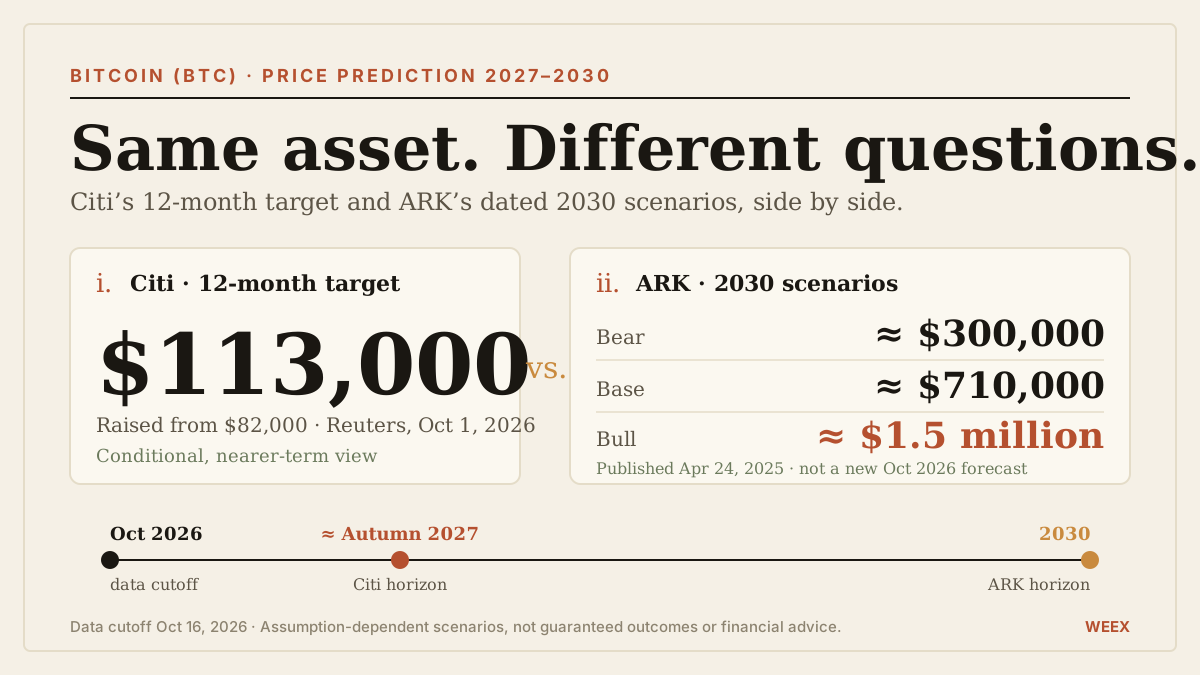
Bitcoin (BTC) Price Prediction 2027–2030: Citi’s $113,000 Target vs. Cathie Wood’s ARK Scenarios
Bitcoin price prediction for 2027–2030: compare Citi’s $113,000 target with ARK’s dated scenarios, demand assumptions, valuation math and key risks.
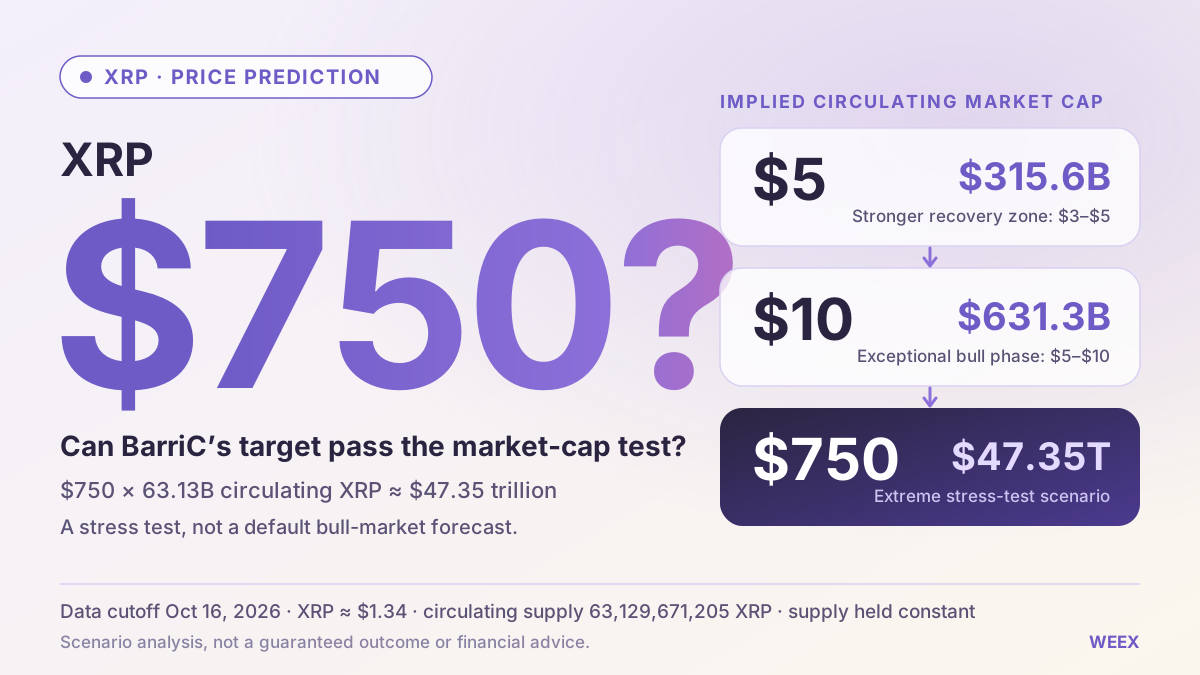
XRP (XRP) Price Prediction: Can BarriC’s $750 Target Pass the Market-Cap Test?
XRP price prediction: examine BarriC’s $750 target, market-cap math, next-bull-run scenarios, token demand and what could support a recovery to $5.
[Exclusive] MemeCore "Has Never Sold Foundation's Holdings... September Transfers Were for Liquidity Supply"
Jason Calacanis calls meme coins a ‘giant scam’
XRP Leads a Broad Crypto Bid on the Eve of a Senate Vote and a Fed Decision
ZeroStack Issues 36.2 Million Shares Linked to Voting
Crypto VC funding: ZeroStack secures $1B, Ripple raises $275M
Data: The cryptocurrency market is experiencing a general rise, with the NFT sector leading with an increase of over 7%, and BTC breaking through $61,000
Contents
Latest articles


Latest coin listings on WEEX


