
XST Coin vs Other Solana AI Tokens: What Makes XSolut Different and What Does Not

 Prefer us on Google


XST coin has started showing up in more Solana AI token searches, but that does not automatically put XSolut in the same class as projects with live networks and public operating history. XST coin, XSolut, and the broader Solana AI narrative now sit in a market where AI infrastructure tokens can attract fast attention, sharp trading volume, and equally sharp risk. This comparison looks at where XSolut genuinely overlaps with names like Render, Nosana, and even Bittensor, and where the differences are too important for investors to ignore.
At a Glance
- XST coin shares the AI infrastructure and Solana ecosystem story with other AI tokens, but that is only the starting point.
- XSolut is still in development, while Render and Nosana already have operating products and visible network utility.
- The biggest gaps around XST coin are transparency, audits, public team disclosure, and token concentration.
- XSolut’s RWA tokenization angle is more distinctive than its basic AI narrative, but it remains a concept rather than a proven product.
Why Comparing XSolut to Other Solana AI Tokens Matters
In 2026, AI remains one of the strongest narratives in crypto. That creates a common problem for beginners: many tokens can sound similar on the surface. A project can mention GPU compute, infrastructure, marketplaces, tokenization, and Solana, and still be very different from another project using the same language.
That is why comparing XST coin to other Solana AI tokens is more useful than looking at XSolut in isolation. When investors search for a Solana AI token, they are not choosing between identical assets. They are choosing between very different stages of development. Some tokens represent live blockchain infrastructure with real users. Others represent early-stage ideas with strong marketing but limited public proof. XSolut fits much closer to the second group based on the currently available information.
What XSolut and Established AI Tokens Have in Common
To be fair, XSolut is not completely unrelated to the better-known AI token category. According to CryptoRank, XSolut is a Solana-based token positioned around AI infrastructure and RWA tokenization. That puts it in the same broad conversation as tokens tied to compute networks, digital infrastructure, and AI-related blockchain services.
Render Network also operates around infrastructure, though its focus is much more specific: a working GPU rendering marketplace where artists and developers can render 3D content. Nosana is also part of the Solana AI conversation because it provides decentralized GPU computing resources. Bittensor is not a Solana token, but it is still relevant as a benchmark because it represents a functioning decentralized AI network with a known development base.
So yes, XST coin shares several traits with these projects. It uses tokenomics as part of its infrastructure narrative. It targets users and investors interested in AI and Web3. It sits inside the Solana ecosystem. It also presents itself as more than a simple meme coin, even though some market behavior and on-chain concerns make traders treat it with extra caution.
-- Price
The Specific Ways XSolut Differs From Tokens With Operating Products
The biggest difference is not branding. It is product reality.
Product existence
Render has a working marketplace. Users can access GPU rendering services and pay for actual computational work. Nosana also has an operating decentralized compute network. These are not just narrative tokens. They connect to live activity inside the blockchain ecosystem.
By contrast, CryptoRank describes XSolut as still in development and without a live product. That matters because a token with no working marketplace, no visible usage metrics, and no live service depends more heavily on narrative, speculation, and trading sentiment.
Public team and credibility
Render has a known founder, Jules Urbach, and a more visible public profile. Established AI tokens generally have identifiable teams, public communication, and enough project history for investors to evaluate leadership quality. XSolut does not currently offer that same level of transparency. The provided materials indicate no public team disclosure for XST coin, which makes it harder to assess execution risk.
Audits and security posture
The available research did not surface a known audit for XSolut from mainstream firms such as CertiK, Hacken, or SlowMist. CoinCodex-based context in the brief also notes no public audit. That does not prove a contract is unsafe, but it removes an important layer of trust. In crypto, especially for low-cap tokens, “no known exploit” is not the same as “independently reviewed.”
This is particularly relevant because smart contract failures remain common across the industry. Security reports from firms such as Hacken and SlowMist regularly show how access control flaws, logic errors, and deployment weaknesses can lead to losses. Beginners should read missing audits as a real data point, not a minor detail.
Usage metrics and business traction
Established AI projects usually give investors something measurable to track, whether that is network usage, fees, task volume, developer participation, or compute demand. XSolut does not currently provide that kind of operating evidence in the supplied materials. Without product usage, valuation tends to lean more on momentum and perceived upside than on fundamentals.
What XSolut's RWA Tokenization Angle Actually Adds
This is the part where XSolut does stand out somewhat. According to the provided materials, XSolut combines an AI infrastructure story with RWA tokenization. More specifically, its pitch involves tokenizing physical infrastructure tied to AI demand, such as data centers, energy, and fiber.
That is different from Render’s focus on rendering workloads and from Nosana’s focus on decentralized GPU computing. On paper, the XSolut angle is broader and arguably more ambitious. It tries to connect digital AI demand with real-world infrastructure ownership or exposure.
But investors should separate uniqueness from proof. A unique concept can help a token attract attention. It does not automatically create durable value. Until a marketplace or operating product exists, the RWA angle remains a thesis rather than an active edge. In other words, XSolut may be more conceptually distinctive than many small AI tokens, but it is not yet more operationally proven.
The Transparency Gap That Separates XSolut From the Comparison Set
This is where the comparison becomes much less flattering for XST coin.
The supplied research points to no clearly verified whitepaper, no public team, and no known mainstream audit. CoinGecko shows a website field for xsolut.ai, but the same research also notes that the official status and completeness of public documentation remain unclear. That is a major difference from more established projects, where core documents, team visibility, and technical materials are standard.
XST coin also carries additional warning signs on the market structure side. Phantom reportedly labels the token as unverified, according to CryptoRank. More importantly, Bubblemaps-related reporting cited by CoinGecko and CryptoRank says around 74% of the total XST supply is concentrated in a small cluster of addresses. That is the strongest risk signal in the entire comparison.
High concentration matters because it affects more than decentralization optics. It can influence liquidity, price stability, and exit risk. If too much supply sits with a few connected holders, the token becomes easier to move sharply in both directions. For beginners, this is where tokenomics becomes practical rather than abstract: concentration can shape real trading outcomes.
| Comparison Area | XSolut (XST) | Render / Nosana / Bittensor Benchmark |
|---|---|---|
| Blockchain ecosystem | Solana-based, per CryptoRank | Render and Nosana tied to Solana ecosystem; Bittensor used as AI network benchmark |
| Core narrative | AI infrastructure plus RWA tokenization | AI compute, GPU rendering, or machine learning infrastructure |
| Live product | Still in development | Operating products or networks |
| Public team | No public team confirmed in supplied materials | Known founders or public developer presence |
| Audit visibility | No known mainstream audit in supplied materials | More mature projects typically provide stronger security documentation |
| Supply distribution | About 74% concentrated in few addresses | Generally expected to be less concentrated for mature utility projects |
What the Comparison Actually Tells an Investor
The practical lesson is simple: not all AI tokens deserve the same valuation logic. If you compare XST coin with tokens that already have operating products, public teams, and stronger trust signals, then XSolut should be treated as a much earlier and riskier asset.
That does not mean XST coin has no upside. Early-stage tokens can outperform in short bursts, especially when the AI narrative is hot and Solana liquidity rotates aggressively into low-cap names. The provided research notes that XST has seen sharp price moves, including roughly 24-hour rallies near 50% in some periods, and market data in the materials points to a total supply of 1 billion tokens with 100% circulating supply on CoinGecko. CryptoRank also lists an all-time high of $0.06981.
But those facts should be read alongside the risks, not instead of them. Thin liquidity, shifting market cap estimates across sources, limited disclosure, and concentrated ownership can all make a token feel stronger during a rally than it really is. In practice, the gap between narrative and fundamentals is the key issue.
For investors, this comparison creates a useful framework. If you want exposure to AI infrastructure crypto, ask what exactly you are buying: a live network, a growing marketplace, or an early narrative token. Those are very different risk structures. Product-stage tokens may grow slower, but they usually offer more measurable fundamentals. Development-stage tokens may move faster, but they carry greater execution risk, governance uncertainty, and liquidity risk.
FAQ
What is the main difference between XSolut and Render Network?
The biggest difference is product status. Render has a functioning GPU rendering marketplace, while XSolut is still described as being in development without a live product in the supplied materials.
What is unique about XSolut’s RWA tokenization angle?
XSolut claims to connect AI demand with tokenized real-world infrastructure such as data centers, energy, and fiber. That is more distinctive than a basic compute narrative, but it is still a concept rather than a proven product.
Why does team transparency matter when comparing AI tokens?
A public team helps investors judge execution ability, credibility, and accountability. When no public team is visible, project risk rises because there is less information to verify.
How does XSolut’s 74% supply concentration compare with established AI tokens?
It looks unusually high and is a major risk signal. Concentrated ownership can increase manipulation risk and weaken liquidity quality, especially compared with more mature utility-driven tokens.
How is investing in a product-stage AI token different from investing in a development-stage token?
Product-stage tokens usually offer measurable usage, network activity, and stronger transparency. Development-stage tokens often rely more on narrative, future promises, and speculative trading momentum.
XSolut is easiest to understand when you stop asking whether it sounds like other AI tokens and start asking whether it operates like them. Right now, the strongest case for XST coin is its concept and market attention; the strongest case against it is the large gap between that concept and the proof investors usually expect from established AI infrastructure projects.
This content is provided for general informational purposes only and doesn't constitute financial, investment, legal, or tax advice. Any events, rewards, online promotions, or related information mentioned herein should not be considered a recommendation, solicitation, or invitation to purchase, sell, trade, or otherwise deal in any crypto assets. Crypto assets are highly volatile and may result in loss. The availability of WEEX services, products, and related events may vary by region. You are responsible for ensuring that your participation is in accordance with applicable local laws and regulations.
You may also like

Does Robinhood Chain Have Its Own Token? What CASHCAT, PONS, and Stock Tokens Actually Are
Is XST a Good Investment After Falling More Than 60% From Its All-Time High? What Buying the Dip Actually Requires
Is XST Crypto a Long-Term Opportunity or Short-Term Hype?
XSolut Company: What Is the Team Behind XST Coin and What Do They Actually Disclose

Meme Coin Guide: Opportunities, Risks, and Strategy in 2026
The 17 October 2026 DBR Unlock: Six Allocations and deBridge's Vesting Schedule
Fake Crypto Payments: What to Check Before Handing Over Goods
What Is Leverage in Trading? How Leverage Ratios Like 5x and 10x Work and What They Do to Your Risk
What Is Leverage Trading? A Beginner’s Guide to Margin, Liquidation and Funding Fees
Is RSI a Good Indicator? How the Relative Strength Index Works, Its Limits and How Traders Use It
CXMT Stock Explained: What Is ChangXin Memory, Why It Fell on October 19 and What to Watch Next
Why Is CoreWeave (CRWV) Stock Falling? Debt, Bond Yields and What Analysts Say
KOSPI Whipsaw Explained: Samsung, SK Hynix and the AI Spending Doubts Behind the Swing
Is Bitget Leaving Russia? What Account Holders Should Check
How to Day Trade Crypto for Beginners: The Math Behind One Trade
Tokenized Stocks List 2026: Issuers, Sectors and What WEEX Lists
Trading Psychology for Beginners: Crypto Traps and Hard Rules
What Is a Bitcoin ETF? How Creation, Custody and Fees Work
What Is Blockchain and How Does It Work? One Transaction, Traced
The Cost of Idle USDT: What Unused Balances Miss Each Year
Flying Tesla Roadster (FTR) Coin: What Is It and What to Check Before Trading a Roadster Memecoin
Tesla Roadster Performance, Thrust and Rocket Trims: Specs, Price and 2028 Production
Cyberleek Token Risks: Memecoins Tied to Leaks, Anonymous Wallets and Why Verification Matters

Staking APR vs Inflation: How Much of Your Crypto Yield Is Real?
CRWV Stock Swings From -9.5% to +5.9%: Why CoreWeave Reversed
WEEX Convert Fees: What Zero-Fee Conversion Really Costs You
Starknet Independent L1 Vote: What It Really Means for STRK
WEEX Convert Quote: How the 8-Second Price Lock Really Works
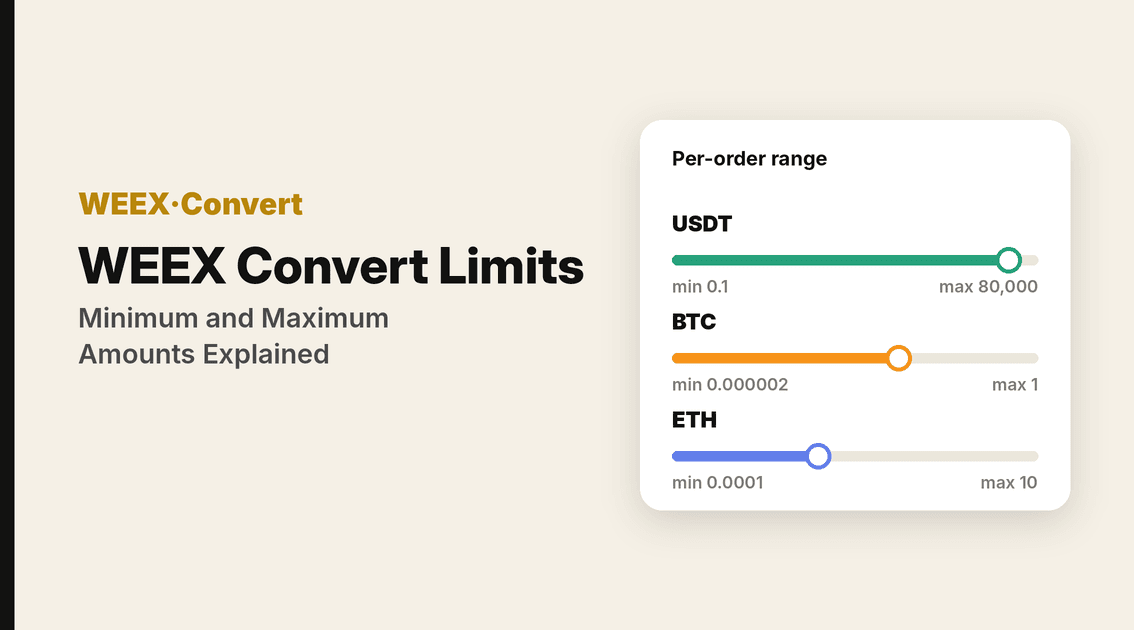
WEEX Convert Limits: Minimum and Maximum Amounts Explained
How to Check a WEEX Convert Order: History, Rate and Status
Does Robinhood Chain Have Its Own Token? What CASHCAT, PONS, and Stock Tokens Actually Are
Is XST a Good Investment After Falling More Than 60% From Its All-Time High? What Buying the Dip Actually Requires
Is XST Crypto a Long-Term Opportunity or Short-Term Hype?
XSolut Company: What Is the Team Behind XST Coin and What Do They Actually Disclose
Meme Coin Guide: Opportunities, Risks, and Strategy in 2026
The 17 October 2026 DBR Unlock: Six Allocations and deBridge's Vesting Schedule
Contents
Popular coins
Latest articles