
What is Tea(Tea)? TEA is now available on WEEX Pre-Market





Tea is the permissionless network powering the future of open source. Tea anchors open source in cryptography and turns every signed commit into part of a global economy.
Please read on for more details about Tea.
Team & Background
Based in Puerto Rico, Tea was co-founded by Max Howell and Timothy Lewis in November 2021.
- Co-Founder & Chief Open Source Officer: Max Howell
- He is renowned as the creator of Homebrew—the world's most contributed-to OSS package manager, with over 30M downloads.
- Co-Founder & CEO: Timothy Lewis
- Lewis brings strategic vision to bridge traditional software ecosystems with blockchain.
Tea has completed multiple rounds of financing, raising nearly $20M.
- Seed Round: Raised $8M and Valuation $60M. Led by YZi Lab.
- Extended Seed Round: Raised $8.9M and Valuation $130M. Led by Acuitas Group Holdings.
- ICO: Raised $3M on Coinlist.
Core Architecture
Tea Network’s technical architecture is a robust Layer 2 rollup design that combines the strengths of Optimism’s OP Stack (scalability and Ethereum alignment) with Tea’s unique innovations (GPG identity precompile and advanced account abstraction features). This foundation sets the stage for the specialized components of the Tea Network described next.
The new Layer 2 architecture introduces notable improvements:
- Scalability: User actions (staking, project registration, reward claims) now occur on Tea’s high-capacity chain, then aggregate to L1. This boosts throughput and reduces per-action costs to near-zero, eliminating adoption bottlenecks.
- Transaction Efficiency: L2 transactions cost fractions of cents vs. L1’s peak fees. Arbitrum’s example shows users paid ~2.3% of Ethereum fees for similar volumes, proving rollup savings via batching.
- Security Model: Ethereum’s validation acts as a security backstop. Fraud proofs allow challenging malicious L2 transactions, and a single honest actor can prevent fraud—unavailable in standalone dApps.
- Extensibility: As a full chain, Tea integrates EIPs protocol-wise (e.g., new precompiles, opcodes) without Ethereum consensus delays. Direct GPG precompile implementation exemplifies this flexibility.
- Interoperability: OP Stack enables native interop with Optimism ecosystem L2s. Future Superchain plans allow trustless cross-chain messaging (e.g., reputation/asset recognition across Tea, Optimism, Base), expanding protocol reach.
Ecosystem
610,000 GitHub developers registered with tea during testnet. EcosystemTea's ecosystem is a vibrant hub for OSS innovation, integrating blockchain with developer tools to foster collaboration and monetization. Core components include:
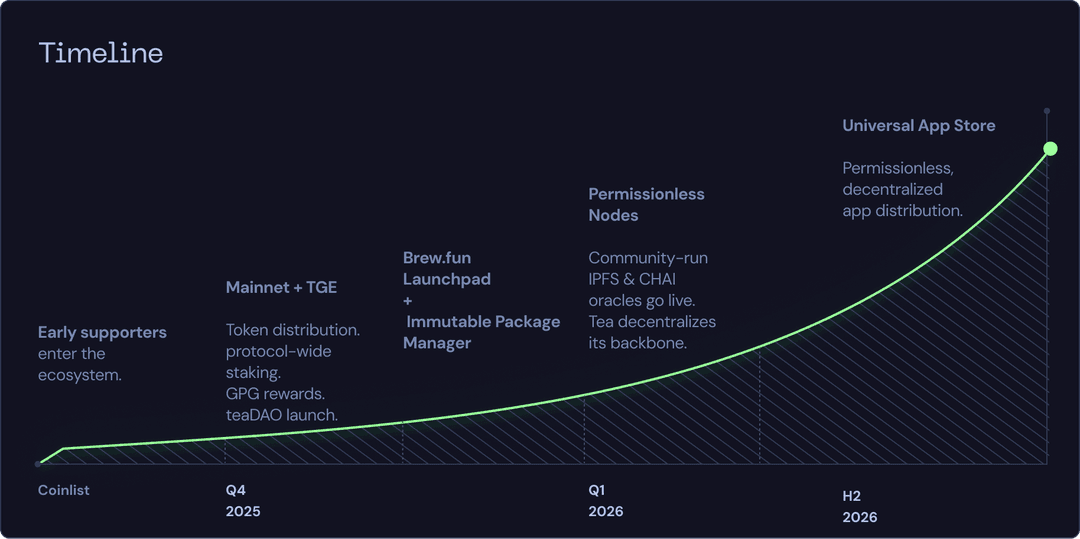
- PKGX: A Web3-native package manager for discovering, installing, and verifying software across ecosystems like RubyGems, npm, PyPI, and Homebrew. AI leaders like HuggingFace are already integrating PKGX into workflows.
- Universal App Store: A decentralized marketplace for OSS, AI models, and applications, enabling verified distributions and dependency staking.
- Brew.fun: A launchpad for OSS projects to create tokens using bonding curves, with automatic liquidity via Velocitea (an AMM powered by Velodrome).
- Bountea: A GitHub add-on for bounties, where issues and PRs are linked to Tea wallets via GPG-signed commits—85% of rewards go to contributors, 15% to project treasuries. 16,000 repos onboarded, with chai identifying the few hundred that matter most.
Token Information
- Ticker: $TEA
- Type: Governance-Balanced Token
- Total Supply: 100,000,000,000
- Initial Supply: About 20,000,000,000(20%)
- Standard: ERC-20
- Contract Address: 0x7eA7ea50ed58BC4d0a9194bCD328E21F7Be80c2B
- Utility & Use Cases
- Gas Fees: TEA tokens are required for transactions (e.g., treasury setup, staking, rewards) and basic actions like token transfers.
- Restricted Access: Projects stake TEA to create DAO treasuries and earn rewards, with staking proportional to reward growth.
- Governance: TEA holders stake/lock tokens to propose/vote on protocol changes via DAO, preventing transient speculation.
- OSS Security: Reporters stake TEA to submit bugs; rewards depend on timely fixes, with penalties for delays.
- Token Distribution
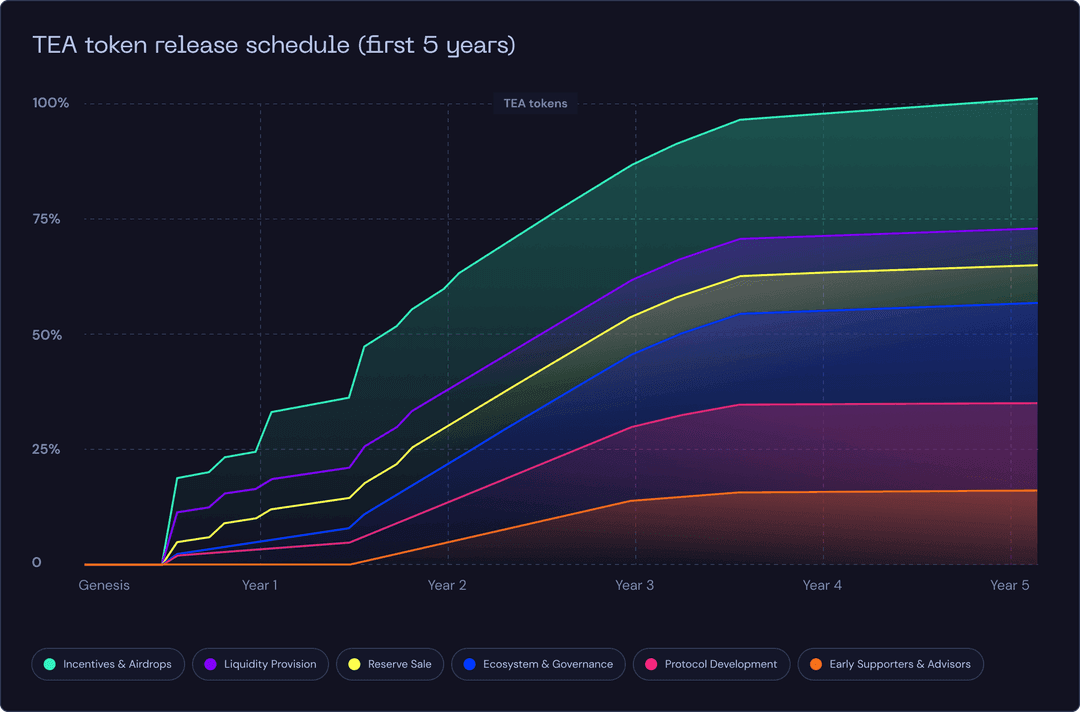
- Incentives & Airdrops:28%
- Ecosystem & Governance:21.8%
- Protocol Development: 18.6%
- Reserve Sale:8.0%
- Liquidity Provision: 8.0%
- Early Supporters & Advisors:15.6%
- Token Economics Philosophy
- Tea takes several measures to enhance the utility of the TEA token:
- TEA is a governance-balanced token with a strictly controlled inflation rate, capped at 2% annually
- The majority of TEA gas fees collected through protocol usage are returned to the community via the emissions pool with additional distribution being earmarked.
- Tea takes several measures to enhance the utility of the TEA token:
Get Ready for $TEA TGE — Don’t Miss the Next Open-source Opportunity
Tea(TEA)'s TGE is coming soon, while TEA is now available on WEEX Pre-Market, giving traders early access to the famous open-source software platform. Available on WEEX. Trusted by over 5 million traders, WEEX offers a secure and seamless platform to sign up, trade, and invite friends. Watch your rewards grow like a thriving digital garden—don’t wait, your share of this exciting airdrop is just a few clicks away!
Latest Updates on WEEX
If you want to buy WXT now, you can sign up for a WEEX account
WEEX Owen: Michael Owen Joins as Global Brand Ambassador
Championing a revolutionary crypto trading experience
You may also like

World Collective Oil Reserve (WCOR) Price Prediction 2026-2045: Expert Insights
WCOR (World Collective Oil Reserve) is a Solana-based cryptocurrency token that promotes an “oil reserve + real-world asset (RWA) narrative.” However, there is no public evidence that it is actually backed by physical oil assets. It is essentially a highly speculative, narrative-driven token. Its current market cap is around $14 million, with relatively low liquidity and high volatility, and its price is mainly driven by market sentiment and hype. Most analyses suggest limited short-term upside, with a possible gradual increase to around $0.02 by 2030. Overall, it is considered a high-risk crypto asset driven more by narrative speculation than fundamentals.
WEEX Gold & Silver 0% Fees Event: Trade Metals, Crude Oil and Stock Futures With Zero Fees
Join the WEEX 0-fee futures event from April 16 to May 31, 2026. Trade eligible gold, silver, crude oil, and stock futures with 0% fees.
Can PAC Coin Reach $1 Soon? Analyzing Public Asset Control
PAC is a Solana-based meme token with a government-themed narrative, but it is highly speculative.
At its current price (~$0.0009) and 1B supply, reaching $1 would require a $1B market cap, which is very unlikely.
Short-term moves to $0.001 or $0.01 are more realistic, but the token is highly volatile due to low liquidity and hype-driven trading.
Overall, $1 is not a realistic target, and PAC is better suited for short-term speculation than long-term investment.
What Is SAOS? Strategic American Oil Supply Token Explained
SAOS is a meme token on Solana with a 75,000 USD market cap and 22,000 USD locked liquidity, positioned around oil supply themes but lacking real asset backing
It thrives on pure narrative speculation, with no utility, website, or doxxed team, making it highly volatile and attention-dependent
Traders should distinguish SAOS from legitimate real-world asset projects, as its branding is speculative rather than substantive
Positive aspects include locked liquidity reducing rug pull risks, but low trading activity signals high uncertainty
NBIS Stock: What Nebius’ AI Cloud Surge Means Now
NBIS stock jumped as Nebius reported rapid AI cloud growth. See the key Q1 2026 numbers, catalysts, valuation risks, and what to watch next.

What Is Public Asset Control (PAC) Coin? Explained for Beginners
Public Asset Control (PAC) is a Solana-based token that uses a “government asset control” narrative involving oil and gold themes, but it has no verified ties to any real institutions or governments. It is mainly an entertainment-focused, speculative meme coin.
The project’s claims about links to entities like BlackRock or Palantir are unverified, and its own disclaimer states it is not a real financial or institutional asset. Like many new Solana tokens, PAC is highly volatile, with low liquidity and limited transparency, including no fully verified audit.
Overall, PAC is a high-risk speculative token driven by hype and storytelling rather than real utility. Beginners are advised to be cautious, verify contract details, and prioritize risk control before considering any trading.
Public Asset Control: What PAC Token Really Is
Public Asset Control PAC is a Solana token with bold asset-control branding. Learn what it is, what is verified, and the key trading risks.

Why Is Chinese Oil Asset Reserve (COAR Crypto) Trending Now?
Why is Chinese Oil Asset Reserve trending now? Learn the latest COAR crypto price action, trading volume, oil narrative, Solana pair data, and what is driving attention today.
How to Buy Chinese Oil Asset Reserve (COAR) Token in 2026: Latest Step-by-Step Guide, Contract Address, and Safe Buying Tips
How to buy Chinese Oil Asset Reserve (COAR) token step by step, including the official COAR contract address, Solana wallet setup, SOL funding, and latest market data.
COAR Coin: What Chinese Oil Asset Reserve Really Is
COAR coin is a new Solana oil-narrative token. Learn what Chinese Oil Asset Reserve claims, how to verify the contract, and key trading risks.
Did the CLARITY Act Pass Today? Latest Status and the History of the Crypto Bill
SEO meta description: Did the CLARITY Act pass today? Read the latest crypto bill update, the history of the CLARITY Act, House and Senate votes, and what happens next for U.S. crypto regulation.
What Is Chinese Oil Asset Reserve (COAR) Token? $COAR and Coar Stock Relationship Explained
Chinese Oil Asset Reserve (COAR) token explained, $COAR price, Solana details, and the relationship between COAR and Coar stock. Learn the latest facts.
Trade to Earn on WEEX: Join the Futures Trading Event and Earn Real-Time WXT Rewards Throughout May 2026
Join the WEEX Trade to Earn Series Five event from May 1–31, 2026 and earn real-time WXT rewards through futures trading. Boost your rebate level, complete missions, invite friends, and maximize your trade to earn rewards with USDT-M futures trading.

Trade to Earn With Futures Trading on WEEX: How Smart Traders Are Turning Every Position Into WXT Rewards
Join the WEEX Trade to Earn Series Five campaign and earn real-time WXT rewards through futures trading from May 1–31, 2026. Upgrade mining levels, unlock higher rebate ratios, complete missions, and maximize your trade to earn rewards with USDT-M futures trading.
CBRS Stock: What to Know About Cerebras After Its IPO
CBRS stock surged after Cerebras priced its IPO at $185. Learn what the AI chipmaker does, why valuation matters, and what risks to watch.

SpaceX IPO Stock Market Impact: What Investors Should Watch
SpaceX’s IPO could reshape indexes, liquidity, space stocks, and crypto risk appetite. Here is what matters before the listing.

HMSTR Token Price: What Moves Hamster Kombat Now
Track HMSTR token price, supply, catalysts, and risks. Learn what drives Hamster Kombat price action and what traders should watch.
How to Buy Public Asset Control (PAC) Token in 2026: Latest Solana Buying Guide
How to buy Public Asset Control (PAC) token in 2026, PAC contract address, Solana wallet setup, Jupiter swap guide, latest price, liquidity, and risks.
World Collective Oil Reserve (WCOR) Price Prediction 2026-2045: Expert Insights
WCOR (World Collective Oil Reserve) is a Solana-based cryptocurrency token that promotes an “oil reserve + real-world asset (RWA) narrative.” However, there is no public evidence that it is actually backed by physical oil assets. It is essentially a highly speculative, narrative-driven token. Its current market cap is around $14 million, with relatively low liquidity and high volatility, and its price is mainly driven by market sentiment and hype. Most analyses suggest limited short-term upside, with a possible gradual increase to around $0.02 by 2030. Overall, it is considered a high-risk crypto asset driven more by narrative speculation than fundamentals.
WEEX Gold & Silver 0% Fees Event: Trade Metals, Crude Oil and Stock Futures With Zero Fees
Join the WEEX 0-fee futures event from April 16 to May 31, 2026. Trade eligible gold, silver, crude oil, and stock futures with 0% fees.
Can PAC Coin Reach $1 Soon? Analyzing Public Asset Control
PAC is a Solana-based meme token with a government-themed narrative, but it is highly speculative.
At its current price (~$0.0009) and 1B supply, reaching $1 would require a $1B market cap, which is very unlikely.
Short-term moves to $0.001 or $0.01 are more realistic, but the token is highly volatile due to low liquidity and hype-driven trading.
Overall, $1 is not a realistic target, and PAC is better suited for short-term speculation than long-term investment.
What Is SAOS? Strategic American Oil Supply Token Explained
SAOS is a meme token on Solana with a 75,000 USD market cap and 22,000 USD locked liquidity, positioned around oil supply themes but lacking real asset backing
It thrives on pure narrative speculation, with no utility, website, or doxxed team, making it highly volatile and attention-dependent
Traders should distinguish SAOS from legitimate real-world asset projects, as its branding is speculative rather than substantive
Positive aspects include locked liquidity reducing rug pull risks, but low trading activity signals high uncertainty
NBIS Stock: What Nebius’ AI Cloud Surge Means Now
NBIS stock jumped as Nebius reported rapid AI cloud growth. See the key Q1 2026 numbers, catalysts, valuation risks, and what to watch next.
What Is Public Asset Control (PAC) Coin? Explained for Beginners
Public Asset Control (PAC) is a Solana-based token that uses a “government asset control” narrative involving oil and gold themes, but it has no verified ties to any real institutions or governments. It is mainly an entertainment-focused, speculative meme coin.
The project’s claims about links to entities like BlackRock or Palantir are unverified, and its own disclaimer states it is not a real financial or institutional asset. Like many new Solana tokens, PAC is highly volatile, with low liquidity and limited transparency, including no fully verified audit.
Overall, PAC is a high-risk speculative token driven by hype and storytelling rather than real utility. Beginners are advised to be cautious, verify contract details, and prioritize risk control before considering any trading.


