
Costco Stock (COST): Price, Forecast, and Is It a Buy in 2026

 Prefer us on Google



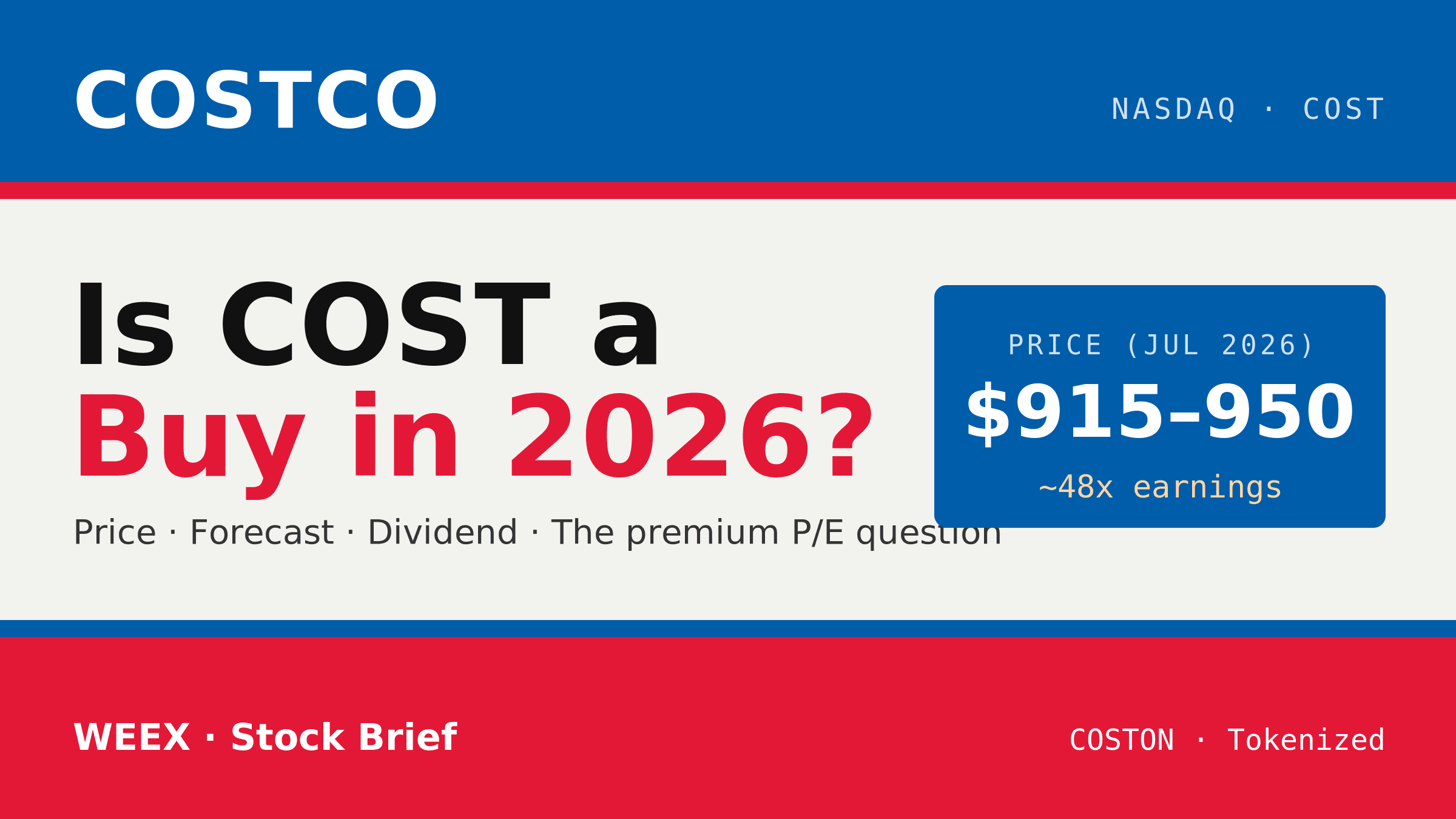
Costco stock (NASDAQ: COST) is one of the market's most admired retailers — and one of its most expensive. In early July 2026 the shares trade in the low-to-mid $900s, giving Costco a market value north of $400 billion and a valuation that keeps sparking the same debate: great business, but is Costco stock still worth buying at this price? This guide breaks down where COST trades now, what the latest earnings show, where analysts see it going, and how to actually buy it — including the tokenized route for investors outside U.S. brokerage access.
Costco Stock at a Glance
Costco is a membership-warehouse retailer that makes most of its profit from annual membership fees rather than thin product margins. That model is the whole investment case, so it helps to see the key numbers in one place before going deeper.
| Metric (early July 2026) | Value |
|---|---|
| Ticker / exchange | COST / NASDAQ |
| Share price | ~$915–950 |
| Market capitalization | Over $400 billion |
| Trailing P/E | ~47–49x |
| 10-year average P/E | ~39x |
| Trailing EPS | ~$19.91 |
| Regular annual dividend | ~$5.37 (yield ~0.57%) |
| Analyst consensus | Buy |
| Average 12-month target | ~$1,060–1,095 |
The single most important line here is the P/E. Costco trades at roughly 47–49 times trailing earnings, well above its own 10-year average near 39x and far above the low-20s multiples of most retail peers. Investors are paying a premium for reliability, not for cheapness.
Why Costco Stock Trades at Such a Premium P/E
The short answer: durability. Costco's renewal rates sit near 90% worldwide and above 92% in the U.S. and Canada, which turns membership income into a recurring, high-margin cash stream that behaves more like a subscription business than a retailer. That predictability is exactly what the market rewards with a high multiple.
The risk of that premium is equally clear. At nearly 50x earnings, Costco stock is priced for continued execution with essentially no room for error. If comparable sales cool or membership growth stalls for even a couple of quarters, the multiple has much further to fall than a cheaper stock would. The better way to frame COST today is not "is the business good?" — it plainly is — but "how much future growth is already in the price?"
What Costco's Latest Earnings Say About Its Growth
Costco's fiscal third-quarter 2026 results, reported on May 28, 2026, showed the growth engine still running hot. The numbers below explain why the premium multiple has held up.
| Q3 FY2026 (reported May 28, 2026) | Result |
|---|---|
| Net sales | $69.2 billion, up 11.6% |
| Total revenue (incl. fees) | $70.53 billion |
| Comparable sales | +9.8% |
| E-commerce comparable sales | +21.5% |
| Membership fee income | $1.37 billion, up 10.7% |
| Paid members | 82.9 million, up 4.1% |
| Worldwide renewal rate | 89.7% |
| Net income / EPS | $2.19 billion / $4.93 (up 15%) |
Two things stand out. First, membership income grew double digits and members keep renewing, which protects the profit base. Second, digitally enabled sales jumped more than 21%, showing Costco is finally converting its traffic into e-commerce without cannibalizing the warehouse trip. For a company this size, low-double-digit revenue growth with 15% EPS growth is a strong print — and it is why bulls argue the valuation, while steep, is not irrational.
Costco Stock Forecast: Where Analysts See COST Going
Wall Street is broadly positive but not unanimous. Across roughly 20 analysts, the consensus rating on Costco is Buy, with an average 12-month price target in the $1,060–1,095 range as of early July 2026 — implying mid-single to low-double-digit upside from current levels. The spread of targets tells the real story.
| Scenario | 12-month target | Implied view |
|---|---|---|
| Bull case (high estimate) | ~$1,315 | Growth and multiple both hold |
| Consensus average | ~$1,060–1,095 | ~13% upside, steady compounding |
| Cautious (e.g., DA Davidson) | ~$1,000, Neutral | Premium multiple caps upside |
| Bear case (low estimate) | ~$740–781 | Multiple compresses toward history |
The gap between the ~$1,315 high and the ~$740 low — a range of more than 40% — is almost entirely a valuation argument, not a disagreement about the business. Analysts who trim their rating, like DA Davidson at Neutral, are not calling Costco a bad company; they are saying a near-50x multiple already reflects the good news. One independent fair-value estimate pegs COST near $1,017, close to where it trades, reinforcing the "great company, full price" reading.
Is Costco Stock a Good Buy Right Now?
For a long-term investor who wants a core, low-drama compounder, Costco remains one of the highest-quality holdings in U.S. retail — the stock is up more than 175% over the past five years, and the membership model has proven resilient in both bull and bear markets. The honest catch is the entry price. Buying at ~48x earnings means your returns depend heavily on Costco sustaining premium growth; a single soft patch could trigger a multiple de-rating even if the business stays healthy.
A practical way experienced investors handle this is to separate the decision to own COST from the decision to buy it all at once. Dollar-cost averaging into a position, rather than committing a lump sum at a record-high multiple, blunts the risk of buying just before a valuation reset. Costco is far more often a "quality you accumulate patiently" stock than a "back up the truck at any price" one.
How to Buy Costco Stock — and the Tokenized Alternative
There are three common routes to Costco exposure, depending on where you live and what you want to own.
- A standard brokerage account. The simplest path: open an account, search COST, and buy shares (or fractional shares) directly. This gives you real ownership, dividends, and voting rights.
- Costco's Direct Stock Purchase Plan. Costco offers a DSPP with a minimum initial purchase of $250, or a commitment of at least $25 per month for ten months, with a $15 setup fee. It also supports dividend reinvestment (DRIP) to compound automatically.
- A tokenized stock, for investors outside U.S. brokerage access. For traders who cannot easily open a U.S. brokerage account, a tokenized version tracks COST's price on-chain. On WEEX, Costco Tokenized Stock (COSTON), issued by Ondo Finance, gives economic exposure to Costco with 24/5 trading against USDT. WEEX listed COSTON for spot trading on December 23, 2025.
One caveat matters more than any other with the tokenized route: a token like COSTON is exposure, not equity. You track the price and simulated dividend reinvestment, but you do not own the underlying share, receive dividends directly, or hold voting rights, and you take on the issuer, custody, and regulatory risks specific to tokenized assets. It is a workaround for market access, not a substitute for owning the stock outright where you can.
The Bottom Line on Costco Stock
Costco stock is the rare case where almost everyone agrees on the business and disagrees only on the price. The membership model, near-90% renewals, double-digit membership growth, and expanding e-commerce make COST one of the most dependable compounders in retail. The premium P/E near 48x is the price of that dependability — and the main reason to buy patiently rather than all at once. If you want to research or trade Costco exposure through a tokenized product, WEEX's COSTON listing is one accessible option; if you want true ownership with dividends, a brokerage or Costco's own purchase plan is the cleaner route.
FAQ
1. Is Costco stock a good buy in 2026?
Analysts rate Costco a Buy on average, with targets around $1,060–1,095, but the near-48x P/E leaves little room for error. It suits long-term investors who value stability more than a cheap entry price, ideally bought gradually rather than in one lump sum.
2. Why is Costco stock so expensive?
Costco earns most of its profit from recurring membership fees with ~90% renewal rates, giving it subscription-like predictability. The market pays a premium multiple — currently ~47–49x earnings versus a ~39x historical average — for that durability.
3. What is the Costco stock price forecast?
The consensus 12-month target sits near $1,060–1,095, with a bullish high around $1,315 and a bearish low near $740–781. The wide range reflects a debate about valuation, not about the quality of the business.
4. Does Costco stock pay a dividend?
Yes. Costco pays a regular quarterly dividend (about $5.37 annualized, a ~0.57% yield) and has periodically paid large one-time special dividends. The regular yield is small, so COST is a growth-and-compounding story more than an income stock.
5. How can I buy Costco stock outside the U.S.?
You can use an international broker that offers U.S. equities, or gain price exposure through a tokenized stock such as Costco Tokenized Stock (COSTON) on WEEX, which trades 24/5 against USDT. Remember that a token gives economic exposure, not real share ownership.
Risk Warning
Costco stock carries the normal risks of single-stock equity investing: a premium valuation near 48x earnings means the share price can fall sharply if growth slows or the multiple compresses, and concentration in one name amplifies that swing. If you gain exposure through a tokenized product like COSTON instead of buying shares, you take on additional risks — you do not own the underlying stock or its voting and dividend rights, and you are exposed to issuer, custody, liquidity, and regulatory risks specific to tokenized assets, which trade 24/5 and can gap when the underlying U.S. market is closed. Never invest more than you can afford to lose, and do your own research before buying.
Disclaimer: For informational purposes only. Not financial advice. Any activities, rewards, campaigns, or promotions mentioned do not constitute an offer, solicitation, or recommendation to buy, sell, or trade crypto assets. Crypto assets are highly volatile and may lose value. WEEX services, products, or campaigns may not be available in all regions. Users are responsible for complying with applicable local laws before participating.
Disclaimer: This content is provided for general branding and informational purposes only and doesn't constitute financial, investment, legal, or tax advice. Any events, rewards, online events, or related information mentioned herein should not be considered a recommendation, solicitation, or invitation to purchase, sell, trade, or otherwise deal in any crypto assets or to use any services. Crypto assets are highly volatile and may result in loss. WEEX services and online events may not be available in all regions and are subject to applicable laws, regulations, and eligibility requirements. You are responsible for ensuring that your use of WEEX services complies with local laws and for carefully assessing the risks before participating in any crypto-related activities.
You may also like
How to Set Up a DCA Strategy for Crypto
Dollar-cost averaging (DCA) helps crypto investors spread buys over time to reduce timing risk. This guide shows how…
What Is Copy Trading? A Beginner’s Guide
Copy trading lets you automatically mirror another trader’s positions in real time. You choose a trader to follow,…

What is Credo Technology Group Holding Tokenized Stock (Ondo)(CRDOON) Coin? Everything You Need to Know Before Trading CRDOON/USDT
This article explains what Credo Technology Group Holding Tokenized Stock (Ondo) (CRDOON) is, how it works, who stands…

Is DCA a Good Strategy for Beginners?
Short answer: for most beginners, DCA (dollar-cost averaging) is a sensible starting point—simple, steady, and less stressful—though it…
Does DCA Actually Work? What the Data Shows
DCA (dollar-cost averaging) means investing a fixed amount on a set schedule, regardless of price. This article looks…
What is Astera Labs Tokenized Stock (Ondo)(ALABON) Coin? Everything You Need to Know Before Trading ALABON/USDT
This article explains what Astera Labs Tokenized Stock (Ondo) (ticker: ALABON) is, how tokenized stocks work, where to…
USA Rare Earth Stock (USAR): Bull Case, Risks, and the 2028 Bet
USA Rare Earth stock (USAR) explained — what the company does, why shares slumped in 2026, the Round Top bull case, the MP Materials lawsuit, and key risks.
USAR Stock Price Prediction: Can USA Rare Earth Reclaim $40?
USAR stock price prediction: USA Rare Earth trades near $19 vs a $36–$39 analyst target. Bull case, bear case, and 2026–2030 scenarios.
Meta Stock in 2026: Price, Forecast, and How to Trade It
Meta stock near $630 in July 2026, down YTD on AI capex fears. See the price, analyst forecast, bull vs bear case, and how to trade META exposure.
SK Hynix Stock: Inside the AI Memory Giant's Nasdaq Debut
SK Hynix stock lists on Nasdaq July 10 as SKHY in the biggest ADR debut ever. Price, 2026 forecast, HBM bull/bear case, and how to buy.
Risks of Shorting Bitcoin You Should Know Before You Trade
Shorting can look simple: you profit when price falls. But the bitcoin short is different from buying because…
Shorting Bitcoin vs Buying Put Options: What’s the Difference
This guide breaks down two ways to express a bearish view on BTC: opening a bitcoin short with…
Prismevm (PP) Airdrop on WEEX: How to Unlock New User Rewards
This guide explains what Prismevm (PP) is, how the Prismevm (PP) airdrop on WEEX works, and a simple,…
How to Short Bitcoin: Methods and Platforms Compared
A bitcoin short lets you profit if BTC falls. This guide explains how to short bitcoin using futures,…
What Is Dollar-Cost Averaging (DCA)? A Beginner’s Guide
Dollar-cost averaging (DCA) is a simple strategy: invest a fixed amount on a fixed schedule, no matter the…
What Does It Mean to Short Bitcoin? A Beginner’s Guide
Shorting is the opposite of buying. Instead of hoping Bitcoin goes up, you take a bitcoin short to…
How to Join GROVE Airdrop and Unlock 50,000 USDT Rewards
The GROVE airdrop marks Grove Finance’s token debut on WEEX with a clear, rules-based campaign that rewards deposits,…
What is Cash Cat (CASHCAT) Coin? Everything You Need to Know Before Trading CASHCAT/USDT
This article explains what Cash Cat (CASHCAT) is, how it works on Robinhood Chain, what drives demand, how…
Bitcoin Price Prediction 2026: Is the BTC Bottom Finally In?
This article maps a clear path to Bitcoin Price Prediction 2026 and weighs the question: Is the BTC…
Aptos (APT) Token Unlock July 12: Will APT Price Crash?
Aptos (APT) faces a scheduled token unlock on July 12, and traders are asking if the added supply…
What is Bitmine BMNR and Why Does It Own 5.7 Million ETH?
This article explains the claim that “Bitmine BMNR” controls 5.7 million ETH, what Bitmine BMNR might be, how…
Why is XRP Price Pumping Today After Ripple MiCA License Approval?
XRP price momentum accelerated after reports that Ripple secured a MiCA-compliant authorization in the EU, a milestone that…
Why Did Bitcoin Drop 33% While Semiconductor Stocks Pumped 102%?
Bitcoin’s 33% drawdown alongside a 102% surge in semiconductor stocks looks contradictory, but the gap is explainable. This…
Is Bitmine Immersion Technologies Safe? BMNR Crypto Holdings Explained
This guide breaks down what Bitmine BMNR and BMNR Crypto could represent, how to judge safety for Bitmine…
Why is Bitcoin Crashing Below 64K After the Weekend Rally?
Bitcoin’s slide below 64K after a strong weekend bounce looks jarring, but the mechanics are familiar: thin weekend…
Crypto Kidnapping and Torture Case: 5 Crucial Rules to Protect Your Cold Wallet Private Keys
Crypto kidnapping is a blunt, offline attack that targets you—not your code. This guide explains how kidnappers force…
What is Trump Crypto Coin and Why Did It Lose 3.8 Billion Dollars?
This article explains what people mean by “Trump Crypto” coin, why multiple Trump-themed tokens surged and then rapidly…
What is Ripple MiCA Crypto Authorization and How Does It Work?
Ripple MiCA Crypto Authorization refers to the process a Ripple-affiliated entity would follow to operate legally under the…
Is Trump Crypto Coin a Scam? The $3.8 Billion Loss Report Explained
“Trump Crypto” has become a catch-all label for tokens, NFTs, and memecoins that reference the former U.S. president.…
What is the Patrick Witt Crypto Bill? US Strategic Bitcoin Reserve Explained
This article explains what people mean by the “Patrick Witt Crypto Bill,” why a U.S. Strategic Bitcoin Reserve…
How to Set Up a DCA Strategy for Crypto
Dollar-cost averaging (DCA) helps crypto investors spread buys over time to reduce timing risk. This guide shows how…
What Is Copy Trading? A Beginner’s Guide
Copy trading lets you automatically mirror another trader’s positions in real time. You choose a trader to follow,…
What is Credo Technology Group Holding Tokenized Stock (Ondo)(CRDOON) Coin? Everything You Need to Know Before Trading CRDOON/USDT
This article explains what Credo Technology Group Holding Tokenized Stock (Ondo) (CRDOON) is, how it works, who stands…
Is DCA a Good Strategy for Beginners?
Short answer: for most beginners, DCA (dollar-cost averaging) is a sensible starting point—simple, steady, and less stressful—though it…
Does DCA Actually Work? What the Data Shows
DCA (dollar-cost averaging) means investing a fixed amount on a set schedule, regardless of price. This article looks…
What is Astera Labs Tokenized Stock (Ondo)(ALABON) Coin? Everything You Need to Know Before Trading ALABON/USDT
This article explains what Astera Labs Tokenized Stock (Ondo) (ticker: ALABON) is, how tokenized stocks work, where to…