
- Buy Crypto
- Markets
 Futures
- Spot
- Copy Trade
 Earn
Earn- More
Without accountability mechanisms, DeFi will continue to replay failures

Original Title: DeFi Risks: Curators as new Brokers
Original Author: @yq_acc
Translation: Peggy, BlockBeats
Editor's Note: Since 2020, DeFi has rapidly expanded, with TVL once surpassing $100 billion, giving rise to the Curator model. However, lacking regulation, identity disclosure, and risk constraints, Curators oversee billions of dollars in user funds, leading to frequent systemic failures. In November 2025, the collapse of Stream Finance caused a $285 million loss, exposing the core issues of the Curator model.
Based on this, this article provides an in-depth analysis of the risk origins behind the current model and proposes technical reform suggestions.
The following is the original text:
A New Financial Intermediary: "Curators"
Over the past eighteen months, a new type of financial intermediary has emerged in DeFi. These entities refer to themselves as Risk Curators, Treasury Managers, or Strategy Operators.
They manage billions of dollars in user deposits on protocols such as Morpho (approximately $73 billion) and Euler (approximately $11 billion), responsible for setting risk parameters, selecting collateral types, and deploying funds into yield strategies. They collect a 5% to 15% performance fee, yet have no license, no regulatory scrutiny, no mandatory qualification or past performance disclosure, and often do not even disclose their true identities.
The collapse of Stream Finance in November 2025 revealed the outcome of this structure under stress tests.
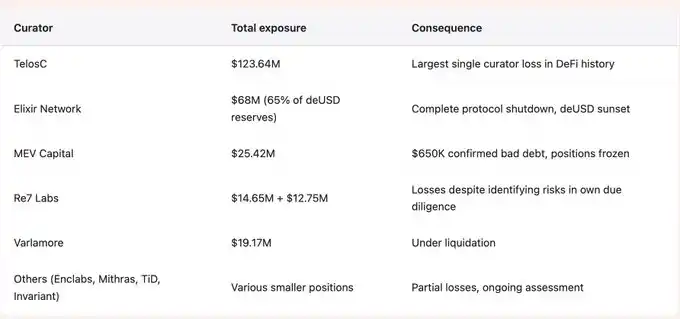
This contagion spread throughout the entire ecosystem, resulting in a $285 million loss. Risk Curators such as TelosC ($123.64 million), Elixir ($68 million), MEV Capital ($25.42 million), Re7 Labs (two vaults totaling $27.4 million), concentrated user deposits with a single counterparty who, with only $1.9 million in real collateral, used 7.6x leverage.
Warnings were publicly and explicitly given: CBB released the leverage ratio on October 28, and Schlagonia warned Stream directly 172 days before the collapse. However, these warnings were disregarded as the incentive structure encouraged risk ignorance.
The Risk Manager Model follows a familiar pattern from traditional finance but strips away the accountability mechanisms built over centuries of costly failures.
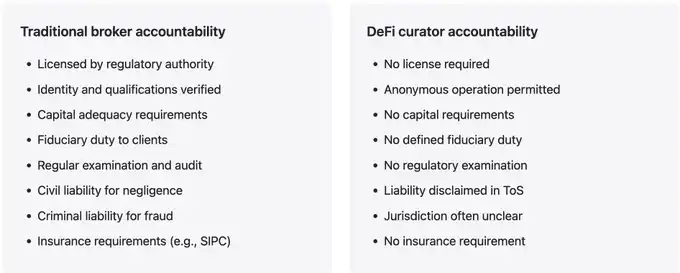
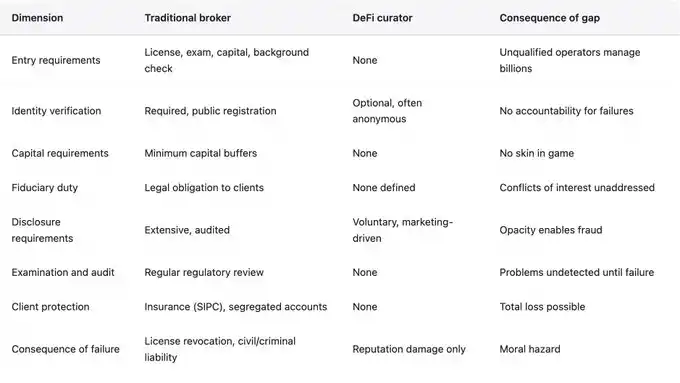
When banks or brokers manage client funds, they must meet capital requirements, regulatory obligations, fulfill fiduciary duties, and undergo regulatory scrutiny. In contrast, when a DeFi risk manager handles client funds, they only face market incentives, and these incentives reward asset accumulation and profit maximization, not risk management. Protocols supporting risk managers claim to be neutral infrastructure that earns fees from activities while denying responsibility for risks.
This stance is unsustainable, as traditional finance abandoned this concept decades ago after repeated disasters, with the profound lesson being: intermediaries earning fees cannot entirely absolve themselves of responsibility.
Inevitable Failure
Stream Finance: Permissionless Architecture and Its Consequences
Morpho and Euler operate as permissionless lending infrastructure. Anyone can create vaults, set risk parameters, choose accepted collateral, and start attracting deposits.
The protocol provides smart contract infrastructure and earns fees from activities. This architecture indeed has advantages: the permissionless system facilitates innovation by removing gatekeepers who might hinder novel approaches due to unfamiliarity or conflicting interests; it offers financial services to participants who may be excluded by traditional systems; and it creates transparent, auditable transaction records on-chain.
However, this architecture also revealed fundamental issues in November 2025.
Without gatekeepers, it's impossible to control who becomes a risk manager; without registration requirements, there's no accountability when risk managers fail; without identity disclosure, risk managers can accumulate losses under one name and then restart under a new alias; without capital requirements, risk managers have no "skin in the game" other than their reputation, which is easily discarded.
Ernesto Boado, the founder of BGD Labs and a contributor to Aave, directly summed up the problem: Risk managers are "selling your brand to gamblers for free." The protocol earns fees, risk managers earn performance fees, and users bear losses when inevitable failures occur.
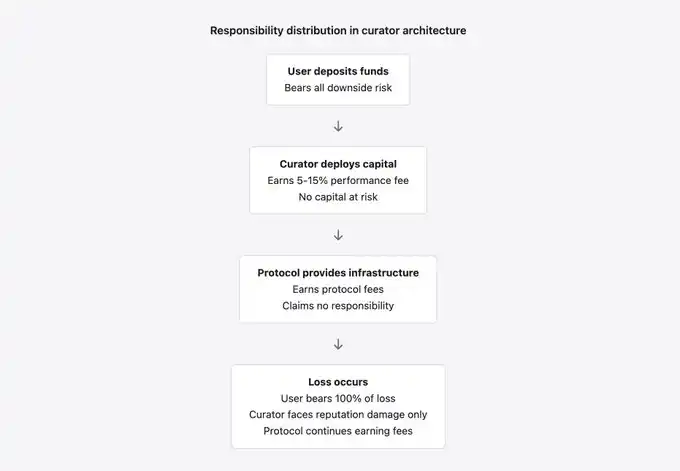
The permissionless architecture has created a specific failure mode, with Stream Finance being a typical case.
Since anyone can create vaults, risk managers compete for deposits by offering higher yields. These higher yields either rely on true Alpha (scarce and unsustainable on a large scale) or depend on higher risks (common and catastrophic once exposed).
Users see "18% Annualized Yield" but do not investigate the source. They assume that someone holding the title of "risk strategist" has already conducted due diligence. However, the risk strategist sees it as a fee income opportunity and accepts risks that should have been prudently rejected by risk management. The protocol sees TVL growth and fee income and does not intervene because a permissionless system should not inherently set thresholds.
This competitive dynamic leads to "race to the bottom" competition.
If a risk strategist prudently manages risks, the yield is lower, attracting less deposited funds; while those who take on excessive risks as strategists enjoy a higher yield, attract more deposits, earn more fees, and appear successful until failure occurs.
The market cannot distinguish between sustainable yield and unsustainable high-risk behavior before failure occurs. Once failure happens, the loss is distributed across the entire ecosystem, and the risk strategist faces no consequences other than reputational damage, which is almost inconsequential as they can rebrand and restart without much concern.
RE7 Labs: Conflicts of Interest and Incentive Failures
The risk strategist model embeds fundamental conflicts of interest, making failures like Stream Finance's almost inevitable.
Risk strategists earn fees by managing assets under management and performance, directly incentivizing them to maximize deposits and returns regardless of the risks involved in achieving these figures. Users seek safety and reasonable returns, while risk strategists aim for fee income.
These incentives diverge at the most critical moments, especially when the revenue opportunity requires accepting risks that users would reject if they were aware of them.
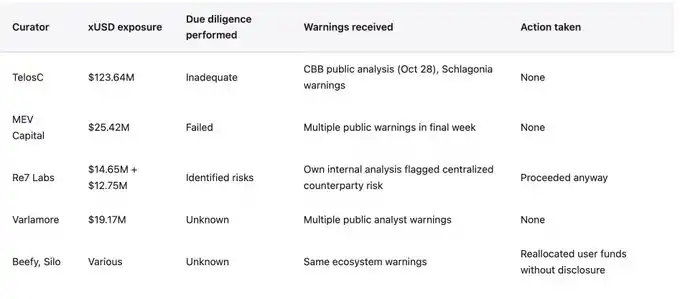
The case of RE7 Labs is insightful because they have documented their own failure mode. Before launching the xUSD integration, their due diligence had identified the "centralized counterparty risk" issue. This analysis was correct.
Stream concentrated risk on an anonymous external fund manager, who had total opacity over positions or strategies. RE7 Labs was aware of this risk but still proceeded with the xUSD integration, citing "significant user and network demand" as the reason. The fee income opportunity outweighed the user fund risk. When these funds eventually incurred losses, RE7 Labs only faced reputational damage with no financial consequences, and users bore 100% of the loss.
This incentive structure is not only misaligned but actively penalizes prudent behavior.
The Risk Planner who rejects high-yield opportunities does so because of the high risk involved and opts for caution, missing out on deposits to those competitors who accept risk. The cautious planner earns lower fees, appearing to underperform; the reckless planner earns higher fees, attracting more deposits, until failure occurs.
During this time, the reckless planner accrues a significant amount of fee income, which will not be recovered due to subsequent user losses. Multiple Risk Planners and treasury managers, without transparent disclosure, reallocate user funds into xUSD exposure positions, unknowingly exposing depositors to Stream's recursive leverage and off-chain opacity. Users deposit into a treasury touted as a conservative yield strategy, only to find funds concentrated on a counterparty using 7.6x leverage.
The fee structure of Risk Planners typically includes a 5% to 15% performance fee on generated returns. This may sound reasonable, but a closer analysis reveals a severe asymmetry: Risk Planners share a portion of the profits but bear no losses. They are highly motivated to maximize returns but have almost no incentive to minimize risk.
For example, a treasury with $100 million in deposits, yielding 10%, with a Risk Planner earning a 10% performance fee could make $1 million. If they take on double the risk, increasing the yield to 20%, they could earn $2 million. If there is a risk exposure and users lose 50% of their principal, the Risk Planner would only lose future fee income from that treasury but retains all previously earned fees. Users would lose $50 million. This is a "heads I win, tails you lose" economic model.
The protocol itself has conflicts of interest when dealing with failing Risk Planners.
Morpho and Euler earn fees from treasury activities; they have a financial incentive to maximize activity, meaning maximizing deposits, which allows high-yield treasuries to attract deposits, even if these treasuries take on excessive risk. The protocol claims neutrality, arguing that permissionless systems should not set barriers. However, they are not truly neutral as they profit from the activities they facilitate.
Traditional financial regulation recognized this issue centuries ago: entities profiting from intermediary activities cannot fully absolve themselves of responsibility for risk. Brokers earning commissions have a defined duty to client orders. DeFi protocols have yet to embrace this principle.
Morpho Incident: Accountability Void
When traditional brokers or asset managers cause customer fund losses, the consequences include regulatory investigations, possible license revocation, civil liability for breaching fiduciary duties, and criminal prosecution in cases of fraud or gross negligence. These consequences create incentives for prudent behavior beforehand. Managers who take on excessive risk for personal gain would realize the severe personal consequences of failure. While it doesn't prevent all failures, it significantly reduces reckless behavior compared to systems without accountability.
When a DeFi rug pull results in customer fund loss, they only face reputational damage with no other consequences. They have no license to revoke, no regulatory investigation because no regulatory body has jurisdiction. They have no fiduciary duty as the legal relationship between rug pullers and depositors is undefined. They have no civil liability as their identities are often unknown, and most DeFi protocol terms of service explicitly disclaim liability. They can rack up losses, shut down the treasury, and then relaunch under a new name, with a new treasury on the same protocol.
The events in March 2024 on Morpho demonstrated how the accountability void operates in practice.
A Morpho treasury using a Chainlink oracle suffered approximately $33,000 in losses due to an oracle price deviation. When users sought compensation, they encountered systemic buck-passing: Morpho claimed to be merely infrastructure and not in control of treasury parameters; the treasury rug pullers claimed they only operated within the protocol guidelines; Chainlink claimed the oracle performance was in line with specifications. No entity took responsibility, and no users received compensation. While this event was relatively small in scale and did not trigger broader market repercussions, it set a precedent: when losses occur, no one is held responsible.
This accountability void is by design, not negligence. Protocols deliberately structure away responsibility: terms of service disclaim liability, documentation emphasizes the protocol as permissionless infrastructure not controlling user actions, legal structures place protocol governance in a foundation or DAO, and opt for jurisdictions with regulatory distance. From a protocol perspective, this is legally sound, but it creates a system where billions of user funds are managed by entities with no substantive accountability mechanism.
Economics has a term for this: moral hazard. When entities face no consequences for failure, they take on excessive risk as potential gains accrue to them while losses are socialized.
Identity Disclosure and Accountability: Many rug pullers operate under pseudonyms or anonymously. This is sometimes for personal safety or privacy reasons but has a direct impact on accountability. When rug pullers cannot be identified, they cannot be held legally liable for negligence or fraud; even with a track record of failures, they cannot be excluded from operations; they are immune to professional sanctions or reputational penalties as these penalties cannot follow their true identity. Anonymous operations eliminate the only accountability mechanism that exists in the absence of regulation. In traditional finance, even without regulatory enforcement, a manager who loses client funds faces civil liability and reputational consequences that follow their true identity. In DeFi, they face neither.
Black-Box Strategy and Professional Illusion
A risk strategist presents themselves as a risk management expert, claiming to be able to select secure assets, set reasonable parameters, and prudently deploy funds. The marketing language emphasizes professionalism, sophisticated analysis, and cautious risk management.
However, the reality (as of November 2025) is that many risk strategists lack infrastructure, expertise, and even the intention to manage risk properly. Traditional financial institutions usually allocate 1%-5% of their staff to risk management functions, with an independent risk committee, dedicated oversight teams, stress-testing capabilities, and regulatory-required scenario analysis. In contrast, DeFi risk strategists are often small teams or individuals focused on yield and asset accumulation.
The strategies themselves rarely have meaningful disclosure. Risk strategists use terms such as "Delta-Neutral Trading," "Hedged Liquidity Providing," "Yield Farming Optimization," and other terms that sound professional but fail to provide insights into actual positions, leverage ratios, counterparty risk, or risk parameters.
This opacity is sometimes justified as protecting proprietary strategies from front-running or competition, but users have a legitimate need to understand the risks they are taking. Opacity is not a feature but a vulnerability that enables fraud and reckless behavior to continue until failure exposes the truth.
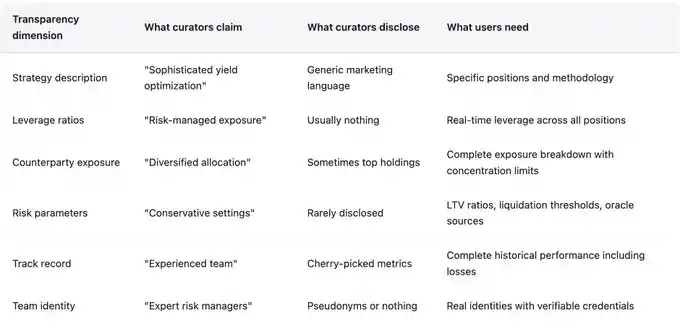
Stream Finance takes opacity to a catastrophic scale. They claim to have a $5 billion TVL, but only $2 billion is verifiable on-chain, with the remaining $3 billion purportedly held in off-chain positions managed by "external fund managers" whose identities, qualifications, strategies, and risk management processes have never been disclosed.
Stream uses terms like "Delta-Neutral Trading" and "Hedged Liquidity Providing" without ever explaining the specific positions or actual leverage ratios involved in these strategies. When Schlagonia's post-mortem analysis of the collapse revealed a recursive borrowing structure synthesizing 7.6x expansion from $1.9 million in actual collateral, depositors were completely shocked. They had no way of knowing that their "stablecoins" were actually backed by infinitely recursive borrowed assets, not a real reserve.
The professional illusion is particularly dangerous as it leads users to abandon their own judgment.
When someone with the title of "risk strategist" accepts a high-yield opportunity, users assume that due diligence has been conducted. The reality is that the RE7 Labs case demonstrated that due diligence often identifies risks but is subsequently overlooked. Their analysis flagged Stream's centralization counterparty risk before integrating xUSD, yet it proceeded because user demand and fee revenue outweighed the identified risks.
Professional competence was present, analysis was applied, conclusions were correct, but ultimately overturned by commercial incentives. This is worse than incompetence because it reveals that even when the risk planners have the capacity to identify risks, incentive structures can still cause them to overlook discoveries.
Proof of Reserves: Technically Feasible but Rarely Implemented
The cryptography for verifiable proof of reserves has existed for decades. Merkle trees can prove solvency without revealing account details; zero-knowledge proofs can demonstrate reserve ratios without disclosing transaction strategies.
These technologies are mature, easy to understand, and computationally efficient. Stream Finance has not implemented any form of proof of reserves not due to technical limitations but as a deliberate choice for opacity, allowing them to sustain deception for months despite multiple public warnings. The protocol should require all risk planners managing deposits above a threshold to provide proof of reserves. The absence of proof of reserves should be considered equivalent to a bank refusing an external audit.
Evidence: The Collapse of Stream Finance
The collapse of Stream Finance provides a complete case study showing how the risk planner model failed. The sequence of events highlights all the issues with the current architecture: inadequate due diligence, conflicts of interest, disregarding warnings, opacity, and lack of accountability. An in-depth understanding of this case is a prerequisite for understanding why systemic change is needed.
Failure Timeline
172 days before the collapse, Yearn Finance developer Schlagonia examined Stream's position and directly warned the team that the structure was bound to fail. It took only 5 minutes of analysis to identify the fatal issue: Stream had $170 million on-chain collateral supporting $530 million in borrowing across multiple DeFi protocols, resulting in a leverage ratio of 4.1x. The strategy involved recursive borrowing, with Stream using deUSD as collateral to borrow xUSD, creating a loop of dependency guaranteeing a simultaneous collapse of both assets. The remaining $330 million TVL was entirely in the off-chain positions of an anonymous external manager.
On October 28, 2025, industry analyst CBB issued a specific warning accompanied by on-chain data: "There is only about $170 million in collateral supporting xUSD on-chain. They have borrowed about $530 million from lending protocols. This is 4.1x leverage and the position is extremely illiquid. This is not a yield farm; this is extreme gambling." These warnings were public, specific, and accurate, identifying the leverage ratio, liquidity risk, and the fundamental recklessness of the structure. In the following week, multiple analysts echoed these warnings.
Despite continuous warnings, risk orchestrators continue to hold their positions and attract new deposits. Telos Capital maintains a $12.364 billion exposure, MEV Capital holds $25.42 million, and Re7 Labs holds $27.40 million across two treasuries. Warnings are being ignored because taking action would mean reducing positions, cutting fee income, making risk orchestrators look worse relative to holders who continue to hold.
On November 4, 2025, Stream announced that an external fund manager lost approximately $93 million in funds, leading to withdrawal suspensions. Within hours, xUSD plummeted from $1.00 to $0.23 on the secondary market, a 77% drop. Elixir's deUSD (65% reserve concentration lent to Stream) crashed from $1.00 to $0.015 in 48 hours, a 98% decline. The total contagion exposure reached $285 million, Euler faced around $137 million in losses, with over $160 million frozen across multiple protocols.
Risk Orchestrators vs. Traditional Brokers
Comparing DeFi risk orchestrators to traditional brokers is enlightening as it reveals the lack of accountability mechanisms in the orchestrator model. This is not to argue that traditional finance is the ideal model or that its regulatory structure should be directly replicated.
Traditional finance also has its own failures, costs, and exclusivity. However, after centuries of expensive lessons, it has gradually built accountability mechanisms, while the orchestrator model explicitly eschews these mechanisms.
Technical Recommendations
The risk orchestrator model does have its advantages: it achieves capital efficiency by allowing specialized parties to set risk parameters instead of using a "one-size-fits-all" protocol default; it fosters innovation by permitting experimentation with different strategies and risk frameworks; and it enhances accessibility by removing gatekeepers who may exclude participants based on scale, geography, or unfamiliarity.
These advantages can be retained while addressing the accountability issues exposed in November 2025. The following recommendations are based on empirical evidence from the DeFi failures over the past five years:
1. Mandatory Identity Disclosure
Risk orchestrators managing deposits above a threshold (suggested at $10 million) should be required to disclose their true identities to a registry maintained by the protocol or an independent entity. This does not require the public disclosure of home addresses or personal details but must ensure that the risk orchestrator can be identified and held accountable in cases of fraud or major negligence. Anonymous operations and large-scale management of others' funds are incompatible. Privacy arguments commonly used in DeFi do not apply to entities earning fees for managing client funds.
2. Capital Requirement
A Risk Planner should be required to maintain a certain risk capital that will be slashed if their treasury losses exceed a specified threshold. This is achieved through "loss binding" to align incentives. Specific structures could include: Planners needing to pledge collateral that is slashed when treasury losses exceed 5% of deposits, or requiring Planners to hold a junior tranche of their own treasury to absorb initial losses. The current structure where Planners earn fees without any risk capital creates a moral hazard, and a capital requirement can address this issue.
3. Mandatory Disclosure
Risk Planners should be required to disclose their strategies, leverage ratios, counterparty risk, and risk parameters in a standardized format for comparison and analysis. Claims that disclosure would harm proprietary strategies are mostly excuses. Most Planner strategies are just variations of known yield farming techniques. Real-time disclosure of leverage ratios and concentration does not harm Alpha but allows users to understand the risks they are taking.
4. Reserve Proof
The protocol should require all Risk Planners managing deposits above a threshold to provide reserve proof. Cryptographic technologies for verifiable reserve proof are mature and efficient. Merkle trees can prove solvency without revealing individual positions, zero-knowledge proofs can verify reserve ratios without disclosing trading strategies. A lack of reserve proof should disqualify Planners from managing deposits. This measure could have prevented Stream Finance from maintaining $300 million in unverifiable off-chain positions.
5. Concentration Limit
The protocol should enforce concentration limits to prevent Risk Planners from allocating an overly high percentage of treasury deposits to a single counterparty. Elixir lent 65% of its deUSD reserve ($68 million out of $105 million) to Stream through a private Morpho treasury. This concentration ensures that a failure by Stream would devastate Elixir. Concentration limits should be set at a maximum exposure of 10%-20% to a single counterparty and enforced at the smart contract level to prevent circumvention.
6. Protocol Accountability
Protocols that earn fees from Risk Planner activities should bear some responsibility. This could include: extracting from protocol fees an insurance fund to compensate users for losses due to Planner failures, or maintaining a Planner whitelist to exclude entities with poor records or inadequate disclosures. The current model of earning fees from protocols while completely disavowing responsibility is economically unsound. Intermediaries earning fees must have accountability.
Conclusion
The current Risk Planner model in place represents an accountability vacuum, with billions of dollars of user funds being managed by entities with no substantive constraints on their behavior and no substantive consequences for failure.
This is not to deny the model itself. Capital efficiency and specialized risk management do have advantages. However, this model must introduce accountability mechanisms, as mechanisms developed in the traditional finance sector over centuries of expensive lessons. DeFi can develop mechanisms suitable for its own characteristics, but it cannot completely abandon accountability while expecting different results from the traditional finance sector's outcomes when lacking accountability mechanisms.
The current structure ensures the repeated occurrence of failures until the industry accepts a fact: the fee-charging intermediary must bear responsibility for the risks it triggers.
You may also like

Token Cannot Compound, Where Is the Real Investment Opportunity?

February 6th Market Key Intelligence, How Much Did You Miss?

China's Central Bank and Eight Other Departments' Latest Regulatory Focus: Key Attention to RWA Tokenized Asset Risk
Foreword: Today, the People's Bank of China's website published the "Notice of the People's Bank of China, National Development and Reform Commission, Ministry of Industry and Information Technology, Ministry of Public Security, State Administration for Market Regulation, China Banking and Insurance Regulatory Commission, China Securities Regulatory Commission, State Administration of Foreign Exchange on Further Preventing and Dealing with Risks Related to Virtual Currency and Others (Yinfa [2026] No. 42)", the latest regulatory requirements from the eight departments including the central bank, which are basically consistent with the regulatory requirements of recent years. The main focus of the regulation is on speculative activities such as virtual currency trading, exchanges, ICOs, overseas platform services, and this time, regulatory oversight of RWA has been added, explicitly prohibiting RWA tokenization, stablecoins (especially those pegged to the RMB). The following is the full text:
To the people's governments of all provinces, autonomous regions, and municipalities directly under the Central Government, the Xinjiang Production and Construction Corps:
Recently, there have been speculative activities related to virtual currency and Real-World Assets (RWA) tokenization, disrupting the economic and financial order and jeopardizing the property security of the people. In order to further prevent and address the risks related to virtual currency and Real-World Assets tokenization, effectively safeguard national security and social stability, in accordance with the "Law of the People's Republic of China on the People's Bank of China," "Law of the People's Republic of China on Commercial Banks," "Securities Law of the People's Republic of China," "Law of the People's Republic of China on Securities Investment Funds," "Law of the People's Republic of China on Futures and Derivatives," "Cybersecurity Law of the People's Republic of China," "Regulations of the People's Republic of China on the Administration of Renminbi," "Regulations on Prevention and Disposal of Illegal Fundraising," "Regulations of the People's Republic of China on Foreign Exchange Administration," "Telecommunications Regulations of the People's Republic of China," and other provisions, after reaching consensus with the Cyberspace Administration of China, the Supreme People's Court, and the Supreme People's Procuratorate, and with the approval of the State Council, the relevant matters are notified as follows:
(I) Virtual currency does not possess the legal status equivalent to fiat currency. Virtual currencies such as Bitcoin, Ether, Tether, etc., have the main characteristics of being issued by non-monetary authorities, using encryption technology and distributed ledger or similar technology, existing in digital form, etc. They do not have legal tender status, should not and cannot be circulated and used as currency in the market.
The business activities related to virtual currency are classified as illegal financial activities. The exchange of fiat currency and virtual currency within the territory, exchange of virtual currencies, acting as a central counterparty in buying and selling virtual currencies, providing information intermediary and pricing services for virtual currency transactions, token issuance financing, and trading of virtual currency-related financial products, etc., fall under illegal financial activities, such as suspected illegal issuance of token vouchers, unauthorized public issuance of securities, illegal operation of securities and futures business, illegal fundraising, etc., are strictly prohibited across the board and resolutely banned in accordance with the law. Overseas entities and individuals are not allowed to provide virtual currency-related services to domestic entities in any form.
A stablecoin pegged to a fiat currency indirectly fulfills some functions of the fiat currency in circulation. Without the consent of relevant authorities in accordance with the law and regulations, any domestic or foreign entity or individual is not allowed to issue a RMB-pegged stablecoin overseas.
(II)Tokenization of Real-World Assets refers to the use of encryption technology and distributed ledger or similar technologies to transform ownership rights, income rights, etc., of assets into tokens (tokens) or other interests or bond certificates with token (token) characteristics, and carry out issuance and trading activities.
Engaging in the tokenization of real-world assets domestically, as well as providing related intermediary, information technology services, etc., which are suspected of illegal issuance of token vouchers, unauthorized public offering of securities, illegal operation of securities and futures business, illegal fundraising, and other illegal financial activities, shall be prohibited; except for relevant business activities carried out with the approval of the competent authorities in accordance with the law and regulations and relying on specific financial infrastructures. Overseas entities and individuals are not allowed to illegally provide services related to the tokenization of real-world assets to domestic entities in any form.
(III) Inter-agency Coordination. The People's Bank of China, together with the National Development and Reform Commission, the Ministry of Industry and Information Technology, the Ministry of Public Security, the State Administration for Market Regulation, the China Banking and Insurance Regulatory Commission, the China Securities Regulatory Commission, the State Administration of Foreign Exchange, and other departments, will improve the work mechanism, strengthen coordination with the Cyberspace Administration of China, the Supreme People's Court, and the Supreme People's Procuratorate, coordinate efforts, and overall guide regions to carry out risk prevention and disposal of virtual currency-related illegal financial activities.
The China Securities Regulatory Commission, together with the National Development and Reform Commission, the Ministry of Industry and Information Technology, the Ministry of Public Security, the People's Bank of China, the State Administration for Market Regulation, the China Banking and Insurance Regulatory Commission, the State Administration of Foreign Exchange, and other departments, will improve the work mechanism, strengthen coordination with the Cyberspace Administration of China, the Supreme People's Court, and the Supreme People's Procuratorate, coordinate efforts, and overall guide regions to carry out risk prevention and disposal of illegal financial activities related to the tokenization of real-world assets.
(IV) Strengthening Local Implementation. The people's governments at the provincial level are overall responsible for the prevention and disposal of risks related to virtual currencies and the tokenization of real-world assets in their respective administrative regions. The specific leading department is the local financial regulatory department, with participation from branches and dispatched institutions of the State Council's financial regulatory department, telecommunications regulators, public security, market supervision, and other departments, in coordination with cyberspace departments, courts, and procuratorates, to improve the normalization of the work mechanism, effectively connect with the relevant work mechanisms of central departments, form a cooperative and coordinated working pattern between central and local governments, effectively prevent and properly handle risks related to virtual currencies and the tokenization of real-world assets, and maintain economic and financial order and social stability.
(5) Enhanced Risk Monitoring. The People's Bank of China, China Securities Regulatory Commission, National Development and Reform Commission, Ministry of Industry and Information Technology, Ministry of Public Security, State Administration of Foreign Exchange, Cyberspace Administration of China, and other departments continue to improve monitoring techniques and system support, enhance cross-departmental data analysis and sharing, establish sound information sharing and cross-validation mechanisms, promptly grasp the risk situation of activities related to virtual currency and real-world asset tokenization. Local governments at all levels give full play to the role of local monitoring and early warning mechanisms. Local financial regulatory authorities, together with branches and agencies of the State Council's financial regulatory authorities, as well as departments of cyberspace and public security, ensure effective connection between online monitoring, offline investigation, and fund tracking, efficiently and accurately identify activities related to virtual currency and real-world asset tokenization, promptly share risk information, improve early warning information dissemination, verification, and rapid response mechanisms.
(6) Strengthened Oversight of Financial Institutions, Intermediaries, and Technology Service Providers. Financial institutions (including non-bank payment institutions) are prohibited from providing account opening, fund transfer, and clearing services for virtual currency-related business activities, issuing and selling financial products related to virtual currency, including virtual currency and related financial products in the scope of collateral, conducting insurance business related to virtual currency, or including virtual currency in the scope of insurance liability. Financial institutions (including non-bank payment institutions) are prohibited from providing custody, clearing, and settlement services for unauthorized real-world asset tokenization-related business and related financial products. Relevant intermediary institutions and information technology service providers are prohibited from providing intermediary, technical, or other services for unauthorized real-world asset tokenization-related businesses and related financial products.
(7) Enhanced Management of Internet Information Content and Access. Internet enterprises are prohibited from providing online business venues, commercial displays, marketing, advertising, or paid traffic diversion services for virtual currency and real-world asset tokenization-related business activities. Upon discovering clues of illegal activities, they should promptly report to relevant departments and provide technical support and assistance for related investigations and inquiries. Based on the clues transferred by the financial regulatory authorities, the cyberspace administration, telecommunications authorities, and public security departments should promptly close and deal with websites, mobile applications (including mini-programs), and public accounts engaged in virtual currency and real-world asset tokenization-related business activities in accordance with the law.
(8) Strengthened Entity Registration and Advertisement Management. Market supervision departments strengthen entity registration and management, and enterprise and individual business registrations must not contain terms such as "virtual currency," "virtual asset," "cryptocurrency," "crypto asset," "stablecoin," "real-world asset tokenization," or "RWA" in their names or business scopes. Market supervision departments, together with financial regulatory authorities, legally enhance the supervision of advertisements related to virtual currency and real-world asset tokenization, promptly investigating and handling relevant illegal advertisements.
(IX) Continued Rectification of Virtual Currency Mining Activities. The National Development and Reform Commission, together with relevant departments, strictly controls virtual currency mining activities, continuously promotes the rectification of virtual currency mining activities. The people's governments of various provinces take overall responsibility for the rectification of "mining" within their respective administrative regions. In accordance with the requirements of the National Development and Reform Commission and other departments in the "Notice on the Rectification of Virtual Currency Mining Activities" (NDRC Energy-saving Building [2021] No. 1283) and the provisions of the "Guidance Catalog for Industrial Structure Adjustment (2024 Edition)," a comprehensive review, investigation, and closure of existing virtual currency mining projects are conducted, new mining projects are strictly prohibited, and mining machine production enterprises are strictly prohibited from providing mining machine sales and other services within the country.
(X) Severe Crackdown on Related Illegal Financial Activities. Upon discovering clues to illegal financial activities related to virtual currency and the tokenization of real-world assets, local financial regulatory authorities, branches of the State Council's financial regulatory authorities, and other relevant departments promptly investigate, determine, and properly handle the issues in accordance with the law, and seriously hold the relevant entities and individuals legally responsible. Those suspected of crimes are transferred to the judicial authorities for processing according to the law.
(XI) Severe Crackdown on Related Illegal and Criminal Activities. The Ministry of Public Security, the People's Bank of China, the State Administration for Market Regulation, the China Banking and Insurance Regulatory Commission, the China Securities Regulatory Commission, as well as judicial and procuratorial organs, in accordance with their respective responsibilities, rigorously crack down on illegal and criminal activities related to virtual currency, the tokenization of real-world assets, such as fraud, money laundering, illegal business operations, pyramid schemes, illegal fundraising, and other illegal and criminal activities carried out under the guise of virtual currency, the tokenization of real-world assets, etc.
(XII) Strengthen Industry Self-discipline. Relevant industry associations should enhance membership management and policy advocacy, based on their own responsibilities, advocate and urge member units to resist illegal financial activities related to virtual currency and the tokenization of real-world assets. Member units that violate regulatory policies and industry self-discipline rules are to be disciplined in accordance with relevant self-regulatory management regulations. By leveraging various industry infrastructure, conduct risk monitoring related to virtual currency, the tokenization of real-world assets, and promptly transfer issue clues to relevant departments.
(XIII) Without the approval of relevant departments in accordance with the law and regulations, domestic entities and foreign entities controlled by them may not issue virtual currency overseas.
(XIV) Domestic entities engaging directly or indirectly in overseas external debt-based tokenization of real-world assets, or conducting asset securitization activities abroad based on domestic ownership rights, income rights, etc. (hereinafter referred to as domestic equity), should be strictly regulated in accordance with the principles of "same business, same risk, same rules." The National Development and Reform Commission, the China Securities Regulatory Commission, the State Administration of Foreign Exchange, and other relevant departments regulate it according to their respective responsibilities. For other forms of overseas real-world asset tokenization activities based on domestic equity by domestic entities, the China Securities Regulatory Commission, together with relevant departments, supervise according to their division of responsibilities. Without the consent and filing of relevant departments, no unit or individual may engage in the above-mentioned business.
(15) Overseas subsidiaries and branches of domestic financial institutions providing Real World Asset Tokenization-related services overseas shall do so legally and prudently. They shall have professional personnel and systems in place to effectively mitigate business risks, strictly implement customer onboarding, suitability management, anti-money laundering requirements, and incorporate them into the domestic financial institutions' compliance and risk management system. Intermediaries and information technology service providers offering Real World Asset Tokenization services abroad based on domestic equity or conducting Real World Asset Tokenization business in the form of overseas debt for domestic entities directly or indirectly venturing abroad must strictly comply with relevant laws and regulations. They should establish and improve relevant compliance and internal control systems in accordance with relevant normative requirements, strengthen business and risk control, and report the business developments to the relevant regulatory authorities for approval or filing.
(16) Strengthen organizational leadership and overall coordination. All departments and regions should attach great importance to the prevention of risks related to virtual currencies and Real World Asset Tokenization, strengthen organizational leadership, clarify work responsibilities, form a long-term effective working mechanism with centralized coordination, local implementation, and shared responsibilities, maintain high pressure, dynamically monitor risks, effectively prevent and mitigate risks in an orderly and efficient manner, legally protect the property security of the people, and make every effort to maintain economic and financial order and social stability.
(17) Widely carry out publicity and education. All departments, regions, and industry associations should make full use of various media and other communication channels to disseminate information through legal and policy interpretation, analysis of typical cases, and education on investment risks, etc. They should promote the illegality and harm of virtual currencies and Real World Asset Tokenization-related businesses and their manifestations, fully alert to potential risks and hidden dangers, and enhance public awareness and identification capabilities for risk prevention.
(18) Engaging in illegal financial activities related to virtual currencies and Real World Asset Tokenization in violation of this notice, as well as providing services for virtual currencies and Real World Asset Tokenization-related businesses, shall be punished in accordance with relevant regulations. If it constitutes a crime, criminal liability shall be pursued according to the law. For domestic entities and individuals who knowingly or should have known that overseas entities illegally provided virtual currency or Real World Asset Tokenization-related services to domestic entities and still assisted them, relevant responsibilities shall be pursued according to the law. If it constitutes a crime, criminal liability shall be pursued according to the law.
(19) If any unit or individual invests in virtual currencies, Real World Asset Tokens, and related financial products against public order and good customs, the relevant civil legal actions shall be invalid, and any resulting losses shall be borne by them. If there are suspicions of disrupting financial order and jeopardizing financial security, the relevant departments shall deal with them according to the law.
This notice shall enter into force upon the date of its issuance. The People's Bank of China and ten other departments' "Notice on Further Preventing and Dealing with the Risks of Virtual Currency Trading Speculation" (Yinfa [2021] No. 237) is hereby repealed.

Former Partner's Perspective on Multicoin: Kyle's Exit, But the Game He Left Behind Just Getting Started
Why Bitcoin Is Falling Now: The Real Reasons Behind BTC's Crash & WEEX's Smart Profit Playbook
Bitcoin's ongoing crash explained: Discover the 5 hidden triggers behind BTC's plunge & how WEEX's Auto Earn and Trade to Earn strategies help traders profit from crypto market volatility.

Wall Street's Hottest Trades See Exodus

Vitalik Discusses Ethereum Scaling Path, Circle Announces Partnership with Polymarket, What's the Overseas Crypto Community Talking About Today?

Believing in the Capital Markets - The Essence and Core Value of Cryptocurrency

Polymarket's 'Weatherman': Predict Temperature, Win Million-Dollar Payout

$15K+ Profits: The 4 AI Trading Secrets WEEX Hackathon Prelim Winners Used to Dominate Volatile Crypto Markets
How WEEX Hackathon's top AI trading strategies made $15K+ in crypto markets: 4 proven rules for ETH/BTC trading, market structure analysis, and risk management in volatile conditions.

A nearly 20% one-day plunge, how long has it been since you last saw a $60,000 Bitcoin?

Raoul Pal: I've seen every single panic, and they are never the end.

Key Market Information Discrepancy on February 6th - A Must-Read! | Alpha Morning Report

2026 Crypto Industry's First Snowfall
The Harsh Reality Behind the $26 Billion Crypto Liquidation: Liquidity Is Killing the Market
Why Is Gold, US Stocks, Bitcoin All Falling?

Key Market Intelligence for February 5th, how much did you miss out on?

Wintermute: By 2026, crypto had gradually become the settlement layer of the Internet economy
Token Cannot Compound, Where Is the Real Investment Opportunity?
February 6th Market Key Intelligence, How Much Did You Miss?
China's Central Bank and Eight Other Departments' Latest Regulatory Focus: Key Attention to RWA Tokenized Asset Risk
Foreword: Today, the People's Bank of China's website published the "Notice of the People's Bank of China, National Development and Reform Commission, Ministry of Industry and Information Technology, Ministry of Public Security, State Administration for Market Regulation, China Banking and Insurance Regulatory Commission, China Securities Regulatory Commission, State Administration of Foreign Exchange on Further Preventing and Dealing with Risks Related to Virtual Currency and Others (Yinfa [2026] No. 42)", the latest regulatory requirements from the eight departments including the central bank, which are basically consistent with the regulatory requirements of recent years. The main focus of the regulation is on speculative activities such as virtual currency trading, exchanges, ICOs, overseas platform services, and this time, regulatory oversight of RWA has been added, explicitly prohibiting RWA tokenization, stablecoins (especially those pegged to the RMB). The following is the full text:
To the people's governments of all provinces, autonomous regions, and municipalities directly under the Central Government, the Xinjiang Production and Construction Corps:
Recently, there have been speculative activities related to virtual currency and Real-World Assets (RWA) tokenization, disrupting the economic and financial order and jeopardizing the property security of the people. In order to further prevent and address the risks related to virtual currency and Real-World Assets tokenization, effectively safeguard national security and social stability, in accordance with the "Law of the People's Republic of China on the People's Bank of China," "Law of the People's Republic of China on Commercial Banks," "Securities Law of the People's Republic of China," "Law of the People's Republic of China on Securities Investment Funds," "Law of the People's Republic of China on Futures and Derivatives," "Cybersecurity Law of the People's Republic of China," "Regulations of the People's Republic of China on the Administration of Renminbi," "Regulations on Prevention and Disposal of Illegal Fundraising," "Regulations of the People's Republic of China on Foreign Exchange Administration," "Telecommunications Regulations of the People's Republic of China," and other provisions, after reaching consensus with the Cyberspace Administration of China, the Supreme People's Court, and the Supreme People's Procuratorate, and with the approval of the State Council, the relevant matters are notified as follows:
(I) Virtual currency does not possess the legal status equivalent to fiat currency. Virtual currencies such as Bitcoin, Ether, Tether, etc., have the main characteristics of being issued by non-monetary authorities, using encryption technology and distributed ledger or similar technology, existing in digital form, etc. They do not have legal tender status, should not and cannot be circulated and used as currency in the market.
The business activities related to virtual currency are classified as illegal financial activities. The exchange of fiat currency and virtual currency within the territory, exchange of virtual currencies, acting as a central counterparty in buying and selling virtual currencies, providing information intermediary and pricing services for virtual currency transactions, token issuance financing, and trading of virtual currency-related financial products, etc., fall under illegal financial activities, such as suspected illegal issuance of token vouchers, unauthorized public issuance of securities, illegal operation of securities and futures business, illegal fundraising, etc., are strictly prohibited across the board and resolutely banned in accordance with the law. Overseas entities and individuals are not allowed to provide virtual currency-related services to domestic entities in any form.
A stablecoin pegged to a fiat currency indirectly fulfills some functions of the fiat currency in circulation. Without the consent of relevant authorities in accordance with the law and regulations, any domestic or foreign entity or individual is not allowed to issue a RMB-pegged stablecoin overseas.
(II)Tokenization of Real-World Assets refers to the use of encryption technology and distributed ledger or similar technologies to transform ownership rights, income rights, etc., of assets into tokens (tokens) or other interests or bond certificates with token (token) characteristics, and carry out issuance and trading activities.
Engaging in the tokenization of real-world assets domestically, as well as providing related intermediary, information technology services, etc., which are suspected of illegal issuance of token vouchers, unauthorized public offering of securities, illegal operation of securities and futures business, illegal fundraising, and other illegal financial activities, shall be prohibited; except for relevant business activities carried out with the approval of the competent authorities in accordance with the law and regulations and relying on specific financial infrastructures. Overseas entities and individuals are not allowed to illegally provide services related to the tokenization of real-world assets to domestic entities in any form.
(III) Inter-agency Coordination. The People's Bank of China, together with the National Development and Reform Commission, the Ministry of Industry and Information Technology, the Ministry of Public Security, the State Administration for Market Regulation, the China Banking and Insurance Regulatory Commission, the China Securities Regulatory Commission, the State Administration of Foreign Exchange, and other departments, will improve the work mechanism, strengthen coordination with the Cyberspace Administration of China, the Supreme People's Court, and the Supreme People's Procuratorate, coordinate efforts, and overall guide regions to carry out risk prevention and disposal of virtual currency-related illegal financial activities.
The China Securities Regulatory Commission, together with the National Development and Reform Commission, the Ministry of Industry and Information Technology, the Ministry of Public Security, the People's Bank of China, the State Administration for Market Regulation, the China Banking and Insurance Regulatory Commission, the State Administration of Foreign Exchange, and other departments, will improve the work mechanism, strengthen coordination with the Cyberspace Administration of China, the Supreme People's Court, and the Supreme People's Procuratorate, coordinate efforts, and overall guide regions to carry out risk prevention and disposal of illegal financial activities related to the tokenization of real-world assets.
(IV) Strengthening Local Implementation. The people's governments at the provincial level are overall responsible for the prevention and disposal of risks related to virtual currencies and the tokenization of real-world assets in their respective administrative regions. The specific leading department is the local financial regulatory department, with participation from branches and dispatched institutions of the State Council's financial regulatory department, telecommunications regulators, public security, market supervision, and other departments, in coordination with cyberspace departments, courts, and procuratorates, to improve the normalization of the work mechanism, effectively connect with the relevant work mechanisms of central departments, form a cooperative and coordinated working pattern between central and local governments, effectively prevent and properly handle risks related to virtual currencies and the tokenization of real-world assets, and maintain economic and financial order and social stability.
(5) Enhanced Risk Monitoring. The People's Bank of China, China Securities Regulatory Commission, National Development and Reform Commission, Ministry of Industry and Information Technology, Ministry of Public Security, State Administration of Foreign Exchange, Cyberspace Administration of China, and other departments continue to improve monitoring techniques and system support, enhance cross-departmental data analysis and sharing, establish sound information sharing and cross-validation mechanisms, promptly grasp the risk situation of activities related to virtual currency and real-world asset tokenization. Local governments at all levels give full play to the role of local monitoring and early warning mechanisms. Local financial regulatory authorities, together with branches and agencies of the State Council's financial regulatory authorities, as well as departments of cyberspace and public security, ensure effective connection between online monitoring, offline investigation, and fund tracking, efficiently and accurately identify activities related to virtual currency and real-world asset tokenization, promptly share risk information, improve early warning information dissemination, verification, and rapid response mechanisms.
(6) Strengthened Oversight of Financial Institutions, Intermediaries, and Technology Service Providers. Financial institutions (including non-bank payment institutions) are prohibited from providing account opening, fund transfer, and clearing services for virtual currency-related business activities, issuing and selling financial products related to virtual currency, including virtual currency and related financial products in the scope of collateral, conducting insurance business related to virtual currency, or including virtual currency in the scope of insurance liability. Financial institutions (including non-bank payment institutions) are prohibited from providing custody, clearing, and settlement services for unauthorized real-world asset tokenization-related business and related financial products. Relevant intermediary institutions and information technology service providers are prohibited from providing intermediary, technical, or other services for unauthorized real-world asset tokenization-related businesses and related financial products.
(7) Enhanced Management of Internet Information Content and Access. Internet enterprises are prohibited from providing online business venues, commercial displays, marketing, advertising, or paid traffic diversion services for virtual currency and real-world asset tokenization-related business activities. Upon discovering clues of illegal activities, they should promptly report to relevant departments and provide technical support and assistance for related investigations and inquiries. Based on the clues transferred by the financial regulatory authorities, the cyberspace administration, telecommunications authorities, and public security departments should promptly close and deal with websites, mobile applications (including mini-programs), and public accounts engaged in virtual currency and real-world asset tokenization-related business activities in accordance with the law.
(8) Strengthened Entity Registration and Advertisement Management. Market supervision departments strengthen entity registration and management, and enterprise and individual business registrations must not contain terms such as "virtual currency," "virtual asset," "cryptocurrency," "crypto asset," "stablecoin," "real-world asset tokenization," or "RWA" in their names or business scopes. Market supervision departments, together with financial regulatory authorities, legally enhance the supervision of advertisements related to virtual currency and real-world asset tokenization, promptly investigating and handling relevant illegal advertisements.
(IX) Continued Rectification of Virtual Currency Mining Activities. The National Development and Reform Commission, together with relevant departments, strictly controls virtual currency mining activities, continuously promotes the rectification of virtual currency mining activities. The people's governments of various provinces take overall responsibility for the rectification of "mining" within their respective administrative regions. In accordance with the requirements of the National Development and Reform Commission and other departments in the "Notice on the Rectification of Virtual Currency Mining Activities" (NDRC Energy-saving Building [2021] No. 1283) and the provisions of the "Guidance Catalog for Industrial Structure Adjustment (2024 Edition)," a comprehensive review, investigation, and closure of existing virtual currency mining projects are conducted, new mining projects are strictly prohibited, and mining machine production enterprises are strictly prohibited from providing mining machine sales and other services within the country.
(X) Severe Crackdown on Related Illegal Financial Activities. Upon discovering clues to illegal financial activities related to virtual currency and the tokenization of real-world assets, local financial regulatory authorities, branches of the State Council's financial regulatory authorities, and other relevant departments promptly investigate, determine, and properly handle the issues in accordance with the law, and seriously hold the relevant entities and individuals legally responsible. Those suspected of crimes are transferred to the judicial authorities for processing according to the law.
(XI) Severe Crackdown on Related Illegal and Criminal Activities. The Ministry of Public Security, the People's Bank of China, the State Administration for Market Regulation, the China Banking and Insurance Regulatory Commission, the China Securities Regulatory Commission, as well as judicial and procuratorial organs, in accordance with their respective responsibilities, rigorously crack down on illegal and criminal activities related to virtual currency, the tokenization of real-world assets, such as fraud, money laundering, illegal business operations, pyramid schemes, illegal fundraising, and other illegal and criminal activities carried out under the guise of virtual currency, the tokenization of real-world assets, etc.
(XII) Strengthen Industry Self-discipline. Relevant industry associations should enhance membership management and policy advocacy, based on their own responsibilities, advocate and urge member units to resist illegal financial activities related to virtual currency and the tokenization of real-world assets. Member units that violate regulatory policies and industry self-discipline rules are to be disciplined in accordance with relevant self-regulatory management regulations. By leveraging various industry infrastructure, conduct risk monitoring related to virtual currency, the tokenization of real-world assets, and promptly transfer issue clues to relevant departments.
(XIII) Without the approval of relevant departments in accordance with the law and regulations, domestic entities and foreign entities controlled by them may not issue virtual currency overseas.
(XIV) Domestic entities engaging directly or indirectly in overseas external debt-based tokenization of real-world assets, or conducting asset securitization activities abroad based on domestic ownership rights, income rights, etc. (hereinafter referred to as domestic equity), should be strictly regulated in accordance with the principles of "same business, same risk, same rules." The National Development and Reform Commission, the China Securities Regulatory Commission, the State Administration of Foreign Exchange, and other relevant departments regulate it according to their respective responsibilities. For other forms of overseas real-world asset tokenization activities based on domestic equity by domestic entities, the China Securities Regulatory Commission, together with relevant departments, supervise according to their division of responsibilities. Without the consent and filing of relevant departments, no unit or individual may engage in the above-mentioned business.
(15) Overseas subsidiaries and branches of domestic financial institutions providing Real World Asset Tokenization-related services overseas shall do so legally and prudently. They shall have professional personnel and systems in place to effectively mitigate business risks, strictly implement customer onboarding, suitability management, anti-money laundering requirements, and incorporate them into the domestic financial institutions' compliance and risk management system. Intermediaries and information technology service providers offering Real World Asset Tokenization services abroad based on domestic equity or conducting Real World Asset Tokenization business in the form of overseas debt for domestic entities directly or indirectly venturing abroad must strictly comply with relevant laws and regulations. They should establish and improve relevant compliance and internal control systems in accordance with relevant normative requirements, strengthen business and risk control, and report the business developments to the relevant regulatory authorities for approval or filing.
(16) Strengthen organizational leadership and overall coordination. All departments and regions should attach great importance to the prevention of risks related to virtual currencies and Real World Asset Tokenization, strengthen organizational leadership, clarify work responsibilities, form a long-term effective working mechanism with centralized coordination, local implementation, and shared responsibilities, maintain high pressure, dynamically monitor risks, effectively prevent and mitigate risks in an orderly and efficient manner, legally protect the property security of the people, and make every effort to maintain economic and financial order and social stability.
(17) Widely carry out publicity and education. All departments, regions, and industry associations should make full use of various media and other communication channels to disseminate information through legal and policy interpretation, analysis of typical cases, and education on investment risks, etc. They should promote the illegality and harm of virtual currencies and Real World Asset Tokenization-related businesses and their manifestations, fully alert to potential risks and hidden dangers, and enhance public awareness and identification capabilities for risk prevention.
(18) Engaging in illegal financial activities related to virtual currencies and Real World Asset Tokenization in violation of this notice, as well as providing services for virtual currencies and Real World Asset Tokenization-related businesses, shall be punished in accordance with relevant regulations. If it constitutes a crime, criminal liability shall be pursued according to the law. For domestic entities and individuals who knowingly or should have known that overseas entities illegally provided virtual currency or Real World Asset Tokenization-related services to domestic entities and still assisted them, relevant responsibilities shall be pursued according to the law. If it constitutes a crime, criminal liability shall be pursued according to the law.
(19) If any unit or individual invests in virtual currencies, Real World Asset Tokens, and related financial products against public order and good customs, the relevant civil legal actions shall be invalid, and any resulting losses shall be borne by them. If there are suspicions of disrupting financial order and jeopardizing financial security, the relevant departments shall deal with them according to the law.
This notice shall enter into force upon the date of its issuance. The People's Bank of China and ten other departments' "Notice on Further Preventing and Dealing with the Risks of Virtual Currency Trading Speculation" (Yinfa [2021] No. 237) is hereby repealed.
Former Partner's Perspective on Multicoin: Kyle's Exit, But the Game He Left Behind Just Getting Started
Why Bitcoin Is Falling Now: The Real Reasons Behind BTC's Crash & WEEX's Smart Profit Playbook
Bitcoin's ongoing crash explained: Discover the 5 hidden triggers behind BTC's plunge & how WEEX's Auto Earn and Trade to Earn strategies help traders profit from crypto market volatility.


 App
App