
- Buy Crypto
- Markets
- Futures
- Spot
- Copy Trade
 Earn
Earn- More
Why is it said that a prediction market is not really a gambling platform?

Original Article Title: "Why Prediction Markets Really Aren't Gambling Platforms"
Original Article Author: Planet Xiaohua, Odaily Planet Daily
Over the past two years, Prediction Markets have quickly moved from a fringe concept in the crypto community to the mainstream vision of tech venture capital and financial capital.
Compliance newcomer Kalshi recently completed a $1 billion Series E financing, with a post-investment valuation of $11 billion. The investment lineup includes the most influential capital entities such as Paradigm, Sequoia, a16z, Meritech, IVP, ARK Invest, CapitalG, Y Combinator, and others.
Leading the race, Polymarket achieved a $9 billion valuation with strategic investment from ICE, and then secured a $12 billion valuation with a $1.5 billion round led by Founders Fund, and is currently raising further funds at a $15 billion valuation.
Despite such intense capital inflow, every time we publish an in-depth article on prediction markets, the comments section cannot escape the remark: "It's just a gambling facade."
Indeed, in fields like sports that are easily comparable, prediction markets and gambling platforms do have similarities in superficial gameplay. However, at a more fundamental and broader level, the two have a structural difference in their operational logic.
A deeper reality is: with top-tier capital entering the scene, they will drive the incorporation of this "structural difference" into regulatory rules, making it a new industry language. Capital is not betting on gambling but on the value of the infrastructure of a new asset class, Event Derivatives Trading Platforms (EDTP).
From a regulatory perspective:
U.S. gambling market = State-level regulation (significant individual differences), high taxes (even a major source of revenue in many states), heavy compliance, numerous restrictions;
New prediction market = Financial derivatives trading platform, federal regulation (CFTC/SEC), nationally recognized, unlimited scale, lighter tax regime.
In short: The boundary of an asset class is never an academic discussion or a philosophical definition but a power distribution between regulation and capital.
1. What is a Structural Difference?
Let's first clarify the objective facts: Why is prediction market not gambling? Because at their most fundamental level, they are two completely different systems.
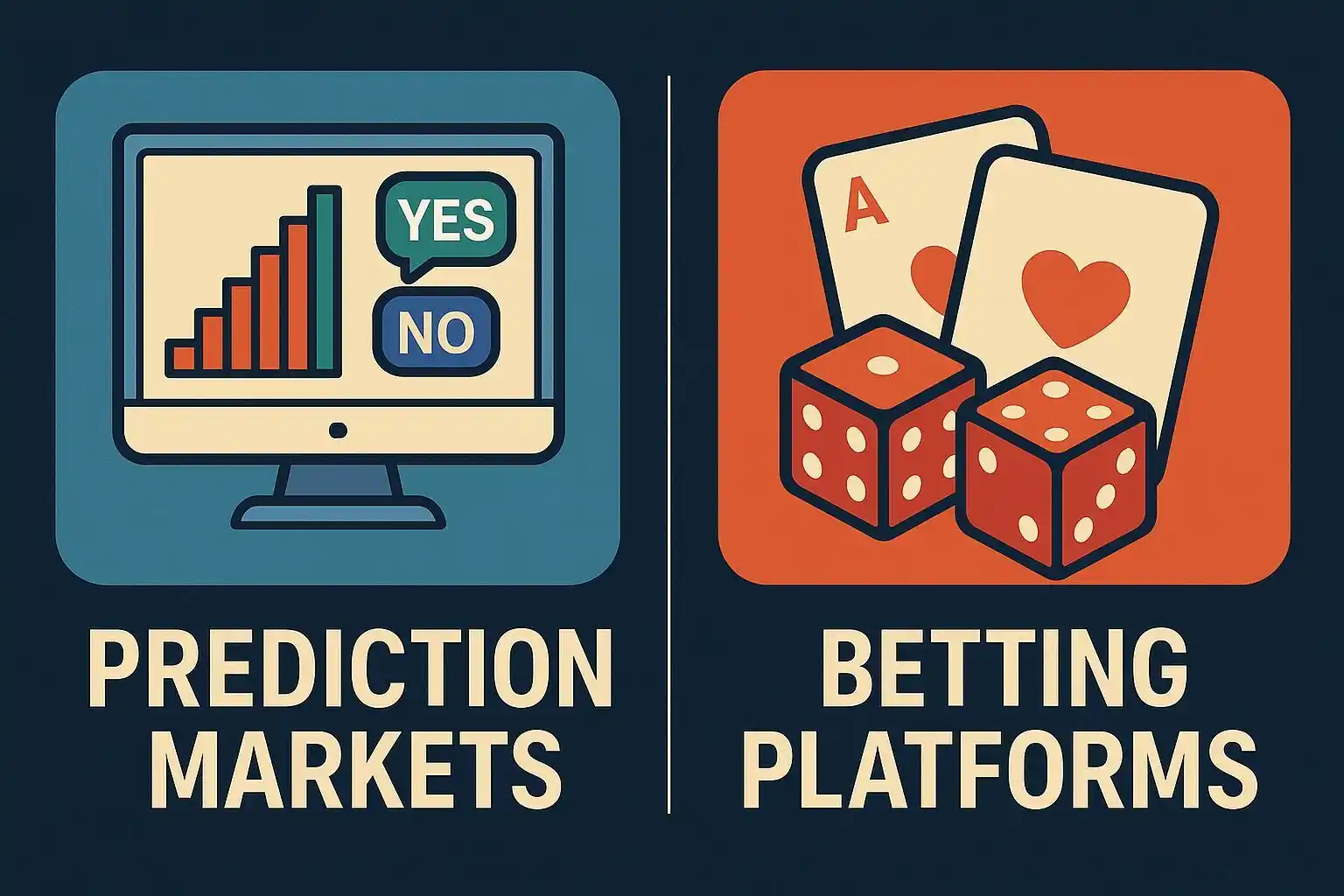
1. Different Price Formation Mechanism: Market vs Bookie
Fundamentally Different Transparency: Prediction markets have a public order book, and the data is auditable; betting odds are internally calculated and not visible, and the platform can adjust them at any time.
· Prediction Market: Prices are matched by the order book, using market-driven pricing of financial derivatives, determined by buyers and sellers. The platform does not set probabilities or bear risks, only charges transaction fees.
· Betting Platform: Odds are set by the platform, with a built-in house edge. Regardless of the event outcome, the platform typically maintains a profitable safety margin in the probability design. The platform's logic is "guaranteed long-term profit."
2. Different Use Cases: Entertainment Consumption vs Economic Significance
The real data generated by prediction markets has economic value and is used in financial decision-making for risk hedging, and may even have a reverse impact on the real world, such as media narratives, asset pricing, corporate decisions, and policy expectations.
· Prediction Market: Prediction markets can generate data products: for example, used for macro-event probability assessment, public sentiment and policy expectations, corporate risk management (weather, supply chain, regulatory events, etc.), probability references for financial institutions, research institutions, media, and even as the basis for arbitrage and hedging strategies.
The most well-known case is, of course, during the US presidential election, where many media outlets referenced Polymarket data as one of the polling references.
· Betting Platform: Purely for entertainment consumption, betting odds ≠ real probability, with no data spillover value.
3. Participant Structure: Speculative Gamblers vs Information Arbitrageurs
The liquidity of gambling is consumption, while the liquidity of prediction markets is information.
· Prediction Market: Users include data model researchers, macro traders, media and policy researchers, information arbitrageurs, high-frequency traders, institutional investors (especially in compliant markets).
This determines that prediction markets have high information density and are forward-looking (e.g., election night, pre-CPI publication). Liquidity is "active, information-driven," and participants are there for arbitrage, price discovery, and information advantage. The essence of liquidity is "informational liquidity."
· Betting Platform: Mainly for ordinary users, easy for emotional betting, and preference-driven (loss chasing / gambler fallacy), such as supporting "favorite player," betting not based on serious prediction but on emotion or entertainment.
Liquidity lacks directional value; odds will not be more accurate because of "smart money" but because of the bookmaker's algorithm adjustments. It does not lead to price discovery; the betting market is not for discovering the true probability but for balancing the bookmaker's risk, essentially "entertainment consumption liquidity."
4. Regulatory Logic: Financial Derivatives vs Regional Betting Industry
· Prediction Market: Kalshi is recognized by the CFTC in the U.S. as an Event Market Exchange (DCM). Financial regulation focuses on market manipulation, information transparency, risk exposure, and prediction markets follow financial product taxation. At the same time, prediction markets, like cryptocurrency exchanges, are naturally global.
· Betting Platform: Betting falls under state gambling regulatory bodies, with gambling regulation focusing on consumer protection, gambling addiction, and creating local tax revenue. Gambling needs to pay gambling tax and state tax. Gambling is strictly limited by a regional licensing system, operating as a regionalized business.
II. The Most Easily "Appear Similar" Example: Sports Prediction
Many articles discussing the difference between prediction and gambling always focus on examples with social attributes such as predicting political trends, macro data, and so on, which are completely different from betting platforms, and easy for everyone to understand.
However, in this article, I want to give an example that is most easily criticized, which is the "sports prediction" mentioned at the beginning. In the eyes of many sports fans, the prediction market and betting platform do not seem different in this part.
But in reality, the contract structures of the two are different.
The current prediction market consists of YES/NO binary contracts, such as:
Will the Lakers win the championship this season? (Yes/No)
Will the Warriors win 45 or more games in the regular season? (Yes/No)
Or is it a range contracts:
Is the player's score>30? (Yes/No)
Essentially, it is a standardized YES/NO, where each binary financial contract is an independent market with a limited structure.
On a betting platform, contracts can be infinitely subdivided, or even customized, such as:
For example, specific scores, first half vs. full game, how many free throws a player will attempt, total three-pointers, parlay bets, custom parlays, point spread, over/under, odd/even, player props, corner kicks, fouls committed, red/yellow cards, injury time, live betting (real-time minute-by-minute odds)...
Not only is it infinitely complex, but it is also a highly fragmented event tree, essentially an infinitely parameterized granular event modeling.
Therefore, even in seemingly similar subjects, the differences in mechanisms lead to the four major structural differences we discussed earlier.
In sports events, the nature of the prediction market remains an order book, formed by buyers and sellers, market-driven, essentially resembling an options market. Settlement rules rely solely on official statistics.
On a betting platform, odds are always set/adjusted by the house, with a built-in house edge, aiming to "balance risk and ensure house profits." Settlements involve interpreting odds, with odds having a degree of ambiguity, and even across fragmented events, results may vary across platforms.
III. The Ultimate Question: A Power Redistribution Issue Regarding Regulation
The reason why capital rapidly bets billions of dollars on the prediction market is not complicated: it is not interested in "speculative narratives" but in a globally undefined event derivative market that has not yet been formally regulated—a new asset class that has the potential to stand alongside futures and options.
What hampers this market is an outdated and vague historical issue: whether the prediction market should be considered a financial tool or gambling?
Until this distinction is clear, the market cannot thrive.
Regulatory attribution determines industry scale, an old Wall Street logic that is now being applied to this new track.
The ceiling for gambling is at the state level, which means fragmented regulation, heavy tax burdens, inconsistent compliance, and exclusion of institutional funds. Its growth trajectory is inherently limited.
The ceiling for prediction markets is at the federal level. Once incorporated into the derivatives framework, it can leverage all the infrastructure of futures and options: globally accessible, scalable, indexable, institutionalizable.
At that point, it is no longer just a "prediction tool" but a full set of tradable event risk curves.
This is also why Polymarket's growth signal is so sensitive. Between 2024 and 2025, its monthly trading volume has repeatedly exceeded $20-30 billion, with sports contracts becoming one of the core growth drivers. This is not about "eating into the gambling market" but directly competing for user attention with traditional sportsbooks—and in the financial markets, attention shifts are often a prelude to scale shifts.
State regulatory agencies are extremely resistant to having prediction markets placed under federal regulation because it signifies two things happening simultaneously: gambling users being drawn away and the state government's gambling tax base being directly usurped by the federal government. This is not just a market issue but a fiscal one.
Once the prediction market falls under the CFTC/SEC, state governments not only lose regulatory power but also lose one of the "easiest to levy, most stable" local taxes.
Recently, this game has become public, with the Southern District of New York Court accepting a class-action lawsuit alleging that Kalshi sold sports contracts without obtaining any state gambling licenses and questioning its market-making structure that "essentially pits users against the house". Just days ago, the Nevada Gaming Control Board also stated that Kalshi's sports "event contracts" are essentially unlicensed gambling products and should not enjoy CFTC regulatory protection. Federal Judge Andrew Gordon even bluntly stated during a hearing, "No one would have thought that sports betting was a financial product before Kalshi appeared."
This is not a product dispute; it is a conflict of regulatory authority and fiscal interests and a struggle for pricing power.
For capital, the issue at hand is not whether the prediction market can grow; it is whether it will be allowed to grow to what extent.
Original Article Link
You may also like
AI Trading's Ultimate Test: Empower Your AI Strategy with Tencent Cloud to Win $1.88M & a Bentley
AI traders! Win $1.88M & a Bentley by crushing WEEX's live-market challenge. Tencent Cloud powers your AI Trading bot - can it survive the Feb 9 finals?

Russia’s Largest Bitcoin Miner BitRiver Faces Bankruptcy Crisis – What Went Wrong?
Key Takeaways BitRiver, the largest Bitcoin mining operator in Russia, faces a bankruptcy crisis due to unresolved debts…

Polymarket Predicts Over 70% Chance Bitcoin Will Drop Below $65K
Key Takeaways Polymarket bettors forecast a 71% chance for Bitcoin to fall below $65,000 by 2026. Strong bearish…

BitMine Reports 4.285M ETH Holdings, Expands Staked Position With Massive Reward Outlook
Key Takeaways BitMine Immersion Technologies holds 4,285,125 ETH, which is approximately 3.55% of Ethereum’s total supply. The company…

US Liquidity Crisis Sparked $250B Crash, Not a ‘Broken’ Crypto Market: Analyst
Key Takeaways: A massive $250 billion crash shook the cryptocurrency markets, attributed largely to liquidity issues in the…

Vitalik Advocates for Anonymous Voting in Ethereum’s Governance — A Solution to Attacks?
Key Takeaways Vitalik Buterin proposes a two-layer governance framework utilizing anonymous voting to address collusion and capture attacks,…

South Korea Utilizes AI to Pursue Unfair Crypto Trading: Offenders Face Severe Penalties
Key Takeaways South Korea is intensifying its use of AI to crack down on unfair cryptocurrency trading practices.…

Average Bitcoin ETF Investor Turns Underwater After Major Outflows
Key Takeaways: U.S. spot Bitcoin ETFs hold approximately $113 billion in assets, equivalent to around 1.28 million BTC.…

Japan’s Biggest Wealth Manager Adjusts Crypto Strategy After Q3 Setbacks
Key Takeaways Nomura Holdings, Japan’s leading wealth management firm, scales back its crypto involvement following significant third-quarter losses.…
CFTC Regulatory Shift Could Unlock New Opportunities for Coinbase Prediction Markets
Key Takeaways: The U.S. Commodity Futures Trading Commission (CFTC) is focusing on clearer regulations for crypto-linked prediction markets,…
Hong Kong Set to Approve First Stablecoin Licenses in March — Who’s In?
Key Takeaways Hong Kong’s financial regulator, the Hong Kong Monetary Authority (HKMA), is on the verge of approving…

BitRiver Founder and CEO Igor Runets Detained Over Tax Evasion Charges
Key Takeaways: Russian authorities have detained Igor Runets, CEO of BitRiver, on allegations of tax evasion. Runets is…

Crypto Investment Products Struggle with $1.7B Outflows Amid Market Turmoil
Key Takeaways: The recent $1.7 billion outflow in the crypto investment sector represents a second consecutive week of…

Why Is Crypto Down Today? – February 2, 2026
Key Takeaways: The crypto market has seen a downturn today, with a significant decrease of 2.9% in the…

Nevada Court Temporarily Bars Polymarket From Offering Contracts in the State
Key Takeaways A Nevada state court has temporarily restrained Polymarket from offering event contracts in the state, citing…

Bitcoin Falls Below $80K As Warsh Named Fed Chair, Triggers $2.5B Liquidation
Key Takeaways Bitcoin’s price tumbled below the crucial $80,000 mark following the announcement of Kevin Warsh as the…

Strategy’s Bitcoin Holdings Face $900M in Losses as BTC Slips Below $76K
Key Takeaways Strategy Inc., led by Michael Saylor, faces over $900 million in unrealized losses as Bitcoin price…
Trump-Linked Crypto Company Secures $500M UAE Investment, Sparking Conflict Concerns
Key Takeaways A Trump-affiliated crypto company, World Liberty Financial, has garnered $500 million from UAE investors, igniting conflict…
AI Trading's Ultimate Test: Empower Your AI Strategy with Tencent Cloud to Win $1.88M & a Bentley
AI traders! Win $1.88M & a Bentley by crushing WEEX's live-market challenge. Tencent Cloud powers your AI Trading bot - can it survive the Feb 9 finals?
Russia’s Largest Bitcoin Miner BitRiver Faces Bankruptcy Crisis – What Went Wrong?
Key Takeaways BitRiver, the largest Bitcoin mining operator in Russia, faces a bankruptcy crisis due to unresolved debts…
Polymarket Predicts Over 70% Chance Bitcoin Will Drop Below $65K
Key Takeaways Polymarket bettors forecast a 71% chance for Bitcoin to fall below $65,000 by 2026. Strong bearish…
BitMine Reports 4.285M ETH Holdings, Expands Staked Position With Massive Reward Outlook
Key Takeaways BitMine Immersion Technologies holds 4,285,125 ETH, which is approximately 3.55% of Ethereum’s total supply. The company…
US Liquidity Crisis Sparked $250B Crash, Not a ‘Broken’ Crypto Market: Analyst
Key Takeaways: A massive $250 billion crash shook the cryptocurrency markets, attributed largely to liquidity issues in the…
Vitalik Advocates for Anonymous Voting in Ethereum’s Governance — A Solution to Attacks?
Key Takeaways Vitalik Buterin proposes a two-layer governance framework utilizing anonymous voting to address collusion and capture attacks,…


 App
App