
- Buy Crypto
- Markets
 Futures
- Spot
- Copy Trade
 Earn
Earn- More
What is Long-Termism? The Old Cat and His Never-Sell Philosophy

Article Source: OKX
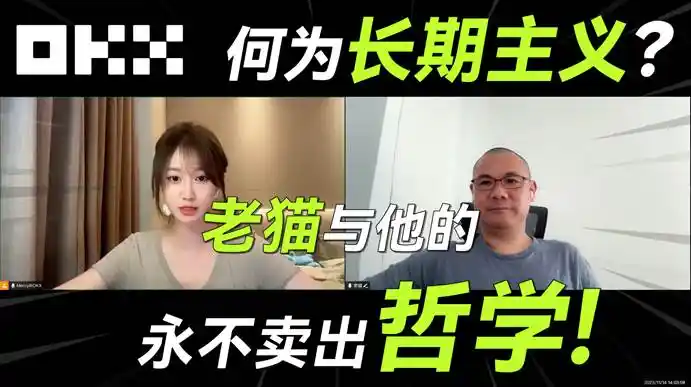
In the ever-changing world of crypto, some chase trends, some chant slogans, while others choose to become followers of time. Old Cat is such a legendary figure.
As one of the earliest evangelists in the industry, he has traversed through four market cycles, from being an early core member of a trading platform, to a keen venture capitalist, and now once again diving back in to become a product founder. His journey is itself a condensed history of the industry.
In this in-depth conversation in the latest edition of "OKX Friends," we had the privilege of engaging in a discussion lasting an hour and a half with this "veteran OG." With his usual clarity and frankness, he shared his profound insights on market cycles, asset value, life philosophy, and even personal well-being without reservation.
Why does he assert that "Bitcoin's four-year cycle is dead"? And why does he liken Bitcoin to the "English of the digital world"? What decade-long emotional journey lies behind his creation of the new product "Anchor"? Most importantly, what kind of trading endgame thinking is implied by his unconventional statement, "Buying Bitcoin is the true profit realization"?
This is not just an interview, but also a "masterclass" on investment, risk, and life. The purpose of this article is not to recount all the details but to attempt to answer a more difficult question:
After going through four market cycles, why would a person turn "never sell" into a worldview? And what does "long-termism" truly mean to him?
Here is the OKX Friends interview series, with this edition featuring Old Cat @Imlaomao as the guest, interviewed by Mercy @Mercy_okx.
Part One: The Core of Investment — Starting from a Life-or-Death Surgery
Key Quote: "I believe in 'forewarned is forearmed.' The surgery was done to mitigate long-term risks, which aligns with my investment long-termism. My strategy of long-term holding is essentially to filter out potential errors in my short-term actions during volatility, simplifying my entire investment structure."
Mercy: Hello Cat, I understand that you once underwent a major neck surgery and have since shared more insights about life. Is there a connection between this discipline towards your body and life and the 'long-term holding' strategy that you have always emphasized?
Lao Mao: The surgery was just a minor episode in my life experience, although it felt like a huge deal at the time.
My surgery involved opening up the back of my neck to insert five titanium alloy segments, with a risk level comparable to that of a coronary artery bypass.
At that time, I considered many scenarios and even made arrangements for my affairs because life is unpredictable. However, I still decided to go through with the surgery because if I didn't, my future life would be in a very fragile state, with low quality of life and immense mental pressure, which was unacceptable to my inherently optimistic nature.
I chose to endure the immediate risks of the surgery to avoid the long-term, greater risks in the future. This reflects the saying I believe in:
“He who is not farsighted must suffer nearsightedness.” Rather than facing risks in the future, it's better to eliminate them in advance. This aligns perfectly with my investment philosophy.
My approach of "hodling for the long term" is essentially about filtering out the risk of making mistakes due to frequent trading amidst short-term fluctuations. Think about it, with long-term holding, you just need to make one right choice—picking the right asset. Whereas, with day trading, you need to make constant decisions. Which one is simpler? I, of course, choose the simplest option.
Therefore, whether it's the decision to undergo surgery or my investment philosophy, they both stem from the unified core logic within me: simplify and focus on the long term.
Mercy: From trading platforms to venture capital, and now founding your own product. How did you develop this cross-disciplinary, essence-grabbing thinking framework?
Lao Mao: You're giving me too much credit. In fact, everyone's choices are naturally led by their circumstances.
There's a saying that goes, everyone lives the life they most want to because every choice is their own. I have always believed that success requires fundamental core thinking, combined with a bit of luck. I never shy away from acknowledging luck; I've always felt blessed by luck.
How do you verify if someone has relied on luck? It's simple, do a thought experiment: put yourself in the position one step back, with your current state and knowledge, could you still reach where you are today?
If it feels precarious, then most of it is luck.
Of course, luck alone is not enough; hard work is a necessity. During the busiest years at Yunbi (2014-2017), working until three or four in the morning every day was the norm for me. There were times when work would finish at two, and I still felt unsatisfied, so I would write another article for the public account. Therefore, you must do what you need to do, face challenges, and then calmly accept the arrangement of fate.
2. The Death of Cycles, Fiatization of Fiat? - Redefining the Macro Narrative
Key Takeaway: "What is driving Bitcoin's rise is not just the dollar, but the gradual entry of funds from around the world, or more bluntly put, it is the global process of fiat 'fiatization'. As long as its value is not invalidated, the long-term upward trend is very certain."
Mercy: Arthur Hayes believes that Bitcoin's four-year halving cycle is dead, and future cycles will be determined by dollar liquidity. What is your view on this perspective?
Old Cat: I agree with the point of "the end of cycle theory." I have also written articles myself, believing that this cycle will not continue.
The fundamental reason is that the supply-demand relationship has undergone a fundamental change. Why was it a four-year cycle before? Because Bitcoin's supply (output) halved every four years, and under unchanged or increasing demand, the price naturally rose.
However, now, after multiple halvings, the daily new output of Bitcoin is already negligible in the face of the vast global funds.
So, what is currently driving the rise in Bitcoin price, I believe, is not just the dollar, but the gradual entry of various global funds.
More bluntly put, it is the global process of fiat 'fiatization'.
This process will cause people seeking asset preservation to gradually participate. Of course, the process will definitely have fluctuations, smart money will come in first, make money, sell to less smart money, Wall Street will then enter...
But as long as Bitcoin's user base and consensus steadily grow exponentially, as long as its core value is not invalidated, then the long-term upward trend is something I am very confident in.
Mercy: You mentioned the 'collapse of the fiat currency system,' do you think this will happen within ten years? What does it mean for the crypto industry?
Old Cat: Predicting the next ten years is too difficult, I don't think fiat will completely disappear within ten years. But the 'fiat collapse' is not in the future tense, it is in the present tense.
This process has been ongoing since the collapse of the Bretton Woods system in 1971 and has been ongoing.
If you look at the curve of currency issuance in various countries, you will know that the value of fiat currency has always been depreciating. This is fundamentally a form of structural asset transfer, transferring assets from ordinary people who have no asset concept to a few through inflation.
This process is happening in every country, just at different rates of "debasement."
During my time in Australia, the price of a cup of coffee has increased from 3 AUD to 5 or 6 AUD, doubling. Therefore, I firmly hold cryptocurrency because I see it as an opportunity to hedge against fiat devaluation.
As for when fiat will "completely" collapse, we can't control that, we just need to know that it is happening.
Mercy: A newbie question, why can cryptocurrency (such as Bitcoin) fight against inflation and not devalue like fiat?
OldCat: This question is quite complex, I will provide a brief answer here.
Firstly, it is incorrect to say that "cryptocurrency" does not devalue. Apart from Bitcoin, the issuance of thousands of other coins is, in itself, a form of inflation.
However, Bitcoin, due to its Satoshi-designed fixed total supply and deflationary model, along with the strong consensus developed over more than a decade, gives it the ability to resist fiat inflation.
Perhaps this was initially just a utopian idea, but it has now become a reality.
If I were to deposit $10 million in a bank right now, I would be anxious because I know that its actual purchasing power might only be worth $9.5 million next year, $9 million the year after, even though the number hasn't changed.
But if I switch to Bitcoin, its inherent appreciation becomes an effective way to hedge against fiat devaluation. So, it's not that cryptocurrency will not devalue, but Bitcoin, as the asset with the strongest consensus already formed, has a powerful function to resist inflation.
III. Bitcoin: The "English" of the Digital World
Key Takeaway: "Bitcoin is the English of digital currencies. The likelihood of it being replaced will only decrease over time. Therefore, I will not heavily hold other varieties."
Mercy: In comparison to traditional assets like real estate and stocks, how is Bitcoin different in essence, performance, and risk?
OldCat: If you look at the data from the past decade, the answer is clear. Bitcoin's price surge leaves everything else in the dust, surpassing the vast majority of all asset classes we can access. Of course, saying this is unfair to other assets, because I am a HODLER of over a decade.
The biggest risk of Bitcoin is actually its key feature — volatility.
It is this huge volatility that has led numerous people trying to "get rich quick" through leverage to get wiped out, even with leverage as low as two or three times.
Many early holders of four-digit Bitcoin that I know can't access any of it now because of playing with leverage.
There is also a hidden risk that I call the "fear of missing out risk."
Many people put their Bitcoin into a cold wallet, but they can't stand that "missing out" feeling. They always want to use it for collateral to earn some interest or participate in some financial project.
As a result, they end up losing everything, and then they show up in various rights protection groups. You already hold the asset with the highest price increase in the past decade, why would you want to take these unnecessary risks?
So, for ordinary traders, there are truly two main risks: first, you chose a bunch of crypto assets but ultimately did not choose Bitcoin; second, you simply never held any Bitcoin. Everything else is just a passing cloud in the long run.
Mercy: You are known as a "Bitcoin maximalist." How do you define Bitcoin's value?
OldCat: I dare not easily wear that hat because I've also been around the block, once very optimistic about blockchain technology, but reality has "educated" me many times, costing me a lot of tuition fees, and eventually I completely gave up on those "what ifs."
It's hard for me to come up with a new perspective on the value of Bitcoin now because there are more articulate people than me.
But I have an inappropriate metaphor in my heart that I can share: English is currently the world's main lingua franca, right? It's an extremely powerful consensus. It's hard to imagine another language replacing it in the next few decades. Bitcoin is the "English" of the digital currency world.
The likelihood of it being replaced by other species will only decrease over time, not increase. That's why I fundamentally won't hold a large position in other species.
IV. Altcoins and the "Experiment" of DeFi
Key Quote: "What is the value of altcoins? They are all already altcoins. You can wear knockoff shoes for a while, but what can you do with knockoff coins? Except for Bitcoin and stablecoins, if all others disappeared overnight, the world would operate normally without any issues."
Mercy: How do you view the recent market's significant fluctuations and the idea of "altcoins going to zero"?
Old Cat: I think that statement is spot on. Market makers coming to this market are not here for charity; they are here to make money. Once a one-way market appears, they will shut down their bots and run to avoid their own risks, with no moral qualms. A market that relies on market makers to maintain liquidity is inherently unhealthy. This recent crash is fundamentally the market squeezing out the bubble.
The only purpose of meme coins is to allow some capable individuals to make money through their intense volatility, then convert the profits into stablecoins, fiat currency, or bitcoin to grow their wealth. But if you ask about their core value? They are all called "meme" for a reason. I have a wallet from years ago when I participated in various projects. When I opened it recently, I didn't recognize most of the coins in it, and the assets were basically worthless.
Therefore, Occam's razor principle applies here as well: Entities should not be multiplied unnecessarily. Except for Bitcoin and stablecoins, if all other crypto assets were to disappear overnight, the real-world would have no issues.
Mercy: Do you consider DeFi to be financial innovation?
Old Cat: I still consider these to be "experiments" so far. They essentially replicate established plays from the traditional financial world on-chain through code and relationships, such as asset collateralization and interest-bearing loans.
However, the issue lies in the fact that many underlying assets in the DeFi world are artificially created tokens lacking solid value support. This makes its foundation far less robust than traditional finance.
So, we see constant problems in the DeFi space: one moment a project exits scams, another moment a protocol is attacked, and yet another moment there is a liquidation. While everyone is having a blast, smart individuals can make money, much like a grand opening sale at a mall where early birds grab eggs, latecomers get laundry detergent, but most people end up just consuming. Personally, I don't participate and choose to continue observing.
Chapter Five: Anchcertainty -- A product I've been contemplating for ten years, a reassuring trust
Key Quote: "I already have some assets, but there are times when I cannot take care of my family properly, and I dare not think of the consequences. I hope for a tool that is reasonably priced but can truly help me solve this problem in case of emergencies."
Mercy: I'm curious, why did you create 'Anchcertainty'?
Old Cat: I had this idea ten years ago.
At that time, I had just started to have some assets, but my work was very busy, flying more than 50 times a year. Every time the plane took off, I was thinking, in case of a slight possibility, my assets, my family would never find them.
I am someone who has a strong desire for independent asset management and does not want my family to intervene too early. However, on the other hand, if my accident were to cause them to fall into dire straits, I would not be able to accept this consequence at all.
At that time, I was thinking, is there a mechanism that could solve this dilemma? High-end family trusts could, but the threshold is too high, often in the hundreds of millions of dollars, and very expensive.
I needed a tool that was affordable, accessible to ordinary people, and could effectively address this "what-if" scenario. This is the original intention of creating "Anqu."
Mercy: How does "Anqu" solve this problem? Who is its target user?
OldCat: Its core is an "Important Clue Intelligent Delivery" feature. Users can set an interaction cycle with the software (e.g., 30 days). If there is no interaction for a long time, our platform will contact you via SMS, email, or even a phone call to confirm your status.
Once, after all efforts, it is still confirmed that you are in a disconnected state, the system will, after your preset cooling-off period (e.g., 180 days), send a pre-prepared encrypted clue package to your designated recipient.
What's even better is that the password for this clue package can be in the form of a "zero-knowledge proof." For example, you can prompt the recipient that the password is the last four digits of "your mother's passport" plus "your family pet's name." Only you and the recipient know this information, which our platform cannot know. This perfectly balances the independent management of assets and the ultimate protection of family.
Its target users are people like me: with some assets, wishing for independent management but having a strong sense of responsibility towards family, willing to spend $100 a year, for a "hidden insurance" for ordinary investors.
Six, Asset Endgame: A Never-Sell Person
Key Takeaway: "I have always had an obsession: if my external world money is deemed useless, the moment I buy Bitcoin is the true 'profit-taking' — gaining from the real world and buying Bitcoin as the conclusion. I haven't learned how to sell, I really don't know how to sell."
Mercy: MicroStrategy's strategy is "only buy, never sell," which is very similar to you. Have you considered selling Bitcoin to "take profits"?
Old Cat: He is actually many years older than me. The following words may not sound like human language to newcomers, but I must tell the truth: I have never considered the so-called "profit-taking". To me, this concept does not exist.
I have indeed sold some Bitcoin, to buy a house, to cover family living expenses in different places.
But at this moment, I don't even have 1 U of a stablecoin in the crypto world.
I have always had an obsession, that is, when I have fiat currency in the real world and feel like I have nowhere to spend it, the moment I use it to buy Bitcoin is when the true "profit-taking" occurs. It is profiting from the real world, buying Bitcoin as the conclusion of that transaction.
Others say I am greedy, holding onto such cheap chips and not selling. I don't mind. I still think Bitcoin is too cheap right now. I have given up the thrill of volatility, leverage, and buying low and selling high because I genuinely understand that the collapse of the fiat world will continue.
So, I really haven't learned how to sell, and I don't know how to sell. As long as my existing fiat is enough, I won't sell.
Chapter 7: The Next Ten Years: Two Tracks, One Principle
Mercy: Looking ahead 5-10 years, which track would you choose to invest in?
Old Cat: I choose two tracks: AI and Crypto. And my choice is very simple, within AI, I only invest in Tesla, and within Crypto, I only invest in Bitcoin.
These are both assets that I will hold for over ten years. Tesla is the only company that integrates AI with the real world and has a unique industrial production capacity, and its vision is unparalleled. The Tesla I drive was given as Tesla stock (laughs).
Mercy: What advice do you have for young people?
Old Cat: I have only one piece of advice for young people, as I have also gone through this: Please be sure to understand clearly that the crypto industry is actually in a continuous process of falsifiability.
Many things that may seem right now could be proven wrong and end up worthless after some time. There are opportunities in this process, but the risks are greater.
So, never bet everything on one thing, always give yourself a chance to start over.
Over the years, I have been able to come this far because I have always deliberately been conservative and very, very restrained in my desires.
8. About OKX: A Steadfast Long-Termist
Mercy: What is your impression of OKX? How do you view OKX as a company?
Old Cat: I have previously voiced some opinions on Twitter about some minor issues, but later I found that OKX really made significant efforts to address those issues. I think OKX is a company that leans towards prudence and a technical roadmap. You are working on compliance, and you have even obtained licenses in many places. It is a company with a long-term view.
Disclaimer:
This article is for reference only. This article represents the author's views and not those of OKX. This article is not intended to provide (i) investment advice or investment recommendations; (ii) an offer or solicitation of an offer to buy, sell, or hold digital assets; or (iii) financial, accounting, legal, or tax advice. We do not guarantee the accuracy, completeness, or usefulness of such information. Holding digital assets (including stablecoins and NFTs) involves high risks and may experience significant fluctuations. Past performance is not indicative of future results, and historical returns do not represent future returns. You should carefully consider whether trading or holding digital assets is suitable for your financial situation. For your specific circumstances, please consult your legal/tax/investment professional. You are responsible for understanding and complying with local applicable laws and regulations.
This article is a contribution and does not represent the views of BlockBeats.
You may also like

Token Cannot Compound, Where Is the Real Investment Opportunity?

February 6th Market Key Intelligence, How Much Did You Miss?

China's Central Bank and Eight Other Departments' Latest Regulatory Focus: Key Attention to RWA Tokenized Asset Risk
Foreword: Today, the People's Bank of China's website published the "Notice of the People's Bank of China, National Development and Reform Commission, Ministry of Industry and Information Technology, Ministry of Public Security, State Administration for Market Regulation, China Banking and Insurance Regulatory Commission, China Securities Regulatory Commission, State Administration of Foreign Exchange on Further Preventing and Dealing with Risks Related to Virtual Currency and Others (Yinfa [2026] No. 42)", the latest regulatory requirements from the eight departments including the central bank, which are basically consistent with the regulatory requirements of recent years. The main focus of the regulation is on speculative activities such as virtual currency trading, exchanges, ICOs, overseas platform services, and this time, regulatory oversight of RWA has been added, explicitly prohibiting RWA tokenization, stablecoins (especially those pegged to the RMB). The following is the full text:
To the people's governments of all provinces, autonomous regions, and municipalities directly under the Central Government, the Xinjiang Production and Construction Corps:
Recently, there have been speculative activities related to virtual currency and Real-World Assets (RWA) tokenization, disrupting the economic and financial order and jeopardizing the property security of the people. In order to further prevent and address the risks related to virtual currency and Real-World Assets tokenization, effectively safeguard national security and social stability, in accordance with the "Law of the People's Republic of China on the People's Bank of China," "Law of the People's Republic of China on Commercial Banks," "Securities Law of the People's Republic of China," "Law of the People's Republic of China on Securities Investment Funds," "Law of the People's Republic of China on Futures and Derivatives," "Cybersecurity Law of the People's Republic of China," "Regulations of the People's Republic of China on the Administration of Renminbi," "Regulations on Prevention and Disposal of Illegal Fundraising," "Regulations of the People's Republic of China on Foreign Exchange Administration," "Telecommunications Regulations of the People's Republic of China," and other provisions, after reaching consensus with the Cyberspace Administration of China, the Supreme People's Court, and the Supreme People's Procuratorate, and with the approval of the State Council, the relevant matters are notified as follows:
(I) Virtual currency does not possess the legal status equivalent to fiat currency. Virtual currencies such as Bitcoin, Ether, Tether, etc., have the main characteristics of being issued by non-monetary authorities, using encryption technology and distributed ledger or similar technology, existing in digital form, etc. They do not have legal tender status, should not and cannot be circulated and used as currency in the market.
The business activities related to virtual currency are classified as illegal financial activities. The exchange of fiat currency and virtual currency within the territory, exchange of virtual currencies, acting as a central counterparty in buying and selling virtual currencies, providing information intermediary and pricing services for virtual currency transactions, token issuance financing, and trading of virtual currency-related financial products, etc., fall under illegal financial activities, such as suspected illegal issuance of token vouchers, unauthorized public issuance of securities, illegal operation of securities and futures business, illegal fundraising, etc., are strictly prohibited across the board and resolutely banned in accordance with the law. Overseas entities and individuals are not allowed to provide virtual currency-related services to domestic entities in any form.
A stablecoin pegged to a fiat currency indirectly fulfills some functions of the fiat currency in circulation. Without the consent of relevant authorities in accordance with the law and regulations, any domestic or foreign entity or individual is not allowed to issue a RMB-pegged stablecoin overseas.
(II)Tokenization of Real-World Assets refers to the use of encryption technology and distributed ledger or similar technologies to transform ownership rights, income rights, etc., of assets into tokens (tokens) or other interests or bond certificates with token (token) characteristics, and carry out issuance and trading activities.
Engaging in the tokenization of real-world assets domestically, as well as providing related intermediary, information technology services, etc., which are suspected of illegal issuance of token vouchers, unauthorized public offering of securities, illegal operation of securities and futures business, illegal fundraising, and other illegal financial activities, shall be prohibited; except for relevant business activities carried out with the approval of the competent authorities in accordance with the law and regulations and relying on specific financial infrastructures. Overseas entities and individuals are not allowed to illegally provide services related to the tokenization of real-world assets to domestic entities in any form.
(III) Inter-agency Coordination. The People's Bank of China, together with the National Development and Reform Commission, the Ministry of Industry and Information Technology, the Ministry of Public Security, the State Administration for Market Regulation, the China Banking and Insurance Regulatory Commission, the China Securities Regulatory Commission, the State Administration of Foreign Exchange, and other departments, will improve the work mechanism, strengthen coordination with the Cyberspace Administration of China, the Supreme People's Court, and the Supreme People's Procuratorate, coordinate efforts, and overall guide regions to carry out risk prevention and disposal of virtual currency-related illegal financial activities.
The China Securities Regulatory Commission, together with the National Development and Reform Commission, the Ministry of Industry and Information Technology, the Ministry of Public Security, the People's Bank of China, the State Administration for Market Regulation, the China Banking and Insurance Regulatory Commission, the State Administration of Foreign Exchange, and other departments, will improve the work mechanism, strengthen coordination with the Cyberspace Administration of China, the Supreme People's Court, and the Supreme People's Procuratorate, coordinate efforts, and overall guide regions to carry out risk prevention and disposal of illegal financial activities related to the tokenization of real-world assets.
(IV) Strengthening Local Implementation. The people's governments at the provincial level are overall responsible for the prevention and disposal of risks related to virtual currencies and the tokenization of real-world assets in their respective administrative regions. The specific leading department is the local financial regulatory department, with participation from branches and dispatched institutions of the State Council's financial regulatory department, telecommunications regulators, public security, market supervision, and other departments, in coordination with cyberspace departments, courts, and procuratorates, to improve the normalization of the work mechanism, effectively connect with the relevant work mechanisms of central departments, form a cooperative and coordinated working pattern between central and local governments, effectively prevent and properly handle risks related to virtual currencies and the tokenization of real-world assets, and maintain economic and financial order and social stability.
(5) Enhanced Risk Monitoring. The People's Bank of China, China Securities Regulatory Commission, National Development and Reform Commission, Ministry of Industry and Information Technology, Ministry of Public Security, State Administration of Foreign Exchange, Cyberspace Administration of China, and other departments continue to improve monitoring techniques and system support, enhance cross-departmental data analysis and sharing, establish sound information sharing and cross-validation mechanisms, promptly grasp the risk situation of activities related to virtual currency and real-world asset tokenization. Local governments at all levels give full play to the role of local monitoring and early warning mechanisms. Local financial regulatory authorities, together with branches and agencies of the State Council's financial regulatory authorities, as well as departments of cyberspace and public security, ensure effective connection between online monitoring, offline investigation, and fund tracking, efficiently and accurately identify activities related to virtual currency and real-world asset tokenization, promptly share risk information, improve early warning information dissemination, verification, and rapid response mechanisms.
(6) Strengthened Oversight of Financial Institutions, Intermediaries, and Technology Service Providers. Financial institutions (including non-bank payment institutions) are prohibited from providing account opening, fund transfer, and clearing services for virtual currency-related business activities, issuing and selling financial products related to virtual currency, including virtual currency and related financial products in the scope of collateral, conducting insurance business related to virtual currency, or including virtual currency in the scope of insurance liability. Financial institutions (including non-bank payment institutions) are prohibited from providing custody, clearing, and settlement services for unauthorized real-world asset tokenization-related business and related financial products. Relevant intermediary institutions and information technology service providers are prohibited from providing intermediary, technical, or other services for unauthorized real-world asset tokenization-related businesses and related financial products.
(7) Enhanced Management of Internet Information Content and Access. Internet enterprises are prohibited from providing online business venues, commercial displays, marketing, advertising, or paid traffic diversion services for virtual currency and real-world asset tokenization-related business activities. Upon discovering clues of illegal activities, they should promptly report to relevant departments and provide technical support and assistance for related investigations and inquiries. Based on the clues transferred by the financial regulatory authorities, the cyberspace administration, telecommunications authorities, and public security departments should promptly close and deal with websites, mobile applications (including mini-programs), and public accounts engaged in virtual currency and real-world asset tokenization-related business activities in accordance with the law.
(8) Strengthened Entity Registration and Advertisement Management. Market supervision departments strengthen entity registration and management, and enterprise and individual business registrations must not contain terms such as "virtual currency," "virtual asset," "cryptocurrency," "crypto asset," "stablecoin," "real-world asset tokenization," or "RWA" in their names or business scopes. Market supervision departments, together with financial regulatory authorities, legally enhance the supervision of advertisements related to virtual currency and real-world asset tokenization, promptly investigating and handling relevant illegal advertisements.
(IX) Continued Rectification of Virtual Currency Mining Activities. The National Development and Reform Commission, together with relevant departments, strictly controls virtual currency mining activities, continuously promotes the rectification of virtual currency mining activities. The people's governments of various provinces take overall responsibility for the rectification of "mining" within their respective administrative regions. In accordance with the requirements of the National Development and Reform Commission and other departments in the "Notice on the Rectification of Virtual Currency Mining Activities" (NDRC Energy-saving Building [2021] No. 1283) and the provisions of the "Guidance Catalog for Industrial Structure Adjustment (2024 Edition)," a comprehensive review, investigation, and closure of existing virtual currency mining projects are conducted, new mining projects are strictly prohibited, and mining machine production enterprises are strictly prohibited from providing mining machine sales and other services within the country.
(X) Severe Crackdown on Related Illegal Financial Activities. Upon discovering clues to illegal financial activities related to virtual currency and the tokenization of real-world assets, local financial regulatory authorities, branches of the State Council's financial regulatory authorities, and other relevant departments promptly investigate, determine, and properly handle the issues in accordance with the law, and seriously hold the relevant entities and individuals legally responsible. Those suspected of crimes are transferred to the judicial authorities for processing according to the law.
(XI) Severe Crackdown on Related Illegal and Criminal Activities. The Ministry of Public Security, the People's Bank of China, the State Administration for Market Regulation, the China Banking and Insurance Regulatory Commission, the China Securities Regulatory Commission, as well as judicial and procuratorial organs, in accordance with their respective responsibilities, rigorously crack down on illegal and criminal activities related to virtual currency, the tokenization of real-world assets, such as fraud, money laundering, illegal business operations, pyramid schemes, illegal fundraising, and other illegal and criminal activities carried out under the guise of virtual currency, the tokenization of real-world assets, etc.
(XII) Strengthen Industry Self-discipline. Relevant industry associations should enhance membership management and policy advocacy, based on their own responsibilities, advocate and urge member units to resist illegal financial activities related to virtual currency and the tokenization of real-world assets. Member units that violate regulatory policies and industry self-discipline rules are to be disciplined in accordance with relevant self-regulatory management regulations. By leveraging various industry infrastructure, conduct risk monitoring related to virtual currency, the tokenization of real-world assets, and promptly transfer issue clues to relevant departments.
(XIII) Without the approval of relevant departments in accordance with the law and regulations, domestic entities and foreign entities controlled by them may not issue virtual currency overseas.
(XIV) Domestic entities engaging directly or indirectly in overseas external debt-based tokenization of real-world assets, or conducting asset securitization activities abroad based on domestic ownership rights, income rights, etc. (hereinafter referred to as domestic equity), should be strictly regulated in accordance with the principles of "same business, same risk, same rules." The National Development and Reform Commission, the China Securities Regulatory Commission, the State Administration of Foreign Exchange, and other relevant departments regulate it according to their respective responsibilities. For other forms of overseas real-world asset tokenization activities based on domestic equity by domestic entities, the China Securities Regulatory Commission, together with relevant departments, supervise according to their division of responsibilities. Without the consent and filing of relevant departments, no unit or individual may engage in the above-mentioned business.
(15) Overseas subsidiaries and branches of domestic financial institutions providing Real World Asset Tokenization-related services overseas shall do so legally and prudently. They shall have professional personnel and systems in place to effectively mitigate business risks, strictly implement customer onboarding, suitability management, anti-money laundering requirements, and incorporate them into the domestic financial institutions' compliance and risk management system. Intermediaries and information technology service providers offering Real World Asset Tokenization services abroad based on domestic equity or conducting Real World Asset Tokenization business in the form of overseas debt for domestic entities directly or indirectly venturing abroad must strictly comply with relevant laws and regulations. They should establish and improve relevant compliance and internal control systems in accordance with relevant normative requirements, strengthen business and risk control, and report the business developments to the relevant regulatory authorities for approval or filing.
(16) Strengthen organizational leadership and overall coordination. All departments and regions should attach great importance to the prevention of risks related to virtual currencies and Real World Asset Tokenization, strengthen organizational leadership, clarify work responsibilities, form a long-term effective working mechanism with centralized coordination, local implementation, and shared responsibilities, maintain high pressure, dynamically monitor risks, effectively prevent and mitigate risks in an orderly and efficient manner, legally protect the property security of the people, and make every effort to maintain economic and financial order and social stability.
(17) Widely carry out publicity and education. All departments, regions, and industry associations should make full use of various media and other communication channels to disseminate information through legal and policy interpretation, analysis of typical cases, and education on investment risks, etc. They should promote the illegality and harm of virtual currencies and Real World Asset Tokenization-related businesses and their manifestations, fully alert to potential risks and hidden dangers, and enhance public awareness and identification capabilities for risk prevention.
(18) Engaging in illegal financial activities related to virtual currencies and Real World Asset Tokenization in violation of this notice, as well as providing services for virtual currencies and Real World Asset Tokenization-related businesses, shall be punished in accordance with relevant regulations. If it constitutes a crime, criminal liability shall be pursued according to the law. For domestic entities and individuals who knowingly or should have known that overseas entities illegally provided virtual currency or Real World Asset Tokenization-related services to domestic entities and still assisted them, relevant responsibilities shall be pursued according to the law. If it constitutes a crime, criminal liability shall be pursued according to the law.
(19) If any unit or individual invests in virtual currencies, Real World Asset Tokens, and related financial products against public order and good customs, the relevant civil legal actions shall be invalid, and any resulting losses shall be borne by them. If there are suspicions of disrupting financial order and jeopardizing financial security, the relevant departments shall deal with them according to the law.
This notice shall enter into force upon the date of its issuance. The People's Bank of China and ten other departments' "Notice on Further Preventing and Dealing with the Risks of Virtual Currency Trading Speculation" (Yinfa [2021] No. 237) is hereby repealed.

Former Partner's Perspective on Multicoin: Kyle's Exit, But the Game He Left Behind Just Getting Started
Why Bitcoin Is Falling Now: The Real Reasons Behind BTC's Crash & WEEX's Smart Profit Playbook
Bitcoin's ongoing crash explained: Discover the 5 hidden triggers behind BTC's plunge & how WEEX's Auto Earn and Trade to Earn strategies help traders profit from crypto market volatility.

Wall Street's Hottest Trades See Exodus

Vitalik Discusses Ethereum Scaling Path, Circle Announces Partnership with Polymarket, What's the Overseas Crypto Community Talking About Today?

Believing in the Capital Markets - The Essence and Core Value of Cryptocurrency

Polymarket's 'Weatherman': Predict Temperature, Win Million-Dollar Payout

$15K+ Profits: The 4 AI Trading Secrets WEEX Hackathon Prelim Winners Used to Dominate Volatile Crypto Markets
How WEEX Hackathon's top AI trading strategies made $15K+ in crypto markets: 4 proven rules for ETH/BTC trading, market structure analysis, and risk management in volatile conditions.

A nearly 20% one-day plunge, how long has it been since you last saw a $60,000 Bitcoin?

Raoul Pal: I've seen every single panic, and they are never the end.

Key Market Information Discrepancy on February 6th - A Must-Read! | Alpha Morning Report

2026 Crypto Industry's First Snowfall
The Harsh Reality Behind the $26 Billion Crypto Liquidation: Liquidity Is Killing the Market
Why Is Gold, US Stocks, Bitcoin All Falling?

Key Market Intelligence for February 5th, how much did you miss out on?

Wintermute: By 2026, crypto had gradually become the settlement layer of the Internet economy
Token Cannot Compound, Where Is the Real Investment Opportunity?
February 6th Market Key Intelligence, How Much Did You Miss?
China's Central Bank and Eight Other Departments' Latest Regulatory Focus: Key Attention to RWA Tokenized Asset Risk
Foreword: Today, the People's Bank of China's website published the "Notice of the People's Bank of China, National Development and Reform Commission, Ministry of Industry and Information Technology, Ministry of Public Security, State Administration for Market Regulation, China Banking and Insurance Regulatory Commission, China Securities Regulatory Commission, State Administration of Foreign Exchange on Further Preventing and Dealing with Risks Related to Virtual Currency and Others (Yinfa [2026] No. 42)", the latest regulatory requirements from the eight departments including the central bank, which are basically consistent with the regulatory requirements of recent years. The main focus of the regulation is on speculative activities such as virtual currency trading, exchanges, ICOs, overseas platform services, and this time, regulatory oversight of RWA has been added, explicitly prohibiting RWA tokenization, stablecoins (especially those pegged to the RMB). The following is the full text:
To the people's governments of all provinces, autonomous regions, and municipalities directly under the Central Government, the Xinjiang Production and Construction Corps:
Recently, there have been speculative activities related to virtual currency and Real-World Assets (RWA) tokenization, disrupting the economic and financial order and jeopardizing the property security of the people. In order to further prevent and address the risks related to virtual currency and Real-World Assets tokenization, effectively safeguard national security and social stability, in accordance with the "Law of the People's Republic of China on the People's Bank of China," "Law of the People's Republic of China on Commercial Banks," "Securities Law of the People's Republic of China," "Law of the People's Republic of China on Securities Investment Funds," "Law of the People's Republic of China on Futures and Derivatives," "Cybersecurity Law of the People's Republic of China," "Regulations of the People's Republic of China on the Administration of Renminbi," "Regulations on Prevention and Disposal of Illegal Fundraising," "Regulations of the People's Republic of China on Foreign Exchange Administration," "Telecommunications Regulations of the People's Republic of China," and other provisions, after reaching consensus with the Cyberspace Administration of China, the Supreme People's Court, and the Supreme People's Procuratorate, and with the approval of the State Council, the relevant matters are notified as follows:
(I) Virtual currency does not possess the legal status equivalent to fiat currency. Virtual currencies such as Bitcoin, Ether, Tether, etc., have the main characteristics of being issued by non-monetary authorities, using encryption technology and distributed ledger or similar technology, existing in digital form, etc. They do not have legal tender status, should not and cannot be circulated and used as currency in the market.
The business activities related to virtual currency are classified as illegal financial activities. The exchange of fiat currency and virtual currency within the territory, exchange of virtual currencies, acting as a central counterparty in buying and selling virtual currencies, providing information intermediary and pricing services for virtual currency transactions, token issuance financing, and trading of virtual currency-related financial products, etc., fall under illegal financial activities, such as suspected illegal issuance of token vouchers, unauthorized public issuance of securities, illegal operation of securities and futures business, illegal fundraising, etc., are strictly prohibited across the board and resolutely banned in accordance with the law. Overseas entities and individuals are not allowed to provide virtual currency-related services to domestic entities in any form.
A stablecoin pegged to a fiat currency indirectly fulfills some functions of the fiat currency in circulation. Without the consent of relevant authorities in accordance with the law and regulations, any domestic or foreign entity or individual is not allowed to issue a RMB-pegged stablecoin overseas.
(II)Tokenization of Real-World Assets refers to the use of encryption technology and distributed ledger or similar technologies to transform ownership rights, income rights, etc., of assets into tokens (tokens) or other interests or bond certificates with token (token) characteristics, and carry out issuance and trading activities.
Engaging in the tokenization of real-world assets domestically, as well as providing related intermediary, information technology services, etc., which are suspected of illegal issuance of token vouchers, unauthorized public offering of securities, illegal operation of securities and futures business, illegal fundraising, and other illegal financial activities, shall be prohibited; except for relevant business activities carried out with the approval of the competent authorities in accordance with the law and regulations and relying on specific financial infrastructures. Overseas entities and individuals are not allowed to illegally provide services related to the tokenization of real-world assets to domestic entities in any form.
(III) Inter-agency Coordination. The People's Bank of China, together with the National Development and Reform Commission, the Ministry of Industry and Information Technology, the Ministry of Public Security, the State Administration for Market Regulation, the China Banking and Insurance Regulatory Commission, the China Securities Regulatory Commission, the State Administration of Foreign Exchange, and other departments, will improve the work mechanism, strengthen coordination with the Cyberspace Administration of China, the Supreme People's Court, and the Supreme People's Procuratorate, coordinate efforts, and overall guide regions to carry out risk prevention and disposal of virtual currency-related illegal financial activities.
The China Securities Regulatory Commission, together with the National Development and Reform Commission, the Ministry of Industry and Information Technology, the Ministry of Public Security, the People's Bank of China, the State Administration for Market Regulation, the China Banking and Insurance Regulatory Commission, the State Administration of Foreign Exchange, and other departments, will improve the work mechanism, strengthen coordination with the Cyberspace Administration of China, the Supreme People's Court, and the Supreme People's Procuratorate, coordinate efforts, and overall guide regions to carry out risk prevention and disposal of illegal financial activities related to the tokenization of real-world assets.
(IV) Strengthening Local Implementation. The people's governments at the provincial level are overall responsible for the prevention and disposal of risks related to virtual currencies and the tokenization of real-world assets in their respective administrative regions. The specific leading department is the local financial regulatory department, with participation from branches and dispatched institutions of the State Council's financial regulatory department, telecommunications regulators, public security, market supervision, and other departments, in coordination with cyberspace departments, courts, and procuratorates, to improve the normalization of the work mechanism, effectively connect with the relevant work mechanisms of central departments, form a cooperative and coordinated working pattern between central and local governments, effectively prevent and properly handle risks related to virtual currencies and the tokenization of real-world assets, and maintain economic and financial order and social stability.
(5) Enhanced Risk Monitoring. The People's Bank of China, China Securities Regulatory Commission, National Development and Reform Commission, Ministry of Industry and Information Technology, Ministry of Public Security, State Administration of Foreign Exchange, Cyberspace Administration of China, and other departments continue to improve monitoring techniques and system support, enhance cross-departmental data analysis and sharing, establish sound information sharing and cross-validation mechanisms, promptly grasp the risk situation of activities related to virtual currency and real-world asset tokenization. Local governments at all levels give full play to the role of local monitoring and early warning mechanisms. Local financial regulatory authorities, together with branches and agencies of the State Council's financial regulatory authorities, as well as departments of cyberspace and public security, ensure effective connection between online monitoring, offline investigation, and fund tracking, efficiently and accurately identify activities related to virtual currency and real-world asset tokenization, promptly share risk information, improve early warning information dissemination, verification, and rapid response mechanisms.
(6) Strengthened Oversight of Financial Institutions, Intermediaries, and Technology Service Providers. Financial institutions (including non-bank payment institutions) are prohibited from providing account opening, fund transfer, and clearing services for virtual currency-related business activities, issuing and selling financial products related to virtual currency, including virtual currency and related financial products in the scope of collateral, conducting insurance business related to virtual currency, or including virtual currency in the scope of insurance liability. Financial institutions (including non-bank payment institutions) are prohibited from providing custody, clearing, and settlement services for unauthorized real-world asset tokenization-related business and related financial products. Relevant intermediary institutions and information technology service providers are prohibited from providing intermediary, technical, or other services for unauthorized real-world asset tokenization-related businesses and related financial products.
(7) Enhanced Management of Internet Information Content and Access. Internet enterprises are prohibited from providing online business venues, commercial displays, marketing, advertising, or paid traffic diversion services for virtual currency and real-world asset tokenization-related business activities. Upon discovering clues of illegal activities, they should promptly report to relevant departments and provide technical support and assistance for related investigations and inquiries. Based on the clues transferred by the financial regulatory authorities, the cyberspace administration, telecommunications authorities, and public security departments should promptly close and deal with websites, mobile applications (including mini-programs), and public accounts engaged in virtual currency and real-world asset tokenization-related business activities in accordance with the law.
(8) Strengthened Entity Registration and Advertisement Management. Market supervision departments strengthen entity registration and management, and enterprise and individual business registrations must not contain terms such as "virtual currency," "virtual asset," "cryptocurrency," "crypto asset," "stablecoin," "real-world asset tokenization," or "RWA" in their names or business scopes. Market supervision departments, together with financial regulatory authorities, legally enhance the supervision of advertisements related to virtual currency and real-world asset tokenization, promptly investigating and handling relevant illegal advertisements.
(IX) Continued Rectification of Virtual Currency Mining Activities. The National Development and Reform Commission, together with relevant departments, strictly controls virtual currency mining activities, continuously promotes the rectification of virtual currency mining activities. The people's governments of various provinces take overall responsibility for the rectification of "mining" within their respective administrative regions. In accordance with the requirements of the National Development and Reform Commission and other departments in the "Notice on the Rectification of Virtual Currency Mining Activities" (NDRC Energy-saving Building [2021] No. 1283) and the provisions of the "Guidance Catalog for Industrial Structure Adjustment (2024 Edition)," a comprehensive review, investigation, and closure of existing virtual currency mining projects are conducted, new mining projects are strictly prohibited, and mining machine production enterprises are strictly prohibited from providing mining machine sales and other services within the country.
(X) Severe Crackdown on Related Illegal Financial Activities. Upon discovering clues to illegal financial activities related to virtual currency and the tokenization of real-world assets, local financial regulatory authorities, branches of the State Council's financial regulatory authorities, and other relevant departments promptly investigate, determine, and properly handle the issues in accordance with the law, and seriously hold the relevant entities and individuals legally responsible. Those suspected of crimes are transferred to the judicial authorities for processing according to the law.
(XI) Severe Crackdown on Related Illegal and Criminal Activities. The Ministry of Public Security, the People's Bank of China, the State Administration for Market Regulation, the China Banking and Insurance Regulatory Commission, the China Securities Regulatory Commission, as well as judicial and procuratorial organs, in accordance with their respective responsibilities, rigorously crack down on illegal and criminal activities related to virtual currency, the tokenization of real-world assets, such as fraud, money laundering, illegal business operations, pyramid schemes, illegal fundraising, and other illegal and criminal activities carried out under the guise of virtual currency, the tokenization of real-world assets, etc.
(XII) Strengthen Industry Self-discipline. Relevant industry associations should enhance membership management and policy advocacy, based on their own responsibilities, advocate and urge member units to resist illegal financial activities related to virtual currency and the tokenization of real-world assets. Member units that violate regulatory policies and industry self-discipline rules are to be disciplined in accordance with relevant self-regulatory management regulations. By leveraging various industry infrastructure, conduct risk monitoring related to virtual currency, the tokenization of real-world assets, and promptly transfer issue clues to relevant departments.
(XIII) Without the approval of relevant departments in accordance with the law and regulations, domestic entities and foreign entities controlled by them may not issue virtual currency overseas.
(XIV) Domestic entities engaging directly or indirectly in overseas external debt-based tokenization of real-world assets, or conducting asset securitization activities abroad based on domestic ownership rights, income rights, etc. (hereinafter referred to as domestic equity), should be strictly regulated in accordance with the principles of "same business, same risk, same rules." The National Development and Reform Commission, the China Securities Regulatory Commission, the State Administration of Foreign Exchange, and other relevant departments regulate it according to their respective responsibilities. For other forms of overseas real-world asset tokenization activities based on domestic equity by domestic entities, the China Securities Regulatory Commission, together with relevant departments, supervise according to their division of responsibilities. Without the consent and filing of relevant departments, no unit or individual may engage in the above-mentioned business.
(15) Overseas subsidiaries and branches of domestic financial institutions providing Real World Asset Tokenization-related services overseas shall do so legally and prudently. They shall have professional personnel and systems in place to effectively mitigate business risks, strictly implement customer onboarding, suitability management, anti-money laundering requirements, and incorporate them into the domestic financial institutions' compliance and risk management system. Intermediaries and information technology service providers offering Real World Asset Tokenization services abroad based on domestic equity or conducting Real World Asset Tokenization business in the form of overseas debt for domestic entities directly or indirectly venturing abroad must strictly comply with relevant laws and regulations. They should establish and improve relevant compliance and internal control systems in accordance with relevant normative requirements, strengthen business and risk control, and report the business developments to the relevant regulatory authorities for approval or filing.
(16) Strengthen organizational leadership and overall coordination. All departments and regions should attach great importance to the prevention of risks related to virtual currencies and Real World Asset Tokenization, strengthen organizational leadership, clarify work responsibilities, form a long-term effective working mechanism with centralized coordination, local implementation, and shared responsibilities, maintain high pressure, dynamically monitor risks, effectively prevent and mitigate risks in an orderly and efficient manner, legally protect the property security of the people, and make every effort to maintain economic and financial order and social stability.
(17) Widely carry out publicity and education. All departments, regions, and industry associations should make full use of various media and other communication channels to disseminate information through legal and policy interpretation, analysis of typical cases, and education on investment risks, etc. They should promote the illegality and harm of virtual currencies and Real World Asset Tokenization-related businesses and their manifestations, fully alert to potential risks and hidden dangers, and enhance public awareness and identification capabilities for risk prevention.
(18) Engaging in illegal financial activities related to virtual currencies and Real World Asset Tokenization in violation of this notice, as well as providing services for virtual currencies and Real World Asset Tokenization-related businesses, shall be punished in accordance with relevant regulations. If it constitutes a crime, criminal liability shall be pursued according to the law. For domestic entities and individuals who knowingly or should have known that overseas entities illegally provided virtual currency or Real World Asset Tokenization-related services to domestic entities and still assisted them, relevant responsibilities shall be pursued according to the law. If it constitutes a crime, criminal liability shall be pursued according to the law.
(19) If any unit or individual invests in virtual currencies, Real World Asset Tokens, and related financial products against public order and good customs, the relevant civil legal actions shall be invalid, and any resulting losses shall be borne by them. If there are suspicions of disrupting financial order and jeopardizing financial security, the relevant departments shall deal with them according to the law.
This notice shall enter into force upon the date of its issuance. The People's Bank of China and ten other departments' "Notice on Further Preventing and Dealing with the Risks of Virtual Currency Trading Speculation" (Yinfa [2021] No. 237) is hereby repealed.
Former Partner's Perspective on Multicoin: Kyle's Exit, But the Game He Left Behind Just Getting Started
Why Bitcoin Is Falling Now: The Real Reasons Behind BTC's Crash & WEEX's Smart Profit Playbook
Bitcoin's ongoing crash explained: Discover the 5 hidden triggers behind BTC's plunge & how WEEX's Auto Earn and Trade to Earn strategies help traders profit from crypto market volatility.


 App
App