
- Buy Crypto
- Markets
 Futures
- Spot
- Copy Trade
 Earn
Earn- More
What have the mainstream Perp DEXs been up to recently?

While the entire crypto market seems to have entered another "bear market" phase, enthusiasm for the new track has not waned much.
Especially in the Derivatives track, many traders and community users are focusing more on the high-frequency, structured, gamified perpetual market. This is why the yet-to-be-launched Perp DEX continues to deliver impressive numbers in a downturn environment.
This momentum will see a concentrated outbreak in December: two top-tier yet-to-be-launched Perp DEXs are about to TGE. Will they be able to recreate the fervor of the Aster launch, or even replicate that phenomenon-level rally? Many users, including the author, are eagerly looking forward to it.
BlockBeats has compiled a list of the current top-ranked in trading volume, and most-discussed Perp DEXs, summarizing their key events and dynamics over the past two to three weeks, helping deepen everyone's understanding of the PerpDEX track.
edgeX: Seal Meme is Here
1. Community Memecoin Seal $MARU Has Arrived
The most standout event for edgeX is undoubtedly the launch of the community memecoin $MARU. This token, based on the edgeX seal mascot, attracted a lot of attention upon its announcement.
With a total supply of 10 billion, the expected launch date is after the Open Season, which is after December 3. The overall allocation is 70% directly allocated to airdrops and ecosystem incentives, 20% for the liquidity pool (unlocked upon listing for trading convenience), and the remaining 10% reserved for core contributors (fully locked for long-term incentives).
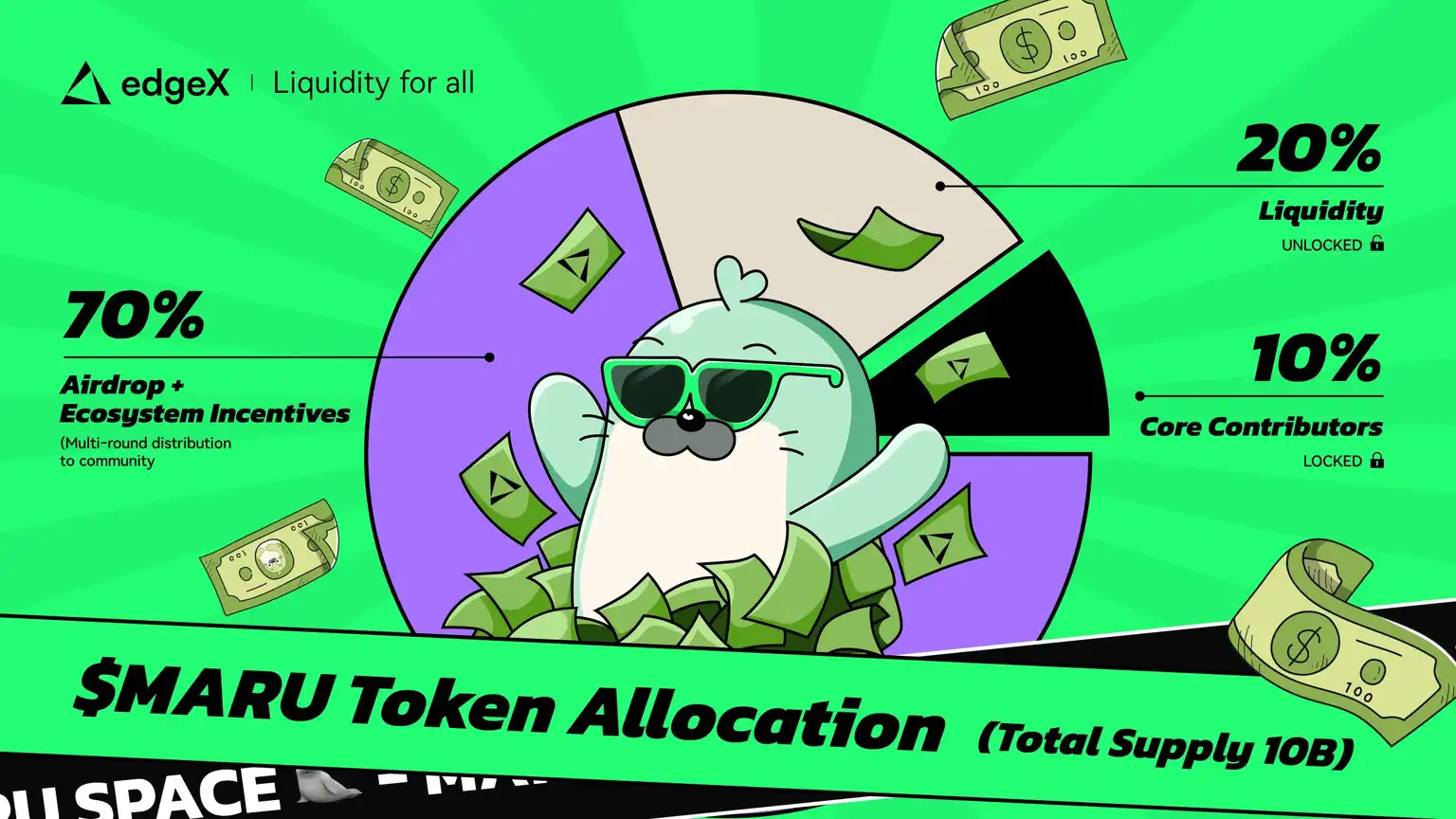
How to get $MARU? There are mainly two channels:
The first is through Open Season points, which is also the primary channel. These points will be converted into $MARU airdrops after December 3. It is important to note that the platform has a minimum trading volume requirement, and wash trading behavior will be identified and excluded. The weightage for obtaining points is as follows:
Trading perpetual contracts: 60% weightage, the major portion of the points;
Referral rewards: 20% weightage;
TVL/Liquidity provision: 10% weightage;
Position Size / Liquidation: Weight 10%;
The second is Creator Activity, which can be simply understood as Kaito's way of earning rewards through content creation. There are various forms of posts, such as making tweets, videos, memes, etc., and mentioning @edgeX_exchange. Original high-quality content selected by the official team (AI-generated content does not count; supports English, Chinese, Korean, and Japanese) will have the opportunity to share a prize pool of 500,000 USDT + 20 million MARU.
Some users have already seen temporary rewards on the dashboard (such as 21,370 MARU + 464 USDT). USDT can be claimed first, and MARU will be distributed after its official launch.
2. edgeX Messenger Upgrade
Related to the previous point, the edgeX Messenger upgrade was announced on November 13. This plan aims to elevate edgeX Messenger from a simple communication tool to a global DeFi collaboration center.
Core direction: Provide a collaboration platform for traders and influencers; deeply integrate with the $MARU incentive mechanism. In simple terms, the goal is to create a platform that combines traders' community, content creation, and incentive mechanisms.
3. edgeXFlow Ecosystem Sets Sail
On November 19, edgeX made another big move by launching the edgeXFlow ecosystem.
In brief, edgeXFlow is a new modular execution layer that operates in parallel with the existing StarkEx. Technical specifications: Execution delay: <10ms; Order processing capacity: 200,000 transactions per second; ZK proof ensures transparency, and so on.
The first partner is Ave.ai, and together they launched the XPIN trading event (November 19-26). The design of this event is quite interesting—not just the traditional PnL competition but adopting a mixed incentive model: airdrop rewards based on trading volume tiers; a leaderboard with 200 slots (to broaden the winning scope); 1.1x edgeX points bonus.
edgeX has ambitious goals, aiming to onboard 30 ecosystem partners by Q2 2026. It seems they intend to establish this infrastructure as an industry standard for a modular execution layer.
4. Points Countdown
The Open Season is now in the final countdown stage! We are currently in weeks 20-24, with an estimated 2-4 weeks remaining. In recent weeks, 300,000 points have been distributed each week, covering 13,000-14,000 addresses.
According to calculations by a community influencer, based on edgeX revenue being approximately 16% of Hyperliquid's, if the FDV reaches around 20-70 billion USD at TGE, the value of a single point may fall in the range of 30-300 USD. Of course, this is only an estimate, and the actual value will depend on market conditions. The probability of edgeX on Polymarket's FDV on launch day is as follows:
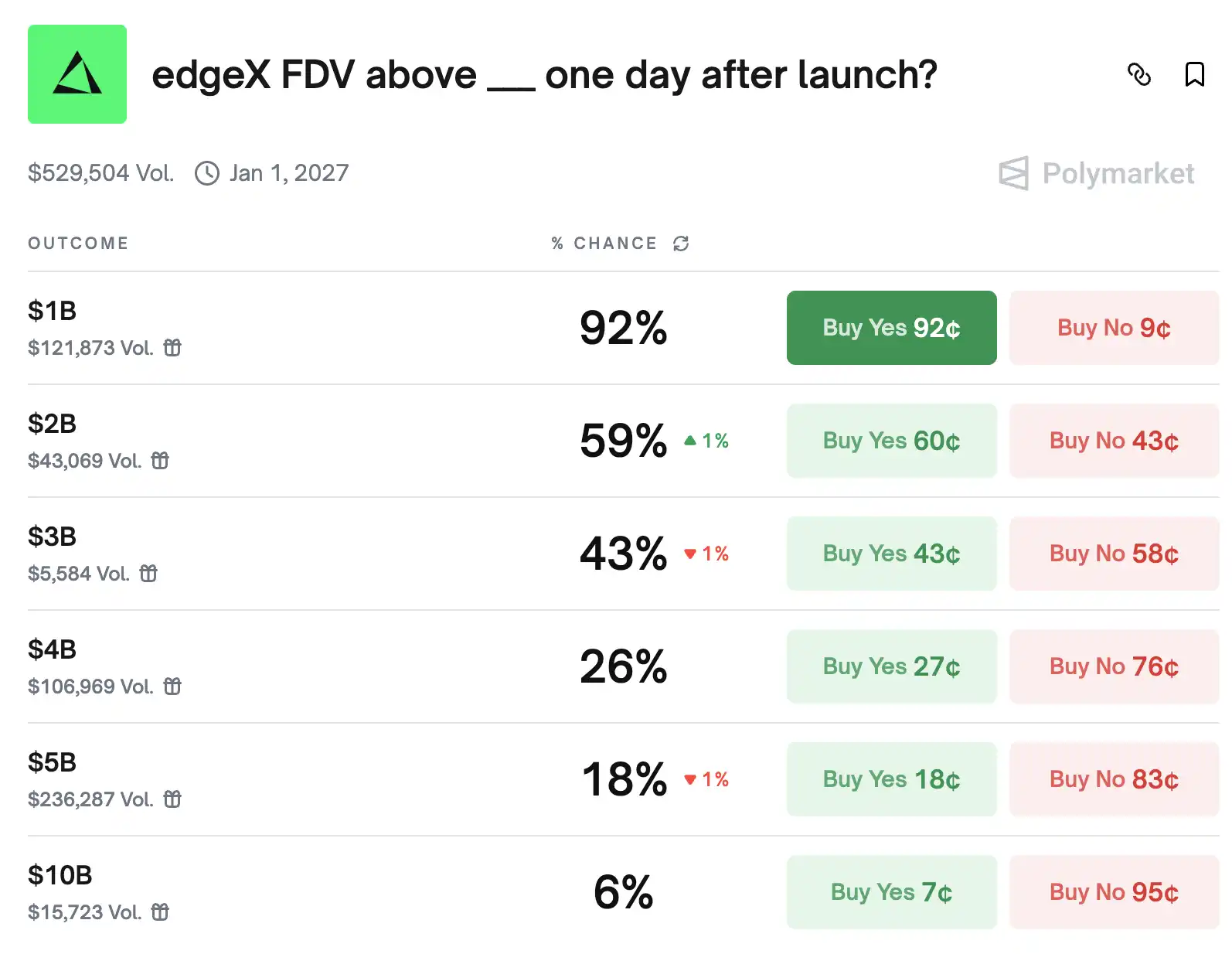
5. Strategic Partnership with Polymarket
This is also a significant piece of news. Yesterday, edgeX announced a strategic partnership with Polymarket: Polymarket's prediction scenarios will seamlessly integrate into the edgeX mobile app; users will be able to participate in event prediction with a single click; and both parties will jointly develop innovative leveraged prediction products.
Since this news was announced yesterday, there are not yet more details available. However, we can follow the updates, and it is expected that the products developed as part of the collaboration in the future will be one of the key projects in the edgeXFlow ecosystem.
Lighter: Raised 68 Million in Funding, Valued at 15 Billion
1. Major Funding Round
On November 11, Lighter announced the completion of a $68 million funding round, propelling it into the ranks of DeFi unicorns. The lineup of investors in this round is quite impressive:
Funding Details:
Amount: $68 million (equity + token subscription rights)
Valuation: $15 billion (post-money valuation)
Lead Investor: Founders Fund (Peter Thiel), Ribbit Capital
Other Investors: Haun Ventures, Robinhood (a rare brokerage VC participant)
Total Funding: Approximately $90 million (previously raised $21 million in 2024, led by Haun/Craft)
This funding round has several key points:
First, the investor lineup is top-notch. Founders Fund is one of Silicon Valley's top VCs, and Robinhood, as a brokerage, personally invested in the perp DEX, which is very rare in the industry. This indicates that traditional finance's acceptance of decentralized derivatives is increasing.
Second, the founder has a hardcore background. Novakovski is a legendary figure—entered Harvard at 16, recruited by Citadel founder Ken Griffin right after graduating at 18, and later worked as an engineer and trader in multiple financial institutions for nearly 15 years. Founders Fund partner Joey Krug bluntly stated that 85%-90% of the investment thesis is because of founder Vladimir Novakovski and his team.
2. The only perp DEX with a daily trading volume exceeding 10 billion
Lighter's recent growth data is quite explosive.
24-hour trading volume: around 79-112 billion USD (fluctuates based on timestamps, once becoming the only perp DEX to break 100 billion);
TVL: around 1.15 billion USD (2000x growth in 6 months! From around 500k USD at the end of March);
Open interest: over 170 billion USD;
L2 Ranking: has already risen to the top in the Ethereum L2 protocol, considered the first native perp DEX on Ethereum;
However, some analysts have expressed concerns: Lighter's trading volume/open interest ratio has at one point reached 27 (industry health value usually ≤5), suggesting that some of the trading volume may come from volume-driven incentivized trading activities. Pre-TGE trading volume contains volume-driven activities, which is also a feature of the industry. The true trading volume of Lighter may be revealed shortly after the TGE. However, considering the platform has just graduated from the beta version, the overall performance is still very impressive.
3. Oracle Integration + RWA Expansion, Targeting Traditional Financial Assets
Lighter recently announced a partnership with Chainlink to integrate real-time oracle data, formally expanding into the real-world asset (RWA) derivatives field.
Supported asset categories include: commodity futures contracts (gold, oil, etc.); stock index derivatives; forex pairs; other real-world assets.
In addition, due to the fact that the RWA price feed is not available 24/7 (for example, assets like gold and stocks only have prices during trading hours), Lighter has also made some special arrangements: during non-trading hours, it enters a "liquidation only" mode where users can only submit liquidation orders; funding rates continue to be calculated as usual during non-trading hours; the RWA market only supports isolated margin mode (considering its experimental nature and high volatility); a dedicated XLP (Experimental Liquidity Provider) pool is established to provide liquidity for the RWA market, isolated from the main LLP pool.
Hyperliquid: The Joy and Sorrow of the King
1. HIP-3 Upgrade, Transaction Fees Reduced by 90%
On November 19, Hyperliquid released a major upgrade: HIP-3 Growth Mode.
HIP-3 itself allows anyone to deploy their own perpetual contract market on Hyperliquid without permission by staking 500,000 HYPE tokens. The "Growth Mode" introduced this time is a further optimization based on HIP-3, specifically designed to provide ultra-low transaction fee incentives for new markets.
The key changes include: Taker fee reduced by over 90%, from the original 0.045% to 0.0045%-0.009%; highly staked users benefit more, as those reaching the highest staking and trading volume tier can enjoy fees as low as 0.00144%-0.00288%; rebates and trading volume contributions can also decrease by over 90% simultaneously.
However, to prevent "parasitic trading volume," there are exclusion rules for the Growth Mode market: it cannot include BTC or markets already operated by validators, cryptocurrency baskets/ETFs, synthetic price indices, or any assets that duplicate existing markets (such as gold already having PAXG-USDC).
The purpose of this upgrade is clear: to lower the barrier of entry for new markets. New markets often start with few traders and low liquidity, a 90% fee discount can effectively attract early users, further helping Hyperliquid transition from "a PerpDEX" to "a permissionless financial infrastructure layer."
2. Another Whale Takes a "Different Path to the Same End"
Internet-famous trader Andrew Tate recently lost all his funds on Hyperliquid, jokingly referred to as being "Hyperliquidated."
According to Arkham on-chain data, Andrew Tate's liquidation dates back to almost a year ago. There was a collective liquidation of long positions in BTC, ETH, SOL, LINK, HYPE, PENGU, and other assets on December 19, 2024.
On November 18, when BTC dropped below $90,000, Andrew Tate's final position was completely liquidated, and his account was emptied. This incident instantly became a meme material, considering he often portrayed himself as a financial master.
Some analysts directly labeled him as "one of the worst traders in crypto history," alongside other whales who suffered significant losses on Hyperliquid (James Wynn lost $23 million, Qwatio lost $25.8 million, 0xa523 lost $43.4 million in a month).
3. POPCAT Manipulation Attack
On November 12, Hyperliquid faced its second major attack of the year, the previous one being XPL, and this time the target was the memecoin POPCAT.
The attacker withdrew 3 million USDC from OKX and dispersed it to 19-26 new wallets. They opened leverage long positions of about $20-30 million in POPCAT on Hyperliquid (around 5x leverage) and then placed a buy wall of about $20 million at a price of $0.21, creating the illusion of strong demand. Other traders, seeing the buy wall and thinking there was support, rushed to go long. The attacker suddenly removed the buy wall, causing the POPCAT price to plummet from $0.21 to $0.13.
In the end, a large number of leveraged long positions were liquidated, totaling $25.5 million in positions across at least 26 liquidated accounts, resulting in a loss of $2.98 million in collateral, and the HLP treasury was forced to absorb $4.9 million in bad debt. The strangeness of this attack lies in the fact that the attacker themselves lost $3 million, seemingly not for profit.
There are two main speculations in the community regarding this: one is that this attack was purely a "stress test" to undermine Hyperliquid's reputation, with Binance/CZ being the main suspect. The other is that the attacker opened hedged positions on a centralized exchange, therefore profiting overall, with on-chain analysis pointing to BTX Capital, but founder Vanessa Cao has denied involvement.
Aster: Giving Away Money While Buying Back
1. Phase Four "Aster Harvest" Airdrops 120 Million ASTER
On November 10, Aster officially launched the fourth phase of airdrops, codenamed Harvest. The distribution size is 120 million ASTER (1.5% of the total supply) over a duration of 6 weeks (November 10 - December 21), with a weekly distribution of 0.25%, evenly spread across 6 epochs.
Compared to the previous phases (S2 4% allocation, S3 2.5% allocation), the allocation ratio for S4 has indeed shrunk. However, community analysis believes that due to a potential decrease in participants, individual user rewards may be higher, and the deflationary halving may drive up the token price.
Some of the key Tips to earn more points in this phase are: $ASTER can be used as perpetual contract collateral, using $ASTER as collateral provides additional points; paying fees with $ASTER grants a 5% discount; spot trading is now also eligible for points; additionally, there are anti-wash trading measures, and Aster now heavily emphasizes high-quality trading, implementing a maker order and symbol accelerator multiplier mechanism in an attempt to filter out wash trading behavior.
2. $10 Million Trading Competition "One Fish, Two Eats"
On November 17, Aster launched its largest-ever trading competition: a total prize pool of $10 million.
In terms of the format, it is divided into 5 weekly stages (lasting until December 21), each stage has an independent leaderboard, with a $1 million prize pool for the first stage, up to $2 million per week; 1000 winning seats per stage; limited to perpetual contract trading, ranked by trading volume and PnL.
The highlight of this trading competition is the "One Fish, Two Eats" feature, where the same trade can be counted for both the competition and the S4 airdrop. For example, the top player can earn up to $300,000 in a single week, and theoretically, if they dominate the leaderboard for 5 consecutive weeks, they could potentially receive $1.5 million.
3. Continued Protocol Buyback
Aster's buyback efforts in the perp DEX track are considered to be quite aggressive. As of November 13, the total repurchase amount is approximately $214 million; the repurchased token amount accounts for 7.11% of the circulating supply.
Recently, CZ publicly announced a purchase of over $2 million worth of ASTER, sparking speculative demand; additionally, market makers such as Wintermute have quietly increased their holdings, leading some analysts to predict that ASTER could rise to $10.
However, some in the community also have concerns: around 6.35 billion ASTER tokens are still locked, and future unlocks may bring selling pressure. There are about $700 million worth of tokens awaiting unlocking by 2026. The fluctuating unlock schedule in recent times has caused some panic. However, the official statement is that the unlock schedule will not be changed.
4. "Machi Mode" Feature
This may be the most meme-worthy new feature launched on Aster. On November 19, Aster announced the introduction of "Machi Mode," where liquidated users can receive point rewards, essentially giving a "consolation prize" to losing traders.
Why is it called Machi Mode? It is a nod to the renowned trader Jeffrey Huang, known in the community as "Machi Big Brother."
According to Lookonchain data, the top three whales in terms of liquidations on Hyperliquid since November 1 are: Machi Big Brother—71 liquidations; James Wynn—26 liquidations; Andrew Tate—19 liquidations.
Machi is way ahead, arguably the unlucky "Liquidation King." He once lost over $53 million in a month, known for his high leverage and aggressive trading style. Aster named this feature after him, to some extent, also embracing the degenerate culture of the crypto community.
Others
Additionally, the editor would like to introduce two other upcoming projects in the space that are of personal interest, especially in the realm of Perp DEX.
1. Pacifica
On November 12, Pacifica announced the launch of the TIF=TOB (Time in Force = Top of Book) order type.
In simple terms, when you submit a post-only limit order, if the price is set too aggressively and would otherwise penetrate the order book (i.e., get immediately filled), the traditional practice would be to cancel the order outright. However, with TIF=TOB, the order is not canceled but automatically adjusted to the top of the order book.
For example, suppose the current best bid for BTC is $100,000, and the best ask is $100,100. If you submit a TOB buy order at $100,200 (which would penetrate the Ask), the system will automatically adjust your order to $100,099—just below the best ask—becoming the new top of the order book. This is a great feature for market makers.
Currently, Pacifica has become one of the most important projects on the Solana blockchain.
2. Variational
Another key aspect is Variational, which played a significant role in the Arbitrum DeFi Revival Strategy for Perp DEX.
Its features include: an automatic listing engine that eliminates coordination delays via internal OLP; currently supporting 515+ tokens, making it the DEX with the most listings; protocol provides liquidity with hedging costs of only 0-2 basis points, with users paying a 4-6 basis point spread; achieving a period of over 300% APY; and loss compensation: currently over $2 million in refunds have been issued, covering 70,000+ trades, benefiting 6,500+ users, with the highest single refund exceeding $100,000, accounting for approximately 2% of the platform's total losses.
On November 15th, over $1 million in retroactive rewards were distributed; on November 17th, a retail sentiment index tool was introduced, showing that 89% of the trading volume comes from the long tail market. Overall, the data growth has been very rapid, with no open championship level yet, but volume retrospection may be possible in the future.
You may also like

Token Cannot Compound, Where Is the Real Investment Opportunity?

February 6th Market Key Intelligence, How Much Did You Miss?

China's Central Bank and Eight Other Departments' Latest Regulatory Focus: Key Attention to RWA Tokenized Asset Risk
Foreword: Today, the People's Bank of China's website published the "Notice of the People's Bank of China, National Development and Reform Commission, Ministry of Industry and Information Technology, Ministry of Public Security, State Administration for Market Regulation, China Banking and Insurance Regulatory Commission, China Securities Regulatory Commission, State Administration of Foreign Exchange on Further Preventing and Dealing with Risks Related to Virtual Currency and Others (Yinfa [2026] No. 42)", the latest regulatory requirements from the eight departments including the central bank, which are basically consistent with the regulatory requirements of recent years. The main focus of the regulation is on speculative activities such as virtual currency trading, exchanges, ICOs, overseas platform services, and this time, regulatory oversight of RWA has been added, explicitly prohibiting RWA tokenization, stablecoins (especially those pegged to the RMB). The following is the full text:
To the people's governments of all provinces, autonomous regions, and municipalities directly under the Central Government, the Xinjiang Production and Construction Corps:
Recently, there have been speculative activities related to virtual currency and Real-World Assets (RWA) tokenization, disrupting the economic and financial order and jeopardizing the property security of the people. In order to further prevent and address the risks related to virtual currency and Real-World Assets tokenization, effectively safeguard national security and social stability, in accordance with the "Law of the People's Republic of China on the People's Bank of China," "Law of the People's Republic of China on Commercial Banks," "Securities Law of the People's Republic of China," "Law of the People's Republic of China on Securities Investment Funds," "Law of the People's Republic of China on Futures and Derivatives," "Cybersecurity Law of the People's Republic of China," "Regulations of the People's Republic of China on the Administration of Renminbi," "Regulations on Prevention and Disposal of Illegal Fundraising," "Regulations of the People's Republic of China on Foreign Exchange Administration," "Telecommunications Regulations of the People's Republic of China," and other provisions, after reaching consensus with the Cyberspace Administration of China, the Supreme People's Court, and the Supreme People's Procuratorate, and with the approval of the State Council, the relevant matters are notified as follows:
(I) Virtual currency does not possess the legal status equivalent to fiat currency. Virtual currencies such as Bitcoin, Ether, Tether, etc., have the main characteristics of being issued by non-monetary authorities, using encryption technology and distributed ledger or similar technology, existing in digital form, etc. They do not have legal tender status, should not and cannot be circulated and used as currency in the market.
The business activities related to virtual currency are classified as illegal financial activities. The exchange of fiat currency and virtual currency within the territory, exchange of virtual currencies, acting as a central counterparty in buying and selling virtual currencies, providing information intermediary and pricing services for virtual currency transactions, token issuance financing, and trading of virtual currency-related financial products, etc., fall under illegal financial activities, such as suspected illegal issuance of token vouchers, unauthorized public issuance of securities, illegal operation of securities and futures business, illegal fundraising, etc., are strictly prohibited across the board and resolutely banned in accordance with the law. Overseas entities and individuals are not allowed to provide virtual currency-related services to domestic entities in any form.
A stablecoin pegged to a fiat currency indirectly fulfills some functions of the fiat currency in circulation. Without the consent of relevant authorities in accordance with the law and regulations, any domestic or foreign entity or individual is not allowed to issue a RMB-pegged stablecoin overseas.
(II)Tokenization of Real-World Assets refers to the use of encryption technology and distributed ledger or similar technologies to transform ownership rights, income rights, etc., of assets into tokens (tokens) or other interests or bond certificates with token (token) characteristics, and carry out issuance and trading activities.
Engaging in the tokenization of real-world assets domestically, as well as providing related intermediary, information technology services, etc., which are suspected of illegal issuance of token vouchers, unauthorized public offering of securities, illegal operation of securities and futures business, illegal fundraising, and other illegal financial activities, shall be prohibited; except for relevant business activities carried out with the approval of the competent authorities in accordance with the law and regulations and relying on specific financial infrastructures. Overseas entities and individuals are not allowed to illegally provide services related to the tokenization of real-world assets to domestic entities in any form.
(III) Inter-agency Coordination. The People's Bank of China, together with the National Development and Reform Commission, the Ministry of Industry and Information Technology, the Ministry of Public Security, the State Administration for Market Regulation, the China Banking and Insurance Regulatory Commission, the China Securities Regulatory Commission, the State Administration of Foreign Exchange, and other departments, will improve the work mechanism, strengthen coordination with the Cyberspace Administration of China, the Supreme People's Court, and the Supreme People's Procuratorate, coordinate efforts, and overall guide regions to carry out risk prevention and disposal of virtual currency-related illegal financial activities.
The China Securities Regulatory Commission, together with the National Development and Reform Commission, the Ministry of Industry and Information Technology, the Ministry of Public Security, the People's Bank of China, the State Administration for Market Regulation, the China Banking and Insurance Regulatory Commission, the State Administration of Foreign Exchange, and other departments, will improve the work mechanism, strengthen coordination with the Cyberspace Administration of China, the Supreme People's Court, and the Supreme People's Procuratorate, coordinate efforts, and overall guide regions to carry out risk prevention and disposal of illegal financial activities related to the tokenization of real-world assets.
(IV) Strengthening Local Implementation. The people's governments at the provincial level are overall responsible for the prevention and disposal of risks related to virtual currencies and the tokenization of real-world assets in their respective administrative regions. The specific leading department is the local financial regulatory department, with participation from branches and dispatched institutions of the State Council's financial regulatory department, telecommunications regulators, public security, market supervision, and other departments, in coordination with cyberspace departments, courts, and procuratorates, to improve the normalization of the work mechanism, effectively connect with the relevant work mechanisms of central departments, form a cooperative and coordinated working pattern between central and local governments, effectively prevent and properly handle risks related to virtual currencies and the tokenization of real-world assets, and maintain economic and financial order and social stability.
(5) Enhanced Risk Monitoring. The People's Bank of China, China Securities Regulatory Commission, National Development and Reform Commission, Ministry of Industry and Information Technology, Ministry of Public Security, State Administration of Foreign Exchange, Cyberspace Administration of China, and other departments continue to improve monitoring techniques and system support, enhance cross-departmental data analysis and sharing, establish sound information sharing and cross-validation mechanisms, promptly grasp the risk situation of activities related to virtual currency and real-world asset tokenization. Local governments at all levels give full play to the role of local monitoring and early warning mechanisms. Local financial regulatory authorities, together with branches and agencies of the State Council's financial regulatory authorities, as well as departments of cyberspace and public security, ensure effective connection between online monitoring, offline investigation, and fund tracking, efficiently and accurately identify activities related to virtual currency and real-world asset tokenization, promptly share risk information, improve early warning information dissemination, verification, and rapid response mechanisms.
(6) Strengthened Oversight of Financial Institutions, Intermediaries, and Technology Service Providers. Financial institutions (including non-bank payment institutions) are prohibited from providing account opening, fund transfer, and clearing services for virtual currency-related business activities, issuing and selling financial products related to virtual currency, including virtual currency and related financial products in the scope of collateral, conducting insurance business related to virtual currency, or including virtual currency in the scope of insurance liability. Financial institutions (including non-bank payment institutions) are prohibited from providing custody, clearing, and settlement services for unauthorized real-world asset tokenization-related business and related financial products. Relevant intermediary institutions and information technology service providers are prohibited from providing intermediary, technical, or other services for unauthorized real-world asset tokenization-related businesses and related financial products.
(7) Enhanced Management of Internet Information Content and Access. Internet enterprises are prohibited from providing online business venues, commercial displays, marketing, advertising, or paid traffic diversion services for virtual currency and real-world asset tokenization-related business activities. Upon discovering clues of illegal activities, they should promptly report to relevant departments and provide technical support and assistance for related investigations and inquiries. Based on the clues transferred by the financial regulatory authorities, the cyberspace administration, telecommunications authorities, and public security departments should promptly close and deal with websites, mobile applications (including mini-programs), and public accounts engaged in virtual currency and real-world asset tokenization-related business activities in accordance with the law.
(8) Strengthened Entity Registration and Advertisement Management. Market supervision departments strengthen entity registration and management, and enterprise and individual business registrations must not contain terms such as "virtual currency," "virtual asset," "cryptocurrency," "crypto asset," "stablecoin," "real-world asset tokenization," or "RWA" in their names or business scopes. Market supervision departments, together with financial regulatory authorities, legally enhance the supervision of advertisements related to virtual currency and real-world asset tokenization, promptly investigating and handling relevant illegal advertisements.
(IX) Continued Rectification of Virtual Currency Mining Activities. The National Development and Reform Commission, together with relevant departments, strictly controls virtual currency mining activities, continuously promotes the rectification of virtual currency mining activities. The people's governments of various provinces take overall responsibility for the rectification of "mining" within their respective administrative regions. In accordance with the requirements of the National Development and Reform Commission and other departments in the "Notice on the Rectification of Virtual Currency Mining Activities" (NDRC Energy-saving Building [2021] No. 1283) and the provisions of the "Guidance Catalog for Industrial Structure Adjustment (2024 Edition)," a comprehensive review, investigation, and closure of existing virtual currency mining projects are conducted, new mining projects are strictly prohibited, and mining machine production enterprises are strictly prohibited from providing mining machine sales and other services within the country.
(X) Severe Crackdown on Related Illegal Financial Activities. Upon discovering clues to illegal financial activities related to virtual currency and the tokenization of real-world assets, local financial regulatory authorities, branches of the State Council's financial regulatory authorities, and other relevant departments promptly investigate, determine, and properly handle the issues in accordance with the law, and seriously hold the relevant entities and individuals legally responsible. Those suspected of crimes are transferred to the judicial authorities for processing according to the law.
(XI) Severe Crackdown on Related Illegal and Criminal Activities. The Ministry of Public Security, the People's Bank of China, the State Administration for Market Regulation, the China Banking and Insurance Regulatory Commission, the China Securities Regulatory Commission, as well as judicial and procuratorial organs, in accordance with their respective responsibilities, rigorously crack down on illegal and criminal activities related to virtual currency, the tokenization of real-world assets, such as fraud, money laundering, illegal business operations, pyramid schemes, illegal fundraising, and other illegal and criminal activities carried out under the guise of virtual currency, the tokenization of real-world assets, etc.
(XII) Strengthen Industry Self-discipline. Relevant industry associations should enhance membership management and policy advocacy, based on their own responsibilities, advocate and urge member units to resist illegal financial activities related to virtual currency and the tokenization of real-world assets. Member units that violate regulatory policies and industry self-discipline rules are to be disciplined in accordance with relevant self-regulatory management regulations. By leveraging various industry infrastructure, conduct risk monitoring related to virtual currency, the tokenization of real-world assets, and promptly transfer issue clues to relevant departments.
(XIII) Without the approval of relevant departments in accordance with the law and regulations, domestic entities and foreign entities controlled by them may not issue virtual currency overseas.
(XIV) Domestic entities engaging directly or indirectly in overseas external debt-based tokenization of real-world assets, or conducting asset securitization activities abroad based on domestic ownership rights, income rights, etc. (hereinafter referred to as domestic equity), should be strictly regulated in accordance with the principles of "same business, same risk, same rules." The National Development and Reform Commission, the China Securities Regulatory Commission, the State Administration of Foreign Exchange, and other relevant departments regulate it according to their respective responsibilities. For other forms of overseas real-world asset tokenization activities based on domestic equity by domestic entities, the China Securities Regulatory Commission, together with relevant departments, supervise according to their division of responsibilities. Without the consent and filing of relevant departments, no unit or individual may engage in the above-mentioned business.
(15) Overseas subsidiaries and branches of domestic financial institutions providing Real World Asset Tokenization-related services overseas shall do so legally and prudently. They shall have professional personnel and systems in place to effectively mitigate business risks, strictly implement customer onboarding, suitability management, anti-money laundering requirements, and incorporate them into the domestic financial institutions' compliance and risk management system. Intermediaries and information technology service providers offering Real World Asset Tokenization services abroad based on domestic equity or conducting Real World Asset Tokenization business in the form of overseas debt for domestic entities directly or indirectly venturing abroad must strictly comply with relevant laws and regulations. They should establish and improve relevant compliance and internal control systems in accordance with relevant normative requirements, strengthen business and risk control, and report the business developments to the relevant regulatory authorities for approval or filing.
(16) Strengthen organizational leadership and overall coordination. All departments and regions should attach great importance to the prevention of risks related to virtual currencies and Real World Asset Tokenization, strengthen organizational leadership, clarify work responsibilities, form a long-term effective working mechanism with centralized coordination, local implementation, and shared responsibilities, maintain high pressure, dynamically monitor risks, effectively prevent and mitigate risks in an orderly and efficient manner, legally protect the property security of the people, and make every effort to maintain economic and financial order and social stability.
(17) Widely carry out publicity and education. All departments, regions, and industry associations should make full use of various media and other communication channels to disseminate information through legal and policy interpretation, analysis of typical cases, and education on investment risks, etc. They should promote the illegality and harm of virtual currencies and Real World Asset Tokenization-related businesses and their manifestations, fully alert to potential risks and hidden dangers, and enhance public awareness and identification capabilities for risk prevention.
(18) Engaging in illegal financial activities related to virtual currencies and Real World Asset Tokenization in violation of this notice, as well as providing services for virtual currencies and Real World Asset Tokenization-related businesses, shall be punished in accordance with relevant regulations. If it constitutes a crime, criminal liability shall be pursued according to the law. For domestic entities and individuals who knowingly or should have known that overseas entities illegally provided virtual currency or Real World Asset Tokenization-related services to domestic entities and still assisted them, relevant responsibilities shall be pursued according to the law. If it constitutes a crime, criminal liability shall be pursued according to the law.
(19) If any unit or individual invests in virtual currencies, Real World Asset Tokens, and related financial products against public order and good customs, the relevant civil legal actions shall be invalid, and any resulting losses shall be borne by them. If there are suspicions of disrupting financial order and jeopardizing financial security, the relevant departments shall deal with them according to the law.
This notice shall enter into force upon the date of its issuance. The People's Bank of China and ten other departments' "Notice on Further Preventing and Dealing with the Risks of Virtual Currency Trading Speculation" (Yinfa [2021] No. 237) is hereby repealed.

Former Partner's Perspective on Multicoin: Kyle's Exit, But the Game He Left Behind Just Getting Started
Why Bitcoin Is Falling Now: The Real Reasons Behind BTC's Crash & WEEX's Smart Profit Playbook
Bitcoin's ongoing crash explained: Discover the 5 hidden triggers behind BTC's plunge & how WEEX's Auto Earn and Trade to Earn strategies help traders profit from crypto market volatility.

Wall Street's Hottest Trades See Exodus

Vitalik Discusses Ethereum Scaling Path, Circle Announces Partnership with Polymarket, What's the Overseas Crypto Community Talking About Today?

Believing in the Capital Markets - The Essence and Core Value of Cryptocurrency

Polymarket's 'Weatherman': Predict Temperature, Win Million-Dollar Payout

$15K+ Profits: The 4 AI Trading Secrets WEEX Hackathon Prelim Winners Used to Dominate Volatile Crypto Markets
How WEEX Hackathon's top AI trading strategies made $15K+ in crypto markets: 4 proven rules for ETH/BTC trading, market structure analysis, and risk management in volatile conditions.

A nearly 20% one-day plunge, how long has it been since you last saw a $60,000 Bitcoin?

Raoul Pal: I've seen every single panic, and they are never the end.

Key Market Information Discrepancy on February 6th - A Must-Read! | Alpha Morning Report

2026 Crypto Industry's First Snowfall
The Harsh Reality Behind the $26 Billion Crypto Liquidation: Liquidity Is Killing the Market
Why Is Gold, US Stocks, Bitcoin All Falling?

Key Market Intelligence for February 5th, how much did you miss out on?

Wintermute: By 2026, crypto had gradually become the settlement layer of the Internet economy
Token Cannot Compound, Where Is the Real Investment Opportunity?
February 6th Market Key Intelligence, How Much Did You Miss?
China's Central Bank and Eight Other Departments' Latest Regulatory Focus: Key Attention to RWA Tokenized Asset Risk
Foreword: Today, the People's Bank of China's website published the "Notice of the People's Bank of China, National Development and Reform Commission, Ministry of Industry and Information Technology, Ministry of Public Security, State Administration for Market Regulation, China Banking and Insurance Regulatory Commission, China Securities Regulatory Commission, State Administration of Foreign Exchange on Further Preventing and Dealing with Risks Related to Virtual Currency and Others (Yinfa [2026] No. 42)", the latest regulatory requirements from the eight departments including the central bank, which are basically consistent with the regulatory requirements of recent years. The main focus of the regulation is on speculative activities such as virtual currency trading, exchanges, ICOs, overseas platform services, and this time, regulatory oversight of RWA has been added, explicitly prohibiting RWA tokenization, stablecoins (especially those pegged to the RMB). The following is the full text:
To the people's governments of all provinces, autonomous regions, and municipalities directly under the Central Government, the Xinjiang Production and Construction Corps:
Recently, there have been speculative activities related to virtual currency and Real-World Assets (RWA) tokenization, disrupting the economic and financial order and jeopardizing the property security of the people. In order to further prevent and address the risks related to virtual currency and Real-World Assets tokenization, effectively safeguard national security and social stability, in accordance with the "Law of the People's Republic of China on the People's Bank of China," "Law of the People's Republic of China on Commercial Banks," "Securities Law of the People's Republic of China," "Law of the People's Republic of China on Securities Investment Funds," "Law of the People's Republic of China on Futures and Derivatives," "Cybersecurity Law of the People's Republic of China," "Regulations of the People's Republic of China on the Administration of Renminbi," "Regulations on Prevention and Disposal of Illegal Fundraising," "Regulations of the People's Republic of China on Foreign Exchange Administration," "Telecommunications Regulations of the People's Republic of China," and other provisions, after reaching consensus with the Cyberspace Administration of China, the Supreme People's Court, and the Supreme People's Procuratorate, and with the approval of the State Council, the relevant matters are notified as follows:
(I) Virtual currency does not possess the legal status equivalent to fiat currency. Virtual currencies such as Bitcoin, Ether, Tether, etc., have the main characteristics of being issued by non-monetary authorities, using encryption technology and distributed ledger or similar technology, existing in digital form, etc. They do not have legal tender status, should not and cannot be circulated and used as currency in the market.
The business activities related to virtual currency are classified as illegal financial activities. The exchange of fiat currency and virtual currency within the territory, exchange of virtual currencies, acting as a central counterparty in buying and selling virtual currencies, providing information intermediary and pricing services for virtual currency transactions, token issuance financing, and trading of virtual currency-related financial products, etc., fall under illegal financial activities, such as suspected illegal issuance of token vouchers, unauthorized public issuance of securities, illegal operation of securities and futures business, illegal fundraising, etc., are strictly prohibited across the board and resolutely banned in accordance with the law. Overseas entities and individuals are not allowed to provide virtual currency-related services to domestic entities in any form.
A stablecoin pegged to a fiat currency indirectly fulfills some functions of the fiat currency in circulation. Without the consent of relevant authorities in accordance with the law and regulations, any domestic or foreign entity or individual is not allowed to issue a RMB-pegged stablecoin overseas.
(II)Tokenization of Real-World Assets refers to the use of encryption technology and distributed ledger or similar technologies to transform ownership rights, income rights, etc., of assets into tokens (tokens) or other interests or bond certificates with token (token) characteristics, and carry out issuance and trading activities.
Engaging in the tokenization of real-world assets domestically, as well as providing related intermediary, information technology services, etc., which are suspected of illegal issuance of token vouchers, unauthorized public offering of securities, illegal operation of securities and futures business, illegal fundraising, and other illegal financial activities, shall be prohibited; except for relevant business activities carried out with the approval of the competent authorities in accordance with the law and regulations and relying on specific financial infrastructures. Overseas entities and individuals are not allowed to illegally provide services related to the tokenization of real-world assets to domestic entities in any form.
(III) Inter-agency Coordination. The People's Bank of China, together with the National Development and Reform Commission, the Ministry of Industry and Information Technology, the Ministry of Public Security, the State Administration for Market Regulation, the China Banking and Insurance Regulatory Commission, the China Securities Regulatory Commission, the State Administration of Foreign Exchange, and other departments, will improve the work mechanism, strengthen coordination with the Cyberspace Administration of China, the Supreme People's Court, and the Supreme People's Procuratorate, coordinate efforts, and overall guide regions to carry out risk prevention and disposal of virtual currency-related illegal financial activities.
The China Securities Regulatory Commission, together with the National Development and Reform Commission, the Ministry of Industry and Information Technology, the Ministry of Public Security, the People's Bank of China, the State Administration for Market Regulation, the China Banking and Insurance Regulatory Commission, the State Administration of Foreign Exchange, and other departments, will improve the work mechanism, strengthen coordination with the Cyberspace Administration of China, the Supreme People's Court, and the Supreme People's Procuratorate, coordinate efforts, and overall guide regions to carry out risk prevention and disposal of illegal financial activities related to the tokenization of real-world assets.
(IV) Strengthening Local Implementation. The people's governments at the provincial level are overall responsible for the prevention and disposal of risks related to virtual currencies and the tokenization of real-world assets in their respective administrative regions. The specific leading department is the local financial regulatory department, with participation from branches and dispatched institutions of the State Council's financial regulatory department, telecommunications regulators, public security, market supervision, and other departments, in coordination with cyberspace departments, courts, and procuratorates, to improve the normalization of the work mechanism, effectively connect with the relevant work mechanisms of central departments, form a cooperative and coordinated working pattern between central and local governments, effectively prevent and properly handle risks related to virtual currencies and the tokenization of real-world assets, and maintain economic and financial order and social stability.
(5) Enhanced Risk Monitoring. The People's Bank of China, China Securities Regulatory Commission, National Development and Reform Commission, Ministry of Industry and Information Technology, Ministry of Public Security, State Administration of Foreign Exchange, Cyberspace Administration of China, and other departments continue to improve monitoring techniques and system support, enhance cross-departmental data analysis and sharing, establish sound information sharing and cross-validation mechanisms, promptly grasp the risk situation of activities related to virtual currency and real-world asset tokenization. Local governments at all levels give full play to the role of local monitoring and early warning mechanisms. Local financial regulatory authorities, together with branches and agencies of the State Council's financial regulatory authorities, as well as departments of cyberspace and public security, ensure effective connection between online monitoring, offline investigation, and fund tracking, efficiently and accurately identify activities related to virtual currency and real-world asset tokenization, promptly share risk information, improve early warning information dissemination, verification, and rapid response mechanisms.
(6) Strengthened Oversight of Financial Institutions, Intermediaries, and Technology Service Providers. Financial institutions (including non-bank payment institutions) are prohibited from providing account opening, fund transfer, and clearing services for virtual currency-related business activities, issuing and selling financial products related to virtual currency, including virtual currency and related financial products in the scope of collateral, conducting insurance business related to virtual currency, or including virtual currency in the scope of insurance liability. Financial institutions (including non-bank payment institutions) are prohibited from providing custody, clearing, and settlement services for unauthorized real-world asset tokenization-related business and related financial products. Relevant intermediary institutions and information technology service providers are prohibited from providing intermediary, technical, or other services for unauthorized real-world asset tokenization-related businesses and related financial products.
(7) Enhanced Management of Internet Information Content and Access. Internet enterprises are prohibited from providing online business venues, commercial displays, marketing, advertising, or paid traffic diversion services for virtual currency and real-world asset tokenization-related business activities. Upon discovering clues of illegal activities, they should promptly report to relevant departments and provide technical support and assistance for related investigations and inquiries. Based on the clues transferred by the financial regulatory authorities, the cyberspace administration, telecommunications authorities, and public security departments should promptly close and deal with websites, mobile applications (including mini-programs), and public accounts engaged in virtual currency and real-world asset tokenization-related business activities in accordance with the law.
(8) Strengthened Entity Registration and Advertisement Management. Market supervision departments strengthen entity registration and management, and enterprise and individual business registrations must not contain terms such as "virtual currency," "virtual asset," "cryptocurrency," "crypto asset," "stablecoin," "real-world asset tokenization," or "RWA" in their names or business scopes. Market supervision departments, together with financial regulatory authorities, legally enhance the supervision of advertisements related to virtual currency and real-world asset tokenization, promptly investigating and handling relevant illegal advertisements.
(IX) Continued Rectification of Virtual Currency Mining Activities. The National Development and Reform Commission, together with relevant departments, strictly controls virtual currency mining activities, continuously promotes the rectification of virtual currency mining activities. The people's governments of various provinces take overall responsibility for the rectification of "mining" within their respective administrative regions. In accordance with the requirements of the National Development and Reform Commission and other departments in the "Notice on the Rectification of Virtual Currency Mining Activities" (NDRC Energy-saving Building [2021] No. 1283) and the provisions of the "Guidance Catalog for Industrial Structure Adjustment (2024 Edition)," a comprehensive review, investigation, and closure of existing virtual currency mining projects are conducted, new mining projects are strictly prohibited, and mining machine production enterprises are strictly prohibited from providing mining machine sales and other services within the country.
(X) Severe Crackdown on Related Illegal Financial Activities. Upon discovering clues to illegal financial activities related to virtual currency and the tokenization of real-world assets, local financial regulatory authorities, branches of the State Council's financial regulatory authorities, and other relevant departments promptly investigate, determine, and properly handle the issues in accordance with the law, and seriously hold the relevant entities and individuals legally responsible. Those suspected of crimes are transferred to the judicial authorities for processing according to the law.
(XI) Severe Crackdown on Related Illegal and Criminal Activities. The Ministry of Public Security, the People's Bank of China, the State Administration for Market Regulation, the China Banking and Insurance Regulatory Commission, the China Securities Regulatory Commission, as well as judicial and procuratorial organs, in accordance with their respective responsibilities, rigorously crack down on illegal and criminal activities related to virtual currency, the tokenization of real-world assets, such as fraud, money laundering, illegal business operations, pyramid schemes, illegal fundraising, and other illegal and criminal activities carried out under the guise of virtual currency, the tokenization of real-world assets, etc.
(XII) Strengthen Industry Self-discipline. Relevant industry associations should enhance membership management and policy advocacy, based on their own responsibilities, advocate and urge member units to resist illegal financial activities related to virtual currency and the tokenization of real-world assets. Member units that violate regulatory policies and industry self-discipline rules are to be disciplined in accordance with relevant self-regulatory management regulations. By leveraging various industry infrastructure, conduct risk monitoring related to virtual currency, the tokenization of real-world assets, and promptly transfer issue clues to relevant departments.
(XIII) Without the approval of relevant departments in accordance with the law and regulations, domestic entities and foreign entities controlled by them may not issue virtual currency overseas.
(XIV) Domestic entities engaging directly or indirectly in overseas external debt-based tokenization of real-world assets, or conducting asset securitization activities abroad based on domestic ownership rights, income rights, etc. (hereinafter referred to as domestic equity), should be strictly regulated in accordance with the principles of "same business, same risk, same rules." The National Development and Reform Commission, the China Securities Regulatory Commission, the State Administration of Foreign Exchange, and other relevant departments regulate it according to their respective responsibilities. For other forms of overseas real-world asset tokenization activities based on domestic equity by domestic entities, the China Securities Regulatory Commission, together with relevant departments, supervise according to their division of responsibilities. Without the consent and filing of relevant departments, no unit or individual may engage in the above-mentioned business.
(15) Overseas subsidiaries and branches of domestic financial institutions providing Real World Asset Tokenization-related services overseas shall do so legally and prudently. They shall have professional personnel and systems in place to effectively mitigate business risks, strictly implement customer onboarding, suitability management, anti-money laundering requirements, and incorporate them into the domestic financial institutions' compliance and risk management system. Intermediaries and information technology service providers offering Real World Asset Tokenization services abroad based on domestic equity or conducting Real World Asset Tokenization business in the form of overseas debt for domestic entities directly or indirectly venturing abroad must strictly comply with relevant laws and regulations. They should establish and improve relevant compliance and internal control systems in accordance with relevant normative requirements, strengthen business and risk control, and report the business developments to the relevant regulatory authorities for approval or filing.
(16) Strengthen organizational leadership and overall coordination. All departments and regions should attach great importance to the prevention of risks related to virtual currencies and Real World Asset Tokenization, strengthen organizational leadership, clarify work responsibilities, form a long-term effective working mechanism with centralized coordination, local implementation, and shared responsibilities, maintain high pressure, dynamically monitor risks, effectively prevent and mitigate risks in an orderly and efficient manner, legally protect the property security of the people, and make every effort to maintain economic and financial order and social stability.
(17) Widely carry out publicity and education. All departments, regions, and industry associations should make full use of various media and other communication channels to disseminate information through legal and policy interpretation, analysis of typical cases, and education on investment risks, etc. They should promote the illegality and harm of virtual currencies and Real World Asset Tokenization-related businesses and their manifestations, fully alert to potential risks and hidden dangers, and enhance public awareness and identification capabilities for risk prevention.
(18) Engaging in illegal financial activities related to virtual currencies and Real World Asset Tokenization in violation of this notice, as well as providing services for virtual currencies and Real World Asset Tokenization-related businesses, shall be punished in accordance with relevant regulations. If it constitutes a crime, criminal liability shall be pursued according to the law. For domestic entities and individuals who knowingly or should have known that overseas entities illegally provided virtual currency or Real World Asset Tokenization-related services to domestic entities and still assisted them, relevant responsibilities shall be pursued according to the law. If it constitutes a crime, criminal liability shall be pursued according to the law.
(19) If any unit or individual invests in virtual currencies, Real World Asset Tokens, and related financial products against public order and good customs, the relevant civil legal actions shall be invalid, and any resulting losses shall be borne by them. If there are suspicions of disrupting financial order and jeopardizing financial security, the relevant departments shall deal with them according to the law.
This notice shall enter into force upon the date of its issuance. The People's Bank of China and ten other departments' "Notice on Further Preventing and Dealing with the Risks of Virtual Currency Trading Speculation" (Yinfa [2021] No. 237) is hereby repealed.
Former Partner's Perspective on Multicoin: Kyle's Exit, But the Game He Left Behind Just Getting Started
Why Bitcoin Is Falling Now: The Real Reasons Behind BTC's Crash & WEEX's Smart Profit Playbook
Bitcoin's ongoing crash explained: Discover the 5 hidden triggers behind BTC's plunge & how WEEX's Auto Earn and Trade to Earn strategies help traders profit from crypto market volatility.


 App
App