UN Digital Cooperation Day Features Blockchain Session, Focus on Financial Inclusion and Sovereign Infrastructure

 Prefer us on Google


Bitcoin was included in discussions on digital public infrastructure, with institutional narratives shifting from speculation to utility.
Written by: Frank Corva, Forbes
Compiled by: AididiaoJP, Foresight News
At the United Nations, Bitcoin is rarely placed on the main agenda. On September 21, during the "Digital Cooperation Day" held in New York, a dedicated session for blockchain and tokenized assets was set up. The event was hosted by the UN Office for Digital and Emerging Technologies, coinciding with the high-level week of the General Assembly. Representatives from both public and private sectors view Bitcoin as a tool for financial inclusion and a strategic asset. The focus of the session was not on price fluctuations, but on whether developing countries can integrate this tool into their national digital public infrastructure.
The session was themed "Blockchain and Tokenized Futures: Sovereign Choices and Protections for Next-Generation Digital Public Infrastructure," with a clear policy orientation. The UN's public list shows that Jeremy Almond, CEO of Paystand, and Bilal Ben Saqib, Chairman of Pakistan's Virtual Assets Regulatory Authority and Minister of State, attended the discussion. Also present were Pakistan's Finance Minister Muhammad Aurangzeb, Circle founder Jeremy Allaire, Ella Zhang from YZi Labs, as well as government officials including Tanzania's Minister of Communications and Information Technology and Singapore's Permanent Representative to the UN. The lineup itself indicates that the discussion is no longer limited to exchanges and fund managers, but includes finance ministries, regulatory authorities, and those tasked with building national digital foundations.
Autonomy, Not Dependency
Almond referred to Bitcoin as a catalyst for advancing the UN's Sustainable Development Goals. His core concern was not whether the price would rise, but "who has the capacity to act." Charity can provide money and projects, but it does not necessarily leave behind a functioning local system. He advocates for using Bitcoin and tokenized tools to create economic autonomy: collecting payments, saving, and local circulation, minimizing reliance on bank branches that may not reach rural areas. This aligns with his previous year's discussions on "Bitcoin Circular Economy"—first enabling money to circulate locally before discussing grander goals.
Ben Saqib brought the discussion back to national realities. With a population of over 230 million and limited rural banking penetration, identity, land, and small payments often get stuck in offline procedures. For such countries, blockchain financial infrastructure is not a theoretical exercise. Pakistan has also been advocating for global rules on digital assets at the UN in recent years, clearly linking it to the Sustainable Development Goals. The simultaneous presence of the Finance Minister and the Chairman of the Virtual Assets Regulatory Authority in related sessions effectively laid out the questions of "whether to regulate, how to regulate, and whether it can be used after regulation."
The session revolved around two key terms: interoperability and sovereign choice. Interoperability means that systems must be able to connect; otherwise, cross-border settlements, identity verification, and tokenized assets remain isolated. Sovereign choice refers to retaining the right to adopt frameworks designed for local economies rather than importing them wholesale. For the Global South, this is very practical: the licensing logic from Washington or Brussels may not align with local cash societies and weak banking networks.
UN's Interest in Crypto is Not Sudden
In 2024, the General Assembly passed the "Global Digital Pact," incorporating digital public goods, digital public infrastructure, digital transformation, and open-source into a common framework. In 2025, the Office of the Secretary-General's Technology Envoy was restructured into the Office for Digital and Emerging Technologies. Digital Cooperation Day serves as a platform to push the pact into the execution phase, with the main focus still on AI governance, skills, and cross-border sandboxes. The ability to have a dedicated blockchain session indicates that tokenization has been included in the menu of "next-generation DPI," rather than being sidelined as background noise.
Earlier substantive discussions occurred at the legal level. In February of this year, the Bitcoin Policy Institute participated in discussions at the UN Commission on International Trade Law regarding digital trade and finance, with the core issue being: how existing trade laws define digital assets and how control constitutes property rights and priorities. Without these definitions, tokenized bonds, on-chain invoices, and cross-border guarantees struggle to enter formal contracts. The UN Development Programme has also conducted pilot projects and research on distributed ledgers, covering scenarios where traditional bureaucratic systems are weak, such as land registration and identity verification. The Digital Cooperation Day meeting pushed the conversation from "can it be used" to "who sets the rules and how to mitigate risks."
Circle's founder appeared in the same session, bringing the topic of stablecoins into the discussion. If sovereign choice is to be realized, many governments are likely to first engage with tokenized tools linked to fiat currencies before deciding Bitcoin's role in reserves, exchange, or private savings. The term "strategic asset" in Corva's writing refers to the discussion framework, not that member states have collectively added BTC to their reserve lists.
Boundaries Must Be Clearly Defined
The UN has not classified Bitcoin as an official reserve asset, nor has it recommended that national treasuries purchase Bitcoin. The discussions were framed around application scenarios, infrastructure, and risk protection. Protection means anti-money laundering, consumer protection, and cross-border regulatory arbitrage; these issues will not disappear because of a side event. The real change lies in the atmosphere: Bitcoin was positively mentioned in the context of the General Assembly's surrounding activities and linked to financial inclusion in the Global South. A few years ago, the official discourse was more often about speculation, energy consumption, and financial stability risks. While risks are still on the agenda, utility has now been allowed to take the stage.
Pakistan deserves special attention. The Virtual Assets Regulatory Authority is also building a framework that balances innovation and consumer protection, and the chairman's presence at the UN session indicates Islamabad's desire to participate in rule-making rather than simply copying existing frameworks. For the market, a side event cannot change the pricing on the day. The key will be to observe three things: whether digital public infrastructure will integrate Bitcoin, stablecoins, and tokenized assets into the national system; how far legal frameworks on "control" and cross-border recognition have progressed; and whether pilot projects from development institutions will transform from white papers into replicable payment and rights confirmation networks.
The entry point has shifted from market websites to policy forums. The next step is not to see who shouts "Bitcoin will change the world," but whether any country will truly integrate settlement, identity, and property registration into this framework.
-- Price
This content is provided for general informational purposes only and doesn't constitute financial, investment, legal, or tax advice. Any events, rewards, online promotions, or related information mentioned herein should not be considered a recommendation, solicitation, or invitation to purchase, sell, trade, or otherwise deal in any crypto assets. Crypto assets are highly volatile and may result in loss. The availability of WEEX services, products, and related events may vary by region. You are responsible for ensuring that your participation is in accordance with applicable local laws and regulations.
You may also like

Value of Deposits in Cryptocurrency Vaults Exceeds $10 Billion

Sales of Bitcoin by Medium-Term Investors Decreased by 36%

Michael Saylor: "Bitcoin is returning to a bull market"
18 Bitcoin Mining Equipment Seized in Paraguay

Financial Repression and AI's Impact on National Security

Jeff Park Discusses AI Pain Trade Impact on Bitcoin

Metaplanet Enters US Stock Market Through SLE, Deal Approved by Shareholders

BingX, YouHodler and Santander’s Openbank join EU MiCA register

QCP: AI Credit Risk Heats Up, Bitcoin May Face Range Breakthrough

French National Assembly Passes Tax Amendment on Stablecoin Transactions, Effective 2027
Bitcoin miner stocks driven by AI sentiment, not BTC prices
Black Monday Posts Break Records
Bitcoin Recovery Faces Challenges as Exchange Reserves Rise and Spot Demand Turns Negative
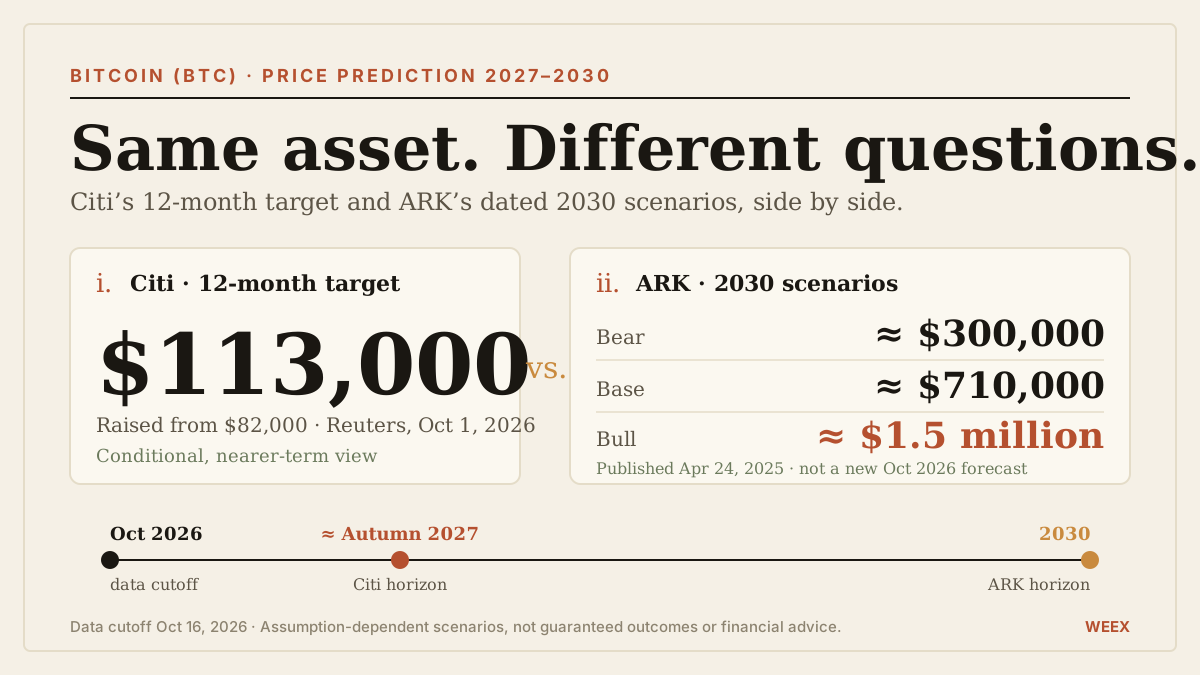
Bitcoin (BTC) Price Prediction 2027–2030: Citi’s $113,000 Target vs. Cathie Wood’s ARK Scenarios
Bitcoin price prediction for 2027–2030: compare Citi’s $113,000 target with ARK’s dated scenarios, demand assumptions, valuation math and key risks.

Mr&强 Analyzes BTC and ETH Short-Term Strategies

Bitcoin futures open interest declines, signaling weaker demand

Cathie Wood Predicts Long-Term Growth for Bitcoin Despite Dollar Strength
Peter Schiff Predicts Bitcoin Crash Over 99%
Liquidity in Cryptocurrency Market Approaches a Turning Point! Circle Aims to Enter 40 Emerging Markets

One dead, Qonto in flames, Nuñez resigns: why the streets worry crypto investors

Security Vulnerability Detected in ILITY Network, Cross-Chain Bridge Suspended

Bitcoin Spot ETF Sees Net Outflow of $229 Million Last Week, BlackRock's IBIT Leads with $165 Million Outflow

Morgan Stanley Recommends Up to 4% in Cryptocurrencies for Aggressive Portfolios

Deutsche Bank to Start Bitcoin and Ethereum Custody Within Weeks — Expansion to Asia by 2027

Bitcoin Ranges After Weekly Low Sweep| WEEX TradFi Daily(October 19, 2026)
Early on October 19, equity futures rebounded from last week’s chip selloff. Major indexes closed lower last week, the Nasdaq posted its worst week since June, the semiconductor ETF fell about 10%, and CoreWeave lost about 25%, while energy stocks were relatively resilient. Bitcoin traded near $82,000 after sweeping lows around $80,000, with markets watching the $79,800 and $83,600 zones.
WEEX Exclusive:Bitcoin Ranges After Weekly Low Sweep| WEEX TradFi Daily(October 19, 2026)

ECB: Lagarde defends rate hikes before the IMF and urges Brussels on digital euro

Sam Price Discusses Bitcoin Market Divergence

唐华斑竹 Analyzes Bitcoin Trends, Suggests Monitoring Support Levels

Saylor Envisions Bitcoin-Backed Stablecoin with Annual Yield of 6% to 8%
Value of Deposits in Cryptocurrency Vaults Exceeds $10 Billion
Sales of Bitcoin by Medium-Term Investors Decreased by 36%
Michael Saylor: "Bitcoin is returning to a bull market"
18 Bitcoin Mining Equipment Seized in Paraguay
Financial Repression and AI's Impact on National Security
Jeff Park Discusses AI Pain Trade Impact on Bitcoin