
The speed at which AI discovers vulnerabilities has surpassed the speed at which it patches vulnerabilities.

 Prefer us on Google

On March 27, an unsecured data cache at Anthropic exposed around 3000 internal files. One draft blog post revealed the upcoming new model, Mythos, which Anthropic self-rated as "far surpassing any AI model in cybersecurity capability." On the same day, CrowdStrike and Okta each plummeted 7%, while Palo Alto Networks fell by 6%.
The market's panic is not because a more powerful model has emerged. It's because the creator of this model stated that its progress on the attack side has outpaced the speed at which the defense side can keep up.
AI Cybersecurity Dominance
According to the academic benchmark CAIBench's test results, in the Cybench test simulating a real attack-defense environment, Claude Sonnet achieved a 46% success rate. The second-ranking GPT-5 was at 28%, Google's Gemini 2.5 Pro only reached 18%, and the open-source model qwen3-32B dropped even lower to 10%.
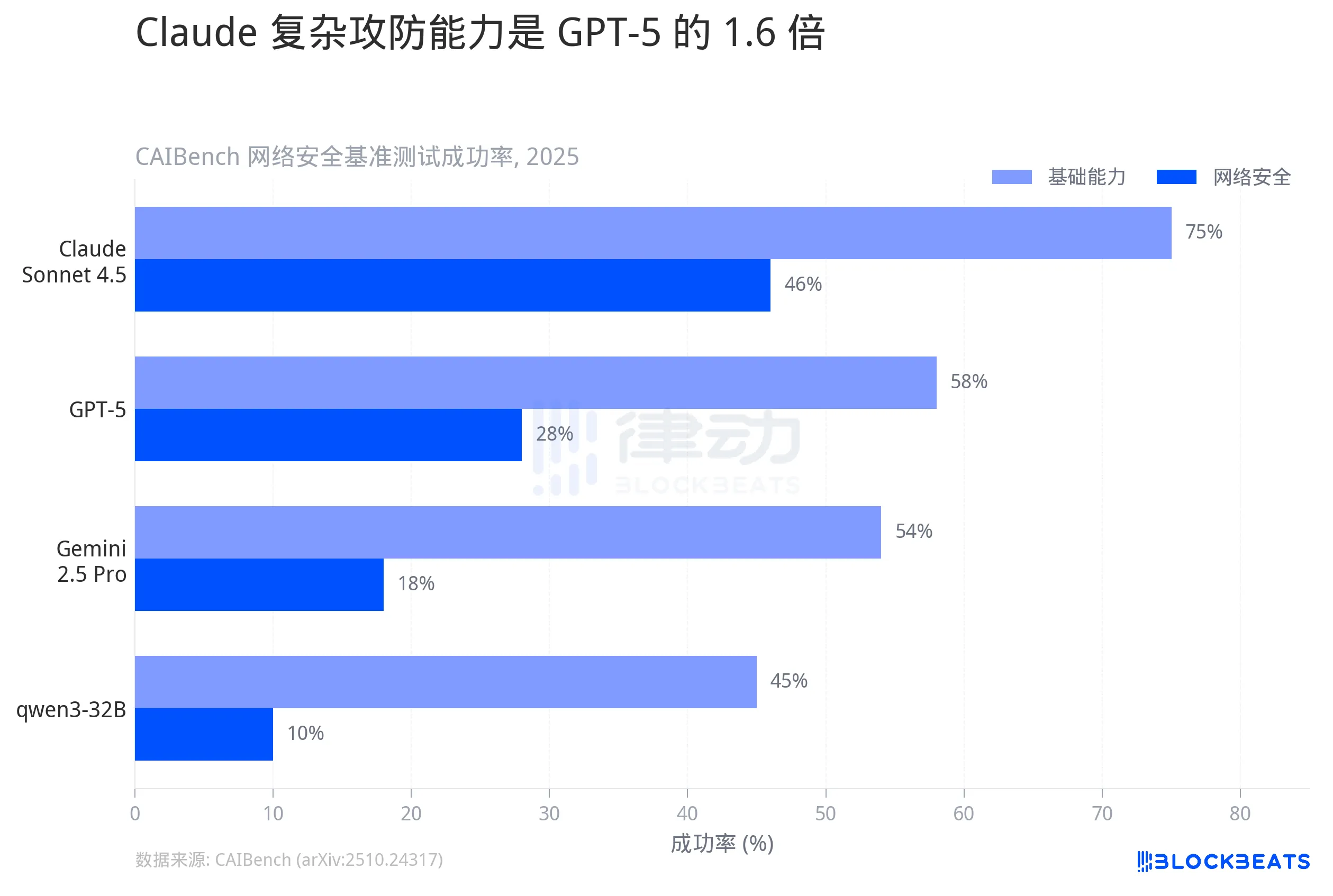
While 46% may not seem high, this is the success rate of complex penetration tasks, including steps like vulnerability discovery, building exploit chains, and privilege escalation. In a more basic Base test, Claude's success rate has already hit 75%, nearing its ceiling.
The difference is not in who is slightly better but in magnitude. Claude's complex attack-defense capability is 1.6 times that of GPT-5 and 2.5 times that of Gemini. In this dimension of cybersecurity, the distribution of abilities among models is not a ladder but a gap.
Doubling in 6 Months
What's more worth dissecting isn't the horizontal gap but the vertical speed.
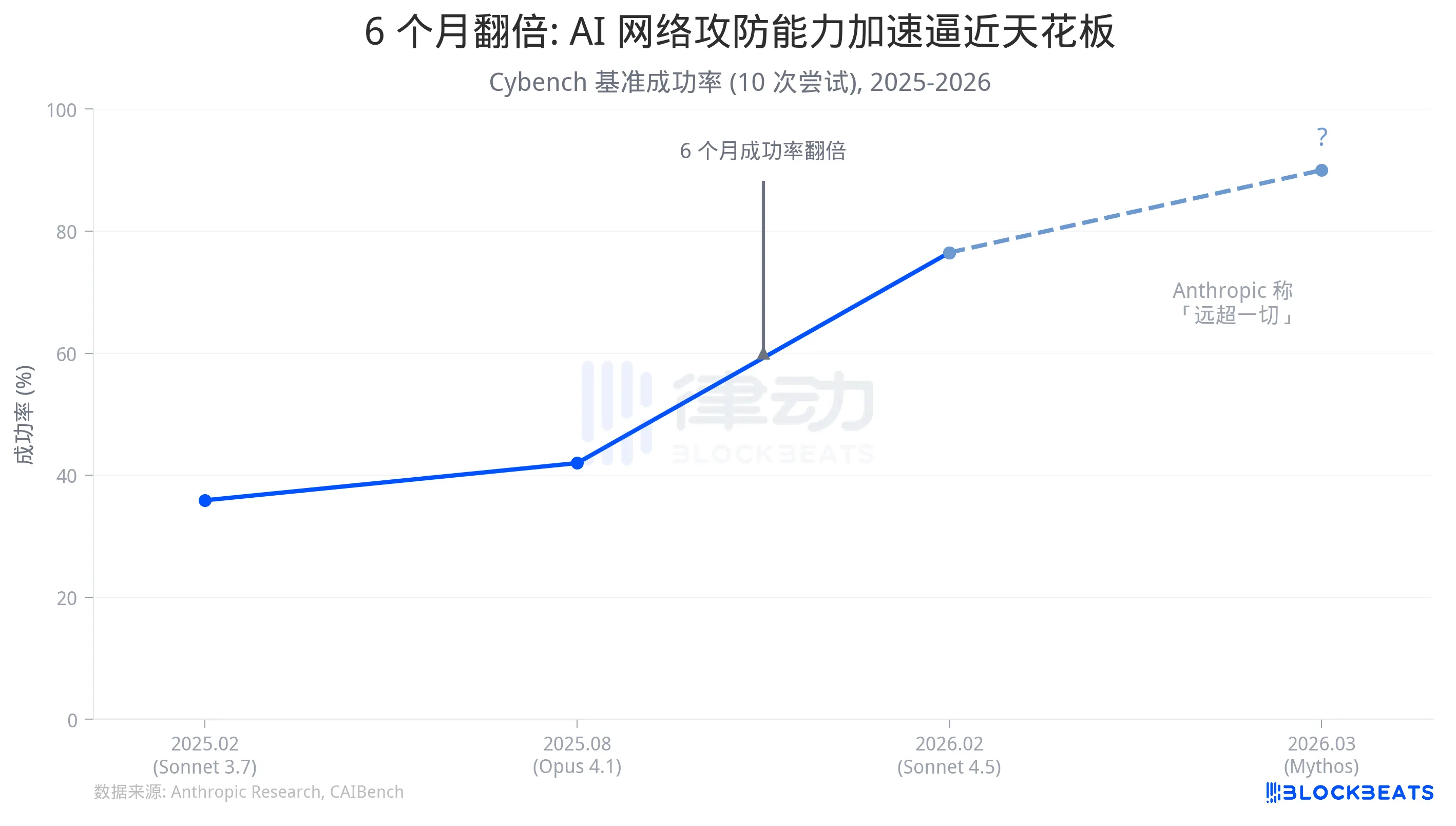
According to Anthropic's official data, Sonnet 3.7, released in February 2025, achieved a 35.9% success rate on Cybench (10 attempts). In the latter half of the same year, Sonnet 4.5 reached 76.5%. The Anthropic research team's conclusion is: within 6 months, the success rate doubled.
What does this speed mean? In a real-world scenario comparison: Claude Opus 4.6 was used to audit the Firefox codebase in March this year. According to InfoQ, 22 security vulnerabilities were discovered within two weeks, with 14 being high-risk. These vulnerabilities had gone undetected despite years of manual audits and millions of hours of CPU fuzz testing. Anthropic's security team previously disclosed that Claude uncovered over 500 high-risk vulnerabilities in multiple production-grade open-source projects, some of which had been present for decades.
And the industry standard timeline for traditional penetration testing is 2 to 3 weeks, and that's just for one application. According to the Verizon 2025 Data Breach Investigations Report, the median time from public disclosure of a critical vulnerability to mass exploitation by attackers is 5 days, with a median time to patch of 32 to 38 days.
The speed at which AI discovers vulnerabilities is growing exponentially, while human patching speed is linear. The difference in time is the attack window.
In the leaked Mythos draft, Anthropic wrote that this model "heralds a coming wave of models that can exploit vulnerabilities in a way far beyond the defender's efforts." Based on the publicly known capability curve, this is not an exaggeration.
The Faster the Release, the More Urgent the Warning
If you put Anthropic's actions over the past three years on a timeline, you will see a clear pattern: every time a stronger model is released, it is quickly followed by a higher level security response.
In July 2023, the White House signed a voluntary pledge, followed by the release of the first Responsible Scaling Policy (RSP v1.0) in September of the same year. In October 2024, the RSP was upgraded to v2.0, adding a threshold for biochemical weapon capabilities. In November 2025, Anthropic disclosed the GTG-1002 incident. A China-backed threat group exploited around 30 organizations using the Claude Code, with AI independently executing 80% to 90% of the tactical operations throughout the operation. This was the first documented large-scale AI-orchestrated inter-organizational espionage campaign.
In February 2026, the RSP updated to v3.0, with the simultaneous release of Claude Code Security. In the same month, the Pentagon labeled Anthropic as a "supply chain risk" because Anthropic refused to lift clauses in the contract prohibiting large-scale surveillance and fully autonomous weapons. A month later, the Mythos leak revealed that Anthropic acknowledged in the draft that this model poses "unprecedented network security risks."
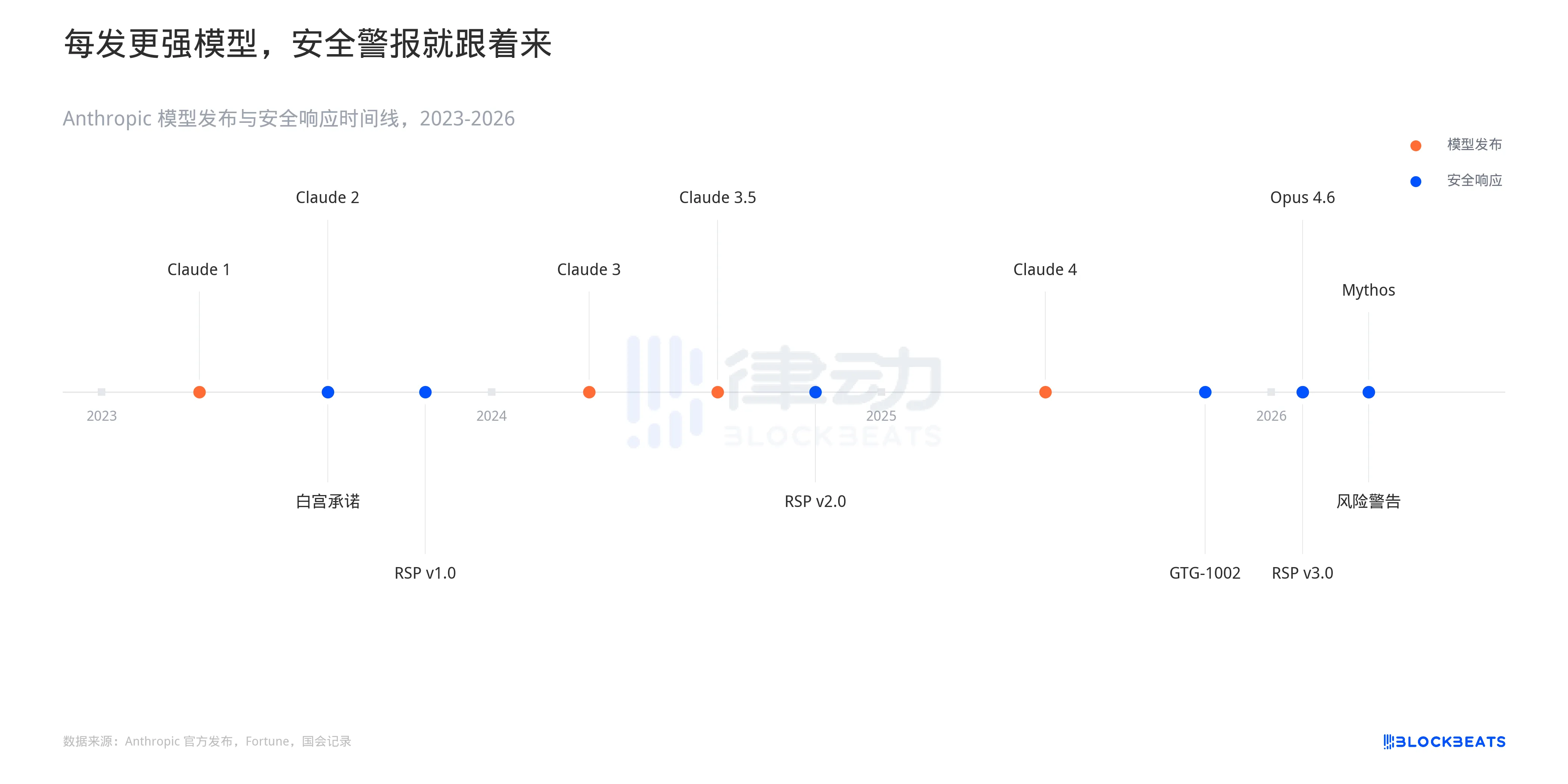
The pace of capability releases is accelerating. There is a one-year gap from Claude 1 to Claude 3, and less than three months from Opus 4.5 to Opus 4.6. Security responses are also accelerating, but they are always reactive: capabilities are exploited first, and policy patches come later. The collective drop in cybersecurity stocks on March 27 is the pricing of this time delta.
A Dark Reading survey earlier this year revealed that 48% of cybersecurity professionals identified AI-powered agents as the top attack vector for 2026. Two years ago, this option was hardly at the top of the list.
Anthropic's Mythos release strategy involves providing early access to defensive organizations, "giving them a first-mover advantage." This statement itself acknowledges the asymmetry of offense and defense. If the defenders do not need a first-mover advantage, it means the attackers have not yet arrived at the doorstep.
-- Price
This content is provided for general informational purposes only and doesn't constitute financial, investment, legal, or tax advice. Any events, rewards, online promotions, or related information mentioned herein should not be considered a recommendation, solicitation, or invitation to purchase, sell, trade, or otherwise deal in any crypto assets. Crypto assets are highly volatile and may result in loss. The availability of WEEX services, products, and related events may vary by region. You are responsible for ensuring that your participation is in accordance with applicable local laws and regulations.
You may also like

Ripple Executive States DeFi Will Open Up to the Masses

CITIC Securities Optimistic About the Development of Domestic Large Models

AI Solves the Origin of NIST Elliptic Curve Seeds

Russia Introduces Technology Fee on Smartphones and Laptops Starting December 1, 2026

Marqeta Partners with Coinbase to Launch Stablecoin Payment Card Service

JPYC EX Cumulative Issuance Exceeds 10 Billion Yen, Listed on Upbit Exchange

JPMorgan Blocks External AI Access to Accounts

Stripe, Mastercard, and Circle Acquire Three Stablecoin Companies in Deals Exceeding $3 Billion

IOSG report highlights fintech firms using crypto as infrastructure

Gennius Partners with Coinbase to Provide Stablecoin Services for Latin American Banks

Japan's Ministry of Finance Proposes Three Types of Government Bond Tokenization

Shawn Owen Discusses Bitcoin Adoption by Banks and Credit Unions

Ripple Enters Leveraged ETF Financial Market
Anchorage Digital Acquires Routable, Integrates Stablecoin Settlements

David Schwartz Describes XRP Ledger Fee Revenue as a Misleading Metric
Median Salary for AI Jobs Reaches 177,000 USD, More Than Double Non-AI Roles

UBS Group is Hiring Two Digital Asset Heads in New York

Stablecoin as Payment Infrastructure for Russia

Superstate Expands Tokenized Short-Duration US Treasury Fund To Base

Base Completes Cobalt Upgrade, Introduces Conditional Trading for Tokenized Assets and Issuer Control Tools

El Salvador Launches Remittance App Sivar with Fixed Fee of $2

Japanese Police Arrest Two Suspects Posing as Police Officers in Fraud Case Involving Approximately 81 Million Yen in Cryptocurrency

Ethereum Research Forum Releases Ethereum TCB Client Article

Bitget Wallet Surpasses 40 Million Global Downloads
Shanghai Financial Regulatory Bureau Explores Privacy Computing and Blockchain Technology for Data Sharing

OpenAI: Apple's Integration of ChatGPT User Conversion Below Expectations

Talmal Closes Pre-Seed Funding Round to Expand in the Saudi Market
Gemini's Market Value Drops to $753 Million, Stock Price Falls by About 80%

106 National Embodied Intelligence Data Collection Centers Established, Over 5,000 Robots
Universal Protocol to Cease Operations on November 17
Ripple Executive States DeFi Will Open Up to the Masses
CITIC Securities Optimistic About the Development of Domestic Large Models
AI Solves the Origin of NIST Elliptic Curve Seeds
Russia Introduces Technology Fee on Smartphones and Laptops Starting December 1, 2026
Marqeta Partners with Coinbase to Launch Stablecoin Payment Card Service
JPYC EX Cumulative Issuance Exceeds 10 Billion Yen, Listed on Upbit Exchange
Contents
Latest articles

Latest coin listings on WEEX


