
The Biggest Enemy of the AI Bull Market Is Not a Bubble, but the Bond Market? Latest Warning from Bank of America’s Hartnett

 Prefer us on Google



Hartnett believes that gold and Bitcoin are quietly bottoming out in 2026, while the bank stock index representing "Main Street" will outperform the brokerage and private equity indices representing "Wall Street" in the second half of the 2020s.
Written by: Dong Jing, Wall Street Insights
The bond market is becoming the most dangerous variable for the AI bull market.
On July 27, Michael Hartnett, Chief Investment Strategist at Bank of America, issued a warning in the latest Flow Show report: the yield on 30-year U.S. Treasuries has risen to 5.2%, the highest level since June 2007, while the real yield has reached a peak of 3% since November 2008. The prices of U.S. tech bonds have fallen to a two-year low—financial conditions are tightening to a degree that surpasses the support provided by corporate earnings for the market.
Hartnett's core judgment is that the pressure in the bond market will not dissipate on its own; rather, it may force the Federal Reserve to raise interest rates, which is precisely the outcome the stock market fears the most. He warns that if the bull market combination of "rising bond yields and rising bank stocks" flips to "higher yields and falling bank stocks," it will trigger a new round of deleveraging in risk assets.
Meanwhile, the credit default swaps (CDS) of hyperscale cloud computing companies have risen to historical highs, as bondholders are voting with their feet, questioning the return logic of the AI capital expenditure frenzy.
The background of this warning is that chip stocks were still sold off after Google and Intel released solid earnings reports. The market's real concern has shifted from "Can we make money?" to "Who will foot the bill?"—if the bond market no longer funds the AI feast, where will the money come from for those overpriced memory chips and negative-return frontier models?
Bond Market Pressure Exceeds Earnings, Financial Conditions Become the Core Variable
Hartnett explicitly presents the core framework of "FCI > EPS" in the report, indicating that the tightening of the Financial Conditions Index (FCI) has impacted the market more than corporate earnings (EPS) can support it.
The nominal yield on 30-year U.S. Treasuries has reached 5.2%, the highest since June 2007; the real yield has risen to 3%, the highest since November 2008; and the prices of U.S. tech bonds have fallen to a two-year low. The combination of these three indicators means that the market's financing costs are systematically rising, and this pressure has not yet been fully priced in by equity investors.
Hartnett points out that there have been 23 central bank interest rate hikes globally so far in 2026, and Bank of America expects another 18 before the end of the year. More notably, the implied probability of a rate hike at the Federal Reserve's meeting on July 29 has risen to 38%, and the meeting on September 16 has fully priced in a rate hike. He even throws out a provocative judgment in the report:
"Politically, it is smarter for the Fed to raise rates this week than to wait until September, isn’t it?"
Hartnett's logic chain points to a paradoxical conclusion: the pressure in the bond market may force the Federal Reserve to stabilize long-term rates through interest rate hikes. He believes that the resolution of this situation can only rely on the Fed raising rates to suppress the disorderly rise of long-term yields.
However, raising rates is not good news for the stock market. Hartnett warns that we need to closely monitor whether the bull market combination of "rising yields and rising bank stocks" flips to "higher yields and falling bank stocks"—once it flips, it will trigger deleveraging in risk assets. In this scenario, he believes that going long on the dollar is the best hedge against the Fed's hawkish stance.
He also points out that equity investors have not yet viewed the current interest rate levels as a threat to the "Anything But Bonds" bull market, but if the pro-market Trump administration tolerates rate hikes to "hit the brakes" on the stock market and anti-billionaire sentiment, the market will face significant negative shocks.
Record Credit Risk for Hyperscale Cloud Providers, AI Capital Expenditure Logic Questioned
The most direct manifestation of bond market pressure is the sharp deterioration of credit risk indicators for hyperscale cloud computing companies. According to the report, the credit spreads of hyperscale cloud service providers have widened significantly, with CDS reaching historical highs, and the concessions on bond issuances are also continuing to expand.
The root of this phenomenon lies in the market's skepticism about the return on investment (ROI) of AI capital expenditures. Google and Tesla are seen as benchmark companies for "capital expenditure ROI"; despite solid earnings reports from Google and Intel last week, chip stocks were still sold off. The core question raised by the market is:
If bondholders are no longer willing to foot the bill for the AI feast, those frontier models and memory chips that heavily rely on continuous capital investment will face the risk of funding breakage.
Hartnett previously resonated with Goldman Sachs' top derivatives trader Brian Garrett's judgment— the real risk of AI stocks does not lie within the stock market, but in the bond market. Garrett had previously warned for two consecutive weeks that the pain in the credit market would intensify, pointing out that the S&P 500 index is becoming increasingly difficult to represent the performance of ordinary stocks, with market internal differentiation (low correlation, high dispersion) intensifying.
Additionally, Hartnett views "blue-collar semiconductors"—namely Texas Instruments, Analog Devices, NXP, Microchip, ON, STMicroelectronics, Infineon, and Monolithic Power—as leading indicators of the industrial cycle. This combination has cumulatively fallen 21% since its peak in June.
Meanwhile, hyperscale tech giants (MAGS) are struggling to hold the 200-day moving average support level (65 USD), which challenges the widely held consensus of "prosperity" in the market. Bank of America’s July fund manager survey shows that investors’ overweight in industrial stocks is at its highest level since July 2021.
In response to the above signals, Hartnett's short-term trading advice is to go long on defensive stocks, high-dividend stocks, and long-duration bonds, while shorting bank stocks (which have seen significant inflows recently), brokerage stocks, tech stocks, and industrial stocks to cope with the reversal of "prosperity" expectations.
Dual Pressure on Bond and Stock Supply, Gold and Bitcoin Quietly Bottoming Out
From a more macro perspective, Hartnett characterizes the 2020s as an era of rising political populism, globalization yielding to national security, fiscal surpluses turning into AI capital expenditure surpluses, the Federal Reserve's independence yielding to political compromise, and U.S. exceptionalism evolving into global rebalancing.
In this context, "supply" rather than "demand" has become the main driving force of the macro and market. This is specifically reflected in three aspects:
Immigration controls are compressing labor supply (the number of initial jobless claims in the U.S. has fallen to the lowest level since 1969); protectionism and tariffs are restricting import supply (the U.S. plans to impose new tariffs on 60 trading partners); geopolitical disturbances are affecting oil supply (of the approximately 80 million barrels/day of seaborne oil globally, about 64 million barrels pass through vulnerable chokepoints such as the Strait of Hormuz and the Malacca Strait).
In contrast, the constraints on bond supply and stock supply are loosening. The U.S. government still maintains an annual fiscal deficit of 2 trillion USD, with annual interest expenses reaching 1 trillion USD. Even though tariff revenues have reached 250 billion USD in the past 12 months, it is still difficult to fill the gap. Companies with negative free cash flow are reducing stock buybacks, further compressing the stock supply support.
In this context, Hartnett believes that gold and Bitcoin are quietly bottoming out in 2026, while the bank stock index representing "Main Street" will outperform the brokerage and private equity indices representing "Wall Street" in the second half of the 2020s.
Additionally, he lists Hong Kong real estate stocks as one of the most attractive long-term buying opportunities—these stocks are currently priced at the same level as 30 years ago, and he states that he will buy on dips during any declines triggered by Fed tightening or a crisis in the Japanese central bank's exchange rate.
-- Price
This content is provided for general informational purposes only and doesn't constitute financial, investment, legal, or tax advice. Any events, rewards, online promotions, or related information mentioned herein should not be considered a recommendation, solicitation, or invitation to purchase, sell, trade, or otherwise deal in any crypto assets. Crypto assets are highly volatile and may result in loss. The availability of WEEX services, products, and related events may vary by region. You are responsible for ensuring that your participation is in accordance with applicable local laws and regulations.
You may also like

BBVA and Santander of Spain lend 150 million euros through decentralized network

Number of Tokenized Stock Wallets on Solana Reaches 1.4 Million

Jito Labs Co-founder Claims Increase in Front-running and Sandwich Attacks on Solana
XRP holders can now earn fees from Kraken’s DeFi customers, but there is a catch

Variant Investment Partner: In the Second Half of the Bull Market, Which Two Camps Are Marginal Dollars Flowing To?
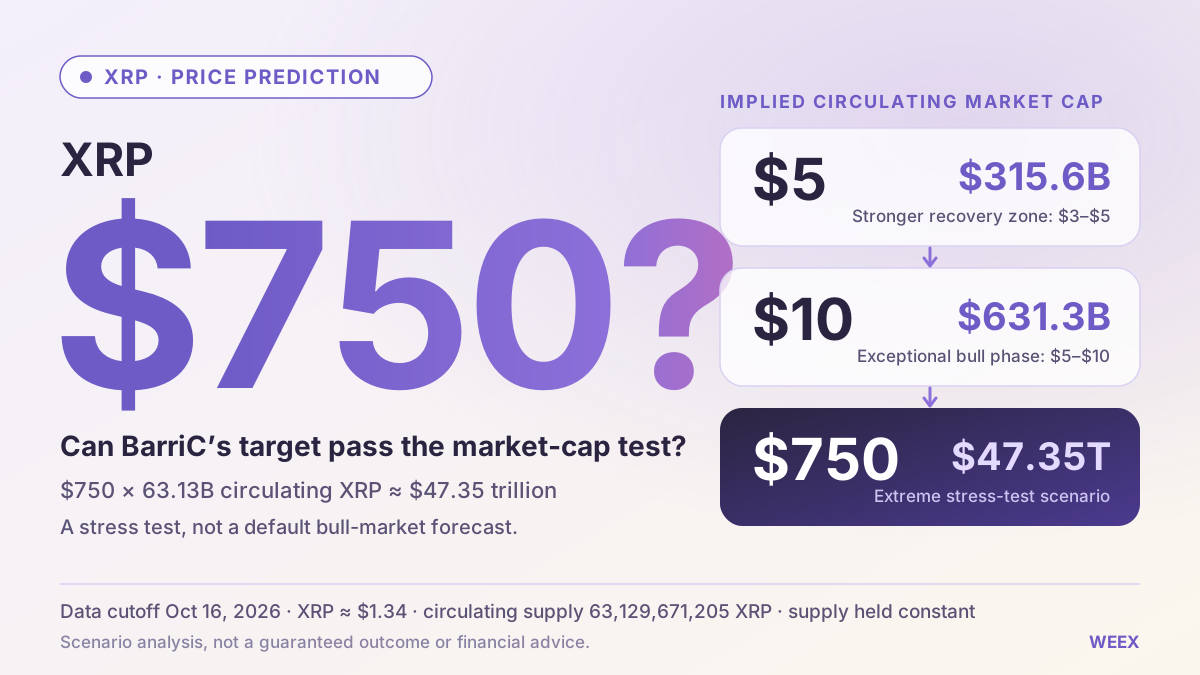
XRP (XRP) Price Prediction: Can BarriC’s $750 Target Pass the Market-Cap Test?
XRP price prediction: examine BarriC’s $750 target, market-cap math, next-bull-run scenarios, token demand and what could support a recovery to $5.

CITIC Securities: Market Overestimation of CoreWeave Concerns, New Cloud Providers' Short-Term Funding Gap 'Still Manageable'

Financing Weekly Report | Fission Completes $10 Million Series A Financing Led by Pantera Capital; DeepSeek Plans to Raise Approximately 100 Billion Yuan in New Financing

The Six-Year Tug of War Between Privacy and Regulation

Goldman Sachs Throws Out 'Chilling Chart': Either the Bond Market is 'Overly Pessimistic' or the Stock Market is 'Too Optimistic'

Ethereum Staking Outflows May Exceed New Inflows

Bitcoin or Dollar Returns: Same Strategy, Opposite Results

BitTorrent Ushers in Next-Gen Web3 Infrastructure with Strategic Rebrand and Inaugural BTT Burn

Cysic Cross-Chain Bridge Attacked, Hacker Minted 10 Million CYS

Bank of America’s Hartnett: Sell Signal Ends, Tech Stocks Return to Focus on Semiconductor Prices

Kraken's New Leader, After Acquiring European Bank, Aims to Disrupt the Crypto Market?

Mr&强 Discusses the Interconnection of Five Major Assets in the Global Financial Market

唐华斑竹 Analyzes Market Trends, BTC Futures Open Interest Remains High
BitTorrent Brand Upgrade and BTT First Phase Buyback and Burn Launch Together, Dual Core Drives a New Era of Web3 Infrastructure

Arthur Hayes Reveals Altcoin Selection Logic, Emphasizes Accumulating Bitcoin
Vitalik, Tom Lee, Arthur Hayes and Others Share Views on Cryptocurrency and AI

Multiple Theft Incidents Fund Flow into ZEC, Attackers Use It to Transfer Stolen Funds

[CoreWeave, AI Crisis Trigger ③] Lessons from the 2008 Financial Crisis
Pago Móvil Reaches 63% of Transactions in Venezuela, Competing with USDT

Analysts Bullish on MicroStrategy, Target Price Raised to $240

Bank of America Report Shows $39 Billion Inflow into US Stocks in One Week, Strategists Prefer Risk Aversion
MSCI New Rules Implemented, 14 Crypto Companies Enter Potential Impact List

What Do the New Tesla Roadster Specs Mean for Tesla (TSLA) Stock?
Explore the new Tesla Roadster specs, reservation payments and 2028 production plan, plus what the reveal could mean for Tesla stock and future profits.

Quant (QNT) Price Prediction 2026–2030: Can Bank Adoption Drive a Return to $500?

Spout raises $2M to offer 0% interest loans on Solana
BBVA and Santander of Spain lend 150 million euros through decentralized network
Number of Tokenized Stock Wallets on Solana Reaches 1.4 Million
Jito Labs Co-founder Claims Increase in Front-running and Sandwich Attacks on Solana
XRP holders can now earn fees from Kraken’s DeFi customers, but there is a catch
Variant Investment Partner: In the Second Half of the Bull Market, Which Two Camps Are Marginal Dollars Flowing To?
XRP (XRP) Price Prediction: Can BarriC’s $750 Target Pass the Market-Cap Test?
XRP price prediction: examine BarriC’s $750 target, market-cap math, next-bull-run scenarios, token demand and what could support a recovery to $5.
Contents
Latest articles


Latest coin listings on WEEX


