Solana’s Yakovenko questions Alpenglow build as vote transactions exit

 Prefer us on Google


Solana co-founder Anatoly Yakovenko has said Alpenglow could have shipped in half the time through a simpler vote-program change, ahead of the Oct. 21 consensus migration that will remove validator vote transactions from blocks.
Summary
- Yakovenko said a simpler vote-program change could have halved Alpenglow's development time.
- Removing validator vote transactions will lower headline TPS counts without necessarily changing user activity.
- A burned 0.8 SOL admission fee per epoch will replace individual voting fees.
- Some RPC nodes may receive finality updates later than Alpenglow's 150-millisecond target.
Yakovenko, in an Oct. 21 X post, made the remark while quoting a comment celebrating the planned removal of on-chain votes and mocking the recurring criticism that most Solana transactions per second consist of validator votes.
"Alpenglow would have shipped in half the time if they just changed the vote program to the ag state machine"
Anza's published design describes a replacement for TowerBFT, the system validators have used to agree on blocks, with direct voting and compact certificates.
The mainnet migration has been scheduled for Oct. 21, as crypto.news previously reported while covering the planned consensus handoff. Solana Foundation's updated guidance identifies epoch 1064 as the trigger and estimates its start at approximately 13:20 UTC.
Anza's migration page separates feature activation from the consensus handoff. The migration boundary comes 5,000 slots later, when blocks temporarily carry only votes while validators complete the transition.
Alpenglow removes votes from headline transaction counts
Solana Foundation's migration guidance tells explorers and analytics services to reset transaction-count and TPS baselines because vote transactions will disappear from blocks. A total that includes votes will fall even if payments, trades, and other non-vote transactions remain unchanged.
The Foundation says services tracking validator participation must replace their reading of Vote program instructions with certificate data in block footers. Its guidance notes that Yellowstone's gRPC footer message does not yet forward those certificates.
Developers had access to the changed behavior when Alpenglow reached devnet in September, after the testnet transition. The Sep. 26 coverage described how explorers must keep competing candidate blocks separate until confirmation, retaining the selected block instead of combining their transactions.
Anza's operator documentation explains how plugins obtain the replacement metadata. Agave 4.3 provides an optional block-footer notification, which services must enable and implement if they need footer data. Those notifications retain their ordering relative to entry notifications.
Under the same documentation, the chain's clock keeps its existing format and whole-second precision. During transaction execution, its timestamp estimates when the parent block ended, and operators are told to keep treating that value as approximate.
Validator fees move to a separate epoch charge
Solana Foundation's fee documentation says removing on-chain votes ends fees paid on individual vote transactions. Validators instead pay a flat 0.8 SOL admission charge per epoch, with the entire amount burned.
The money comes from the vote account, replacing the identity account as the source of voting-related payments. Operators must hold the charge above the account's rent-exempt minimum, according to the same guidance.
Payment is made one epoch ahead. The first charge at the start of epoch 1064 covers participation in epoch 1065, and a validator that cannot pay loses permission to vote or produce blocks in the following epoch.
The Foundation says BLS public-key registration became available on mainnet July 8, while the admission feature activated July 22. Those preparatory changes did not themselves activate Alpenglow consensus.
Before the migration, its checklist requires version 4.3.2 of Agave, Jito-Solana, or Harmonic Salsa. Firedancer and Frankendancer are not supported during the handoff, according to the Foundation's operator instructions.
Two voting paths replace TowerBFT
Anza describes Votor as running two voting paths at the same time. One finalizes a block in a single round with responses from 80% of stake, while the second uses two rounds and 60% thresholds.
Votes become direct messages signed with BLS cryptography, allowing multiple signatures to be combined into a compact certificate. Anza says validators use their own timers to identify an unresponsive leader and vote to skip it.
The published SIMD-0326 proposal documents alternatives considered during development. A design without single-round finality offered simpler operation and 33% Byzantine fault tolerance, but its authors listed worse latency and lower crash resilience among the disadvantages.
Another alternative used a directed acyclic graph, with possible bandwidth savings. The proposal's authors listed latency and difficulty using bandwidth fully among its drawbacks.
The proposal caps the admitted set at 2,000 validators, prioritizing the highest-staked operators. Its authors explain that the limit helps keep certificates small enough for a single UDP message, while participation records support rewards for validators that actively vote.
Governance approval preceded implementation. In September 2025, the Alpenglow proposal passed with 98.27% support among votes cast, while participating stake represented 52% of the total, according to the completed ballot's published figures.
-- Price
RPC delivery can lag behind consensus finality
Anza's operator documentation qualifies the roughly 150-millisecond finality target by explaining that nodes outside the admitted validator set may receive the result later.
Through the default path, those nodes learn finality from certificates included in a subsequent block. Anza says that can add up to one produced-block interval, with longer waits when blocks are skipped or delayed.
An admitted validator can send consensus messages directly to a partner node, leaving network latency between the partners as the main added delay. If every configured partner becomes unreachable, the recipient falls back to learning finality from later block footers.
This content is provided for general informational purposes only and doesn't constitute financial, investment, legal, or tax advice. Any events, rewards, online promotions, or related information mentioned herein should not be considered a recommendation, solicitation, or invitation to purchase, sell, trade, or otherwise deal in any crypto assets. Crypto assets are highly volatile and may result in loss. The availability of WEEX services, products, and related events may vary by region. You are responsible for ensuring that your participation is in accordance with applicable local laws and regulations.
You may also like

Bitcoin: JPMorgan Sees It Outperforming Stocks and Gold in the Long Term

Tether joins Tenstorrent’s $1.5B round as AI investments grow

110 wallets account for 99.6% of RLUSD payments on XRP Ledger

Raised US$28 million and now seeking to expand in Argentina and other Latin American countries

Claude Pushes Bitcoin and Banks to Accelerate in 53 Hours

Capital as Production Capacity: Where Did the Money of the Top 100 VC and CVC in the U.S. Go in the First Three Quarters of 2026?
Strive Surpasses Saylor in Bitcoin Purchases: What Is This Company?

Charles Hoskinson's Meme Coin Plummets Over 90% in Just Hours

After Disassembling a Genuine Ledger, TBC Discusses the True Boundaries of Self-Custody
Unitree Stock Surges: Why Shares Jumped 16% on October 19 and What Investors Should Check Before Q3 Results

SpaceX Stock Price Explained: Why SPCX Is Down From Its $225 High and What Could Move It Next
21shares launches Lighter, Venice crypto ETPs in Europe

Stablecoins Have Solved On-Chain Settlement, But How Do They Enter Merchant Checkout?
CFTC Chair: Breaking State-Level Fragmentation to Make the U.S. a Global Crypto Hub
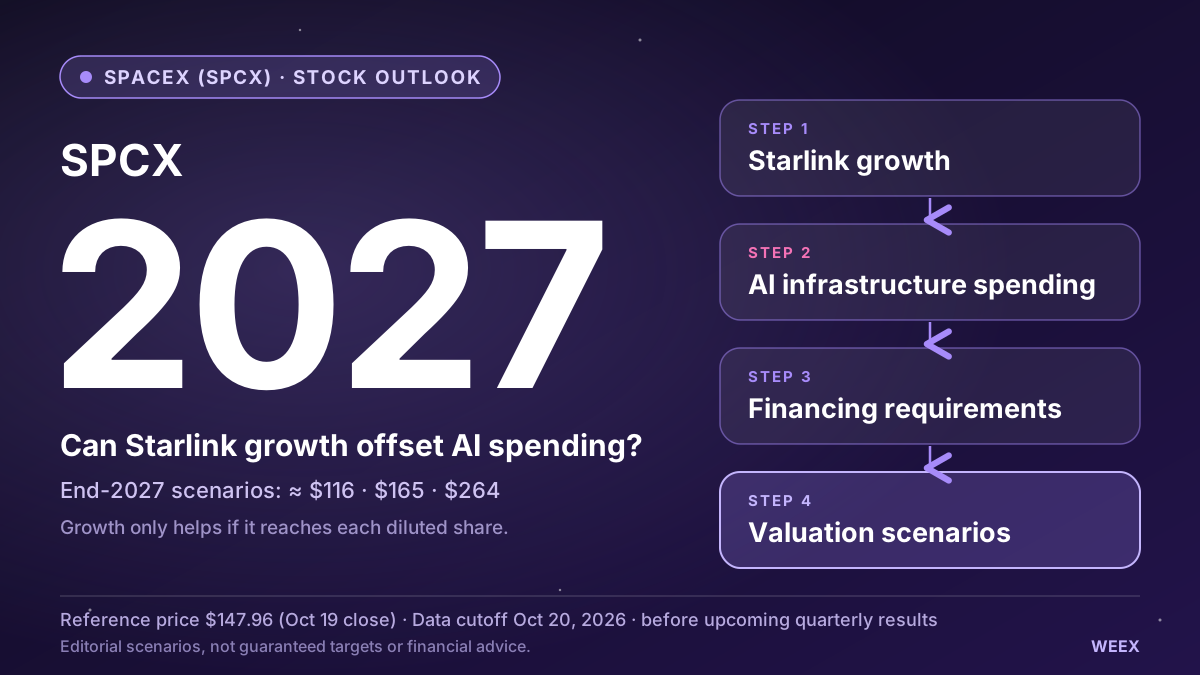
SpaceX Stock(SPCX) Price Prediction 2027: Can Starlink Growth Offset AI Spending?
SpaceX stock price prediction for 2027: assess Starlink growth, AI spending, valuation compression and dilution through transparent price scenarios.
a16z Talks to Circle Founder: Arc is More Than Just a Public Chain, It is the Foundation of the Machine Economy
NDV: Where Did the Money Go? A Review of the 16 Years of Stagflation and Wealth Erosion in the United States
Danantara Boosts Economy 30-Fold Through Technology - Fintech World
What Is Messari? Crypto Research, Blockworks Integration and Investor Tools
How Did Myer Kripke Invest With Warren Buffett? Long-Term Investing Lessons
Bitcoin (BTC) Mining Profitability: Will Higher Difficulty Trigger Miner Selling?

In the Winter of Blockchain Games, "$8 Million Sold in 30 Seconds" - A New Speculative Game on Robinhood

Kerman Kohli: The Bottleneck in Computing Financing Lies in Credit

Banking Coalition Gathers: Stablecoin Market Faces Structural Shock
AI 'Challenges' Cryptography? Web3 Must Prepare in Advance, But Should Never Rush Migration

Brooklyn's 'Crypto Hunters': A Cross-National Scam Chase Across Three Time Zones
Without diesel subsidies and with a shortage of dollars, Bolivia protests and adopts USDT

XRP Opens X Account After 10 Years, Gains 47,000 Followers on First Post
Circle cites 175+ institutions as CPN wins Money20/20 payments bronze

The Architecture Of Money: Mapping Financial Power In The Age Of Bitcoin
Bitcoin: JPMorgan Sees It Outperforming Stocks and Gold in the Long Term
Tether joins Tenstorrent’s $1.5B round as AI investments grow
110 wallets account for 99.6% of RLUSD payments on XRP Ledger
Raised US$28 million and now seeking to expand in Argentina and other Latin American countries
Claude Pushes Bitcoin and Banks to Accelerate in 53 Hours
Capital as Production Capacity: Where Did the Money of the Top 100 VC and CVC in the U.S. Go in the First Three Quarters of 2026?