Post-quantum Bitcoin Protection: QuFi Tests Bitcoin Security Without Blockchain Changes

 Prefer us on Google


Post-quantum Bitcoin protection from QuFi Network demonstrates how digital assets can be prepared for future quantum risks without rewriting existing settlement networks. The company launched a post-quantum verification platform and showcased its operation on Bitcoin Testnet4. The overall principle of this protection is to preemptively replace or supplement vulnerable cryptographic elements with more robust schemes, without disrupting the operation of the network and wallets.
Verification Beyond the Blockchain
The main idea of QuFi Network is not to force the blockchain itself to perform all the heavy cryptographic work. The platform separates the verification of an operation from its final execution: independent nodes conduct cryptographic verification in advance and then transmit a compact proof to the network.
This approach is intended to reduce the load on base networks if they need to transition to post-quantum cryptography. Post-quantum schemes often require more data, computations, and resources than traditional public key cryptography mechanisms, so directly embedding new signatures into each blockchain could increase storage, bandwidth, and transaction processing requirements. In addition to the load, migration may face compatibility issues with wallets, exchanges, bridges, and nodes: users will need to update tools, carefully transfer keys, and avoid errors when transitioning to new formats.
QuFi Network relies on standards prepared under the initiative of the National Institute of Standards and Technology. NIST acts as the coordinator for standardization in this area: it collects candidates, opens them for public cryptanalysis, compares their resilience and practicality, and then approves the selected algorithms as standards.
If we break down the schemes used by QuFi Network by roles, we get the following picture:
- ML-DSA-65 --- lattice cryptography; digital signature; NIST standardization.
- SLH-DSA --- hash signatures; additional digital signature scheme; NIST standardization.
- ML-KEM-1024 --- lattice cryptography; secure key exchange; NIST standardization.
- Kyber --- a benchmark for post-quantum key exchange in the same area.
Among the well-known families of post-quantum algorithms, Dilithium, Falcon, and SPHINCS+ are also frequently mentioned. Dilithium and Falcon belong to lattice signatures: their resilience is based on problems that are considered difficult for quantum attacks. SPHINCS+ uses hash signatures and does not rely on lattices, but generally requires heavier signatures and careful tuning.
How QuFi Network Tested the System on Bitcoin
For demonstration, the team created uBTC --- a proof-of-concept that verifies the presence of BTC as collateral and generates cryptographic proofs for subsequent value transfer. The full cycle of uBTC includes issuance, burning, and redemption.
All of this operates on Bitcoin Testnet4. Upon redemption, the funds are ultimately sent via a regular Bitcoin transaction, which can be independently verified on the network. The protocol of the first cryptocurrency has not changed in this process.
This is where the key boundary lies between QuFi Network's approach and attempts to directly embed post-quantum algorithms into the blockchain. Some post-quantum signatures are significantly larger than traditional ones, which can increase the requirements for storage, communication channels, and transaction processing on nodes. Among other approaches to securing Bitcoin, updating signature rules at the protocol level, hybrid schemes with classical and post-quantum cryptography, additional layers of verification, and more cautious key management in wallets are typically considered.
Why Quantum Threat is Important for the Crypto Market
Post-quantum cryptography is a set of algorithms that are expected to remain secure even against attacks using powerful quantum computers. It is important because some classical protection schemes are based on mathematical problems that quantum algorithms can theoretically solve much faster than classical computers.
This refers to a scenario known in the industry as the quantum threat. Quantum computing changes the risk model for computer security: a sufficiently powerful computer with stable physical and logical qubits could theoretically attack several classical schemes, including RSA through integer factorization and elliptic curve cryptography through discrete logarithms. In this context, Shor's algorithm, qubits, cryptanalysis, and logarithms are often mentioned.
Such computers will not become a practical threat to old schemes simply after an increase in the number of qubits, but when stable logical qubits, working error correction, available computational power, and effective implementation of attack algorithms emerge. Therefore, the timelines are usually described as long-term and dependent on progress in hardware, engineering, and cryptanalysis, but preparations must begin in advance: replacing cryptography in wallets, protocols, and financial infrastructure takes a lot of time.
For cryptocurrencies, several levels of protection are critical:
- Signatures.
- Key management.
- Authentication.
- Privacy.
- Protection of cryptocurrency wallets.
- Public key certificates.
- Communication protocols.
- Cryptographic protocols.
- Key exchange.
- Diffie-Hellman key exchange.
Vulnerabilities at any of these levels can affect wallets, communication channels, and cryptographic protocols. A specific risk is known as "Harvest now, decrypt later": an attacker collects encrypted data in advance to decrypt it later when suitable hardware becomes available. Protection against such a scenario is built on transitioning to post-quantum or hybrid encryption schemes, regularly updating protocols, reducing the lifespan of sensitive data, and careful key rotation.
Transitioning to post-quantum cryptography should begin early: digital assets must remain protected not only today but also when quantum attacks become a practical risk.
In this context, encryption remains a multi-layered task. Symmetric methods like the Advanced Encryption Standard and symmetric algorithms are considered a separate class of protection, while cryptographic hash functions help build proofs and verification schemes. Hardware security modules and zero-knowledge proofs can also be applied in the infrastructure, but QuFi Network focuses specifically on a separate layer of post-quantum verification for different networks.
While This is a Test Environment, Not a Mainnet Protection
It is still too early to talk about full post-quantum protection for Bitcoin: the test was conducted in a testnet, not in the main network. QuFi Network plans to expand the solution to EVM networks, Stellar, and Solana.
Bitcoin users currently do not need to change the protocol themselves or transfer funds to experimental schemes. Practical steps are simpler: keep an eye on wallet updates, securely store seed phrases and keys, avoid disclosing public keys unnecessarily, and, if possible, do not keep large amounts for long on addresses from which transactions have already been sent, and prepare for migration when verified solutions become available in main wallets.
The company has also launched a Genesis Node program for operators who will support a decentralized verification network. In the future, QuFi Network expects to use a single verification layer for multiple blockchains and financial systems.
In August, StarkWare conducted the first quantum-resistant transaction on the Bitcoin mainnet. Various market participants and technology stakeholders, including Google, the Ethereum Foundation, and Coinbase, are involved in broader research around this topic. For other networks, preparation typically begins with testnets, verification of new signatures, hybrid schemes, and wallet updates, as resilience to quantum risks is gradually becoming part of the long-term agenda for cryptocurrencies and digital asset infrastructure.
-- Price
This content is provided for general informational purposes only and doesn't constitute financial, investment, legal, or tax advice. Any events, rewards, online promotions, or related information mentioned herein should not be considered a recommendation, solicitation, or invitation to purchase, sell, trade, or otherwise deal in any crypto assets. Crypto assets are highly volatile and may result in loss. The availability of WEEX services, products, and related events may vary by region. You are responsible for ensuring that your participation is in accordance with applicable local laws and regulations.
You may also like

BingX, YouHodler and Santander’s Openbank join EU MiCA register

QCP: AI Credit Risk Heats Up, Bitcoin May Face Range Breakthrough

French National Assembly Passes Tax Amendment on Stablecoin Transactions, Effective 2027

Bitcoin miner stocks driven by AI sentiment, not BTC prices
Black Monday Posts Break Records
Bitcoin Recovery Faces Challenges as Exchange Reserves Rise and Spot Demand Turns Negative
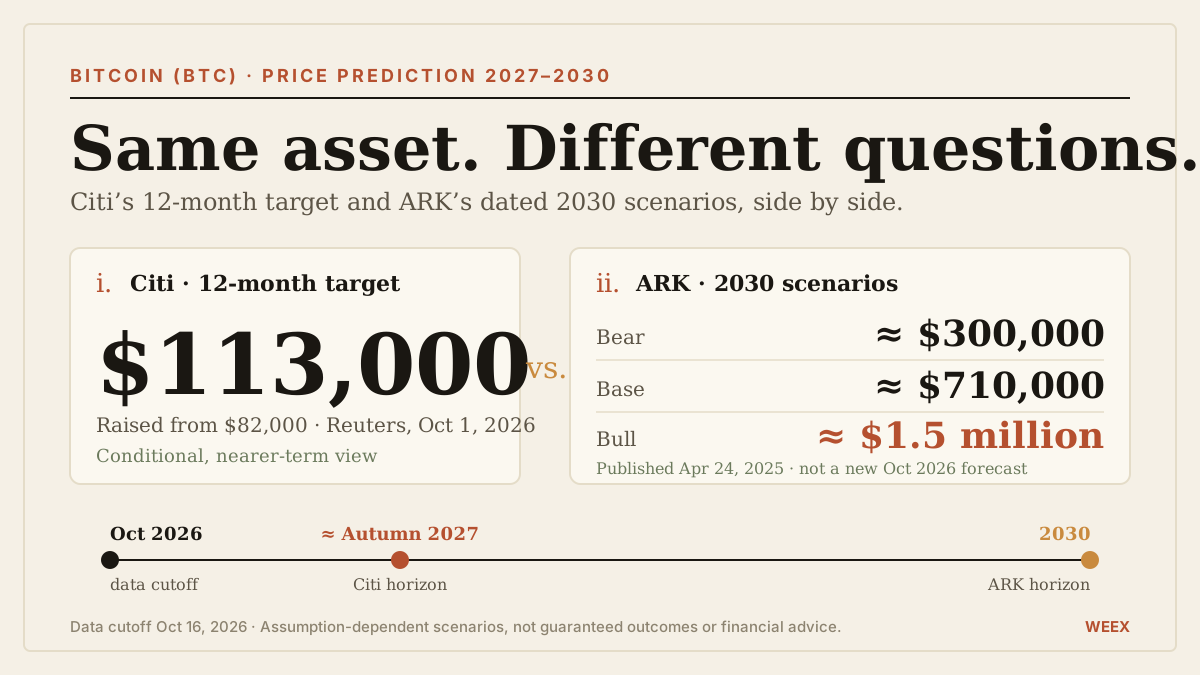
Bitcoin (BTC) Price Prediction 2027–2030: Citi’s $113,000 Target vs. Cathie Wood’s ARK Scenarios
Bitcoin price prediction for 2027–2030: compare Citi’s $113,000 target with ARK’s dated scenarios, demand assumptions, valuation math and key risks.

Mr&强 Analyzes BTC and ETH Short-Term Strategies

Bitcoin futures open interest declines, signaling weaker demand

Cathie Wood Predicts Long-Term Growth for Bitcoin Despite Dollar Strength
Peter Schiff Predicts Bitcoin Crash Over 99%
Liquidity in Cryptocurrency Market Approaches a Turning Point! Circle Aims to Enter 40 Emerging Markets

One dead, Qonto in flames, Nuñez resigns: why the streets worry crypto investors

Security Vulnerability Detected in ILITY Network, Cross-Chain Bridge Suspended

Bitcoin Spot ETF Sees Net Outflow of $229 Million Last Week, BlackRock's IBIT Leads with $165 Million Outflow

Morgan Stanley Recommends Up to 4% in Cryptocurrencies for Aggressive Portfolios

Deutsche Bank to Start Bitcoin and Ethereum Custody Within Weeks — Expansion to Asia by 2027

Bitcoin Ranges After Weekly Low Sweep| WEEX TradFi Daily(October 19, 2026)
Early on October 19, equity futures rebounded from last week’s chip selloff. Major indexes closed lower last week, the Nasdaq posted its worst week since June, the semiconductor ETF fell about 10%, and CoreWeave lost about 25%, while energy stocks were relatively resilient. Bitcoin traded near $82,000 after sweeping lows around $80,000, with markets watching the $79,800 and $83,600 zones.
WEEX Exclusive:Bitcoin Ranges After Weekly Low Sweep| WEEX TradFi Daily(October 19, 2026)
ECB: Lagarde defends rate hikes before the IMF and urges Brussels on digital euro

Sam Price Discusses Bitcoin Market Divergence

唐华斑竹 Analyzes Bitcoin Trends, Suggests Monitoring Support Levels

Saylor Envisions Bitcoin-Backed Stablecoin with Annual Yield of 6% to 8%

Strive CEO Emphasizes Going Long on Bitcoin and Short on USD, Claims Currency Depreciation is Irreversible

Bloomberg analyst warns BTC 50-week average decline may signal stock and metal downturns

Sam Price Focuses on Strategy Stock Price Drop and MSCI Index Adjustment
US Institutions See Net Inflows in Bitcoin as Demand for Dollar-Based Stablecoins Grows
Sam Price Focuses on the Hormuz Strait Tanker Incident, Crude Oil Prices Fluctuate
$4.8 Million Bitcoin Stolen from Scammer with Manipulated Ledger Wallet

Sazmining Offers Proto Hashboards at 4187 Dollars Each
BingX, YouHodler and Santander’s Openbank join EU MiCA register
QCP: AI Credit Risk Heats Up, Bitcoin May Face Range Breakthrough
French National Assembly Passes Tax Amendment on Stablecoin Transactions, Effective 2027
Bitcoin miner stocks driven by AI sentiment, not BTC prices
Black Monday Posts Break Records
Bitcoin Recovery Faces Challenges as Exchange Reserves Rise and Spot Demand Turns Negative