
Polymarket Sponsors Golden Joystick Awards, Predicts How Hollywood Turns into Odds Table


Original Title: Polymarket's eye-watering brush with the 1958 Onion Futures Act
Original Authors: George Steer and Anna Nicolaou, Financial Times
Translation: Peggy, BlockBeats
Editor's Note: As the red carpet of the Golden Globe Awards increasingly resembles a "carefully choreographed business of eyeballs," this year's biggest innovation was its sponsorship by the prediction market Polymarket. Starting from this collaboration, this article traces back to the history of the "Onion Futures Act" and the ban on box office futures, revealing how prediction markets navigate regulatory boundaries through both US-based and offshore platforms.
The following is the original text:
Sunday's Golden Globe Awards ceremony proceeded as usual, with tired jokes and political performances. Perhaps the only novelty this year was the sponsorship of this "performance" by the betting site Polymarket.
For the tens of viewers watching the live broadcast at home, the presence of Polymarket as the ceremony's "exclusive prediction market partner" was hard to overlook:
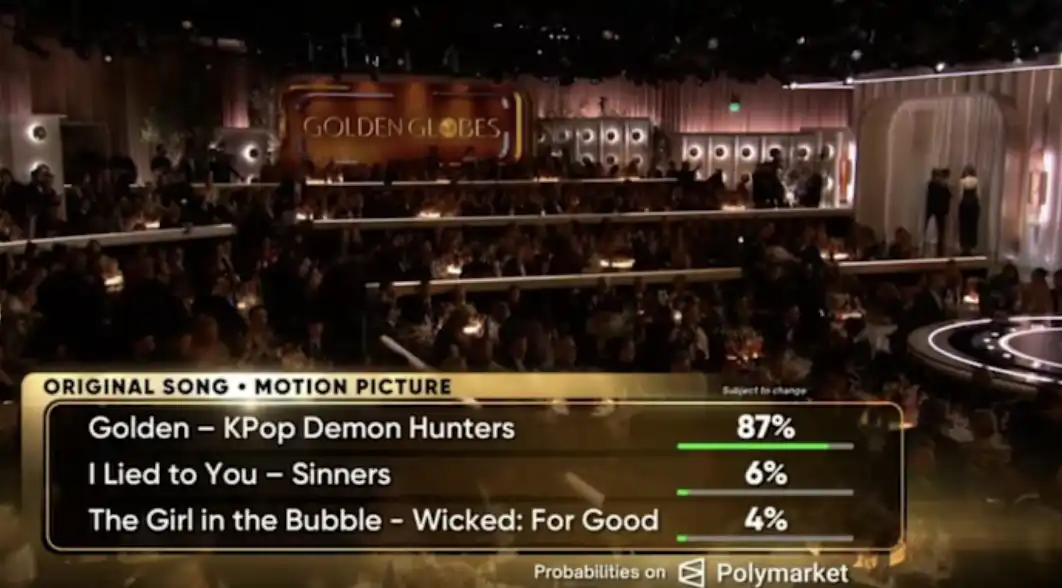
“Our partnership with Polymarket has ushered in a groundbreaking new frontier, redefining how audiences interact and connect with the content they love.” said Craig Perreault, CEO of Penske Media Corporation. © Golden Globe Awards
How did things come to this?
In 2023, after a series of scandals, the Golden Globes were sold by the Hollywood Foreign Press Association to a joint venture formed by sports industry tycoon Todd Boehly's Eldridge Industries and Penske Media.
By then, Jay Penske (whose father amassed a huge fortune through motorsports) had already acquired multiple media assets, including key Hollywood trade publications. This means that Penske now not only controls the Golden Globes ceremony but also owns the major media outlets reporting on the Golden Globes, such as Variety, The Hollywood Reporter, and Deadline, raising questions about the impartiality of reporting and fairness of coverage.
During Sunday night's TV broadcast, the "Penske Takeover" imprint was evident: the show featured a skit where a "security guard" was tasked with protecting the star of Heated Rivalry, which was actually a UFC promotion, conveniently in partnership with Golden Globe Awards broadcaster CBS.
But there was more. In a red carpet pre-show led by Variety, senior editor Angelique Jackson and Marc Malkin repeatedly urged viewers to "get your predictions in," while at the same time, the lower-thirds continued to display Polymarket's probability predictions for the award outcomes.
The real "fun" was happening on Polymarket's website: in the end, the bet just on "who will win Best Picture" approached $250,000. Another contract betting on "what will be mentioned during the ceremony," with options including "Venezuela/Maduro" (not mentioned), "Jesus" (mentioned), and "Epstein" (not mentioned), also attracted $86,000 in bets.
However, what caught our attention the most were several other film-related contracts on Polymarket.
For example, bets on how much box office revenue Greenland 2 or the latest installment of Avatar would earn by the end of January seemed harmless enough. But you wouldn't see similar betting pools on the US-regulated competitor, Kalshi, for good reason, with the root of this traced back to the 1955 manipulation of the US onion market.
Onion Futures Act
Vincent Kosuga, born in New York State, was a hobbyist pilot who was said to carry a nightstick with him wherever he went. He reportedly started trading onion futures at the Chicago Mercantile Exchange in the late 1940s or early 1950s and quickly became an expert.
By the end of 1955, Kosuga and his business partner held approximately 1,000 "carlots" of onion inventory, with each carlot containing 600 bags of 50-pound "spot" onions, which were vegetables deliverable through the spot market, ready for immediate delivery. According to a fascinating case file from the US Commodity Futures Trading Commission (CFTC) released five years later, this inventory represented a staggering 98% of the deliverable onion supply in Chicago.
A summary description of Sherwood Financial Partners stated that Kosuga then did this: he sat down with other onion growers to negotiate, telling them that unless everyone agreed to raise onion prices collectively, he would flood the market with onions. Other growers/shippers agreed and began buying Kosuga's stock at these inflated prices.
Upon identifying another opportunity to capitalize on in the market, Kosuga and his partners swiftly took short positions on a large number of onion contracts.
They then, going back on their word, proceeded to dump all the onions they had stored in various local warehouses onto the market. At one point, onion prices plummeted to such an extent that the canvas bags used to hold the onions were worth more than the onions themselves. The situation deteriorated to the point where entire truckloads of onions were dumped into the Chicago River.
The losses incurred were so substantial that in the summer of 1956, Congress held hearings to discuss whether to outright ban onion futures trading. The result was the Onion Futures Act, signed into law two years later, which indeed did just that.
History turned into legend, legend turned into myth. For the next 52 years, onions became the only commodity in the United States prohibited from futures trading.
Everything changed in 2010 when, under the lobbying of the Motion Picture Association of America, the ban on onion derivatives was revised to include a provision prohibiting any futures trading based on movie box office revenue—reasoning that betting on a movie's box office performance could influence audiences' decision to see a movie and incentivize studios to engage in various "shenanigans."
Today, the law stipulates that anyone caught trading "contracts for the sale of movie box office receipts (or any index, measure, value, or data related to such receipts) or onion futures for future delivery" will, upon conviction, be subject to a "fine not exceeding $5,000."
Of course, the event contracts Polymarket offered during the Golden Globes were around award outcomes and did not involve box office receipts, so there were no issues.
However, some other contracts related to movies on the Polymarket website—such as bets on the box office receipts of movies like "Avatar," "Greenland 2," and others before a certain point in time—while not featured in the awards ceremony TV broadcast, could potentially cross the red line set by the 2010 revision.
So why can Polymarket still offer this prediction market? As always, the answer lies in: it operates offshore.
Keep Your Onions
Despite receiving approval from the Commodity Futures Trading Commission (CFTC) last year and being able to re-enter the U.S. market, Polymarket's current U.S. operation is a limited version of the website, focusing mainly on relatively "non-controversial" events, such as sports match outcomes, or sensational topics like which country Trump may "acquire" next.
Provisions in the Dodd-Frank Act banning futures contracts based on movie box office revenues remain in effect. However, by providing two separate platforms for U.S. and non-U.S. users, Polymarket is able to comply with regulatory boundaries in different jurisdictions.
Therefore, bets related to movies like "Avatar" or "Greenland 2" can only appear on Polymarket's main site, which is the version not subject to U.S. regulations. U.S. bettors are blocked and cannot access the platform, in accordance with the CFTC's order issued in 2022: at that time, Polymarket paid a $1.4 million fine and agreed to cease providing certain services to U.S. customers, as well as close non-compliant markets.
"This is a bit like the common disclaimer: 'void where prohibited by law,'" said lawyer and former Wall Street regulator Bill Singer. "If Polymarket were to accept bets from U.S. customers onshore, it would appear illegal until the company provides a strong clarification."
Polymarket did not respond to a request for comment. One source said that Kalshi does not offer box office futures or onion derivatives.
FTAV, on the other hand, plans to sail into international waters and begin trading both types of contracts, regardless of how much your VPN tries to bypass restrictions.
You may also like

From Followers to Price Setters: The Role of the Crypto Market is Reversing

Interpretation of xBubble SOP: Packaging Vibe Coding for non-technical users
Deposit Smarter & Faster: Discover WEEX’s Powerful Upgrade for Crypto and Fiat Deposit

Morning Report | Deloitte acquires crypto infrastructure company Blocknative; stablecoin company Checker completes $8 million financing; a16z may have become the largest external institutional holder of HYPE

WEEX New Navigation: Trade Faster, Find Trends, Copy Top Traders Instantly
TL;DRYou can now discover trending trading pairs faster with dedicated Spot and Futures themes.The platform automatically resumes your last viewed trading pair so you never lose your place.Simply hover over Copy Trade to see top-performing traders from the past three weeks.This upgrade is rolling out now to all WEEX users. Trading Slows You Down? Here’s How We Fix ItEvery tap, scroll, and menu click steals seconds from your trading. Missed trends. Lost progress. Hidden copy traders. Scattered asset views. That’s why WEEX rebuilt the top navigation — to remove every speed bump. Now you can catch trending pairs before they run, pick up exactly where you left off, find top-performing copy traders in one hover, and check your wallet without digging through menus. Less friction, faster decisions. 5 Navigation Boosts That Make You Trade SmarterHere’s what changed and why it matters for your daily trading:Trending Spot & Futures themes: Switch market themes and spot high-momentum pairs instantly. No more hunting.Auto-resume last pair: WEEX remembers your last viewed pair. Come back anytime, keep trading.One-hover copy trader discovery: Hover over Copy Trade to see top 3-week traders. Click into their pages instantly.Wallet shortcut in main navigation: One click to check balances, deposits, and withdrawals.Combined language & currency selector: View and switch both settings together. Personalize in seconds. Who Gets the Biggest Speed Gains?Everyone wins, but high-frequency and copy traders see the biggest efficiency jump.New traders learn faster — clean layout and visible copy trading lowers the barrier.Active spot & futures traders save minutes per session with auto-resume and trending filters.Copy trading followers find top performers in one hover instead of multiple clicks.Frequent asset movers love the Wallet shortcut for quick deposits and balance checks.Find New Navigation Features in Two ClicksHere's how you can find the new navigation features on WEEX homepage within a few clicks:Log in and look at the top bar (Spot, Futures, Copy Trade, Wallet, globe icon).Hover Copy Trade → see top 3-week traders.Click Spot or Futures → your last viewed pair loads automatically.Click the globe → switch language and currency side by side.Click Wallet → view all assets instantly. Start Trading Smarter — It’s Live NowThese upgrades are available now. No settings to enable. No extra cost.👉 Try the new WEEX navigation nowTrade faster. Miss less. WEEX. Thank you for trading with WEEX About WEEXFounded in 2018, WEEX has developed into a global crypto exchange with over 6.2 million users across more than 150 countries. The platform emphasizes security, liquidity, and usability, providing over 1,200 spot trading pairs and offering up to 400x leverage in crypto futures trading. In addition to the traditional spot and derivatives markets, WEEX is expanding rapidly in the AI era delivering real time AI news, empowering users with AI trading tools, and exploring innovative trade to earn models that make intelligent trading more accessible to everyone. Its 1,000 BTC Protection Fund further strengthens asset safety and transparency, while features such as copy trading and advanced trading tools allow users to follow professional traders and experience a more efficient, intelligent trading journey.Follow WEEX on social mediaX: @WEEX_OfficialInstagram: @WEEX ExchangeTiktok: @weex_globalYoutube: @WEEX_OfficialDiscord: WEEX CommunityTelegram: WeexGlobal Group

Morning Report | Musk's xAI launches Skills; Duan Yongping to first build position in Circle in Q1 2026; Polymarket partners with Nasdaq to launch prediction market

Vitalik: What is the key to the next phase of Ethereum?

Interlace: A global leader in Agentic Payment and stablecoin infrastructure platform, building the next generation of digital financial foundation
Duan Yongping establishes a position in a cryptocurrency company for the first time: Why Circle?

Recovering cryptocurrency assets is a lucrative business that quietly makes a fortune

Gemini 3.5 is here! Tonight, Google personally eliminates Google
Harvard and other institutions are liquidating their assets, and six core talents have left in a month. What is happening with Ethereum?
The tokenized market will reach a trillion-dollar scale, but there are still four major obstacles

Founder of Baixing.com: We have transformed from leaders in AI to guides in AI

The AI stock god who made 60 times profit bets 7.7 billion dollars on Nvidia reaching its peak

WEEX Crypto Pizza Day: Join Us in Dubai for a Slice of Crypto History

WEEX P2P now supports KES—Merchant Recruitment Now Open

WEEX P2P now supports COP—Merchant Recruitment Now Open
From Followers to Price Setters: The Role of the Crypto Market is Reversing
Interpretation of xBubble SOP: Packaging Vibe Coding for non-technical users
Deposit Smarter & Faster: Discover WEEX’s Powerful Upgrade for Crypto and Fiat Deposit
Morning Report | Deloitte acquires crypto infrastructure company Blocknative; stablecoin company Checker completes $8 million financing; a16z may have become the largest external institutional holder of HYPE
WEEX New Navigation: Trade Faster, Find Trends, Copy Top Traders Instantly
TL;DRYou can now discover trending trading pairs faster with dedicated Spot and Futures themes.The platform automatically resumes your last viewed trading pair so you never lose your place.Simply hover over Copy Trade to see top-performing traders from the past three weeks.This upgrade is rolling out now to all WEEX users. Trading Slows You Down? Here’s How We Fix ItEvery tap, scroll, and menu click steals seconds from your trading. Missed trends. Lost progress. Hidden copy traders. Scattered asset views. That’s why WEEX rebuilt the top navigation — to remove every speed bump. Now you can catch trending pairs before they run, pick up exactly where you left off, find top-performing copy traders in one hover, and check your wallet without digging through menus. Less friction, faster decisions. 5 Navigation Boosts That Make You Trade SmarterHere’s what changed and why it matters for your daily trading:Trending Spot & Futures themes: Switch market themes and spot high-momentum pairs instantly. No more hunting.Auto-resume last pair: WEEX remembers your last viewed pair. Come back anytime, keep trading.One-hover copy trader discovery: Hover over Copy Trade to see top 3-week traders. Click into their pages instantly.Wallet shortcut in main navigation: One click to check balances, deposits, and withdrawals.Combined language & currency selector: View and switch both settings together. Personalize in seconds. Who Gets the Biggest Speed Gains?Everyone wins, but high-frequency and copy traders see the biggest efficiency jump.New traders learn faster — clean layout and visible copy trading lowers the barrier.Active spot & futures traders save minutes per session with auto-resume and trending filters.Copy trading followers find top performers in one hover instead of multiple clicks.Frequent asset movers love the Wallet shortcut for quick deposits and balance checks.Find New Navigation Features in Two ClicksHere's how you can find the new navigation features on WEEX homepage within a few clicks:Log in and look at the top bar (Spot, Futures, Copy Trade, Wallet, globe icon).Hover Copy Trade → see top 3-week traders.Click Spot or Futures → your last viewed pair loads automatically.Click the globe → switch language and currency side by side.Click Wallet → view all assets instantly. Start Trading Smarter — It’s Live NowThese upgrades are available now. No settings to enable. No extra cost.👉 Try the new WEEX navigation nowTrade faster. Miss less. WEEX. Thank you for trading with WEEX About WEEXFounded in 2018, WEEX has developed into a global crypto exchange with over 6.2 million users across more than 150 countries. The platform emphasizes security, liquidity, and usability, providing over 1,200 spot trading pairs and offering up to 400x leverage in crypto futures trading. In addition to the traditional spot and derivatives markets, WEEX is expanding rapidly in the AI era delivering real time AI news, empowering users with AI trading tools, and exploring innovative trade to earn models that make intelligent trading more accessible to everyone. Its 1,000 BTC Protection Fund further strengthens asset safety and transparency, while features such as copy trading and advanced trading tools allow users to follow professional traders and experience a more efficient, intelligent trading journey.Follow WEEX on social mediaX: @WEEX_OfficialInstagram: @WEEX ExchangeTiktok: @weex_globalYoutube: @WEEX_OfficialDiscord: WEEX CommunityTelegram: WeexGlobal Group
Morning Report | Musk's xAI launches Skills; Duan Yongping to first build position in Circle in Q1 2026; Polymarket partners with Nasdaq to launch prediction market