
Polymarket Fee Surge Explained: Where Did 90%+ of Extreme Fees Come From?

 Prefer us on Google

Original Title: "Deep Dive into Polymarket's Fee Formula: How Did 90%+ Extreme Fee Rate Come About?"
Original Author: Azuma, Odaily Planet Daily
Polymarket suddenly found itself in a fee controversy.
Many community users discovered last night that when trading on Polymarket, they were charged unusually high fees, resulting in a significant reduction in received shares or earnings compared to before.
Overseas user Frosen (@frosen) even posted a screenshot, indicating that they tried to place an order for 100 shares at a price of 0.1 cents in an "economics" market, but the Polymarket frontend displayed a correct payout amount of only $5.2 (which should normally be $100) — corresponding to an outrageously high fee rate of 94.8%!
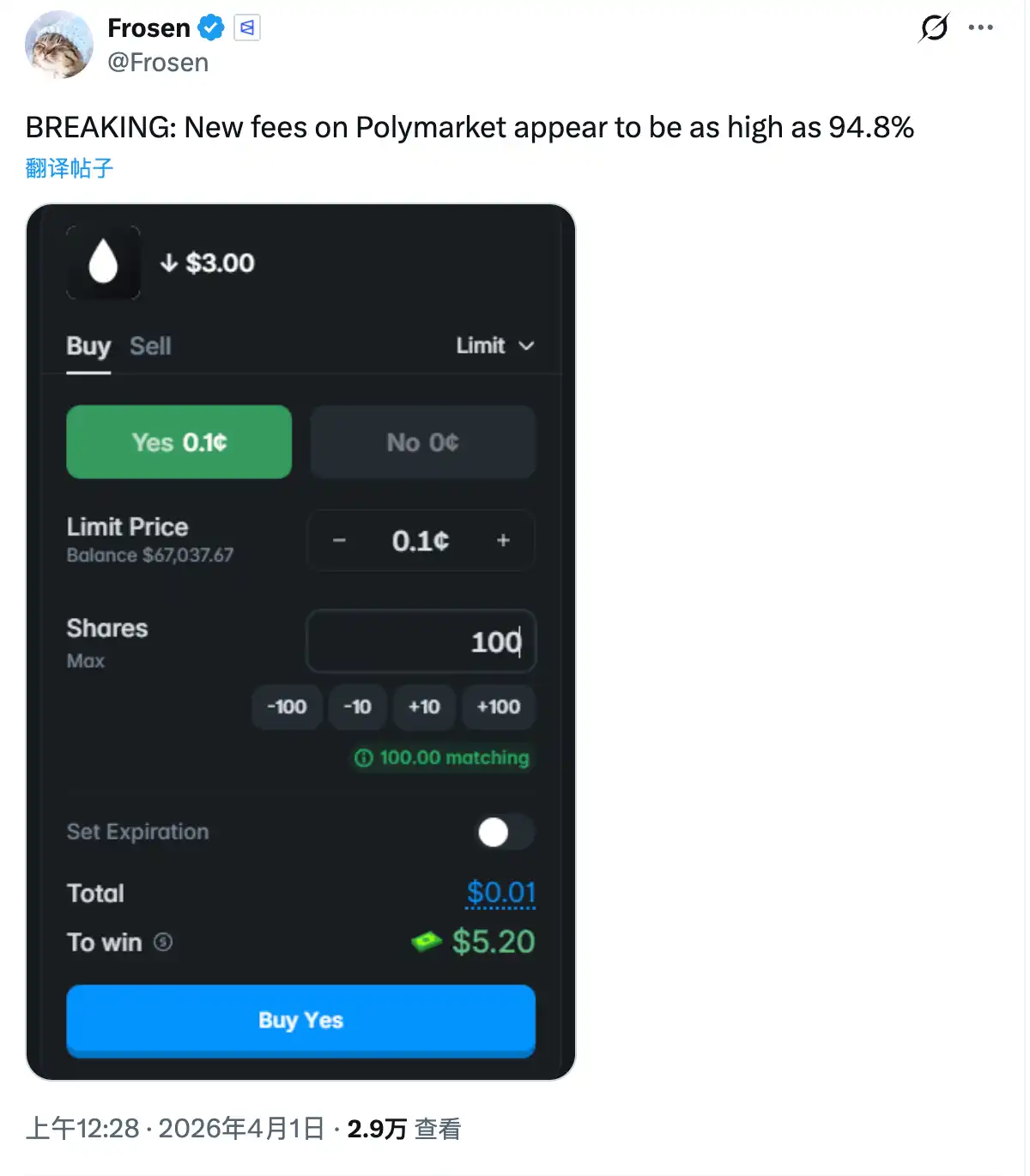
What's going on? Is Polymarket going crazy for money? Odaily, based on Polymarket's official disclosure and community investigation, found that the direct cause of this unexpected situation was that Polymarket modified the platform's fee formula last night, with three versions of changes:
· First was the "old formula" introduced since March 30: fee = C × p × feeRate × (p × (1 - p))^exponent;
· Then came the first modification, the formula that caused the unexpected situation (referred to as the "abnormal formula"): fee = C × feeRate × (p × (1 - p))^exponent;
· Subsequently, after realizing the issue, Polymarket made corrections, resulting in the current version of the "new formula": fee = C × feeRate × p × (1 - p);
· It's important to note that in all three formulas, C refers to the number of shares traded, p refers to the share price, and feeRate and exponent are variables.
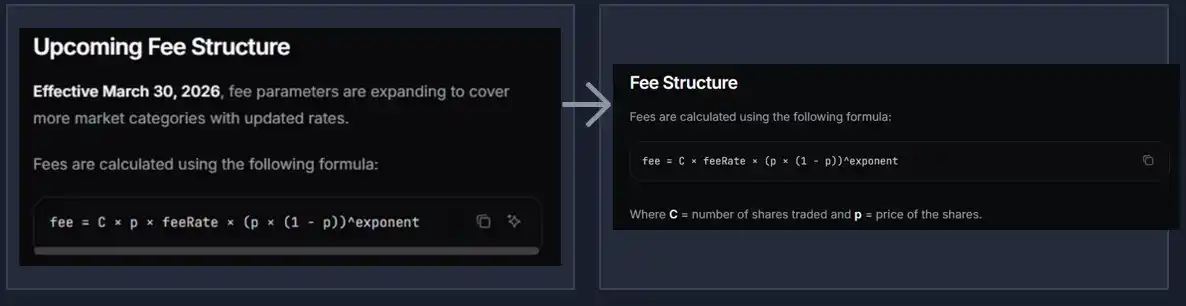
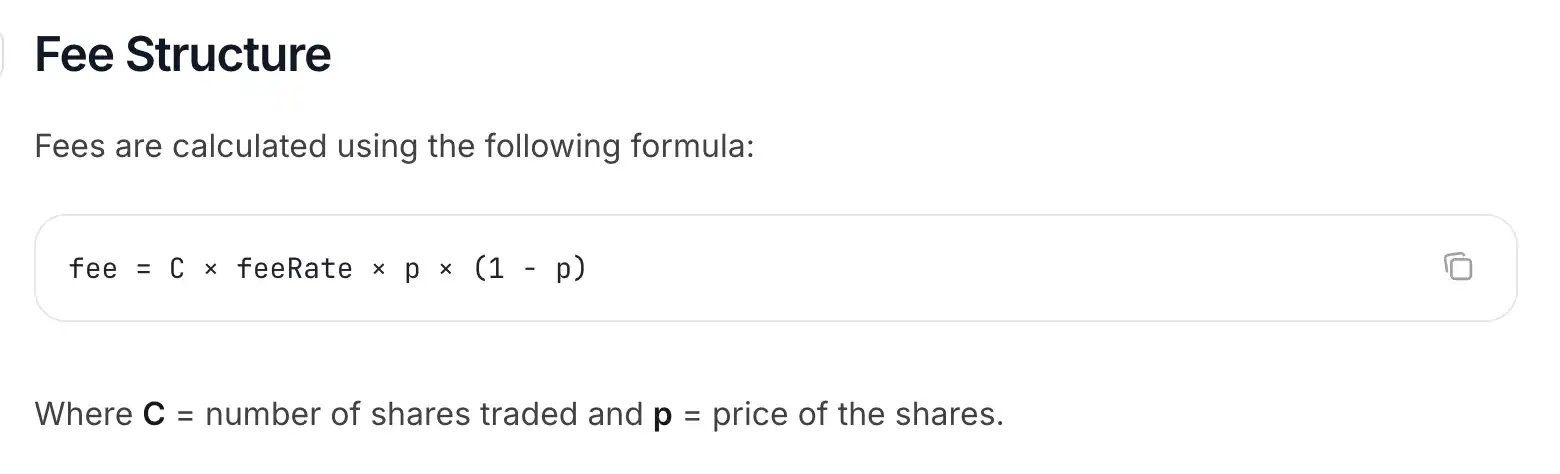
Decoding the Abnormal Formula, How Did the 94.8% Outrageous Fee Rate Occur?
You don't need to worry too much about the math details. By comparing the "Old Formula" and "Anomalous Formula," you can easily see that the latter only removes one "× p" (this is the multiplication symbol, not the lowercase x), meaning it ultimately multiplies the share price one less time.
Since the price of all shares on Polymarket is always less than 1 USD, this will inevitably lead to a overall increase in fees. The lower the price of shares, the more significant the fee increase due to skipping one multiplication — when the share price approaches 0, the fee rate may become absurdly high.
As for how absurd this fee can become, it also depends on the same variable ^exponent present in both the Old Formula and Anomalous Formula. Translated directly, ^exponent means "raised to the power of exponent," and this variable is mainly used to control the steepness of the fee curve.
According to Polymarket staff member Mustafa, the anomaly formula introduced last night only included the exponent in two types of markets: "Weather" and "Economic." According to overseas KOL Quant Chad (@Autonomous_Chad), the exponent parameter set for these two major markets at the time was 0.5.
Now, going back to Frosen's case and plugging the corresponding numbers into the equation fee = C × feeRate × (p × (1 - p))^exponent from this anomaly formula. Knowing that C equals 100, meaning Frosen wants to place an order for 100 shares; p equals 0.001, meaning 0.001 USD (0.1 cents); exponent equals 0.5, meaning another power operation on (p × (1 - p)); the final fee rate is 94.8%.
By feeding this to an AI directly, you can reverse-engineer that the feeRate level at that time was around 0.03, while also reconstructing the formula calculation details that Polymarket applied to this order.
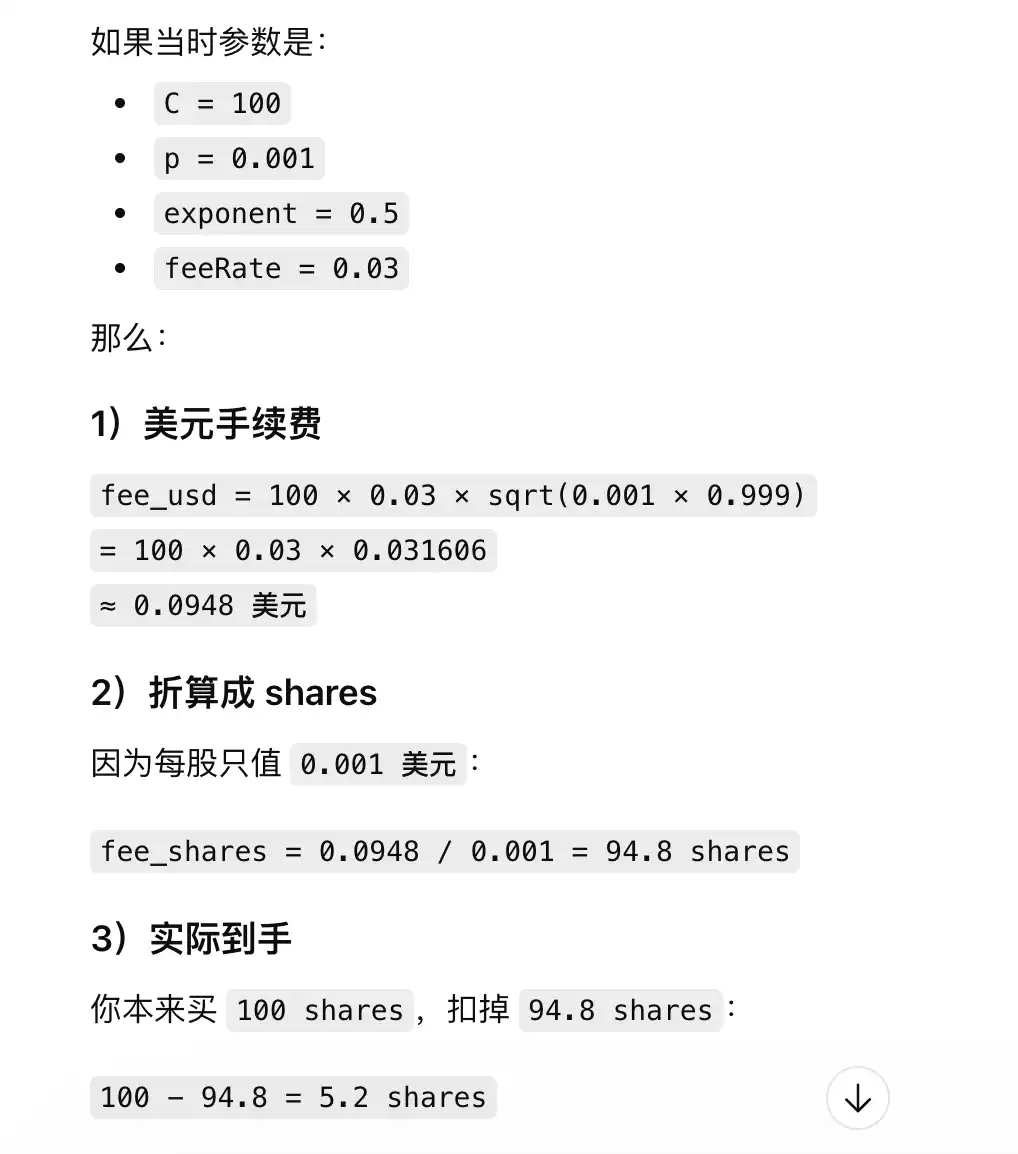
In simple terms, Polymarket calculated, based on the anomalous formula, that the fee for this order should be 0.0948 USD. Since Polymarket deducts the corresponding value of shares directly from the buy order, and the share price at the time was only 0.001 USD, it needed to deduct 94.8 shares. Therefore, Frosen would ultimately receive only 5.2 shares, even if the prediction is correct, the potential profit would only be 5.2 USD.
Polymarket Remedial Action
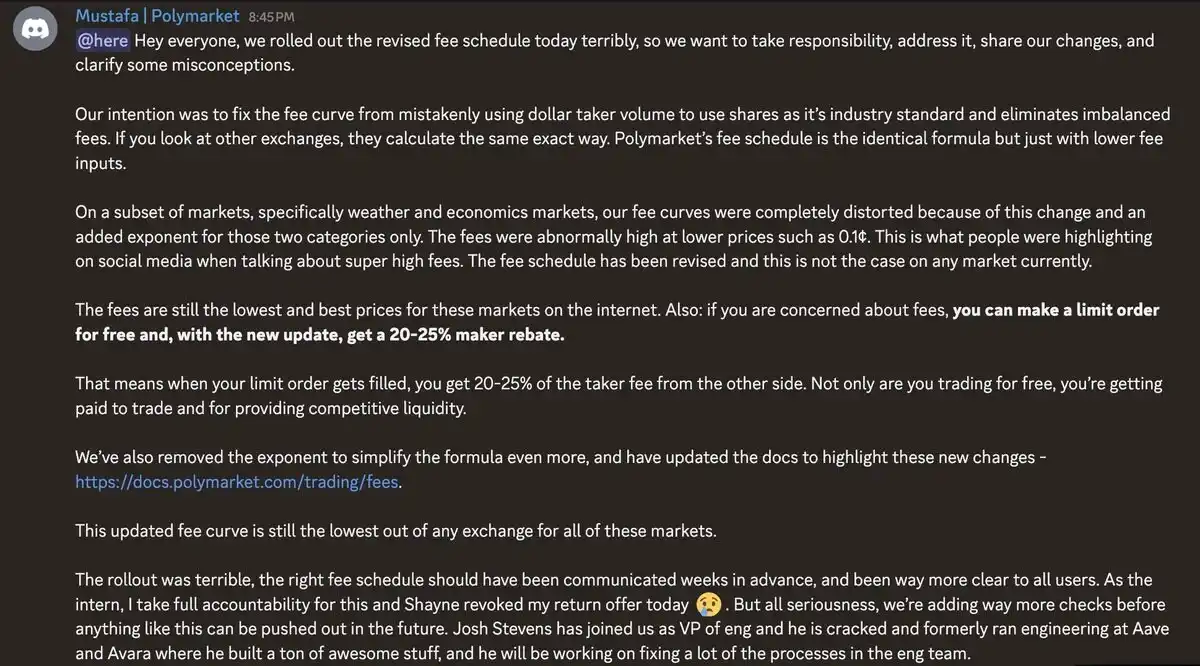
Shortly after the anomalous fee issue arose, Polymarket promptly responded by modifying the formula to its current version, fee = C × feeRate × p × (1 - p). Compared to the anomalous formula, the new formula removed the '^exponent'—effectively raising the exponent parameter from 0.5 to 1 in the anomalous formula fee = C × feeRate × (p × (1 - p))^exponent.
In the anomalous formula, the '^exponent' effect was to perform another power operation on the p × (1-p) data set. In Polymarket's actual operational scenario, the theoretical result range of p × (1 - p) is between '0.000999 - 0.25'—as p approaches 0.5 (shares price approaches $0.5), this data set gets closer to 0.25; when p approaches 0 or 1 (shares price approaches 0 or $1, with extreme quotes at $0.001 and $0.999), this data set gets closer to 0.000999.
Within the '0.000999 - 0.25' range, regardless of the value taken, raising the exponent parameter from 0.5 to 1 directly reduces the final fee result in the formula calculation, thereby decreasing the overall cost.
More importantly, this reduction has a more pronounced inhibitory effect on exceptionally high fees near very low price levels—when p × (1-p) = 0.000999, the fee under the new formula is only about 3.16% of the fee under the anomalous formula, representing a decrease of approximately 96.84%; when p × (1-p) = 0.25, the fee under the new formula is 50% of the fee under the anomalous formula.
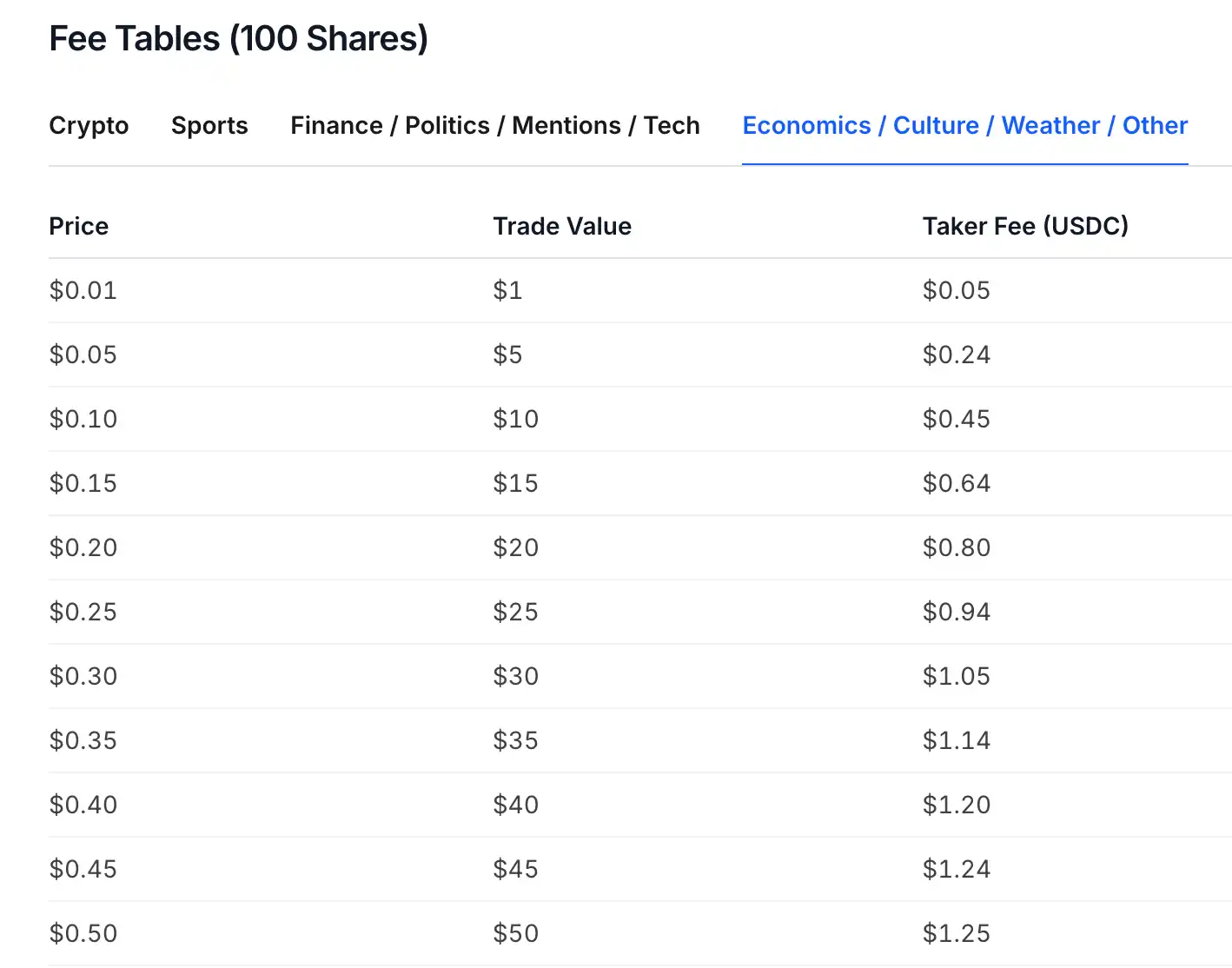
As indicated in the Polymarket official documentation, following the implementation of the new formula, fee rates at extremes in the 'Weather' and 'Economics' market categories have now decreased to 5%.
How Can Retail Users Avoid Fees?
I know most users are lazy to look at the above formula, but are also concerned about Polymarket's current fee issue.
In response to this, Mustafa mentioned on the official Discord: "If you're worried about fees, you can place limit orders for free, and after this new update, you can also receive a 20%-25% maker rebate—this means that when your limit order is executed, you will receive 20%-25% of the taker fee, essentially enabling you to not only trade for free but also potentially earn rewards by trading and providing competitive liquidity."
So let's change our habits, try not to market buy directly anymore, switch to using limit orders more often, and you can also try using Polymarket's Split feature more frequently, indirectly build your position by selling the other side of the shares through a reverse limit order.
-- Price
This content is provided for general informational purposes only and doesn't constitute financial, investment, legal, or tax advice. Any events, rewards, online promotions, or related information mentioned herein should not be considered a recommendation, solicitation, or invitation to purchase, sell, trade, or otherwise deal in any crypto assets. Crypto assets are highly volatile and may result in loss. The availability of WEEX services, products, and related events may vary by region. You are responsible for ensuring that your participation is in accordance with applicable local laws and regulations.
You may also like

The New PayPal Mafia: 10 Interns, $100 Billion

Quant (QNT) Price Prediction 2026–2030: Can Bank Adoption Drive a Return to $500?

DeepSigma launches RWA perpetuals demo with 77 traditional markets

UK banks eye faster settlement as 71% expect tokenization to reshape finance

The crypto job market accelerates: job postings triple to 1,241 in three months

QNT Price Surged 5x in September: Can Quant Actually Break $400
QNT price climbed from around $60 to as high as $372 in September before settling near $300, a move driven by Quant's selection for a major U.S. banking initiative. With RSI above 81 and a founder linked wallet moving millions in tokens, the next move hinges on whether $400 gets absorbed or rejected.

Mr&强 Claims QNT Rises 300% in a Week, Driven by Buying in Europe and the US

QNT Price Prediction October 2026: Can Quant Stay Above $300?
QNT price prediction for October 2026: Explore Quant’s Clearing House catalyst, recent rally, key support and resistance levels, and whether QNT can stay above $300.

Why Is Quant (QNT) Price Rising? The Clearing House Tokenized Deposit Deal Explained
Why is Quant (QNT) rising? Explore The Clearing House tokenized deposit deal, QNT utility, price risks and how to trade QNT on WEEX.

Quant Secures Major Deal with US Clearing House: What Comes After the 300% Surge?

QNT Token Has Surged Sharply in a Week: What The Clearing House Deal Does and Doesn't Mean for Holders
QNT jumped after The Clearing House picked Quant to build a bank tokenized deposit network. The announcement is about the company, and how it reaches the token has not been disclosed.

Quant Provides Technical Support for The Clearing House's Tokenized Deposit Clearing Network

The Clearing House Selects Quant for US Tokenized Deposit Network

Seven UK Banks Complete First Interbank Tokenized Pound Deposit Transaction

The Clearing House Chooses Quant to Support Tokenized Deposit Technology
WEEX AI Wars II: Round 2 Recap — Humans Just Broke the Leaderboard (Literally)
Round 2 of WEEX AI Wars II has closed, and Team Human didn't just win again — they posted returns north of 50,000%. Here's the full breakdown, how the gap to Team AI widened even further, and how to join Round 3's live $20,000 USDT prize pool.

WEEX AI Wars II: Round One Is Over, The War Has Just Begun
Round 1 of WEEX AI Wars II has closed with humans dominating the top of the leaderboard. Here's the full breakdown of the results, what's coming in Round 2, and how anyone — trader or spectator — can still get in on the action and start earning rewards.

Killa: Bitcoin Prices Move Ahead of Macroeconomic Changes

Cryptocurrency Arbitrage and Price Scanning: How Quants Identify Inefficiencies in Funding Rates and Spreads Using Trading APIs
The Leverage Frenzy of Borrowing to Invest in Stocks: Why Wall Street is Paying Attention to the Sharp Decline in the Korean Stock Market

Bitfire launches compliant crypto quant strategy as RWA assets top HK$2B

Jane Street Loses $15 Billion in July Due to AI Fund Collapse

Scale Labs Unveils AI Prediction Market Sandbox Agent Fit

Helio Protocol's XAUT ecosystem has reached a strategic cooperation with Dephy and APRO

Trump appoints Todd Blanche, the author of the cryptocurrency enforcement memorandum, as acting Attorney General

Founder of DeepSeek's magic square quantitative strategy achieved a 56.55% return last year, with assets under management exceeding 700 billion yuan

Champion Crowned at WEEX AI Hackathon: Revealing Strategy That Won $600K
A trader with only 6 months of AI trading experience won $600,000 at the WEEX AI Hackathon. Discover the strategy, tools, and lessons behind this breakthrough victory.

From CTA to AI: The Evolution of Adaptive Quant Strategies in Crypto Markets
Explore how an LLM-powered AI market-neutral trading strategy achieved a 2.75 Sharpe ratio with controlled drawdown. Inside crypto_trade’s adaptive hedging system at the WEEX AI Trading Hackathon.

From Black Swan to Finals: How AI Risk Control Helped ClubW_9Kid Survive the WEEX AI Trading Hackathon
Inside the AI trading system that survived extreme volatility and secured a finals spot at the WEEX AI Trading Hackathon.

$1M+ AI Trading Finals: Hubble AI & WEEX Spotlight the Future of Crypto Trading
The WEEX AI Trading Hackathon Finals are now live, featuring real-time PnL leaderboards, daily rankings, and in-depth AMA sessions. Explore how top AI trading strategies perform under real market volatility and follow the competition as it unfolds.
The New PayPal Mafia: 10 Interns, $100 Billion
Quant (QNT) Price Prediction 2026–2030: Can Bank Adoption Drive a Return to $500?
DeepSigma launches RWA perpetuals demo with 77 traditional markets
UK banks eye faster settlement as 71% expect tokenization to reshape finance
The crypto job market accelerates: job postings triple to 1,241 in three months
QNT Price Surged 5x in September: Can Quant Actually Break $400
QNT price climbed from around $60 to as high as $372 in September before settling near $300, a move driven by Quant's selection for a major U.S. banking initiative. With RSI above 81 and a founder linked wallet moving millions in tokens, the next move hinges on whether $400 gets absorbed or rejected.





