
Kyle Samani Returns to Crypto? Post Discusses How to Efficiently Weed Out CEX


Original Author: Kyle Samani, Co-founder of Multicoin
Original Translator: Azuma, Odaily Planet Daily
Editor's Note: The man known for his shilling of Solana, Multicoin Capital's former co-founder Kyle Samani, who recently made a high-profile return after stepping back, is back at it again!
Yesterday evening, Kyle Samani posted a lengthy thread on his personal X account. In the post, Kyle Samani once again employed his continued shilling (not meant negatively) rhetoric, using "efficiency" as a breakthrough point in the decentralized narrative, elaborating on how the current Solana ecosystem's flagship PropAMM will match or even outperform traditional centralized models in terms of efficiency. He argued that PropAMM is one of the most important innovations in market microstructure in recent years or even decades.
· Related articles: "Kyle Samani's Exit from the Scene, Is There Another Story?", "Kyle Samani's Turnaround, The Person Who Believed Most in Web3 Also Exits the Scene"
Below is the original content by Kyle Samani, translated by Odaily Planet Daily.
Original Content:
PropAMM is one of the most important innovations in market microstructure in recent years, and may even be one of the most important innovations in decades.
To help everyone understand this conclusion, let's first take a look at how Market Makers (MM) quote on traditional centralized exchanges (CEX).
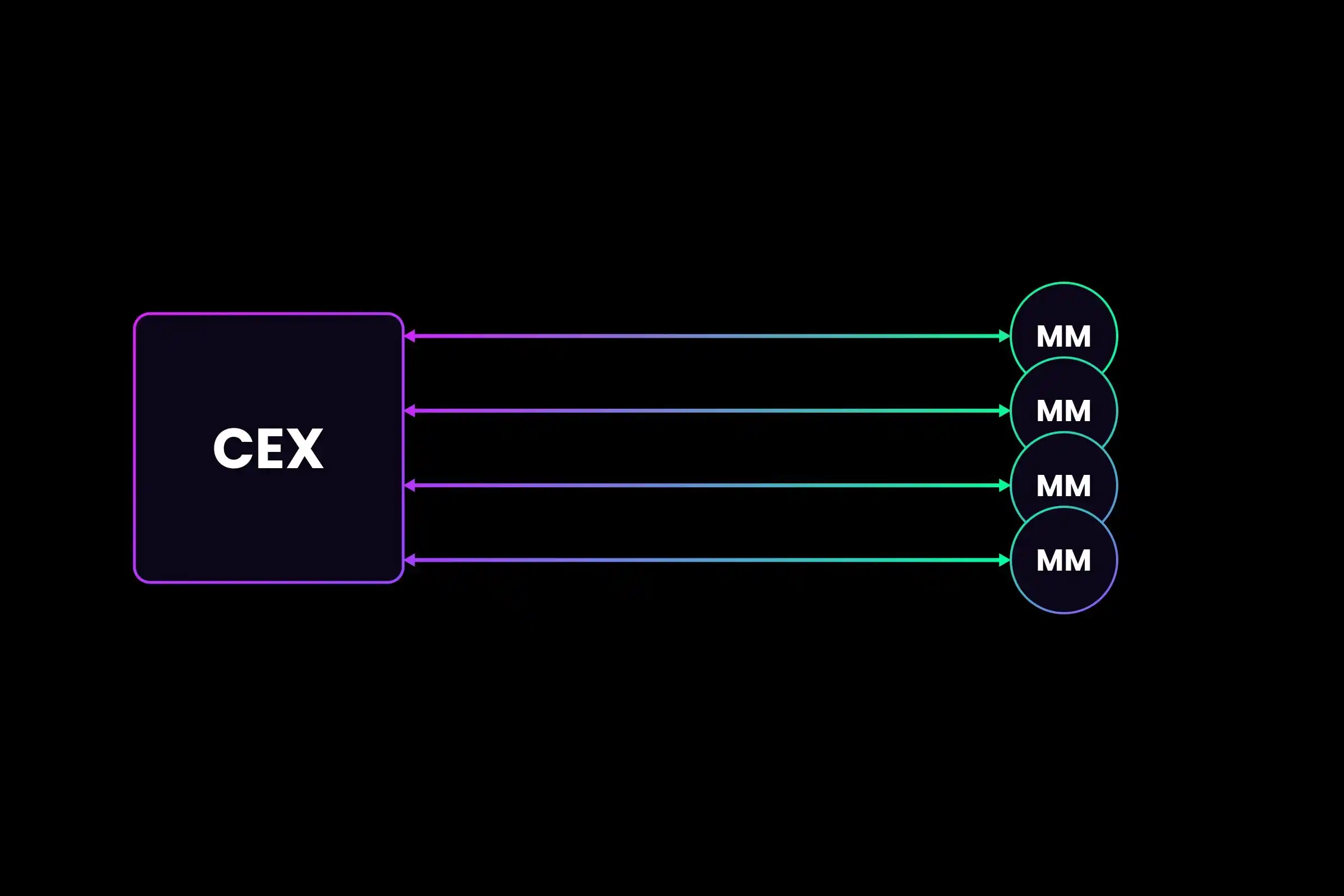
Market Makers typically engage in physical co-location with the exchange. Each Market Maker runs algorithms on a server and is connected to another server through a standardized length of network cable (e.g., 50 meters), where the exchange's system is running.
There is a constant back-and-forth data flow between market makers and trading platforms. Every time a market maker sends an order to the trading platform—whether it's a limit order, cancel order, or market order—the trading platform needs to broadcast this information to all other market makers; then, other market makers will resend their orders based on the new information; and so the cycle repeats, indefinitely.
Below is a simple schematic.
Now let's take a look at how PropAMM works on the Solana mainnet.
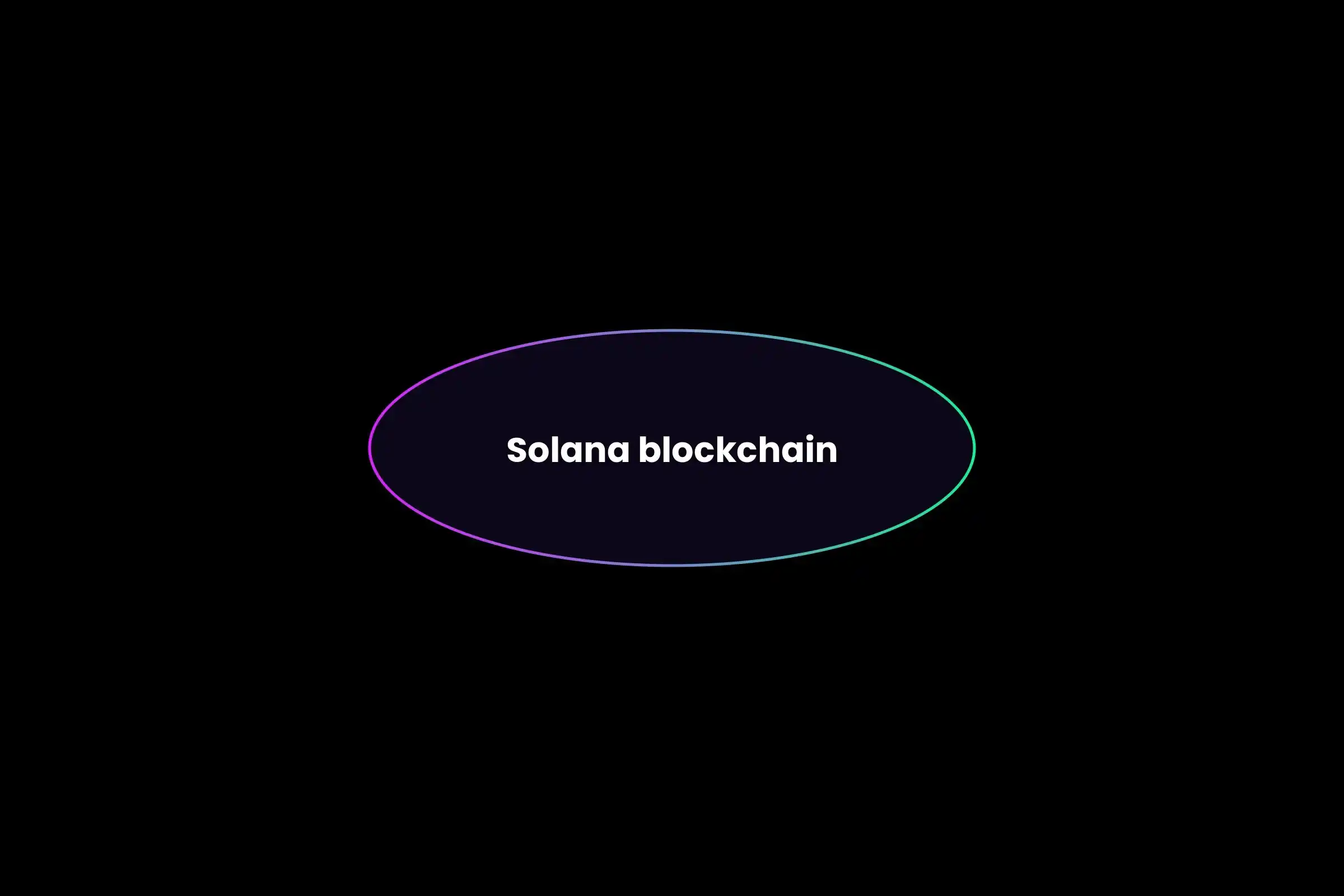
The beauty of PropAMM on Solana is that the blockchain itself directly "hosts" the market maker algorithm. This means the system no longer needs to shuttle billions of messages back and forth between market makers and trading platforms; the market maker algorithm will run directly on the same physical machine as the trading platform.
The new schematic is as follows. (Yes, only the Solana blockchain is needed!)
In the cryptocurrency industry, there has always been a perennial view that, because decentralized systems need to communicate between global nodes, they will surely be slower (have higher latency) than centralized systems.
But if you look at this problem in a different way, on-chain hosted algorithms may actually have lower latency than traditional centralized trading platforms in finance.
Why is this so? The reason is the latency required for PropAMM to update prices only involves electrons moving within the same block of physical silicon. For example, if a previous market order caused a price change for SOL-USD, this information is immediately visible to all PropAMM and used for pricing the next market order. Everything happens within the same block of silicon, eliminating the need for bidirectional communication between servers.
It is worth noting that PropAMM does require frequent oracle updates, but this is not a problem and does not change the overall fact as I described above.
The most critical point remains that when a trading platform—in the case above, the Solana blockchain—directly hosts the PropAMM algorithm, market maker pricing changes in real-time within the same block of physical silicon.
PropAMM has become the dominant mechanism for the SOL-USDC spot price on Solana, with a spread tighter than all major CEXs. I expect this market structure to become the dominant mode of on-chain trading this year, including spot, perpetuals, and even prediction markets.
The biggest challenge for PropAMM is that there is currently no way to guarantee that a taker will always receive the best execution, due to:
· All PropAMM algorithms are not public (which is actually reasonable, as traditional market-making algorithms are also private);
· The outcome of trading routing across multiple PropAMMs is non-deterministic.
However, this issue is solvable. I expect all relevant aggregator teams to introduce solutions this year, such as Jupiter and dFlow on the spot side, and Phoenix on the derivatives side.
Current PropAMMs are still not fully optimized and are subject to various limitations of the Solana blockchain itself. This year, Solana will roll out a series of major upgrades that will significantly improve PropAMM performance, including:
1. Higher CU (Computational Unit) limits per trade and larger trade sizes;
2. Higher CU limits per block;
3. Alpenglow: reducing slot time from 400ms to 100–150ms;
4. DoubleZero: reducing global network latency;
5. Application-controlled execution;
6. Multiple concurrent leaders.
If on the Solana mainnet, PropAMMs are already able to provide quotes tighter than all CEXs without these upgrades, it is conceivable that as these upgrades are gradually rolled out, their performance will become even more powerful.
You may also like

After 18 years, blockchain has finally started to head towards the main channel

SpaceX IPO, Nvidia, and Bitcoin: Why Traders Are Watching More Than Just Crypto in 2026

Paul Graham: How to Make a Billion Dollars

If the AI bubble has already burst, who will truly remain?

Morning Report | Prediction market platforms like Kalshi and Polymarket jointly sue Kentucky over 14.25% trading tax; Bridgewater founder discusses decision-making in the AI era: principled thinking should run parallel to AI, human insight remains irre...

What is the connection between Huang Zheng of Pinduoduo and blockchain?

The other side of Musk's trillion-dollar fortune: 85% cannot be sold

The U.S. government prohibits foreigners from using Fable 5, Anthropic issues a rebuttal

Citibank releases "2030 Asset Tokenization Market Outlook": 6 major trends may create a $8.2 trillion market
The trillion-dollar valuation test: Are the three major super IPOs a celebration for tech stocks or a nightmare for the crypto market?
Morning Report | Digital Asset completes $355 million financing led by a16z Crypto; Meta completes operational separation from Manus

a16z Crypto Partner: Cash flow is the moat

Cryptocurrency market makers collectively seek change as it becomes increasingly difficult to make money

How TradeXYZ, xStocks, and Alpaca break down the SpaceX IPO into three different strategies
$75 billion in risk asset redistribution: How will SpaceX's IPO affect U.S. stocks and Bitcoin?
Why Is BlackRock Investing $5 Billion in the SpaceX IPO?
Morning News | CME Group launches Nasdaq Cryptocurrency Index futures; Asset management giant Janus Henderson strategically invests in Ethena

Bitcoin Layer 2 Network Botanix: Why Did We Choose to Dissolve?
After 18 years, blockchain has finally started to head towards the main channel
SpaceX IPO, Nvidia, and Bitcoin: Why Traders Are Watching More Than Just Crypto in 2026
Paul Graham: How to Make a Billion Dollars
If the AI bubble has already burst, who will truly remain?
Morning Report | Prediction market platforms like Kalshi and Polymarket jointly sue Kentucky over 14.25% trading tax; Bridgewater founder discusses decision-making in the AI era: principled thinking should run parallel to AI, human insight remains irre...
What is the connection between Huang Zheng of Pinduoduo and blockchain?


