
Ethena 2025 Roadmap: Penetrating Traditional Finance with Customized Product sUSDe


Original Title: Ethena 2025: Convergence
Original Author: G | Ethena, Founder of Ethena
Original Translation: 0xresearcher
In May, I once described the final roadmap of Ethena 2024, elaborating on the vision of the most important product we have created in the crypto space - Internet Money - and using it to drive the fusion of funds and interest rates in DeFi, CeFi, and TradFi.
Looking back, what made us most proud is the resilience we showed during a six-month market downturn. During this time, we encountered many schadenfreude onlookers, but there were also some who stood steadfastly by our side. For this, I am deeply grateful.
I am well aware that choosing to support us in the early days of Ethena was not an easy decision. It required taking on special risks, understanding a brand-new concept, and choosing to trust - believing that we could deliver on our promises.
But this is the essence of innovation, challenging the status quo, and driving industry progress.
Both the team and I appreciate everyone's trust, and we are honored and work tirelessly to build better products to repay your trust.
A few days after the Luna crash, I quit my job, founded Ethena, and assembled the team months after the FTX incident.
We forged ahead during the bear market of 2023 and redoubled our efforts during the market downturn of the past six months, increasing Ethena's core product and ecosystem goals tenfold.
This article will detail our goals for 2025 and will revolve around the following themes:
· 2024 Ethena Key Metrics Summary
· Ethena's Differentiated Products
· sUSDe Entering the Traditional Finance Sector
· Why sUSDe is the Rational Next Development Step for Traditional Finance after ETFs?
· Loose Rate Environment's Macroeconomic Benefit to USDe
· The Current State and Future of the Cryptodollar Landscape
· Ethena Creating a Savings Payment App for One Billion Users on Telegram
· Ethena Network Ecosystem Applications and New Chains
Ethena 2024 Year in Review
· Became the third largest USD asset in the space within ten months, with a supply of $60 billion
· Fastest in history to grow to a $50 billion USD asset
· Last month's annualized revenue exceeded $12 billion
· Second only to pump.fun, becoming the second fastest crypto startup to reach $1 billion in revenue
· In December, became the protocol with the highest per capita revenue in the space
What initially interested me about DeFi protocols was:
· Financial services can scale at marginal cost through software
· Capital can freely flow globally at internet speed
This gave us the ability to create the most profitable entity on Earth, almost for free.
For this purpose, Ethena has only existed for a year.
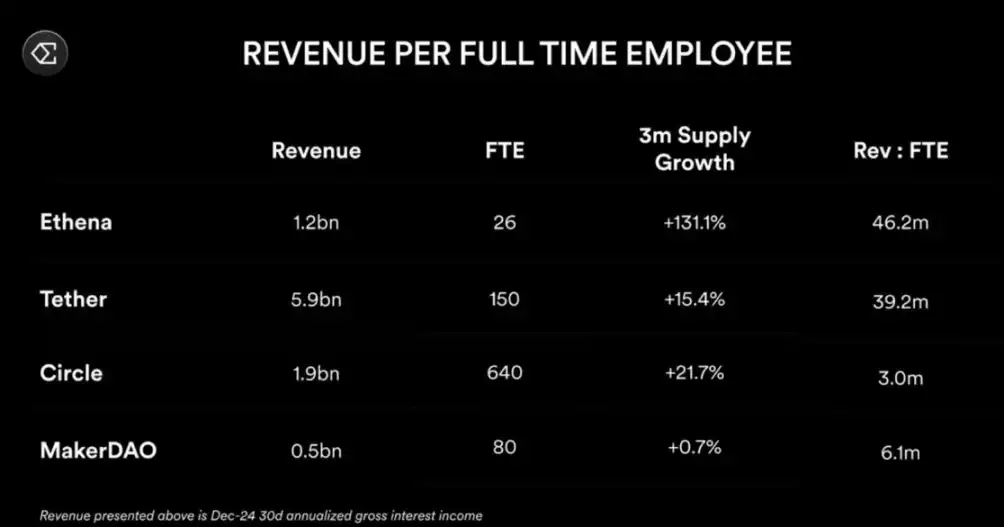
Comparison of Revenue Run Rate per Employee in December
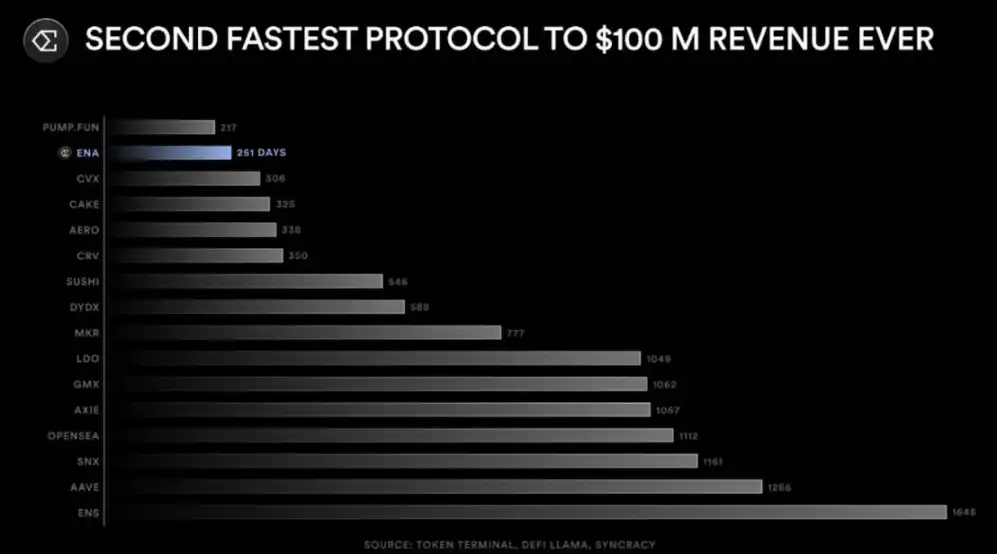
Ethena is the second fastest startup in history to reach $1 billion in revenue
Ethena officially launched in February 2024. The current supply of USDe is around $60 billion, making it one of the fastest-growing applications in cryptocurrency history. One year after its founding, USDe is only behind USDT and USDC, which have been in operation for nearly a decade.
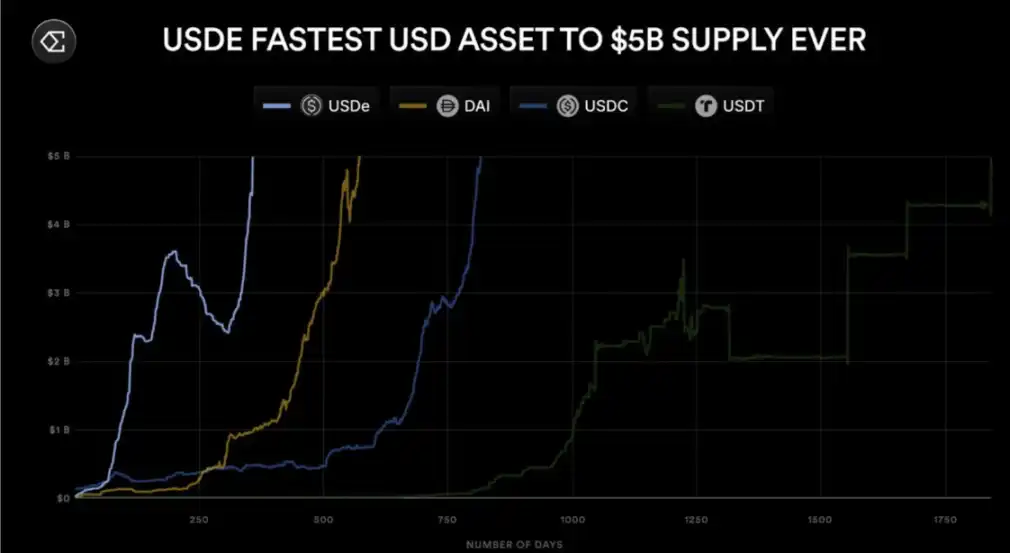
Fastest in history to reach $50 billion USD asset
In addition to USDT and USDC, Ethena accounted for 85% of all on-chain USD asset growth in 2024. In recent weeks, the nominal USD inflow into USDe has exceeded the total growth of ETFs, all of which are the most successful ETF products in history.
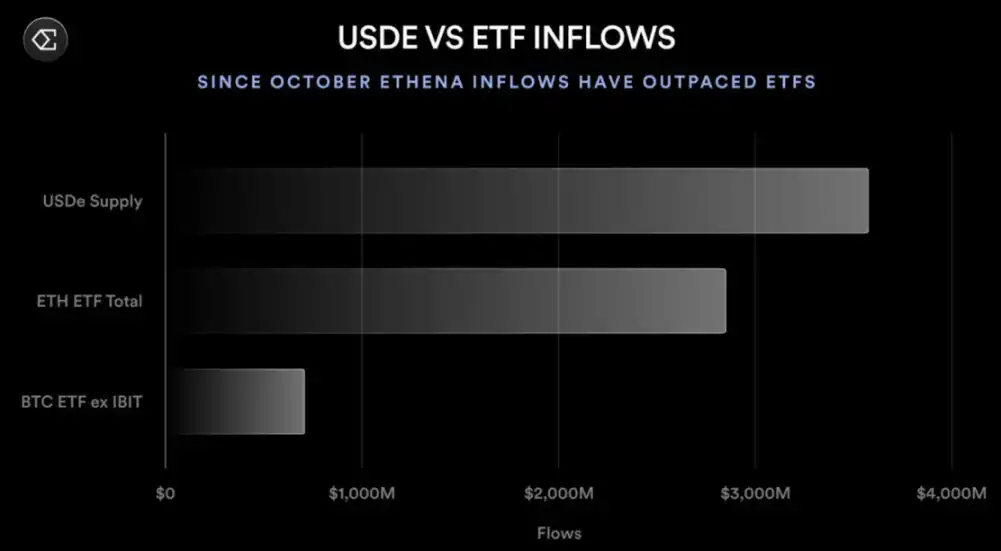
Since October 1st, the inflow of funds into USDe has exceeded all aggregated ETFs of ETH and BTC (excluding IBIT)
In the DeFi space, Ethena has become a key component for other financial applications. Over 50% of Pendle's Total Value Locked (TVL) comes from Ethena; Sky generates around 25% of its revenue (over $1 billion) related to Ethena; Morpho's TVL is approximately 30% from Ethena assets; Ethena's listing on Aave was the fastest-growing asset in 2024, reaching over $1.2 billion within three weeks; most EVM-based perpetual contract exchanges have listed USDe collateral assets.
Ethena is also one of the first on-chain products to enter the CeFi market (primarily used as margin collateral for trading derivatives). USDe is currently listed on about 60% of centralized exchange markets, with only two major exchanges yet to list it. In just a few weeks, USDe surpassed the USDC balance on Bybit, demonstrating the product's alignment with the market.
USDtb was also launched last month, backed by BlackRock's BUIDL Treasury Fund as collateral for the stablecoin. For end-users, the product operates like a regular stablecoin since it is designed specifically for profit-sharing partners such as centralized exchanges, incentivizing them to use the product on their platforms. We will gradually announce exchange integrations in January, allowing these institutions to offer a full suite of dollar products to their users through Ethena's products.
Lastly, we see decentralized and on-chain stablecoins starting to adopt a hybrid approach using USDe and Real-World Asset (RWA) products to support their offerings. Ethena can now provide backend infrastructure to issuers for both products, with products like Sky, Frax, and Usual leveraging Ethena in their offerings.
However, all these achievements pale in comparison to the upcoming changes.
The next phase of Ethena's growth will be primarily driven by entering the traditional finance sector.
The infrastructure is now in place, with the product's regulatory path in the traditional finance sector clear, presenting opportunities far beyond anything we have seen in the cryptocurrency space to date.
Entering Traditional Finance: A Win-Win Integration
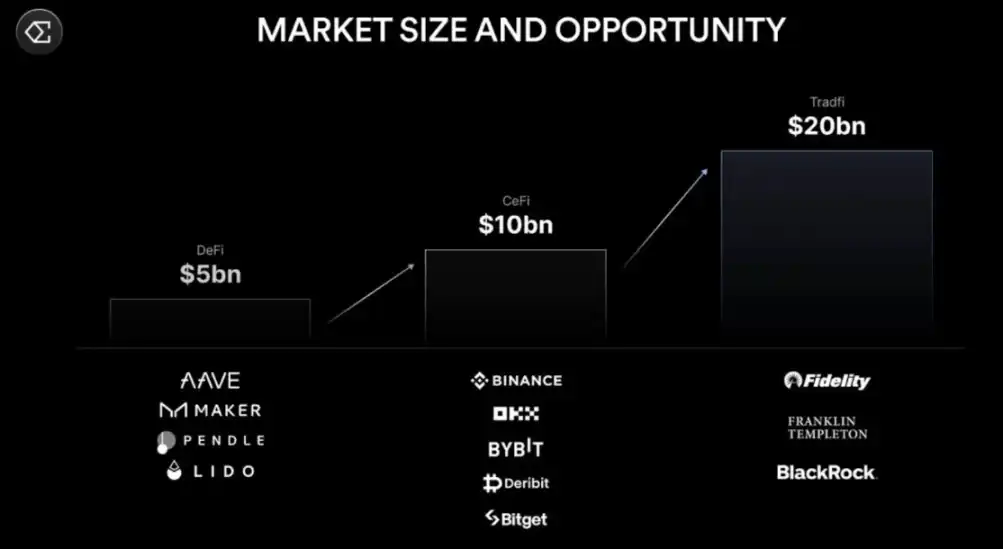
Note: The target distribution platforms listed above are for reference only, and not all institutions are current partners.
The fixed income market is the world's largest liquidity investment category, with a total size exceeding $190 trillion. Most asset management firms, sovereign wealth funds, pension funds, and insurance funds invest in fixed income products. The entire cryptocurrency market's market cap is currently less than Australia's debt capital market, despite Australia's population accounting for less than 0.5% of the global population.
The most important financial instrument used worldwide for saving and preserving value is the U.S. dollar and its yield. While this may sound simple, the demand for this product far exceeds the entire cryptocurrency market (including Bitcoin).
That's why, following ETFs, U.S. dollar savings products are the logical next step for these institutions. The futures market is the only market within cryptocurrency that is large enough to meet their dollar demand.
Ethena is prepared to offer such a product.
sUSDe-iUSDe for Traditional Finance
Ethena will launch a new product, iUSDe, next month with the aim of bringing sUSDe into the traditional financial realm through a regulated product.
iUSDe is similar to sUSDe but includes a simple wrapping contract that adds some transfer restrictions at the token level for ease of holding and usage by traditional financial entities.
This includes partnering to provide an independent special purpose vehicle (SPV) managed by regulated investment managers, allowing subscription to shares of this vehicle, enabling traditional financial institutions to effectively participate in the product without exposure to the crypto space.
We will announce the first batch of iUSDe traditional finance distribution partners this month.
The focus for the first quarter of 2025 will be collaborating with traditional finance distribution partners to enable their clients to access iUSDe, covering the entire spectrum:
· Asset Management Firms
· Private Equity Funds
· Exchange-Traded Products
· Private Investment Trusts
· Prime Brokerages
By establishing a bridge to traditional finance, traditional financial institutions can obtain U.S. dollar loans at a spread of SOFR+100-200bps, leading to unprecedented capital inflows into Ethena until the yield spread of the sUSDe protocol narrows with the risk-free rate.
In this scenario, Ethena will play the role of a rate arbitrage tool, facilitating capital flow and rate market convergence between DeFi, CeFi, and traditional finance.
Traditional finance will be able to price iUSDe relative to a risk-free rate, while the supply of USDe will adjust based on changes in the crypto-native rate, serving as a bridge between traditional finance and internet finance.
Based on the current market conditions, we find these pools to have over $10 billion in incremental iUSDe capacity.
The Appeal of iUSDe to Traditional Finance
The uniqueness of Ethena's iUSDe lies in:
· It combines the only two forms capable of achieving real crypto-native yields at a billion-dollar scale.
· Its yield exhibits a weak negative correlation with rates in traditional finance.
· Its underlying assets are held by custodial institutions, which can be underwritten by traditional financial institutions.
By integrating the only two scalable native crypto-yield sources into a dollar product, it provides a simple avenue for capital allocators in traditional finance to access and harvest excess returns from the crypto space through a single asset.
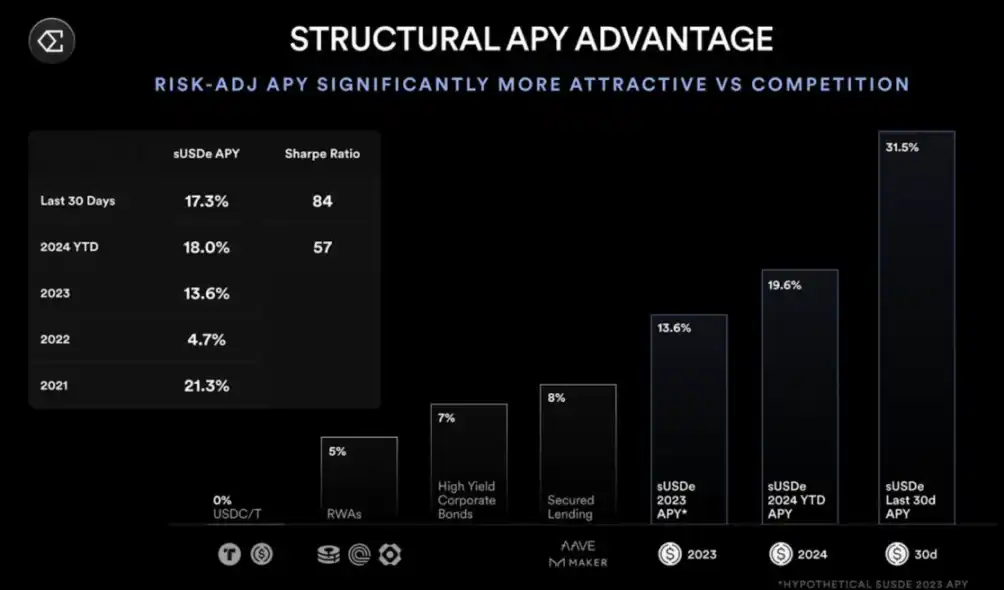
The highest risk-adjusted dollar return in crypto
When Ethena's iUSDe is compared to existing traditional fixed-income portfolios, the unlevered dollar annual return last year was around 20%, which was unheard of before. As rates drop, iUSDe as an alternative will become even more attractive.
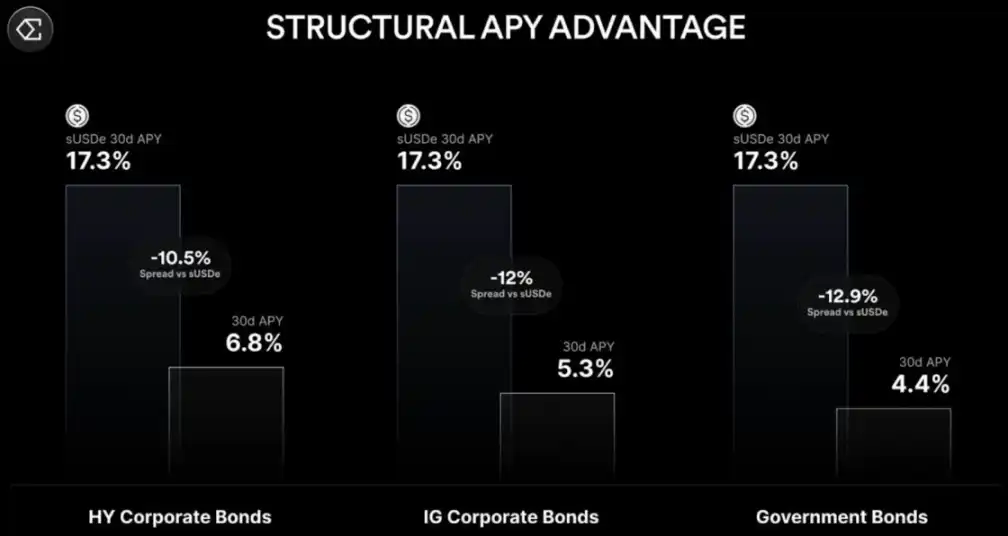
sUSDe vs. traditional fixed-income products
The scale of the basis spread in the crypto market is not yet fully understood. Undoubtedly, this is the largest potential source of cash flow in the entire space. Since Ethena's launch, the spread has grown over threefold. Importantly, this scale is sufficient to attract the attention of the traditional financial sector, becoming a viable opportunity.
The total open interest scale reaches $110 billion, with an annualized basis spread of around 20%, enabling Ethena to generate approximately $10 billion in cash flow annually, nearly ten times the cash flow of the entire ETH staking market.
Currently, Ethena holds approximately 7% of the open interest. At a $200,000 Bitcoin price, if only 10% of the open interest is held, USDe's supply would reach $25 billion.
The path forward is now clear, and the task at hand is to execute and deliver this product to the traditional financial market.
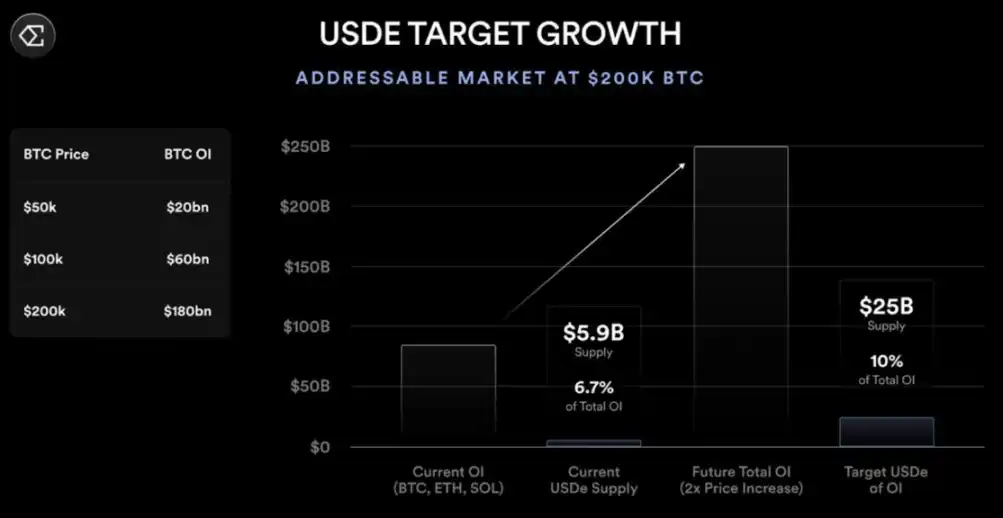
With the growth of Bitcoin open interest and market share, USDe's target supply is $25 billion.
Macro Interest Rate Bull Case and Negative Correlation
The most attractive feature of sUSDe to traditional finance is its negative correlation with real interest rates. There are hardly any other debt products in traditional finance that have this feature.
This point is intuitive: as real interest rates continue to decline, speculative activity in the cryptocurrency market accelerates, while the long-term demand for leverage increases, driving funding rates up, ultimately boosting Ethena's harvested yield.
We observed this phenomenon during the zero interest rate policy (ZIRP) period in 2020/21 when the funding rate spread exceeded 15%, and this phenomenon re-emerged in the fourth quarter of 2024.
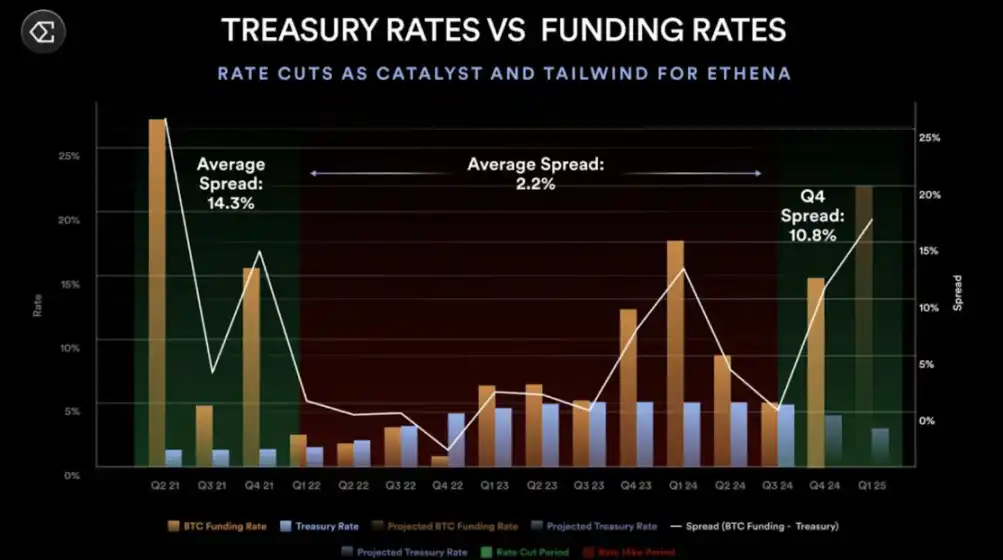
Rate cuts as a driving force for sUSDe growth
Recently, we have seen the precise response to rate cuts: a cut of approximately 75 basis points caused the funding rate to increase from around 8% to over 20%, a change that occurred over the past few months of the previous quarter. With the arrival of an easing cycle next year, this trend is expected to continue.
Compound Effect of Rate Cuts
Rate cuts have certainly had a compounded effect on Ethena's growth and fundamentals. The rate reduction not only drove the expansion of stablecoin demand but also, as the RWA benchmark rate decreased, from a risk-adjusted standpoint, Ethena became more appealing, able to offset the impact of the decline in real interest rates on traditional fixed-income products.
Simple Example:
For a $1 trillion fixed-income investment portfolio, if the rate decreases by 200 basis points, approximately $150 billion of sUSDe would need to be added to keep the blended portfolio return at the same level.
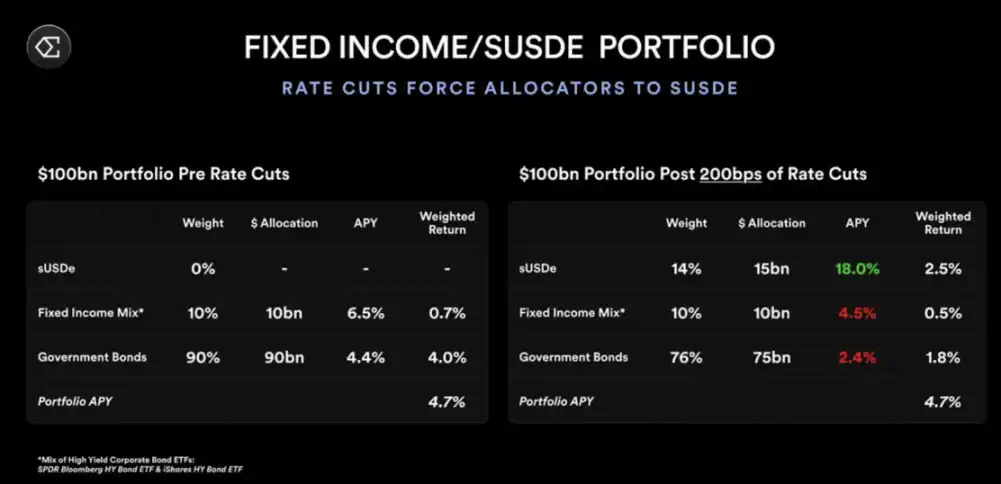
The Demonstrative Impact of sUSDe on a $100 Billion Fixed Income Portfolio
A higher-risk-adjusted USD yield brought by native crypto assets, this product type has the potential to siphon billions of dollars from the old financial system into the Internet system.
Ethena will act as the bridge for this transition.
By the first quarter of 2025, this transition will take place.
The Future of the Crypto Dollar Landscape
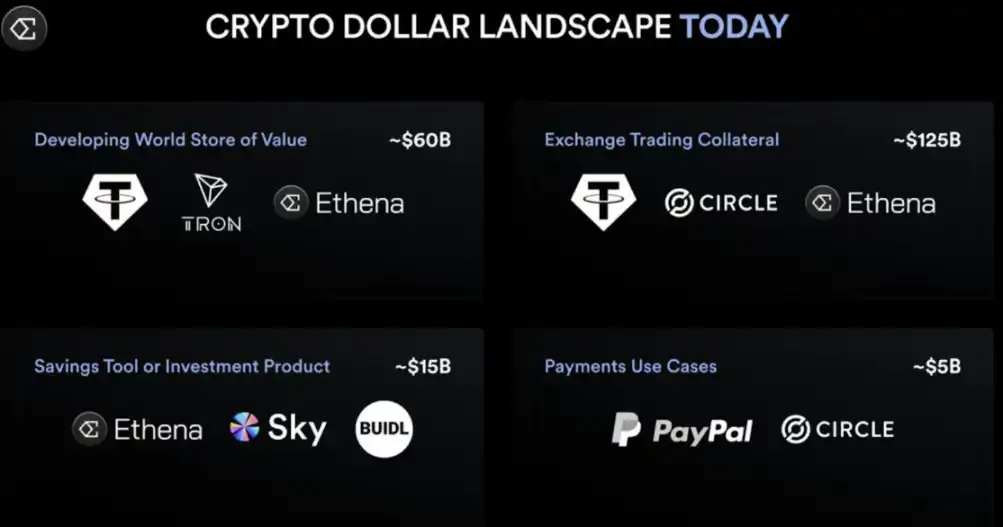
Current Crypto Dollar Landscape
The present and future of the crypto dollar will be drastically different.
Currently, stablecoin use cases can be broadly categorized as follows:
1. Trading and Collateral: Currently dominated by Tether, with the vast majority of spot and perpetual contract pairs priced in USDT with a market size of approximately $125 billion. Ethena, as a derivative collateral asset, has surpassed USDC on the second-largest exchange.
2. Value Savings Tool for Developing Countries: Providing a global USD channel for individuals outside the US banking system, primarily dominated by Tether on the Tron network, with a market size of around $600 billion.
3. Savings or Investment Tool: Currently led by Ethena and Sky, with almost no participation from the traditional financial system in on-chain products, with a market size of about $150 billion.
4. Payment Scenarios: Currently, this market is almost non-existent, although there are instances of PYUSD and USDC, meaningful integration with traditional payment systems has not yet been achieved, with a market size of less than $50 billion.
In conclusion, Tether dominates the current two major application scenarios: trading and the value storage tool for developing countries.
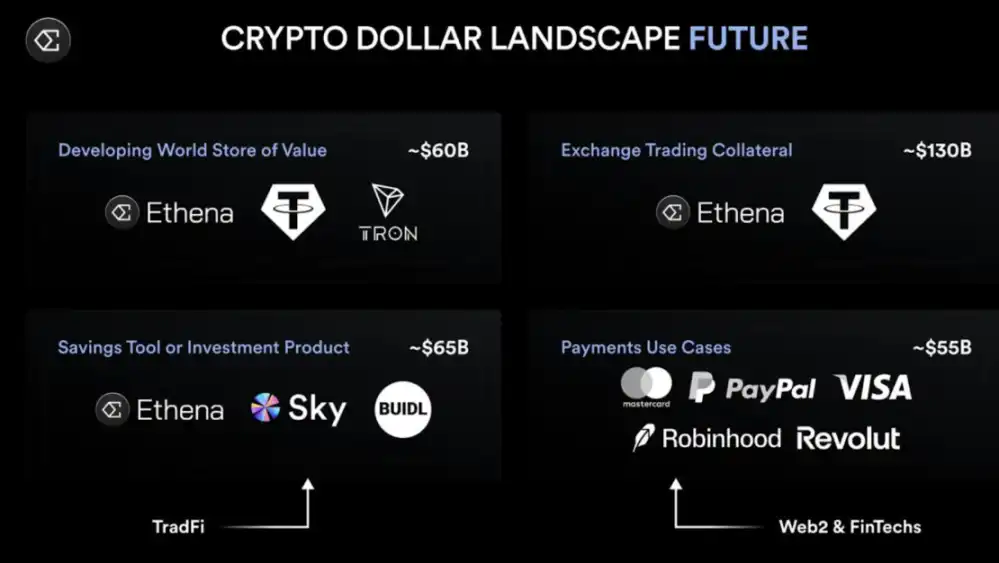
Future Crypto Dollar Landscape
However, I believe that with the entry of the following two categories, the existing landscape will see a significant transformation:
1. Traditional Finance Enters Savings Product Use Case
2. FinTech Companies and Web2 Companies Enter Payment Product Use Case
While the above two categories are currently the smallest in scale, they have the greatest growth opportunities in the future.
Although Ethena has already found product-market fit in the two most popular use cases, I believe that traditional finance entering the savings product and Web2 or FinTech companies entering the payment use case will bring in over $500 billion in net new US dollar inflows to the market in the next two years.
sUSDe will be the primary beneficiary of the former.
As for the latter, we plan to address the payment and savings tool use cases by creating dedicated applications within the Telegram and TON ecosystems, without directly entering into competition in the payment company space.
Product Aimed at One Billion Users
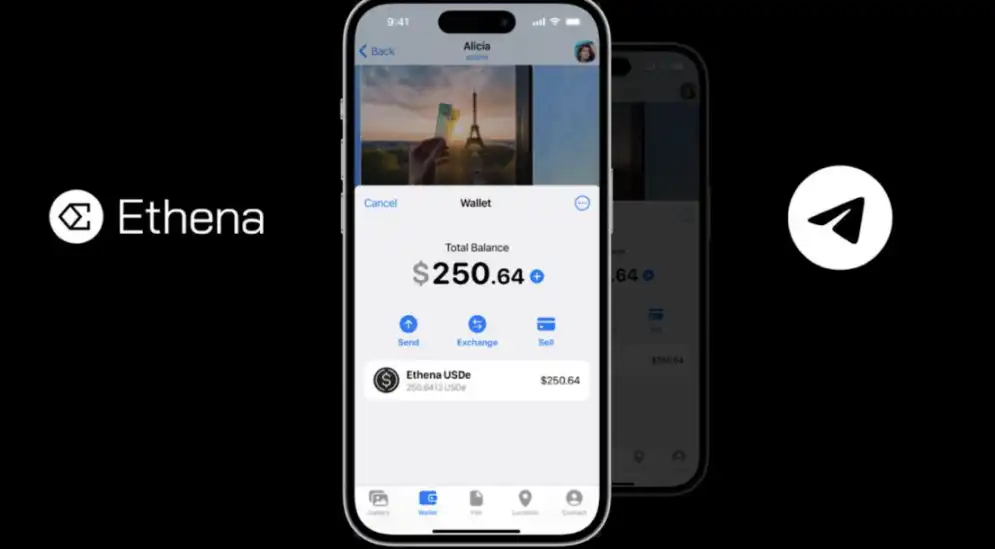
sUSDe Application on Telegram
By 2025, we will launch a dedicated sUSDe use case within the Telegram app, where users can engage in transfers, spending, and savings in an experience similar to that of a mobile digital bank.
Payments will be directly linked to Apple Pay, allowing users to switch between savings assets in sUSDe and direct mobile payments on their phones.
Interest-bearing US dollars are the world's most important savings asset, used for wealth preservation, and I believe it is the only cryptographic product outside of Bitcoin that can reach a billion people.
With Telegram's access to over 9 billion users, we have a distribution platform to bring this product to the world.
Our shared goal is to provide a payment and savings product that is as easy to use as sending a message to one billion people.
Ethena Ecosystem Network
The core product goal of Ethena is simple: with USDe and USDtb, to be the most important product in the cryptocurrency field alongside Tether.
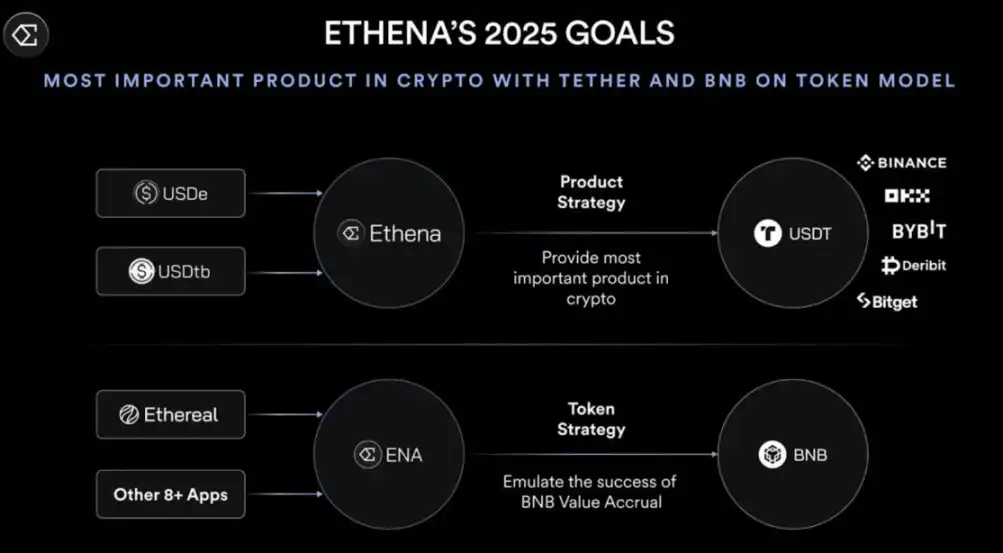
Product and token strategies closely integrated through ecosystem applications
In addition to these core products, Ethena will continue to evolve from a single-asset issuer to a platform, providing support to the best developers and driving on-chain financial innovation.
As part of building an ecosystem based on sUSDe, the design of sENA aims to accrue value through a token model similar to BNB, where applications in the ecosystem will reserve a portion of the token supply to airdrop to sENA holders.
The dollar will continue to serve as the infrastructure for on-chain capital flow, not only used for settlement and payments but also encompassing all core DeFi primitives such as trading, lending, derivatives, and leverage.
Today, every DeFi protocol involving the dollar can be rebuilt around Ethena and achieve an improved economic structure by default.
sUSDe has unlocked new possibilities for this round of innovation, such as fixed-rate lending, leveraged strategies in the money markets, and derivative margin collateral with staking rewards. However, the full picture of new products that could be built based on sUSDe is still worth looking forward to.
The Ethena Network is our plan to directly support innovative protocols based on Ethena's sUSDe applications, while staying aligned with these new protocols through the ENa token.
We have announced two applications:
· Ethereal: a perpetual and spot exchange based on its own application chain, with a full order book denominated in sUSDe and native rewards, where Ethena will provide liquidity and hedge the exchange.
· Derive: the largest on-chain options and structured products protocol, where sUSDe is the system's core collateral asset.
Ethereal will open its testnet next month, while Derive plans to launch its token in the next two weeks.
These are just the first examples in the entire DeFi ecosystem built on sUSDe, with more applications set to be released in the first quarter of 2025.
On-chain detailing will be released alongside the Ethereal mainnet in the first quarter.
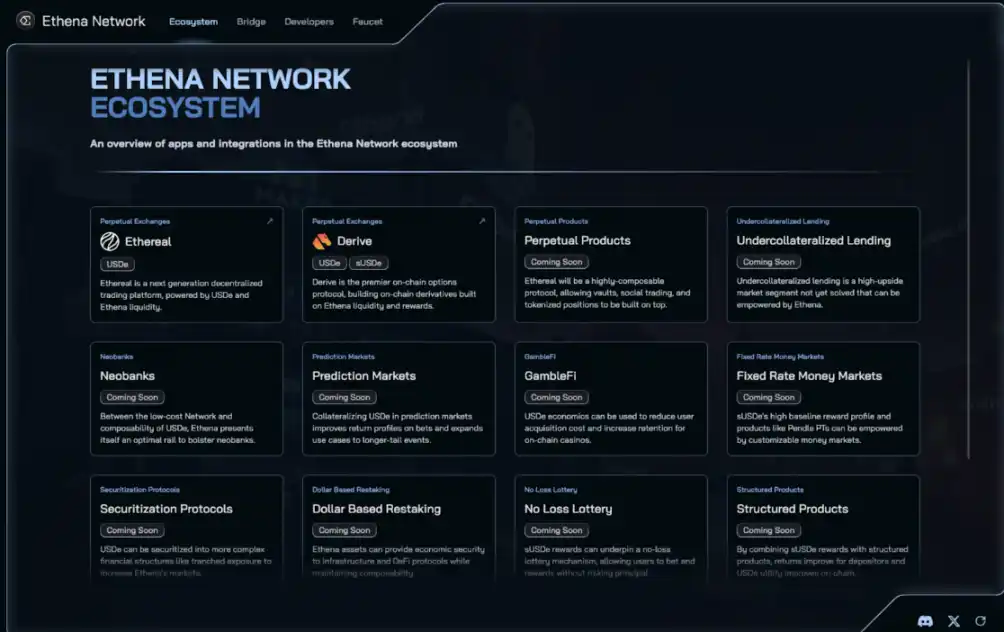
Ethena Network Applications
Thank you once again for your support in 2024. Without our users and those who have always believed in our vision, Ethena would be nothing.
2024 was the year we launched our first tangible product, laying the groundwork and preparing for the intersection of a macroeconomic tailwind.
In 2025, we will disrupt the financial system on a scale far beyond what we have achieved so far.
You may also like

Morning Report | BitMine increased its holdings by 126,971 ETH last week; trader Eugene announced his exit from the crypto market

Wang Chuan: How can one not feel anxious after the neighbor Old Wang made thirty times profit by investing in storage stocks? (Seven) - A quarter-century cycle

Cryptocurrency CEXs are flocking to sell US stocks, and traditional brokerages are facing an "uninvited guest."

$75 billion in foreign capital has fled, and South Korean retail investors have absorbed it all using leverage

Japan’s Three Megabanks Plan Joint Stablecoin Issuance in Fiscal 2026
MUFG, SMBC, and Mizuho reportedly plan to jointly issue fiat-pegged stablecoins in fiscal 2026, signaling Japan’s growing push into bank-led digital payment infrastructure.

Humanity Discloses H Token Dual-Chain Attack Details, With Losses on Ethereum and BSC Exceeding $36 Million
Humanity said the H token attack across Ethereum and BSC caused more than $36 million in losses after leaked ProxyAdmin keys enabled malicious contract upgrades and token minting.
White House Discusses CLARITY Act With Law Enforcement Ahead of Senate Vote
The White House discussed the CLARITY Act with law enforcement ahead of a Senate vote, focusing on illicit finance risks and developer protections.

Bitcoin Trading Guide 2026: Strategies for Experienced Traders

What Is XAUT and PAXG? Why Tokenized Gold Is Booming in 2026

Will the SpaceX IPO Hurt Bitcoin? Here's What Traders Are Watching

Foreign selling in the South Korean stock market accelerates, with cumulative net sales reportedly reaching $75 billion this year
On June 9, The Kobeissi Letter, citing Goldman Sachs data, reported that global investors are selling South Korean stocks at an unusually rapid pace. In the latest trading session, foreign investors sold about $801 million worth of Kospi constituent stocks again; total foreign outflows last week reached about $10 billion, and the market has been in net foreign selling on nearly every trading day over the past month. According to the data cited in the report, foreign investors have sold about $75 billion worth of South Korean stocks so far this year. Meanwhile, South Korean retail and institutional investors together recorded roughly $69 billion in net buying over the same period, suggesting that the market’s main buying support has come from domestic capital rather than returning overseas funds. The information currently disclosed still mainly comes from The Kobeissi Letter’s retelling and Goldman Sachs data summaries, while public details on the statistical period and the specific definition of “selling” remain relatively limited.

Fortune Warns of Strategy’s Financing Structure Risks as Bitcoin Premium Narrows
Fortune warned that Strategy’s Bitcoin treasury model faces growing financing risks as MSTR’s net asset premium narrows and preferred stock dividend pressure increases.

Ferrari Challenge Le Mans: Carl Moon to Dominate in WEEX Livery

Sahara AI Responds to SAHARA’s Sharp Drop: No Contract or Product Security Issues Found, Internal Investigation Underway
Sahara AI responded to SAHARA’s 60% price drop, saying no token contract or product security issues have been found and an internal investigation is underway.

WEEX Deposit/Withdrawal Dynamic Island: Your Asset Status, Always in Sight
Scaling Crypto Derivatives: The Digital Asset Infrastructure Behind High-Volume Trading
In the fast-moving digital asset ecosystem, derivatives platforms face an extreme architectural test. High-leverage futures markets demand more than just standard security—they require absolute operational precision, zero-latency matching engines, and ironclad structural scalability, all while navigating intense market volatility.
As global platforms scale to meet these demands, the industry is shifting away from rigid, monolithic setups toward a more agile, "decoupled" infrastructure philosophy.
The Blueprint for High-Volume Copy TradingFor elite global exchanges like WEEX (founded in 2018), this architectural choice becomes critical when scaling high-volume retail features like social copy trading. When thousands of users automatically mirror the real-time strategies of elite traders simultaneously, it triggers sudden, monumental spikes in concurrent transactional volume.
To prevent execution latency or settlement bottlenecks during these peak volatility events, a platform's primary engine must remain entirely dedicated to risk management, copy-trade synchronization, and order matching.
The Architectural Rule: New-generation platforms must separate front-end user execution engines from heavy backend infrastructural overhead to eliminate operational friction.
By separating these layers, platforms can maintain complete sovereignty over their trading environments and user experiences while strategically aligning with institutional-grade infrastructure ecosystems. This strategic framework allows modern exchanges to leverage advanced Digital Asset Custody infrastructure such as Cobo’s behind the scenes, ensuring that backend wallet management scales elastically alongside trading spikes.
Capitalizing on Market Momentum and 400× LeverageIn a derivatives arena where platforms offer up to 400× leverage on perpetual contracts, capital efficiency and market agility are core business metrics. To capture market momentum, an exchange needs the ability to rapidly expand its asset offerings, supporting everything from legacy crypto assets to sudden, trending altcoins across a massive library of trading pairs.
Adopting a flexible, scalable Wallet-as-a-Service (WaaS) solution such as Cobo’s could completely rewrite the development timeline for high-growth exchanges. Instead of spending months of engineering capital building out custom backend wallet architectures for every new blockchain network, platforms can deploy localized infrastructure in days.
This agility allows platforms to instantly scale their listings to over a thousand trading pairs without compromising security or delaying time-to-market. It mirrors the exact operational advantages seen during high-velocity market events, similar to how advanced wallet infrastructure empowers platforms during sudden asset surges; allowing exchanges to pass that speed and liquidity directly to their global user base.
A Mature Foundation for GrowthThe synergy between trusted infrastructure ecosystems and global trading platforms represents the natural evolution of a maturing crypto market. As WEEX continues to scale its global spot and derivatives offerings for over 6 million users, adopting robust backend paradigms proves that platforms no longer have to compromise between cutting-edge trading velocity and uncompromised structural security.

Get Paid to Onboard? Try WEEX’s New Homepage with Rewards for Registration, Deposit & Trade
WEEX Custom Layout: Build Your Perfect Trading Workspace in Seconds
Morning Report | BitMine increased its holdings by 126,971 ETH last week; trader Eugene announced his exit from the crypto market
Wang Chuan: How can one not feel anxious after the neighbor Old Wang made thirty times profit by investing in storage stocks? (Seven) - A quarter-century cycle
Cryptocurrency CEXs are flocking to sell US stocks, and traditional brokerages are facing an "uninvited guest."
$75 billion in foreign capital has fled, and South Korean retail investors have absorbed it all using leverage
Japan’s Three Megabanks Plan Joint Stablecoin Issuance in Fiscal 2026
MUFG, SMBC, and Mizuho reportedly plan to jointly issue fiat-pegged stablecoins in fiscal 2026, signaling Japan’s growing push into bank-led digital payment infrastructure.
Humanity Discloses H Token Dual-Chain Attack Details, With Losses on Ethereum and BSC Exceeding $36 Million
Humanity said the H token attack across Ethereum and BSC caused more than $36 million in losses after leaked ProxyAdmin keys enabled malicious contract upgrades and token minting.


