
- Buy Crypto
- Markets
 Futures
- Spot
- Copy Trade
 Earn
Earn- More
Deconstructing iNAV: Moving Beyond mNAV, How to Identify "True vs. Fake" Hodling?

Original Title: "Deconstructing DAT: Building Deep Analysis Beyond mNAV"
Original Authors: @sui414, @0xallyzach, @cosmo_jiang, Pantera Capital
Original Translation: @kokii_eth
Abstract
• Pareto Distribution Pattern: The DAT industry exhibits a power-law distribution, with top projects in each category occupying the majority of market share, making it difficult for long-tail projects to survive. Despite the presence of bubbles, DAT, based on real assets and differentiated treasury strategies, still represents significant financial innovation.
• Value vs. Sentiment Divergence: mNAV often obscures long-term value drivers. Our growth-driven decomposition model separates fundamental compounding growth from market sentiment. Data shows that companies like BMNR and HSDT continue to increase their per-share value, while the majority of DAT price decreases are primarily due to sentiment contraction rather than fundamental deterioration.
• Fragile Flywheel Effect: DAT relies on reflexive capital cycles—issuing stock growth during premiums to the treasury and defending per-share value during discounts. This is highly challenging in a falling market. Companies like Bitmine exhibit prudent management, while some enterprises' aggressive issuance leads to dilution, harming long-term sustainability.
• Dual Evaluation Framework: A comprehensive assessment needs to focus on 1. fundamental value growth independent of sentiment; 2. issuance and treasury management—i.e., whether management is responsibly responsive to market conditions. Both determine whether DAT is creating value or eroding it.
• Data Infrastructure Gap: The industry urgently needs structured comparable data, including establishing disclosure standards, enhancing transparency, and optimizing operational practices. Stronger data transparency will drive industry maturity and safeguard investor information rights.
The year 2025 ushered in the DAT Summer, with DAT such as Bitmine (BMNR), Sharplink (SBET), and Solana Company (HSDT) entering the mainstream, rapidly expanding the field. The total market value of the 30 tracked BTC, ETH, and SOL DAT has reached $117 billion. However, after the market shock, the initial hype has begun to cool off.
Despite the ongoing market noise, most investors still only assess DAT through the narrow view of mNAV (market value / net asset value ratio), failing to understand the intrinsic mechanisms of its core value, treasury strategy, or issuance discipline.
Therefore, we have compiled this report based on the DAT data dashboard built in collaboration with partner Pantera, aiming to drive discussion, clarify misconceptions, and establish a more rigorous DAT evaluation framework.
What is a Digital Asset Treasury (DAT)?
A Digital Asset Treasury (DAT) is one of the most prominent financial experiments in today's public markets. They are balance sheet-focused, publicly-listed companies with digital assets at their core, allowing investors to gain exposure to assets like BTC, ETH, SOL, and others indirectly through the stock market. This means investors can trade in a regulated environment through their traditional brokerage accounts, avoiding the complexity of on-chain platforms.
Unlike ETFs or trusts, a DAT is an operating company rather than a passive investment vehicle. They can directly hold, trade, or even stake digital assets, issue new shares, or raise funds, creating an actively managed treasury tool tied to the value of the underlying digital assets and the company's capital management strategy.
A typical DAT starts with a small publicly-listed company or Special Acquisition Purpose Company (SAPC) holding digital assets, where the Net Asset Value (NAV) reflects the total fair value held, and the Market Cap (MCAP) reflects the market's pricing of the same asset exposure—often at a premium or discount due to market sentiment, liquidity, and management confidence.
Some DATs, like the BTC Strategy, focus on utilizing equity financing to continuously accumulate the target asset. Other DATs explore yield farming, derivatives exposure, or diversified investment portfolios, layering additional income streams beyond price exposure.
For investors, DATs act as a bridge between traditional finance and on-chain assets:
• For both retail and institutional investors, DATs offer regulatory clarity, brokerage accessibility, and compliance compatibility, allowing them to have exposure to digital assets through familiar channels.
• For the crypto ecosystem, DATs create new channels of capital inflow, increasing the scarcity of underlying assets, supporting staking infrastructure, and deepening secondary market liquidity.
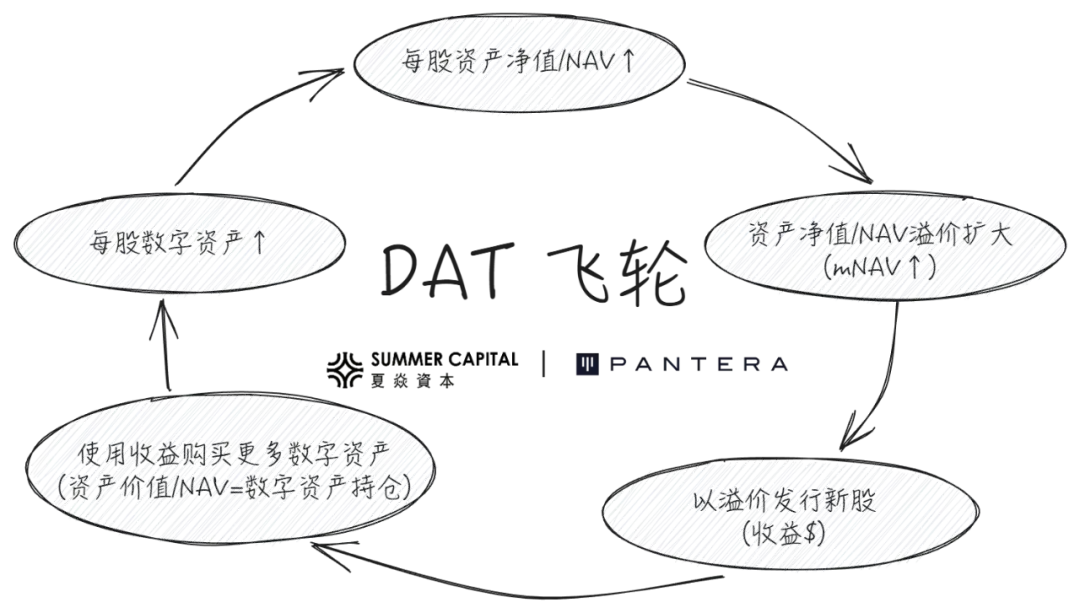
Many companies and institutions participate in DAT issuances through Private Investments in Public Equity (PIPE), whose investment thesis is based on the "virtuous cycle" shown in the diagram below:
However, the market also holds various doubts about DATs:
• This virtuous cycle may easily be seen as an eternal bull market engine, but what happens when both mNAV and underlying asset prices decline?
• PIPE investors receive shares at a pre-set price (usually below retail) before the DAT announcement, often criticized as insider trading or retail investor exploitation.
• Trading above NAV is seen as problematic because retail investors are forced to pay a high premium; trading below NAV is also seen as problematic because assets need to be sold to buy back shares.
This article will use data analysis to address these concerns, clarify misconceptions, explain the true meanings of each indicator, and share the DAT valuation methodology.
1. Key Indicator Analysis: mNAV and Limitations
Since March 2025, the total market value of the 30 DATs we track has risen from $880 billion (largely attributed to Strategy/MSTR at the time) to around $1,170 billion, covering the three major digital assets: BTC, ETH, SOL. However, market discussion still overly focuses on the mNAV single indicator, overlooking its true meaning and other important indicators.
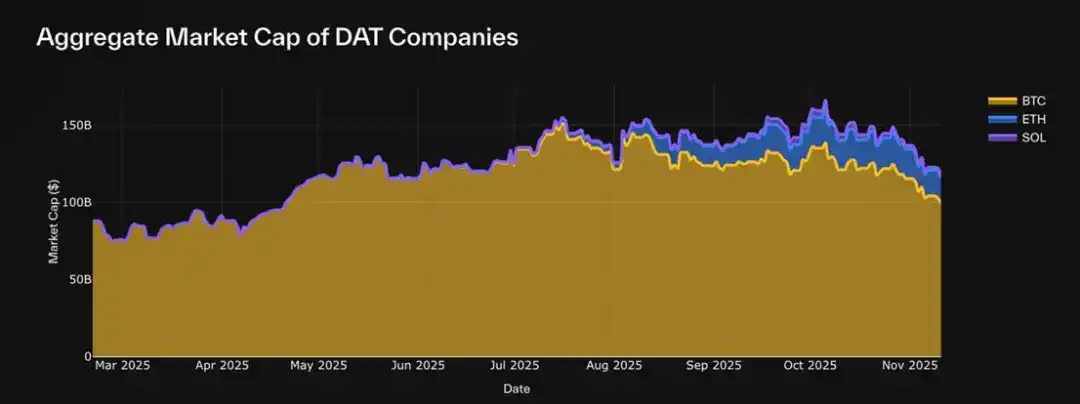
DAT Company Market Value Growth Trend (based on 30 tracked assets)
DAT is essentially a publicly traded stock, and evaluation needs to focus on two key elements:
• Net Asset Value (NAV): Reflects the company's true value. For DAT, this refers to the total current assets on the balance sheet—including digital assets and undeployed cash equivalents. The core value driver of the company is not traditional operating profit but rather the holding and growth of digital assets.
• Market Capitalization (MCAP): The market's assessment of the company's value, calculated by multiplying the stock price by the total number of outstanding shares.
Net Asset Value (NAV)

NAV reflects the fundamental value of the assets held, but the specific composition varies by company. Some companies hold cash reserves, short-term government bonds, or other equities, while others hold convertible bonds or warrants, making NAV difficult to standardize. Existing data dashboards often use a simplified formula, some of which include debt and convertible instruments.
Multiple NAV (mNAV)
While NAV reflects the company's underlying assets, it does not reflect the market's assessment of these assets. This requires market capitalization: the real-time assessment of the company's value by the market.
The relationship between market cap and NAV provides the most closely watched indicator in the DAT field: mNAV (Multiple NAV).
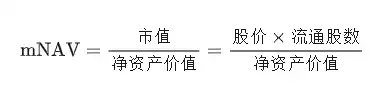
mNAV represents how much the market is willing to pay for each dollar of Net Asset Value:
• mNAV > 1 → Indicates optimism about the company's future prospects or growth potential. The market values the company higher than its balance sheet assets, usually considering anticipated future per-token growth.
• mNAV < 1 → Reflects market skepticism. Investors may be concerned about equity dilution, question management discipline, or believe that the company's digital asset exposure has not been effectively translated into shareholder value.
Essentially, mNAV is an emotion multiplier built on fundamentals, revealing market beliefs about DAT's cumulative digital asset holding capacity.
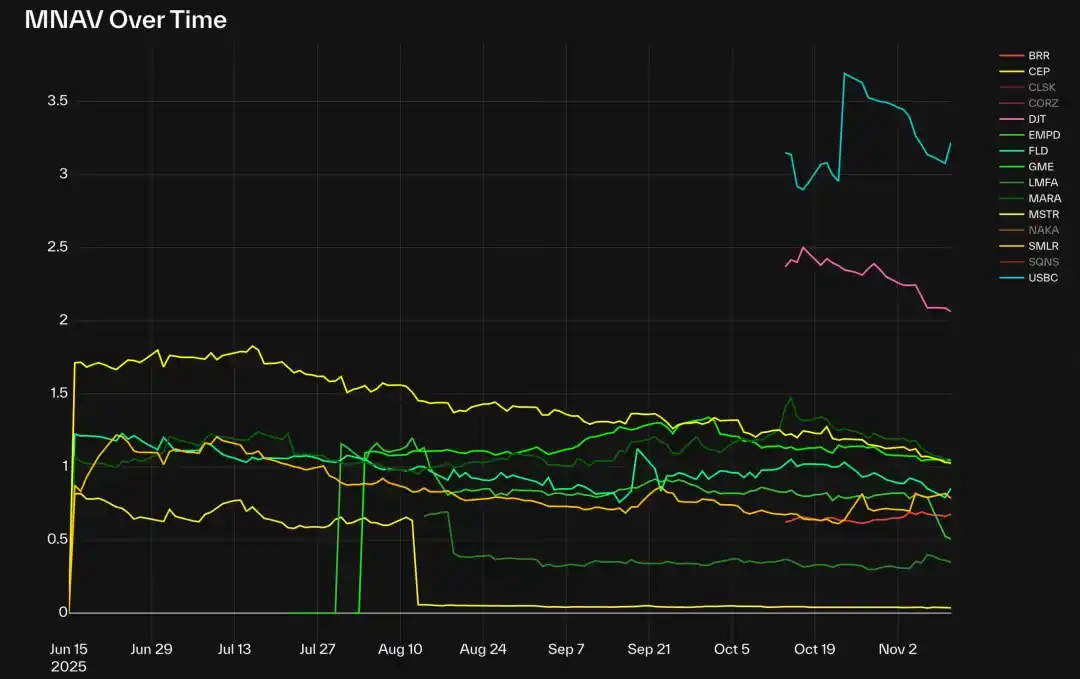
mNAV Multiples for BTC DATs (excluding CLSK, CORZ, NAKA, and SGNS)
As of today, in the BTC DAT category, Strategy (MSTR), GME, and MARA are all close to 1.0 following a recent market adjustment. However, most other BTC DATs have mNAV ratios below 1.0, with EMPD being the lowest at around 0.5.
Newcomer DATs like DJT and USBC currently have mNAV ratios around 2-3, reflecting early-stage DAT speculative characteristics. A few exceptions: CLSK around 4, CORZ close to 7, both AI data center companies (formerly BTC miners), indicating that despite overall market normalization, specific narratives or structural factors are still driving premiums.
The ETH DAT market is similar: BMNR, SBET, and GAME trade near 1 times mNAV, reflecting fair value pricing; BTBT and COSM have higher multiples due to these companies having revenue-generating business lines beyond their digital asset holdings, which the market may not view as pure DAT valuations.
In Solana DATs where PIPE shares are already registered, only HSDT trades at a slight premium of 1.12 times mNAV (as of November 12, 2025), while the rest are slightly below 1, indicating that market trends are largely aligned with fundamentals, signaling a cooler early-cycle.
Premium and Discount
Premium/Discount is essentially another presentation of mNAV, measuring the market's trust or speculation level on the company's treasury value, represented in relative price rather than multiples. A high premium signifies leverage, strong sentiment, or operational excess returns, while a discount usually reflects concerns about equity dilution or weak capital discipline.


In the data dashboard, extreme premium cases of around 800% for assets such as COSM and CORZ can be seen, mainly due to the market valuing them based on existing core business, not on DAT attributes.
Per-Share Digital Asset
Assessing the intrinsic growth of DAT requires tracking both the digital asset holdings and the circulating share count. A healthy DAT aims to achieve growth in two key metrics: increasing digital asset holdings to enhance the underlying asset base and issuing new shares to raise funds to support growth. While new share issuances dilute existing shareholder equity, if the asset growth rate exceeds the new share issuance rate, this dilution actually brings benefits.
A key derivative metric, per-share digital asset, measures how much of a digital asset each share effectively represents, reflecting the degree of shareholder exposure. An increase in per-share digital asset indicates that the funds raised from the issuance were used for asset growth rather than offsetting equity dilution.
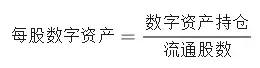
Among the 30 DATs being tracked, few companies show consistent growth in per-share digital assets. Notable exceptions include Strategy (MSTR), BMNR, HSDT, ETHM, BTCS, CEP, and UPXI.
Experience shows that many DATs, even if they initially show robust performance, will experience rapid equity dilution due to extensive new share issuances. In contrast, the above-mentioned companies have maintained continuous growth without significant declines, indicating a more cautious approach in balancing capital issuance and asset accumulation.
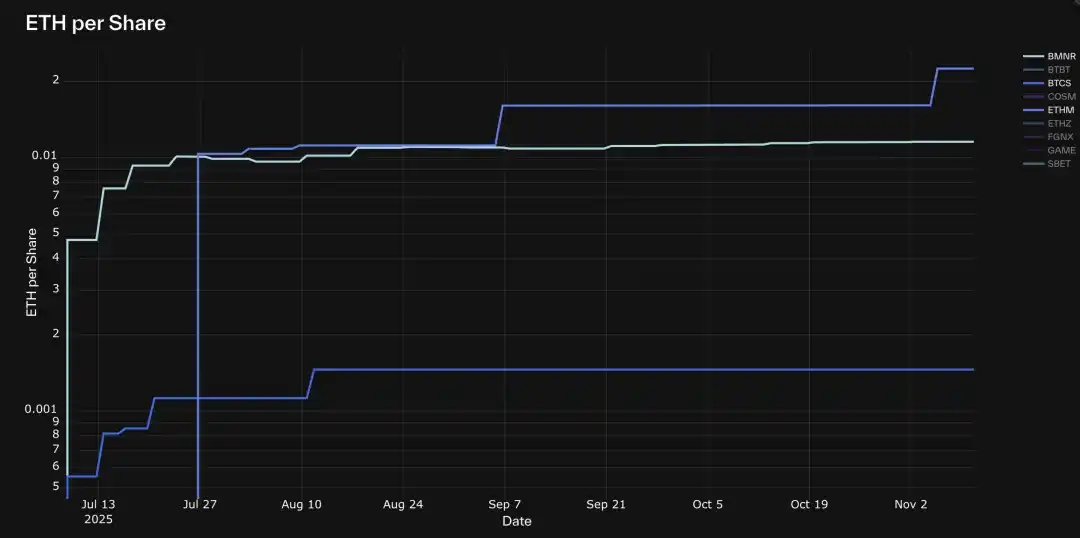
ETH DATs with ongoing per-share asset growth: BMNR, ETHM, BTCS
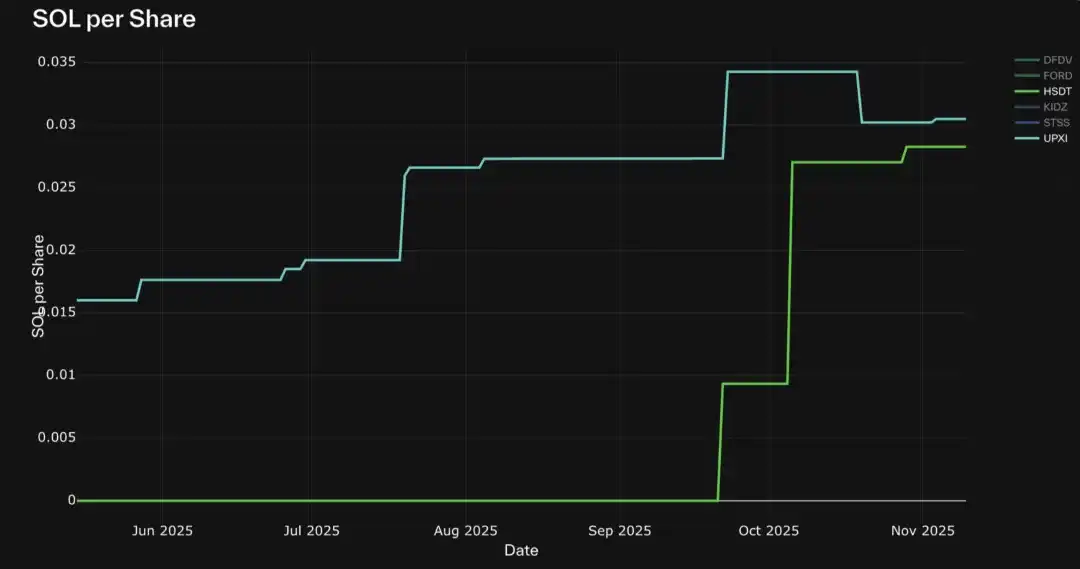
SOL DATs with ongoing per-share asset growth: HSDT, UPXI
Other Market Indicators
In addition to company-level indicators, several comparative indicators help measure a DAT's position in the broader ecosystem:
• Market Share (by NAV, market cap, or trading volume): Measures the relative dominance of different digital assets within a DAT. As DAT shares represent the underlying value of different assets, comparing raw trading volumes may be misleading; the turnover rate (trading volume / market cap) more accurately measures liquidity and activity.
• Asset Supply Share %: The DAT holding token's share of the total supply, reflecting its systemic impact on the underlying ecosystem.
In the BTC DAT sector, Strategy has a significant dominance: holding 83.3% of the total BTC DAT holdings (representing 3.22% of the total BTC supply), commanding 72% of the category's market cap. GME and BRR have seen a notable increase in transaction volume share, reflecting an increase in retail investor activity.
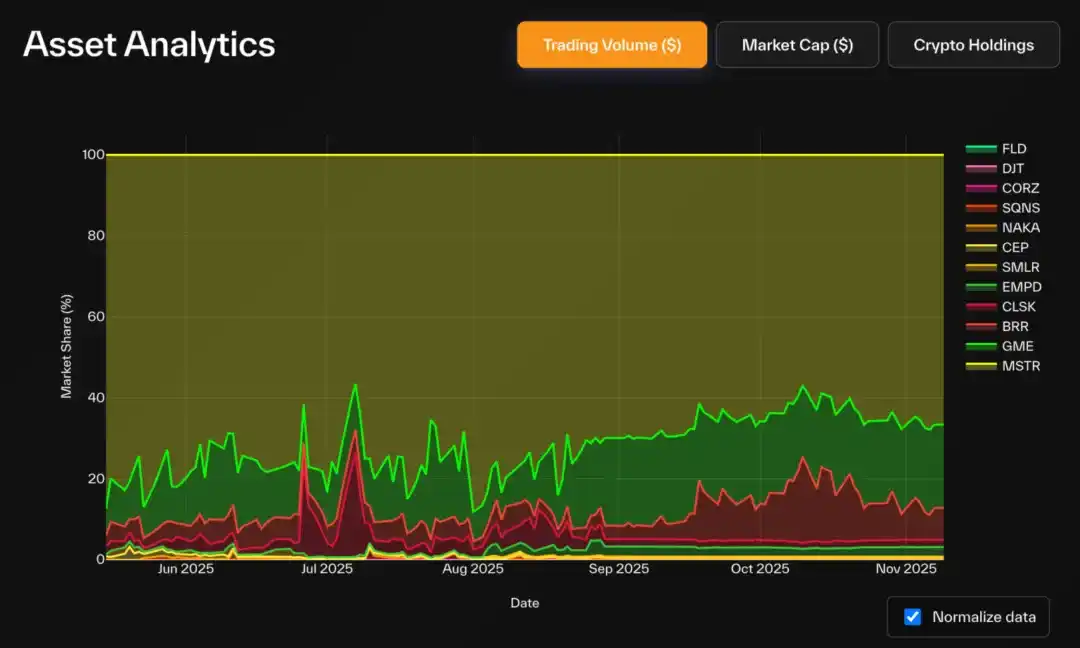
BTC DATs Trading Volume (USD) Market Share
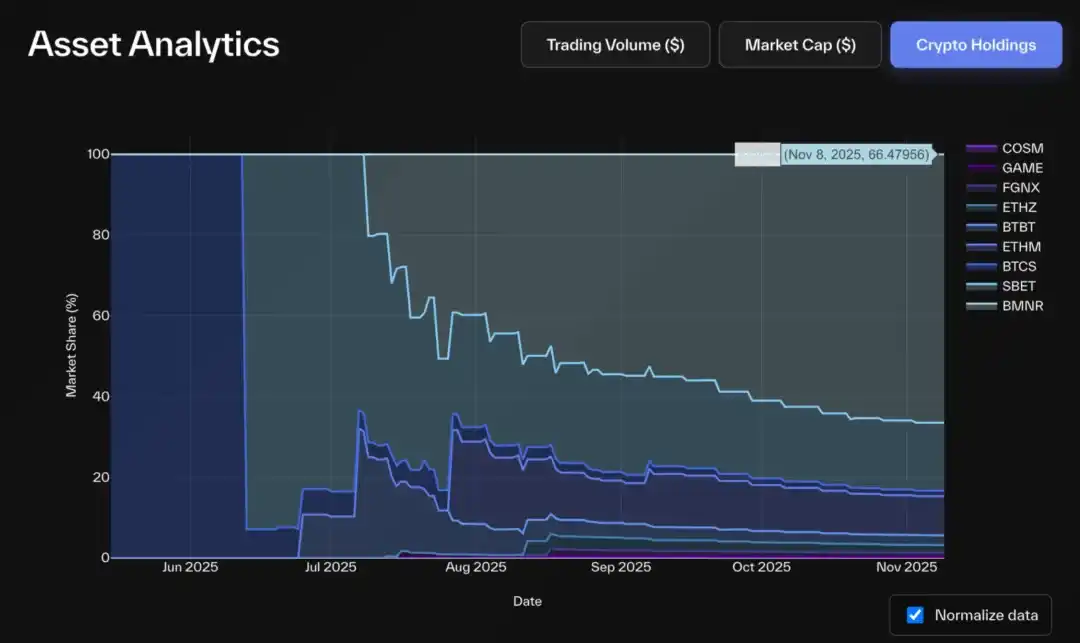
ETH DATs Crypto Asset Holdings Market Share
In the ETH DAT sector, Bitmine similarly dominates: holding over 66% of the total ETH DAT holdings (approximately 2.9% of the ETH supply), commanding 68% of the market cap and 85% of the transaction volume. The second-largest player, SBET, holds around 16-20% of the ETH holdings and market cap share, while BTBT ranks third (approximately 6%).
Solana DAT exhibits lower market concentration: FORD leads with 45% market cap and 44% SOL holdings share. HSDT, DFDV, STSS, UPXI each hold around 13-14% of the holdings share, but Solana Company (HSDT) leads the industry with approximately 22% market cap share.
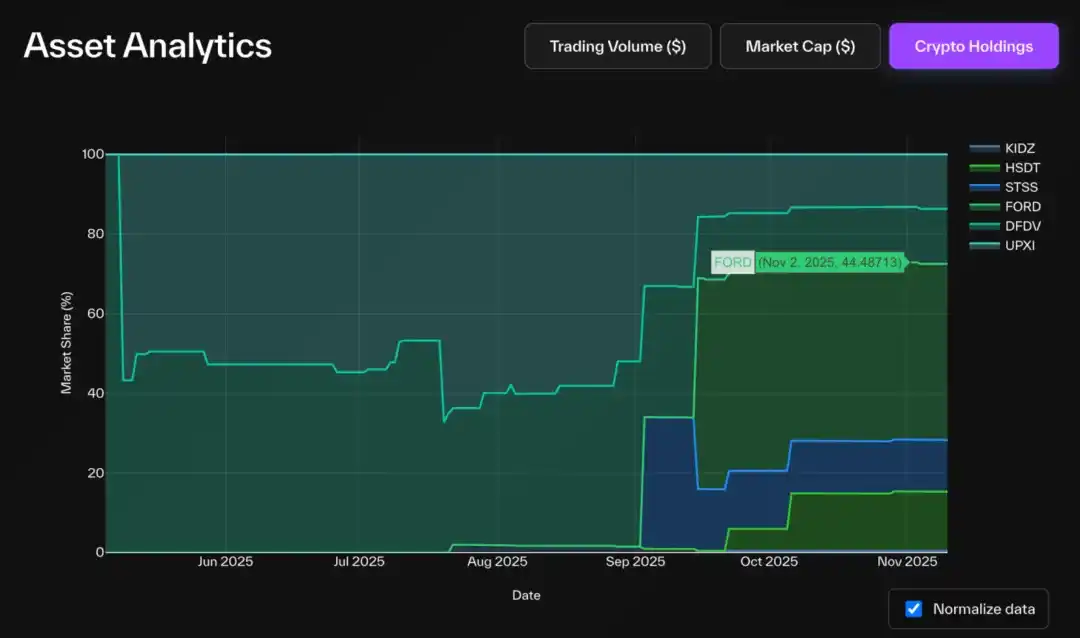
SOL DATs Crypto Asset Holdings Market Share
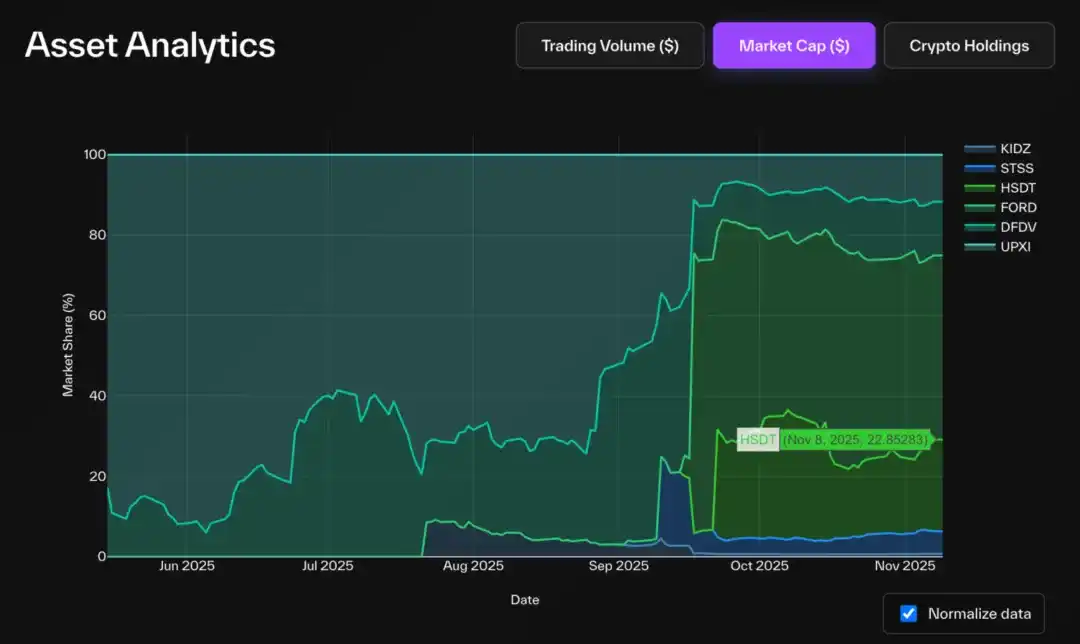
SOL DATs Market Cap Market Share
Interestingly, in terms of trading volume, the situation is reversed: DFDV and UPXI lead in activity over FORD. Historical trends indicate that these two are pioneers in the Solana DAT category, and this advantage seems to persist even today, despite FORD later achieving a higher NAV. The trading momentum and market attention held by the early entrants remain difficult to shake.
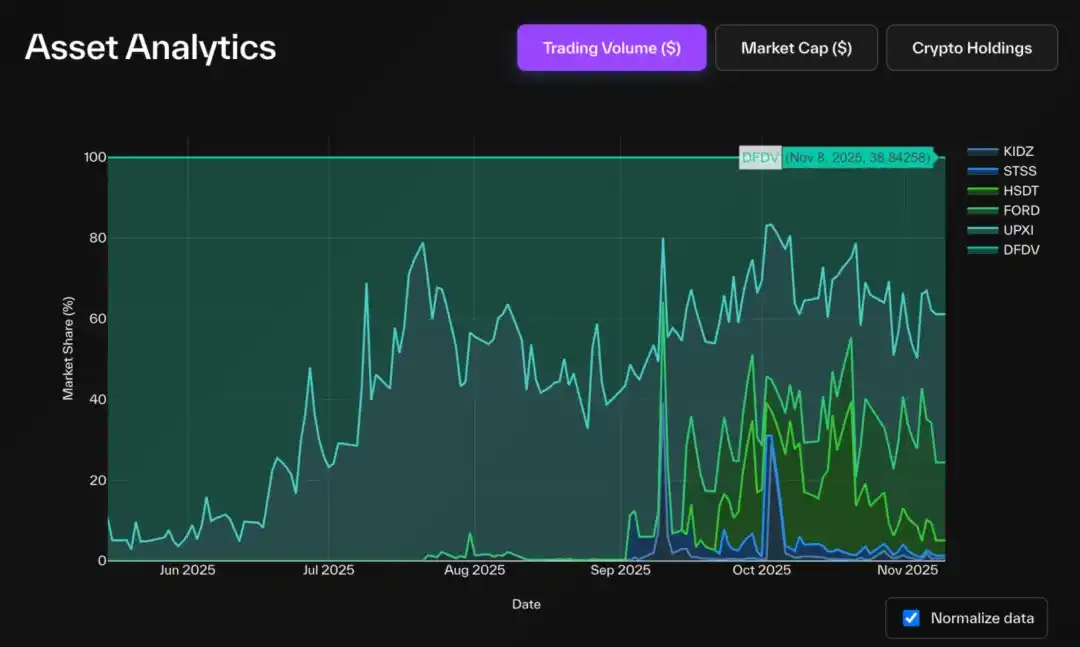
SOL DAT Trading Volume (USD) Market Share
2. Limitations and Misunderstandings
While the definitions are simple, tracking these fundamental metrics is not an easy task—mainly because U.S. Securities and Exchange Commission (SEC) filing data is neither real-time nor as standardized as on-chain data.
The best source for balance sheet accounting format is the 10-Q form, but it is only released quarterly. Many companies use custom-designed or branded PDF files, making extraction more challenging. Even when data is consistently reported in the same format, it is often embedded in text files that require semantic parsing. Furthermore, each company reports items in different formats, considering their equity structure and financial asset differences, which is understandable.
The sources of position update data may be very scattered—some companies do not even submit filings to the SEC but disclose changes through Twitter, press releases, or media interviews.
Despite this, most stock market metrics (such as price and trading volume) are fairly standardized. However, tracking the number of outstanding shares is still challenging—companies are not required to report daily through filings, and many data dashboards rely on third-party APIs, which source data from market makers or banks, often with a delay of several days.
One of the best practices comes from Bitmine, which reports its digital asset holdings through an 8-K filing every week (sometimes more frequently).
When interpreting DAT data, it is important to note these data challenges that distort the metrics:
• Position Updates
• Low frequency (monthly/quarterly) leading to outdated NAV, boosting mNAV or premium
• Some DAT holdings include DeFi tokens, NFTs, other stocks, or semi-liquid assets, complicating asset valuation
• Share updates: Failure to submit large-scale issuance or buyback notifications will affect estimated market value, mNAV, premium/discount, and per-token digital asset.
We have identified some common blind spots in public reporting:
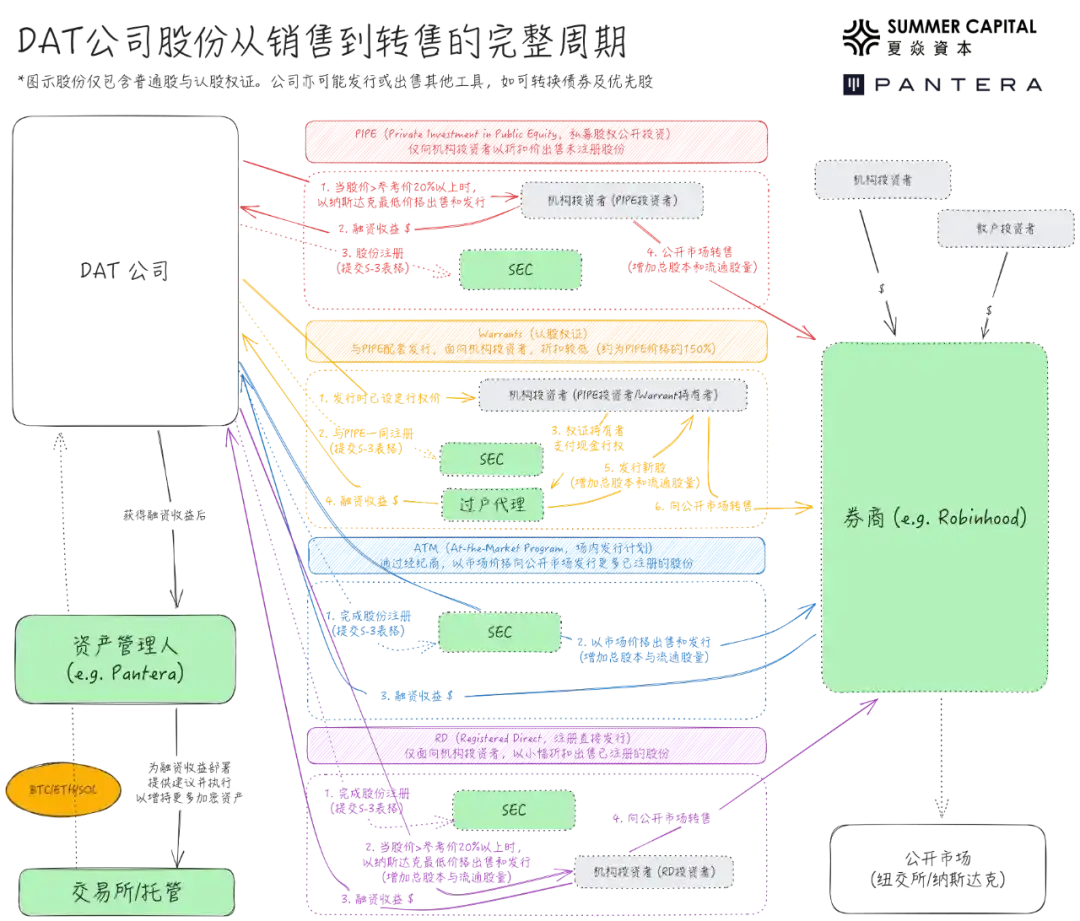
• Pro-Forma Accounting: Most data dashboards rely only on reported outstanding shares, without considering the potential exercise of previously issued warrants. In DAT's PIPE transactions, warrants are often sold bundled with PIPE shares, with exercise prices usually equal to or higher than the PIPE share price. Anytime after the exercise date, as long as the stock trades above that level, the warrants can be exercised—a reasonable move for the holder. The issuance of warrants that have not been exercised increases the number of outstanding shares but may not add corresponding value, thus significantly diluting key metrics. Including these unexercised warrants in simulation calculations can more accurately reflect potential dilution effects and shareholder true risk exposure.
• Prefunded Warrants: The proceeds from these warrants have been received and included in NAV, but the corresponding shares have not yet been issued. In many cases, the exercise price of these warrants is close to zero, meaning that once exercised, they will increase the share count without adding new proceeds—a one-sided impact on equity dilution. We believe these warrants should be included in outstanding shares; otherwise, the resulting mNAV calculation would underestimate the market value and overestimate NAV, creating an imbalance.
• Pending Mergers and PIPEs: When a company announces a new PIPE, cash proceeds are typically reflected in NAV updates before the stock is formally issued through an S-3 filing. If no pro forma adjustments are made to the shares, the NAV per share denominator is understated, artificially inflating the metric. The following chart summarizes the main types of share issuance plans and their impact on outstanding shares.
Debt Data and Derivative Exposure: Apart from Artemis, there is currently almost no data dashboard that incorporates debt liabilities or leverage exposure information. This omission distorts NAV, especially for DATs adopting structured income or collateralization strategies.
After considering debt, the adjusted NAV (and adjusted mNAV) should reflect the true book value. This allows for a clear comparison between pure treasury exposure DATs (such as MSTR) and mixed-operation DATs (such as BMNR or SBET). What role does debt play in DAT management? In the traditional financial field, companies issue debt to fund growth while protecting shareholder ownership. In the DAT field, the motivation is similar. Issuing equity means selling future earnings to new shareholders, diluting existing shareholder equity. Conversely, issuing debt means borrowing against existing assets, without causing equity dilution (if managed properly). Therefore, DATs utilize debt to expand on-chain asset scale without reducing the per-share digital asset value.
Due to these complexities, Pantera has built a DAT Control Panel — aimed at presenting the overview in a clearer, more in-depth manner. In addition to data cleaning and standardization, the goal is to drive the conversation forward: to compare DATs with the broader stock market, not just within their own category; and advocate for greater on-chain transparency by tracking treasury wallets, revenue generation, and other on-chain activities in future versions.
3. Choose the Right Metrics
Relying solely on mNAV cannot fully reflect DAT performance. Here is our summary of the most valuable analytical framework when comprehensively evaluating DAT performance.
Growth Drivers and Fundamental Price
If we take the DAT company's stock price as a product of several potential growth factors (per-token growth, token price, and market sentiment), we can break it down, examining the factors that truly drive performance rather than a mere narrative.
In essence, we can represent the stock price at time t as:
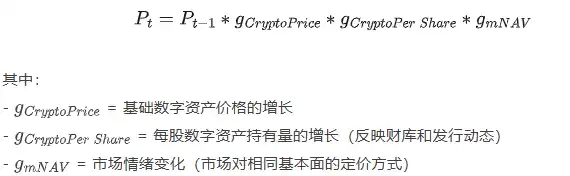
This decomposition method allows us to separate each factor and independently track the factors that truly drive price fluctuations:
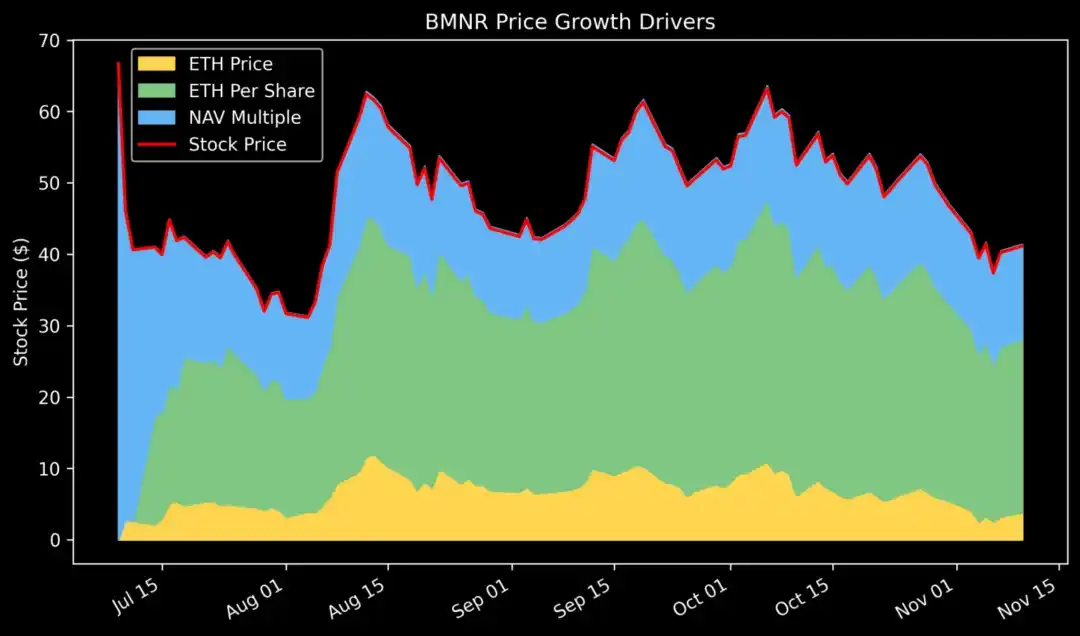
• When the stock price drops, we can look to see if this is due to a cooling market sentiment, a declining underlying asset price, or deteriorating company fundamentals — conversely, which of these factors drives the price increase.
• It also helps us see through the noise — for example, when the company's intrinsic value continues to grow while the market price falls.
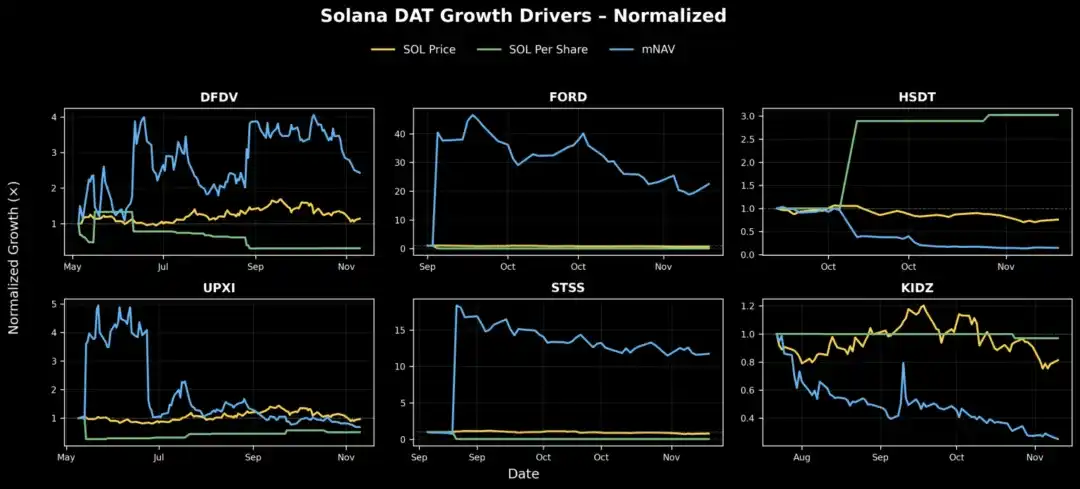
When breaking down the price growth of Bitmine (BMNR), we find that since its launch, the price per ETH has steadily increased, while the mNAV (Sentiment Multiple) has significantly contracted. This indicates that its fundamentals remain strong, with only a cooling off in market hype.
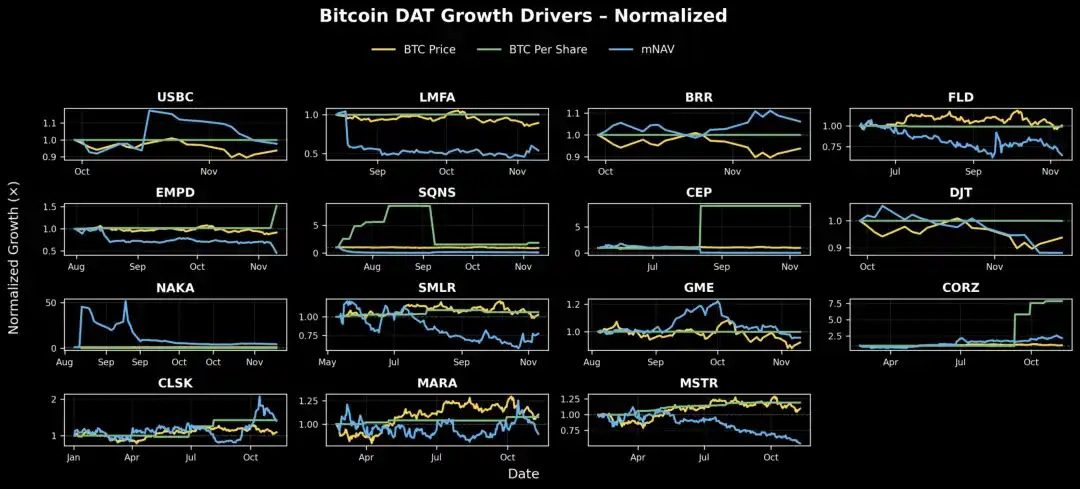
Summarizing this framework into three growth factors, we can categorically chart the DAT company, evaluating its overall health:
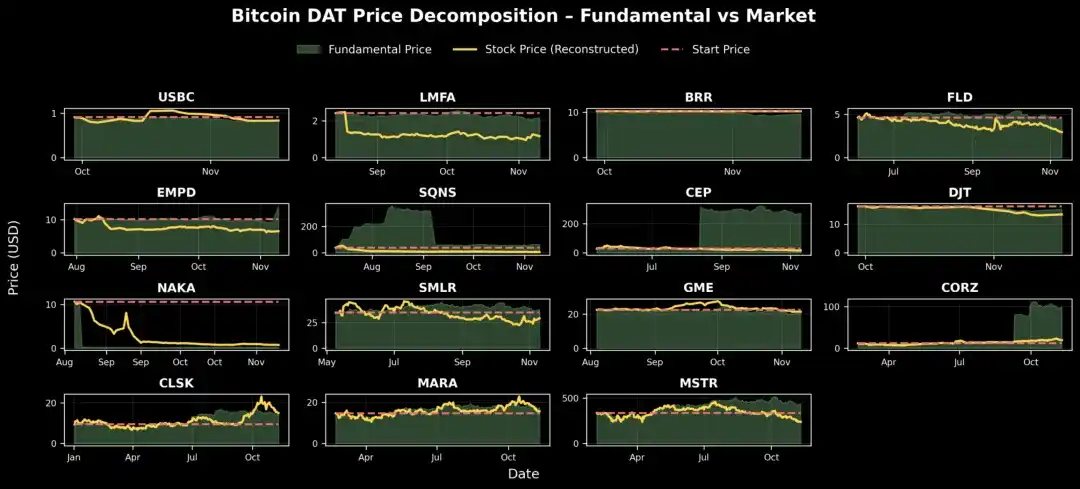
BTC DAT: Most of the fundamental value growth has remained relatively stable, as seen in MSTR, CLSK, and CEP, showing a clear upward trend. In contrast, though SMLR, FLD, DJT, LMFA, and EMPD have maintained stable fundamentals, since the tracking began, the market sentiment for these companies has sharply declined, being the primary reason for the stock price decrease. The only DAT currently experiencing an actual decrease in value is SQNS.
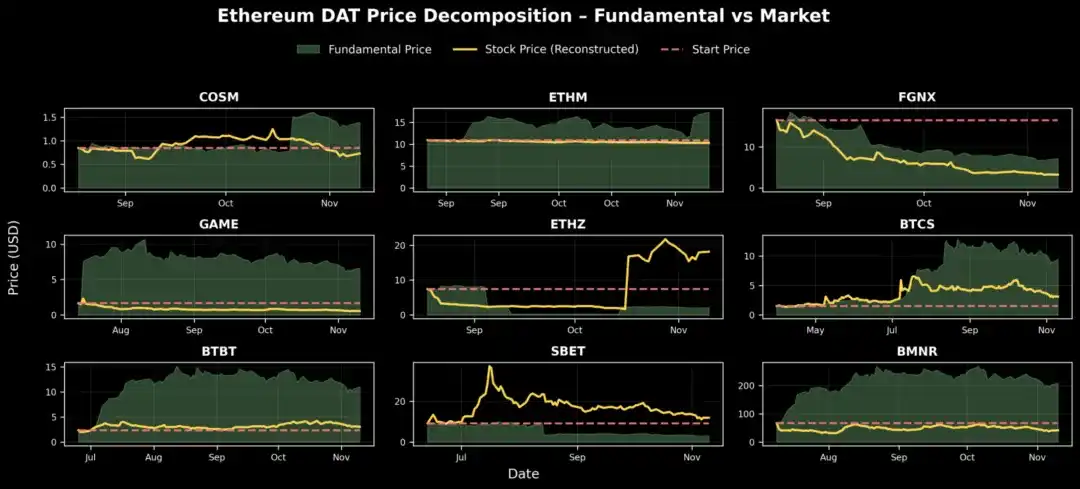
ETH DAT: As a category pioneer, ETHZ and SBET benefited from the initial market sentiment surge, although the price per ETH remained relatively stable. Subsequently, the per ETH value of BMNR, ETHM, BTCS, BTBT, and GAME has steadily increased, even though their mNAV growth is trending downwards—possibly indicating their launch near the market cycle top. FGNX is an exception, experiencing significant equity dilution and a sharp decline in market sentiment, resulting in a performance significantly below expectations.
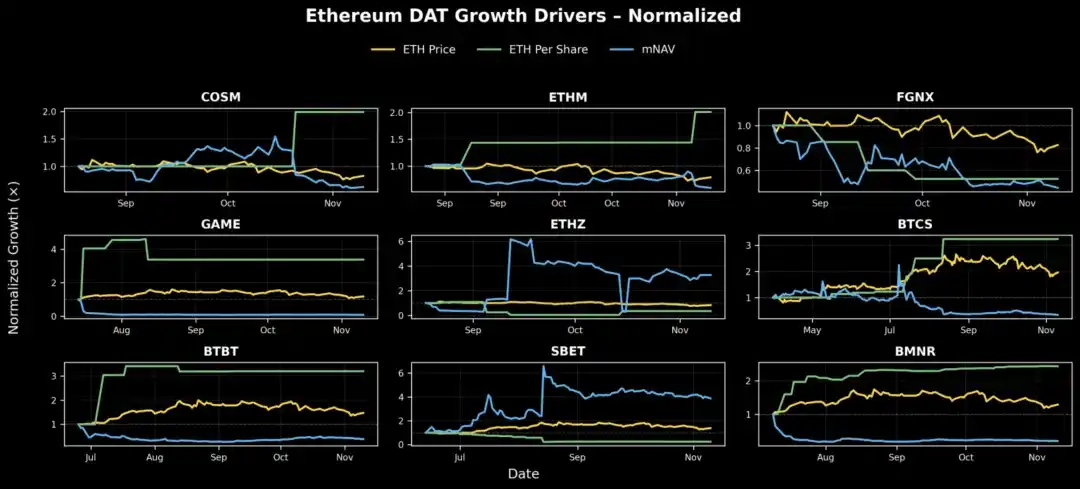
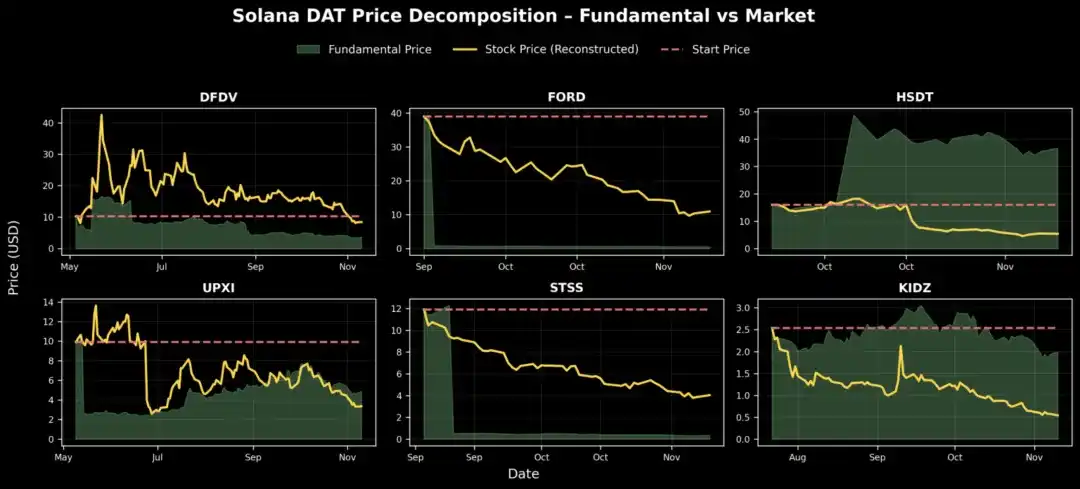
SOL DAT: The most significant growth in per SOL for HSDT, tripling from October to the time of the report; UPXI also has a steady increase, albeit on a smaller scale. DFDV benefited from the rise in market sentiment, but during the same period, its per SOL declined, indicating that the rise is more driven by market sentiment rather than fundamentals. Meanwhile, FORD and STSS have seen a substantial expansion in mNAV, but the growth in fundamental value has remained relatively flat, indicating performance driven by market sentiment rather than balance sheet dynamics.
Fundamental Price
As shown in the chart above, most DAT companies have experienced a market cooldown or contraction since their launch. To understand their potential development trajectory, we can further reconstruct the theoretical fundamental price of each company—essentially answering: "If the market conditions were the same as the day DAT was launched, what would today's stock price be?"
In other words, if you had held a share of stock from the company's inception and allowed the company to gradually accumulate stock and issue shares over time, what would be the actual value of that stock today?
The chart below shows that the fundamental value of several DAT companies — HSDT, BMNR, BTBT, BTCS, CORZ, and CEP — has been steadily increasing, but due to changing market conditions, their stock prices have not fully reflected this. Since their inception, these companies' fundamental indicators have shown significant growth, even as overall market sentiment has somewhat declined.
Share Issuance and Dilution
The success of DAT companies hinges on their equity issuance discipline. Evaluating a DAT company revolves around how the management responds to market conditions, whether they take strategic actions or passively react when market sentiment shifts.
• When mNAV > 1: The company has the opportunity to issue shares at a premium. The key issue here is issuance discipline; overly aggressive issuance can erode per-share digital assets, depress per-share NAV, and ultimately damage market sentiment. A disciplined issuer responsibly expands the issuance scale, while a reckless issuer plays the so-called "infinite ATM game."
• When mNAV < 1: The challenge is greater. A valuation multiple below 1 indicates market lack of confidence in the company's capital discipline, liquidity, or fund management strategy. The market may price in expectations of future equity dilution, fearing that the management will continue issuing shares during low market sentiment. This may also suggest inefficiency in capital use, where the company fails to translate its digital asset exposure into shareholder value.
Sustained mNAV below 1 will break the DAT flywheel effect. The company can no longer issue new shares at a premium without diluting existing shareholder equity. If forced to issue, the per-share digital assets further decline, damaging trust and losing the ability for equity growth. Over time, this dynamic may transform the company into a "zombie DAT": a static holding company with a trading price below liquidation value.
When mNAV falls below 1, the right approach is to take defensive measures and restore credibility: halt all equity issuance (including ATM and PIPE) and make protecting per-share digital assets a core metric. The company must also enhance transparency and financial reporting — releasing wallet proofs, dashboards, and regularly updated NAV to demonstrate a clean, verifiable financial package rather than an opaque shell. If liquidity permits, stock buybacks below NAV price can boost returns and send a strong signal of confidence, often restoring the premium level. The management can also leverage on-chain earnings — staking ETH, engaging in re-staking, or earning from financial assets — to organically boost NAV growth and convert passive asset holdings into income sources. Lastly, the company must strengthen its narrative, positioning itself as a clear, reliable representative of a specific asset or ecosystem, as investor trust often returns when the investment thesis is clear.
For DATs with mNAV <1, the correct strategy is to protect per-share value, increase transparency, and rebuild trust. By studying issuance data, stock buybacks, and fund management behavior, we can understand which companies choose value-adding paths and which companies continue to dilute equity.
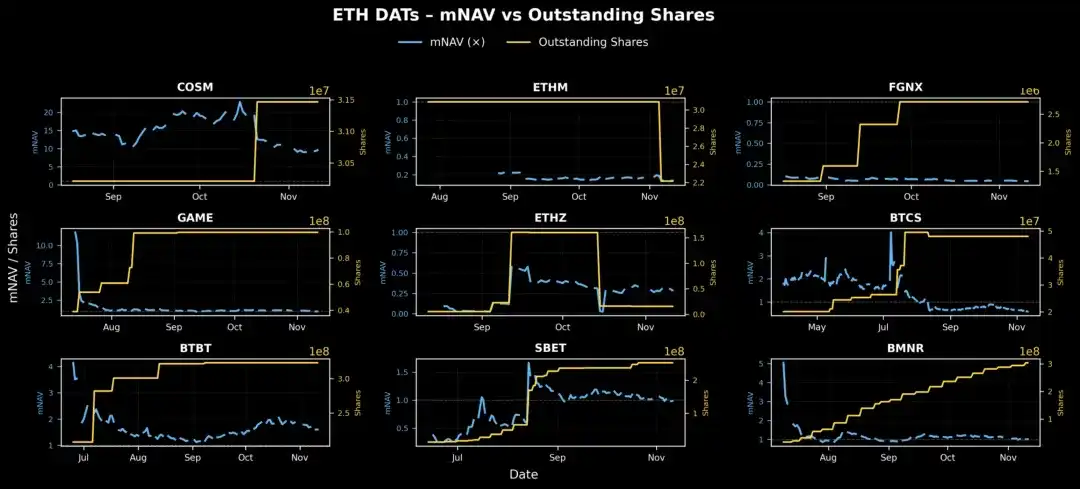
Data shows that the best-managed DATs have historically been able to protect shareholder leverage during economic downturns—laying the groundwork for a rebound in market sentiment.
From the chart above, it can be seen that ETH DATs exhibit significant differences in equity issuance and market sentiment management. Most companies show a gradual increase in outstanding shares, indicating a possible PIPE or ATM issuance.
BMNR data reveals that compared to peers, the company's stock issuance and mNAV change pattern is more gradual. This sets an example for how companies can responsibly scale up—using equity as a growth tool without disrupting the mNAV growth flywheel.
Companies like BTBT, GAME, and BTCS experienced a sharp, sudden increase in outstanding shares while mNAV remained stable or decreased. However, their issuance timing was still reasonable as it occurred when the mNAV trading price was above 1, within a premium window.
In contrast, FGNX and ETHZ conducted large-scale issuances when mNAV was <1, essentially issuing shares in a weak market instead of waiting for favorable market conditions, a typical sign of capital discipline erosion. For FGNX, early and aggressive dilution near mNAV close to zero led to a destructive dilution event, erasing investor leverage and long-term confidence. However, ETHZ briefly showed signs of corrective action by reducing the number of shares in mid-October, helping its mNAV bounce back from below 0.2, partially restoring balance.
4. Open Research Questions for Further Investigation
Pantera's dashboard data has also opened up new research directions:
• Unlocking Events: What is the contribution to price declines?
• PIPE Investor ROI: In the DAT space, which transactions achieve positive returns? How do these results fare when adjusted based on underlying token performance (e.g., relative to spot ETF returns)?
• Market Microstructure: How does PIPE pricing news affect trading behavior?
• Dynamic mNAV Modeling: Is there a quantifiable relationship between issuance/buybacks and mNAV recovery?
More work is needed on the DATA side, calling for the establishment of more comprehensive data standards. Stock data is much more chaotic than on-chain data: inconsistent formats, low update frequency, and no unified pattern. To develop DATA into a legitimate asset class, we need open, standardized APIs for companies to report financial updates daily, covering:
• Issued Shares (including outstanding and PIPE shares)
• Treasury Holdings classified by asset
• Warrant and Debt Data
Just as on-chain data transparency drives DeFi analytics, this layer of financial data transparency can change the way capital flows into DATA.
5. Conclusion
DAT is neither an angel nor a devil; neither a savior nor a culprit.
They are a new form of capital formation - innovative investment tools that operate bidirectionally: helping to appreciate digital assets while providing financial institutions with leveraged exposure to on-chain returns. They are not a perpetual motion machine, as the flywheel may break under market impact, but rather require disciplined strategy and execution by asset management firms. In their optimal state, DATs can unlock meaningful value for both sides of the ecosystem:
• For traditional investors, they provide regulated, liquid, and yield-enhanced digital asset exposure - often with additional on-chain returns that ETFs or trusts cannot provide.
• For the crypto ecosystem, they direct traditional market capital directly into token treasuries - anchoring asset value in a compliant structure and enhancing liquidity.
• If managed properly, they can amplify the positive feedback loop between the capital markets and digital asset fundamentals: rising mNAV leads to new issuances, new capital flows into digital asset purchases, and the cycle continues to develop upwards.
In this sense, DATs act as the "second cornerstone" of digital assets: institutionalizing capital inflows while providing investors with new, yield-enhancing investment opportunities.
Indeed, criticism is both real and often instructive:
• Some DATs are merely hype-filled shells, lacking a true operational strategy, serving as short-term instruments for PIPE investors to exit to retail, with no fundamental difference from Memecoins;
• The market does not need tens of DATs tracking the same asset. If fund management strategies or governance lack differentiation, DAT proliferation will only add market noise, eroding trust in the model. Similarly, there is no need to establish DATs for hundreds of digital assets that lack long-term value, especially those operated by teams with low credibility, lack of community recognition, or limited technological innovation. This expansion may lead DATs into a speculation frenzy rather than reliable financial tools;
• Death Spiral (mNAV < 1) remains the most challenging hurdle. DAT fundamentally represents amplified exposure to an already highly volatile asset class, and once market sentiment shifts, the discount may rapidly widen. However, mNAV < 1 usually signals mispricing rather than a collapse. Investors may reflect weak capital discipline, concerns over equity dilution, or inefficient fund management, rather than the failure of the underlying digital asset itself. Skilled operators can turn the situation around through transparent communication and rigorous equity management.
At its core, holding DAT requires market participants to have a dual belief:
• Long-term bullishness on the underlying asset—believing in its price appreciation over time and seeking leveraged exposure through an active equity vehicle;
• Trust in operational execution and capital discipline—as highlighted by Tom Lee of Fundstrat, mNAV < 1 is illogical, and competent management teams will ultimately bring the share price back to parity.
If both are valid, a lower mNAV is not an alarm but a temporary phenomenon of market sentiment mispricing the actual asset's balance sheet value.
The essence of DAT lies in representing a new type of investment tool—it helps digital assets accumulate lasting value while providing financial institutions with a regulated, income-enhancing path to participate in the future development of the digital asset era.
You may also like

Token Cannot Compound, Where Is the Real Investment Opportunity?

February 6th Market Key Intelligence, How Much Did You Miss?

China's Central Bank and Eight Other Departments' Latest Regulatory Focus: Key Attention to RWA Tokenized Asset Risk
Foreword: Today, the People's Bank of China's website published the "Notice of the People's Bank of China, National Development and Reform Commission, Ministry of Industry and Information Technology, Ministry of Public Security, State Administration for Market Regulation, China Banking and Insurance Regulatory Commission, China Securities Regulatory Commission, State Administration of Foreign Exchange on Further Preventing and Dealing with Risks Related to Virtual Currency and Others (Yinfa [2026] No. 42)", the latest regulatory requirements from the eight departments including the central bank, which are basically consistent with the regulatory requirements of recent years. The main focus of the regulation is on speculative activities such as virtual currency trading, exchanges, ICOs, overseas platform services, and this time, regulatory oversight of RWA has been added, explicitly prohibiting RWA tokenization, stablecoins (especially those pegged to the RMB). The following is the full text:
To the people's governments of all provinces, autonomous regions, and municipalities directly under the Central Government, the Xinjiang Production and Construction Corps:
Recently, there have been speculative activities related to virtual currency and Real-World Assets (RWA) tokenization, disrupting the economic and financial order and jeopardizing the property security of the people. In order to further prevent and address the risks related to virtual currency and Real-World Assets tokenization, effectively safeguard national security and social stability, in accordance with the "Law of the People's Republic of China on the People's Bank of China," "Law of the People's Republic of China on Commercial Banks," "Securities Law of the People's Republic of China," "Law of the People's Republic of China on Securities Investment Funds," "Law of the People's Republic of China on Futures and Derivatives," "Cybersecurity Law of the People's Republic of China," "Regulations of the People's Republic of China on the Administration of Renminbi," "Regulations on Prevention and Disposal of Illegal Fundraising," "Regulations of the People's Republic of China on Foreign Exchange Administration," "Telecommunications Regulations of the People's Republic of China," and other provisions, after reaching consensus with the Cyberspace Administration of China, the Supreme People's Court, and the Supreme People's Procuratorate, and with the approval of the State Council, the relevant matters are notified as follows:
(I) Virtual currency does not possess the legal status equivalent to fiat currency. Virtual currencies such as Bitcoin, Ether, Tether, etc., have the main characteristics of being issued by non-monetary authorities, using encryption technology and distributed ledger or similar technology, existing in digital form, etc. They do not have legal tender status, should not and cannot be circulated and used as currency in the market.
The business activities related to virtual currency are classified as illegal financial activities. The exchange of fiat currency and virtual currency within the territory, exchange of virtual currencies, acting as a central counterparty in buying and selling virtual currencies, providing information intermediary and pricing services for virtual currency transactions, token issuance financing, and trading of virtual currency-related financial products, etc., fall under illegal financial activities, such as suspected illegal issuance of token vouchers, unauthorized public issuance of securities, illegal operation of securities and futures business, illegal fundraising, etc., are strictly prohibited across the board and resolutely banned in accordance with the law. Overseas entities and individuals are not allowed to provide virtual currency-related services to domestic entities in any form.
A stablecoin pegged to a fiat currency indirectly fulfills some functions of the fiat currency in circulation. Without the consent of relevant authorities in accordance with the law and regulations, any domestic or foreign entity or individual is not allowed to issue a RMB-pegged stablecoin overseas.
(II)Tokenization of Real-World Assets refers to the use of encryption technology and distributed ledger or similar technologies to transform ownership rights, income rights, etc., of assets into tokens (tokens) or other interests or bond certificates with token (token) characteristics, and carry out issuance and trading activities.
Engaging in the tokenization of real-world assets domestically, as well as providing related intermediary, information technology services, etc., which are suspected of illegal issuance of token vouchers, unauthorized public offering of securities, illegal operation of securities and futures business, illegal fundraising, and other illegal financial activities, shall be prohibited; except for relevant business activities carried out with the approval of the competent authorities in accordance with the law and regulations and relying on specific financial infrastructures. Overseas entities and individuals are not allowed to illegally provide services related to the tokenization of real-world assets to domestic entities in any form.
(III) Inter-agency Coordination. The People's Bank of China, together with the National Development and Reform Commission, the Ministry of Industry and Information Technology, the Ministry of Public Security, the State Administration for Market Regulation, the China Banking and Insurance Regulatory Commission, the China Securities Regulatory Commission, the State Administration of Foreign Exchange, and other departments, will improve the work mechanism, strengthen coordination with the Cyberspace Administration of China, the Supreme People's Court, and the Supreme People's Procuratorate, coordinate efforts, and overall guide regions to carry out risk prevention and disposal of virtual currency-related illegal financial activities.
The China Securities Regulatory Commission, together with the National Development and Reform Commission, the Ministry of Industry and Information Technology, the Ministry of Public Security, the People's Bank of China, the State Administration for Market Regulation, the China Banking and Insurance Regulatory Commission, the State Administration of Foreign Exchange, and other departments, will improve the work mechanism, strengthen coordination with the Cyberspace Administration of China, the Supreme People's Court, and the Supreme People's Procuratorate, coordinate efforts, and overall guide regions to carry out risk prevention and disposal of illegal financial activities related to the tokenization of real-world assets.
(IV) Strengthening Local Implementation. The people's governments at the provincial level are overall responsible for the prevention and disposal of risks related to virtual currencies and the tokenization of real-world assets in their respective administrative regions. The specific leading department is the local financial regulatory department, with participation from branches and dispatched institutions of the State Council's financial regulatory department, telecommunications regulators, public security, market supervision, and other departments, in coordination with cyberspace departments, courts, and procuratorates, to improve the normalization of the work mechanism, effectively connect with the relevant work mechanisms of central departments, form a cooperative and coordinated working pattern between central and local governments, effectively prevent and properly handle risks related to virtual currencies and the tokenization of real-world assets, and maintain economic and financial order and social stability.
(5) Enhanced Risk Monitoring. The People's Bank of China, China Securities Regulatory Commission, National Development and Reform Commission, Ministry of Industry and Information Technology, Ministry of Public Security, State Administration of Foreign Exchange, Cyberspace Administration of China, and other departments continue to improve monitoring techniques and system support, enhance cross-departmental data analysis and sharing, establish sound information sharing and cross-validation mechanisms, promptly grasp the risk situation of activities related to virtual currency and real-world asset tokenization. Local governments at all levels give full play to the role of local monitoring and early warning mechanisms. Local financial regulatory authorities, together with branches and agencies of the State Council's financial regulatory authorities, as well as departments of cyberspace and public security, ensure effective connection between online monitoring, offline investigation, and fund tracking, efficiently and accurately identify activities related to virtual currency and real-world asset tokenization, promptly share risk information, improve early warning information dissemination, verification, and rapid response mechanisms.
(6) Strengthened Oversight of Financial Institutions, Intermediaries, and Technology Service Providers. Financial institutions (including non-bank payment institutions) are prohibited from providing account opening, fund transfer, and clearing services for virtual currency-related business activities, issuing and selling financial products related to virtual currency, including virtual currency and related financial products in the scope of collateral, conducting insurance business related to virtual currency, or including virtual currency in the scope of insurance liability. Financial institutions (including non-bank payment institutions) are prohibited from providing custody, clearing, and settlement services for unauthorized real-world asset tokenization-related business and related financial products. Relevant intermediary institutions and information technology service providers are prohibited from providing intermediary, technical, or other services for unauthorized real-world asset tokenization-related businesses and related financial products.
(7) Enhanced Management of Internet Information Content and Access. Internet enterprises are prohibited from providing online business venues, commercial displays, marketing, advertising, or paid traffic diversion services for virtual currency and real-world asset tokenization-related business activities. Upon discovering clues of illegal activities, they should promptly report to relevant departments and provide technical support and assistance for related investigations and inquiries. Based on the clues transferred by the financial regulatory authorities, the cyberspace administration, telecommunications authorities, and public security departments should promptly close and deal with websites, mobile applications (including mini-programs), and public accounts engaged in virtual currency and real-world asset tokenization-related business activities in accordance with the law.
(8) Strengthened Entity Registration and Advertisement Management. Market supervision departments strengthen entity registration and management, and enterprise and individual business registrations must not contain terms such as "virtual currency," "virtual asset," "cryptocurrency," "crypto asset," "stablecoin," "real-world asset tokenization," or "RWA" in their names or business scopes. Market supervision departments, together with financial regulatory authorities, legally enhance the supervision of advertisements related to virtual currency and real-world asset tokenization, promptly investigating and handling relevant illegal advertisements.
(IX) Continued Rectification of Virtual Currency Mining Activities. The National Development and Reform Commission, together with relevant departments, strictly controls virtual currency mining activities, continuously promotes the rectification of virtual currency mining activities. The people's governments of various provinces take overall responsibility for the rectification of "mining" within their respective administrative regions. In accordance with the requirements of the National Development and Reform Commission and other departments in the "Notice on the Rectification of Virtual Currency Mining Activities" (NDRC Energy-saving Building [2021] No. 1283) and the provisions of the "Guidance Catalog for Industrial Structure Adjustment (2024 Edition)," a comprehensive review, investigation, and closure of existing virtual currency mining projects are conducted, new mining projects are strictly prohibited, and mining machine production enterprises are strictly prohibited from providing mining machine sales and other services within the country.
(X) Severe Crackdown on Related Illegal Financial Activities. Upon discovering clues to illegal financial activities related to virtual currency and the tokenization of real-world assets, local financial regulatory authorities, branches of the State Council's financial regulatory authorities, and other relevant departments promptly investigate, determine, and properly handle the issues in accordance with the law, and seriously hold the relevant entities and individuals legally responsible. Those suspected of crimes are transferred to the judicial authorities for processing according to the law.
(XI) Severe Crackdown on Related Illegal and Criminal Activities. The Ministry of Public Security, the People's Bank of China, the State Administration for Market Regulation, the China Banking and Insurance Regulatory Commission, the China Securities Regulatory Commission, as well as judicial and procuratorial organs, in accordance with their respective responsibilities, rigorously crack down on illegal and criminal activities related to virtual currency, the tokenization of real-world assets, such as fraud, money laundering, illegal business operations, pyramid schemes, illegal fundraising, and other illegal and criminal activities carried out under the guise of virtual currency, the tokenization of real-world assets, etc.
(XII) Strengthen Industry Self-discipline. Relevant industry associations should enhance membership management and policy advocacy, based on their own responsibilities, advocate and urge member units to resist illegal financial activities related to virtual currency and the tokenization of real-world assets. Member units that violate regulatory policies and industry self-discipline rules are to be disciplined in accordance with relevant self-regulatory management regulations. By leveraging various industry infrastructure, conduct risk monitoring related to virtual currency, the tokenization of real-world assets, and promptly transfer issue clues to relevant departments.
(XIII) Without the approval of relevant departments in accordance with the law and regulations, domestic entities and foreign entities controlled by them may not issue virtual currency overseas.
(XIV) Domestic entities engaging directly or indirectly in overseas external debt-based tokenization of real-world assets, or conducting asset securitization activities abroad based on domestic ownership rights, income rights, etc. (hereinafter referred to as domestic equity), should be strictly regulated in accordance with the principles of "same business, same risk, same rules." The National Development and Reform Commission, the China Securities Regulatory Commission, the State Administration of Foreign Exchange, and other relevant departments regulate it according to their respective responsibilities. For other forms of overseas real-world asset tokenization activities based on domestic equity by domestic entities, the China Securities Regulatory Commission, together with relevant departments, supervise according to their division of responsibilities. Without the consent and filing of relevant departments, no unit or individual may engage in the above-mentioned business.
(15) Overseas subsidiaries and branches of domestic financial institutions providing Real World Asset Tokenization-related services overseas shall do so legally and prudently. They shall have professional personnel and systems in place to effectively mitigate business risks, strictly implement customer onboarding, suitability management, anti-money laundering requirements, and incorporate them into the domestic financial institutions' compliance and risk management system. Intermediaries and information technology service providers offering Real World Asset Tokenization services abroad based on domestic equity or conducting Real World Asset Tokenization business in the form of overseas debt for domestic entities directly or indirectly venturing abroad must strictly comply with relevant laws and regulations. They should establish and improve relevant compliance and internal control systems in accordance with relevant normative requirements, strengthen business and risk control, and report the business developments to the relevant regulatory authorities for approval or filing.
(16) Strengthen organizational leadership and overall coordination. All departments and regions should attach great importance to the prevention of risks related to virtual currencies and Real World Asset Tokenization, strengthen organizational leadership, clarify work responsibilities, form a long-term effective working mechanism with centralized coordination, local implementation, and shared responsibilities, maintain high pressure, dynamically monitor risks, effectively prevent and mitigate risks in an orderly and efficient manner, legally protect the property security of the people, and make every effort to maintain economic and financial order and social stability.
(17) Widely carry out publicity and education. All departments, regions, and industry associations should make full use of various media and other communication channels to disseminate information through legal and policy interpretation, analysis of typical cases, and education on investment risks, etc. They should promote the illegality and harm of virtual currencies and Real World Asset Tokenization-related businesses and their manifestations, fully alert to potential risks and hidden dangers, and enhance public awareness and identification capabilities for risk prevention.
(18) Engaging in illegal financial activities related to virtual currencies and Real World Asset Tokenization in violation of this notice, as well as providing services for virtual currencies and Real World Asset Tokenization-related businesses, shall be punished in accordance with relevant regulations. If it constitutes a crime, criminal liability shall be pursued according to the law. For domestic entities and individuals who knowingly or should have known that overseas entities illegally provided virtual currency or Real World Asset Tokenization-related services to domestic entities and still assisted them, relevant responsibilities shall be pursued according to the law. If it constitutes a crime, criminal liability shall be pursued according to the law.
(19) If any unit or individual invests in virtual currencies, Real World Asset Tokens, and related financial products against public order and good customs, the relevant civil legal actions shall be invalid, and any resulting losses shall be borne by them. If there are suspicions of disrupting financial order and jeopardizing financial security, the relevant departments shall deal with them according to the law.
This notice shall enter into force upon the date of its issuance. The People's Bank of China and ten other departments' "Notice on Further Preventing and Dealing with the Risks of Virtual Currency Trading Speculation" (Yinfa [2021] No. 237) is hereby repealed.

Former Partner's Perspective on Multicoin: Kyle's Exit, But the Game He Left Behind Just Getting Started
Why Bitcoin Is Falling Now: The Real Reasons Behind BTC's Crash & WEEX's Smart Profit Playbook
Bitcoin's ongoing crash explained: Discover the 5 hidden triggers behind BTC's plunge & how WEEX's Auto Earn and Trade to Earn strategies help traders profit from crypto market volatility.

Wall Street's Hottest Trades See Exodus

Vitalik Discusses Ethereum Scaling Path, Circle Announces Partnership with Polymarket, What's the Overseas Crypto Community Talking About Today?

Believing in the Capital Markets - The Essence and Core Value of Cryptocurrency

Polymarket's 'Weatherman': Predict Temperature, Win Million-Dollar Payout

$15K+ Profits: The 4 AI Trading Secrets WEEX Hackathon Prelim Winners Used to Dominate Volatile Crypto Markets
How WEEX Hackathon's top AI trading strategies made $15K+ in crypto markets: 4 proven rules for ETH/BTC trading, market structure analysis, and risk management in volatile conditions.

A nearly 20% one-day plunge, how long has it been since you last saw a $60,000 Bitcoin?

Raoul Pal: I've seen every single panic, and they are never the end.

Key Market Information Discrepancy on February 6th - A Must-Read! | Alpha Morning Report

2026 Crypto Industry's First Snowfall
The Harsh Reality Behind the $26 Billion Crypto Liquidation: Liquidity Is Killing the Market
Why Is Gold, US Stocks, Bitcoin All Falling?

Key Market Intelligence for February 5th, how much did you miss out on?

Wintermute: By 2026, crypto had gradually become the settlement layer of the Internet economy
Token Cannot Compound, Where Is the Real Investment Opportunity?
February 6th Market Key Intelligence, How Much Did You Miss?
China's Central Bank and Eight Other Departments' Latest Regulatory Focus: Key Attention to RWA Tokenized Asset Risk
Foreword: Today, the People's Bank of China's website published the "Notice of the People's Bank of China, National Development and Reform Commission, Ministry of Industry and Information Technology, Ministry of Public Security, State Administration for Market Regulation, China Banking and Insurance Regulatory Commission, China Securities Regulatory Commission, State Administration of Foreign Exchange on Further Preventing and Dealing with Risks Related to Virtual Currency and Others (Yinfa [2026] No. 42)", the latest regulatory requirements from the eight departments including the central bank, which are basically consistent with the regulatory requirements of recent years. The main focus of the regulation is on speculative activities such as virtual currency trading, exchanges, ICOs, overseas platform services, and this time, regulatory oversight of RWA has been added, explicitly prohibiting RWA tokenization, stablecoins (especially those pegged to the RMB). The following is the full text:
To the people's governments of all provinces, autonomous regions, and municipalities directly under the Central Government, the Xinjiang Production and Construction Corps:
Recently, there have been speculative activities related to virtual currency and Real-World Assets (RWA) tokenization, disrupting the economic and financial order and jeopardizing the property security of the people. In order to further prevent and address the risks related to virtual currency and Real-World Assets tokenization, effectively safeguard national security and social stability, in accordance with the "Law of the People's Republic of China on the People's Bank of China," "Law of the People's Republic of China on Commercial Banks," "Securities Law of the People's Republic of China," "Law of the People's Republic of China on Securities Investment Funds," "Law of the People's Republic of China on Futures and Derivatives," "Cybersecurity Law of the People's Republic of China," "Regulations of the People's Republic of China on the Administration of Renminbi," "Regulations on Prevention and Disposal of Illegal Fundraising," "Regulations of the People's Republic of China on Foreign Exchange Administration," "Telecommunications Regulations of the People's Republic of China," and other provisions, after reaching consensus with the Cyberspace Administration of China, the Supreme People's Court, and the Supreme People's Procuratorate, and with the approval of the State Council, the relevant matters are notified as follows:
(I) Virtual currency does not possess the legal status equivalent to fiat currency. Virtual currencies such as Bitcoin, Ether, Tether, etc., have the main characteristics of being issued by non-monetary authorities, using encryption technology and distributed ledger or similar technology, existing in digital form, etc. They do not have legal tender status, should not and cannot be circulated and used as currency in the market.
The business activities related to virtual currency are classified as illegal financial activities. The exchange of fiat currency and virtual currency within the territory, exchange of virtual currencies, acting as a central counterparty in buying and selling virtual currencies, providing information intermediary and pricing services for virtual currency transactions, token issuance financing, and trading of virtual currency-related financial products, etc., fall under illegal financial activities, such as suspected illegal issuance of token vouchers, unauthorized public issuance of securities, illegal operation of securities and futures business, illegal fundraising, etc., are strictly prohibited across the board and resolutely banned in accordance with the law. Overseas entities and individuals are not allowed to provide virtual currency-related services to domestic entities in any form.
A stablecoin pegged to a fiat currency indirectly fulfills some functions of the fiat currency in circulation. Without the consent of relevant authorities in accordance with the law and regulations, any domestic or foreign entity or individual is not allowed to issue a RMB-pegged stablecoin overseas.
(II)Tokenization of Real-World Assets refers to the use of encryption technology and distributed ledger or similar technologies to transform ownership rights, income rights, etc., of assets into tokens (tokens) or other interests or bond certificates with token (token) characteristics, and carry out issuance and trading activities.
Engaging in the tokenization of real-world assets domestically, as well as providing related intermediary, information technology services, etc., which are suspected of illegal issuance of token vouchers, unauthorized public offering of securities, illegal operation of securities and futures business, illegal fundraising, and other illegal financial activities, shall be prohibited; except for relevant business activities carried out with the approval of the competent authorities in accordance with the law and regulations and relying on specific financial infrastructures. Overseas entities and individuals are not allowed to illegally provide services related to the tokenization of real-world assets to domestic entities in any form.
(III) Inter-agency Coordination. The People's Bank of China, together with the National Development and Reform Commission, the Ministry of Industry and Information Technology, the Ministry of Public Security, the State Administration for Market Regulation, the China Banking and Insurance Regulatory Commission, the China Securities Regulatory Commission, the State Administration of Foreign Exchange, and other departments, will improve the work mechanism, strengthen coordination with the Cyberspace Administration of China, the Supreme People's Court, and the Supreme People's Procuratorate, coordinate efforts, and overall guide regions to carry out risk prevention and disposal of virtual currency-related illegal financial activities.
The China Securities Regulatory Commission, together with the National Development and Reform Commission, the Ministry of Industry and Information Technology, the Ministry of Public Security, the People's Bank of China, the State Administration for Market Regulation, the China Banking and Insurance Regulatory Commission, the State Administration of Foreign Exchange, and other departments, will improve the work mechanism, strengthen coordination with the Cyberspace Administration of China, the Supreme People's Court, and the Supreme People's Procuratorate, coordinate efforts, and overall guide regions to carry out risk prevention and disposal of illegal financial activities related to the tokenization of real-world assets.
(IV) Strengthening Local Implementation. The people's governments at the provincial level are overall responsible for the prevention and disposal of risks related to virtual currencies and the tokenization of real-world assets in their respective administrative regions. The specific leading department is the local financial regulatory department, with participation from branches and dispatched institutions of the State Council's financial regulatory department, telecommunications regulators, public security, market supervision, and other departments, in coordination with cyberspace departments, courts, and procuratorates, to improve the normalization of the work mechanism, effectively connect with the relevant work mechanisms of central departments, form a cooperative and coordinated working pattern between central and local governments, effectively prevent and properly handle risks related to virtual currencies and the tokenization of real-world assets, and maintain economic and financial order and social stability.
(5) Enhanced Risk Monitoring. The People's Bank of China, China Securities Regulatory Commission, National Development and Reform Commission, Ministry of Industry and Information Technology, Ministry of Public Security, State Administration of Foreign Exchange, Cyberspace Administration of China, and other departments continue to improve monitoring techniques and system support, enhance cross-departmental data analysis and sharing, establish sound information sharing and cross-validation mechanisms, promptly grasp the risk situation of activities related to virtual currency and real-world asset tokenization. Local governments at all levels give full play to the role of local monitoring and early warning mechanisms. Local financial regulatory authorities, together with branches and agencies of the State Council's financial regulatory authorities, as well as departments of cyberspace and public security, ensure effective connection between online monitoring, offline investigation, and fund tracking, efficiently and accurately identify activities related to virtual currency and real-world asset tokenization, promptly share risk information, improve early warning information dissemination, verification, and rapid response mechanisms.
(6) Strengthened Oversight of Financial Institutions, Intermediaries, and Technology Service Providers. Financial institutions (including non-bank payment institutions) are prohibited from providing account opening, fund transfer, and clearing services for virtual currency-related business activities, issuing and selling financial products related to virtual currency, including virtual currency and related financial products in the scope of collateral, conducting insurance business related to virtual currency, or including virtual currency in the scope of insurance liability. Financial institutions (including non-bank payment institutions) are prohibited from providing custody, clearing, and settlement services for unauthorized real-world asset tokenization-related business and related financial products. Relevant intermediary institutions and information technology service providers are prohibited from providing intermediary, technical, or other services for unauthorized real-world asset tokenization-related businesses and related financial products.
(7) Enhanced Management of Internet Information Content and Access. Internet enterprises are prohibited from providing online business venues, commercial displays, marketing, advertising, or paid traffic diversion services for virtual currency and real-world asset tokenization-related business activities. Upon discovering clues of illegal activities, they should promptly report to relevant departments and provide technical support and assistance for related investigations and inquiries. Based on the clues transferred by the financial regulatory authorities, the cyberspace administration, telecommunications authorities, and public security departments should promptly close and deal with websites, mobile applications (including mini-programs), and public accounts engaged in virtual currency and real-world asset tokenization-related business activities in accordance with the law.
(8) Strengthened Entity Registration and Advertisement Management. Market supervision departments strengthen entity registration and management, and enterprise and individual business registrations must not contain terms such as "virtual currency," "virtual asset," "cryptocurrency," "crypto asset," "stablecoin," "real-world asset tokenization," or "RWA" in their names or business scopes. Market supervision departments, together with financial regulatory authorities, legally enhance the supervision of advertisements related to virtual currency and real-world asset tokenization, promptly investigating and handling relevant illegal advertisements.
(IX) Continued Rectification of Virtual Currency Mining Activities. The National Development and Reform Commission, together with relevant departments, strictly controls virtual currency mining activities, continuously promotes the rectification of virtual currency mining activities. The people's governments of various provinces take overall responsibility for the rectification of "mining" within their respective administrative regions. In accordance with the requirements of the National Development and Reform Commission and other departments in the "Notice on the Rectification of Virtual Currency Mining Activities" (NDRC Energy-saving Building [2021] No. 1283) and the provisions of the "Guidance Catalog for Industrial Structure Adjustment (2024 Edition)," a comprehensive review, investigation, and closure of existing virtual currency mining projects are conducted, new mining projects are strictly prohibited, and mining machine production enterprises are strictly prohibited from providing mining machine sales and other services within the country.
(X) Severe Crackdown on Related Illegal Financial Activities. Upon discovering clues to illegal financial activities related to virtual currency and the tokenization of real-world assets, local financial regulatory authorities, branches of the State Council's financial regulatory authorities, and other relevant departments promptly investigate, determine, and properly handle the issues in accordance with the law, and seriously hold the relevant entities and individuals legally responsible. Those suspected of crimes are transferred to the judicial authorities for processing according to the law.
(XI) Severe Crackdown on Related Illegal and Criminal Activities. The Ministry of Public Security, the People's Bank of China, the State Administration for Market Regulation, the China Banking and Insurance Regulatory Commission, the China Securities Regulatory Commission, as well as judicial and procuratorial organs, in accordance with their respective responsibilities, rigorously crack down on illegal and criminal activities related to virtual currency, the tokenization of real-world assets, such as fraud, money laundering, illegal business operations, pyramid schemes, illegal fundraising, and other illegal and criminal activities carried out under the guise of virtual currency, the tokenization of real-world assets, etc.
(XII) Strengthen Industry Self-discipline. Relevant industry associations should enhance membership management and policy advocacy, based on their own responsibilities, advocate and urge member units to resist illegal financial activities related to virtual currency and the tokenization of real-world assets. Member units that violate regulatory policies and industry self-discipline rules are to be disciplined in accordance with relevant self-regulatory management regulations. By leveraging various industry infrastructure, conduct risk monitoring related to virtual currency, the tokenization of real-world assets, and promptly transfer issue clues to relevant departments.
(XIII) Without the approval of relevant departments in accordance with the law and regulations, domestic entities and foreign entities controlled by them may not issue virtual currency overseas.
(XIV) Domestic entities engaging directly or indirectly in overseas external debt-based tokenization of real-world assets, or conducting asset securitization activities abroad based on domestic ownership rights, income rights, etc. (hereinafter referred to as domestic equity), should be strictly regulated in accordance with the principles of "same business, same risk, same rules." The National Development and Reform Commission, the China Securities Regulatory Commission, the State Administration of Foreign Exchange, and other relevant departments regulate it according to their respective responsibilities. For other forms of overseas real-world asset tokenization activities based on domestic equity by domestic entities, the China Securities Regulatory Commission, together with relevant departments, supervise according to their division of responsibilities. Without the consent and filing of relevant departments, no unit or individual may engage in the above-mentioned business.
(15) Overseas subsidiaries and branches of domestic financial institutions providing Real World Asset Tokenization-related services overseas shall do so legally and prudently. They shall have professional personnel and systems in place to effectively mitigate business risks, strictly implement customer onboarding, suitability management, anti-money laundering requirements, and incorporate them into the domestic financial institutions' compliance and risk management system. Intermediaries and information technology service providers offering Real World Asset Tokenization services abroad based on domestic equity or conducting Real World Asset Tokenization business in the form of overseas debt for domestic entities directly or indirectly venturing abroad must strictly comply with relevant laws and regulations. They should establish and improve relevant compliance and internal control systems in accordance with relevant normative requirements, strengthen business and risk control, and report the business developments to the relevant regulatory authorities for approval or filing.
(16) Strengthen organizational leadership and overall coordination. All departments and regions should attach great importance to the prevention of risks related to virtual currencies and Real World Asset Tokenization, strengthen organizational leadership, clarify work responsibilities, form a long-term effective working mechanism with centralized coordination, local implementation, and shared responsibilities, maintain high pressure, dynamically monitor risks, effectively prevent and mitigate risks in an orderly and efficient manner, legally protect the property security of the people, and make every effort to maintain economic and financial order and social stability.
(17) Widely carry out publicity and education. All departments, regions, and industry associations should make full use of various media and other communication channels to disseminate information through legal and policy interpretation, analysis of typical cases, and education on investment risks, etc. They should promote the illegality and harm of virtual currencies and Real World Asset Tokenization-related businesses and their manifestations, fully alert to potential risks and hidden dangers, and enhance public awareness and identification capabilities for risk prevention.
(18) Engaging in illegal financial activities related to virtual currencies and Real World Asset Tokenization in violation of this notice, as well as providing services for virtual currencies and Real World Asset Tokenization-related businesses, shall be punished in accordance with relevant regulations. If it constitutes a crime, criminal liability shall be pursued according to the law. For domestic entities and individuals who knowingly or should have known that overseas entities illegally provided virtual currency or Real World Asset Tokenization-related services to domestic entities and still assisted them, relevant responsibilities shall be pursued according to the law. If it constitutes a crime, criminal liability shall be pursued according to the law.
(19) If any unit or individual invests in virtual currencies, Real World Asset Tokens, and related financial products against public order and good customs, the relevant civil legal actions shall be invalid, and any resulting losses shall be borne by them. If there are suspicions of disrupting financial order and jeopardizing financial security, the relevant departments shall deal with them according to the law.
This notice shall enter into force upon the date of its issuance. The People's Bank of China and ten other departments' "Notice on Further Preventing and Dealing with the Risks of Virtual Currency Trading Speculation" (Yinfa [2021] No. 237) is hereby repealed.
Former Partner's Perspective on Multicoin: Kyle's Exit, But the Game He Left Behind Just Getting Started
Why Bitcoin Is Falling Now: The Real Reasons Behind BTC's Crash & WEEX's Smart Profit Playbook
Bitcoin's ongoing crash explained: Discover the 5 hidden triggers behind BTC's plunge & how WEEX's Auto Earn and Trade to Earn strategies help traders profit from crypto market volatility.


 App
App