
- Buy Crypto
- Markets
 Futures
- Spot
- Copy Trade
 Earn
Earn- More
Arthur Hayes New Article: BTC Could Dip to $80,000 Before Starting a New Round of "Money Printing" Rally

Original Article Title: Snow Forecast
Original Article Author: Arthur Hayes, Co-Founder of BitMEX
Original Article Translation: Bitpush News
It's that time of year again when I play amateur meteorologist. Concepts like La Niña and El Niño have entered my vocabulary.
Predicting the storm's direction is as important as the amount of snowfall, as it determines which slopes are suitable for skiing. I use my shallow knowledge of weather patterns to predict when autumn ends and winter begins in Hokkaido, Japan.
I discuss with other local ski enthusiasts when my dream powder season might start early. I no longer refresh my favorite cryptocurrency trading app frequently; now I spend most of my time on the Snow-Forecast app.
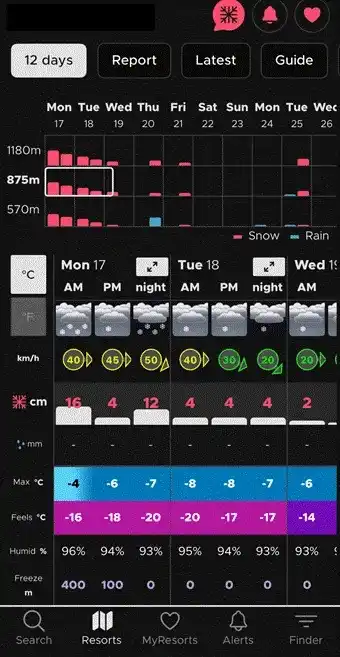
As the data points start coming in, I must decide when to hit the slopes with incomplete information. Sometimes it's not until the day before I strap on my snowboard that I know what the weather pattern will be.
A few snow seasons ago, when I arrived in mid-December, I found the mountain covered in dirt. Only one gondola was open, serving thousands of excited skiers. The queue was hours long to ski on a sparsely covered, flat beginner-to-intermediate slope. The next day, a heavy snowfall arrived, and I had one of the epic powder days in my favorite tree-lined ski area.
Bitcoin is a global fiat liquidity weather vane. Its trading depends on expectations of future fiat supply. Sometimes reality aligns with expectations, and sometimes it doesn't.
Money is politics. And the ever-changing political rhetoric influences the market's expectation of future dirty fiat supply.
Our imperfect leaders one day call for pumping their favorite supporters' assets with more massive, cheaper funds, and the next day call for measures to counter inflation that destroys ordinary people and their chances of re-election or perpetuating their autocratic rule.
As with science, in trading, holding firm beliefs but maintaining a flexible attitude is worthwhile.
After the disastrous failure of the "Great Tariff Day" in the United States on April 2, 2025, I once called for only rises and no falls.
I believe U.S. President Trump and his Treasury Secretary "Buffalo Bill" Bessent have learned their lesson and are no longer attempting to rapidly change the world's financial and trade operating systems.
In order to regain popularity, they will provide benefits to their supporters (individuals who hold a significant amount of real estate, stocks, and cryptocurrency financial assets), and these benefits are funded with printed money.
On April 9, Trump "Taco'd" (surrendered), announcing a tariff truce, turning a crisis that seemed like the beginning of a major depression into the best buying opportunity of the year. Bitcoin rose by 21%, and some altcoins (mainly Ethereum) also saw increases, with Bitcoin's dominance dropping from 63% to 59% to prove this.
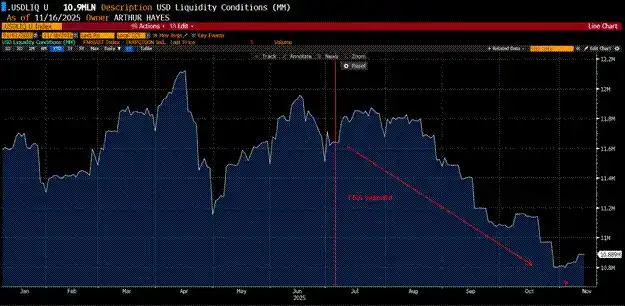
However, recently, Bitcoin's implied dollar liquidity forecast has deteriorated. Since hitting an all-time high in early October, Bitcoin has fallen by 25%, with many altcoins hit harder than the blow capitalists received in the New York City mayoral election.
What has changed?
The Trump administration's rhetoric has not changed. Trump still criticizes the Fed for keeping rates too high. He and his deputies continue to talk about pumping up the real estate market through various means.
Most importantly, at every turning point, Trump has made concessions to China, postponing the mandatory reversal of the trade and financial imbalance between these two economic giants because the financial and political pain of such actions is unbearable for politicians who must face voters every two to four years.
What has not changed but is now given more weight by the market than political speeches is the contraction of dollar liquidity.
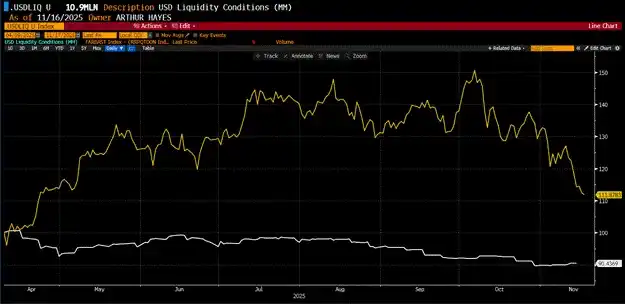
My dollar liquidity index (white line) has dropped by 10% since April 9, 2025, while Bitcoin (gold line) has risen by 12%. This divergence is partly due to the liquidity-positive comments released by the Trump administration. Part of the reason is that retail investors see inflows into Bitcoin ETFs and DAT mNAV premiums as evidence of institutional investors seeking Bitcoin exposure.
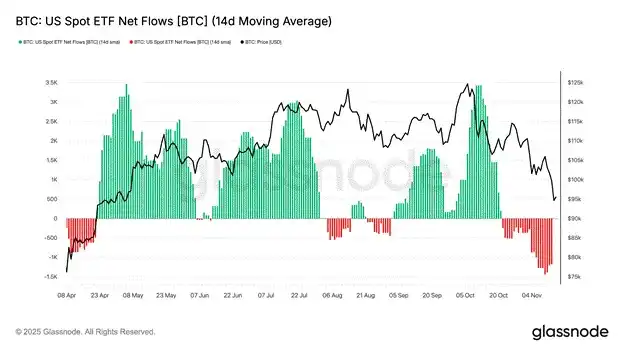
The narrative goes as follows: institutional investors are pouring into Bitcoin ETFs. As you can see, the net inflows from April to October provided continuous buying pressure for Bitcoin, despite a decrease in dollar liquidity. I must attach a warning to this chart. The largest ETF (BlackRock IBIT US) has its largest holders using the ETF as part of a basis trade; they are not bullish on Bitcoin.
They capitalize on the price difference by shorting Bitcoin futures contracts listed on CME and simultaneously buying ETFs.
This approach is capital efficient because their brokers typically allow them to use ETFs as collateral, securing their short futures positions.

These are the top five holders of IBIT US. They are large hedge funds or investment banks focused on proprietary trading, such as Goldman Sachs.
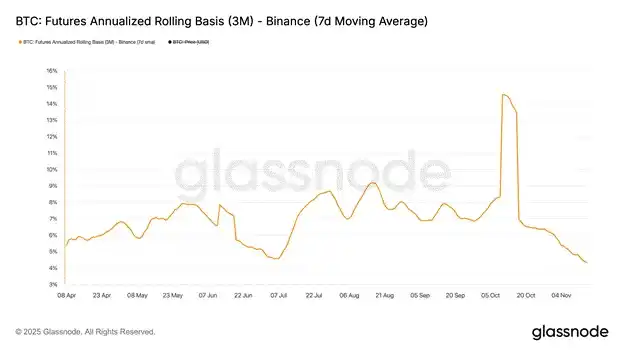
The chart above illustrates the annualized spread income these funds achieve by purchasing IBIT US and selling CME futures contracts.
While the exchange mentioned above is Binance, the CME's annualized spread is essentially the same. When the spread is significantly higher than the federal funds rate, hedge funds flock to trade, creating substantial and sustained net inflows into ETFs.
This has led to a misconception among those unaware of market microstructure, believing that institutional investors have a keen interest in holding Bitcoin exposure when, in reality, they are indifferent to Bitcoin entirely, merely playing in our sandbox to earn additional returns a few percentage points above the federal funds rate. As the spread decreases, they swiftly offload their positions. Recently, with the spread decreasing, ETF complexes have seen massive net outflows.
Now retail investors believe these institutional investors dislike Bitcoin, creating a negative feedback loop prompting them to sell, further reducing the spread, ultimately leading to more institutional investors selling ETFs.
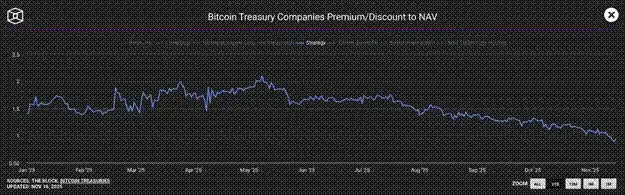
Digital Asset Trust (DAT) companies offer institutional investors another way to gain Bitcoin exposure. Strategy (ticker: MSTR US) is the largest DAT holding Bitcoin. When its stock price exhibits a significant premium relative to its held Bitcoin (referred to as mNAV), the company can issue shares and other financing methods to acquire Bitcoin at a discounted price. As the premium decreases to a discount, Strategy's rate of acquiring Bitcoin slows down.
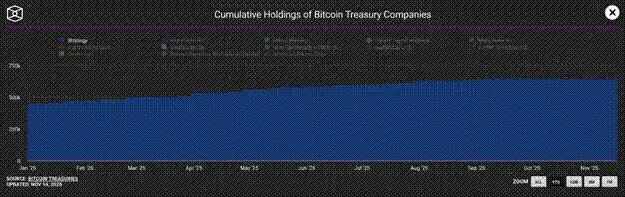
This is a Cumulative Holdings chart, not the rate of change of that variable, but you can see that as the Strategy's mNAV premium disappears, the growth rate of its holdings slows down.
Despite the USD liquidity contraction from April 9 to date, Bitcoin ETF inflows and DAT purchases have propelled Bitcoin higher. However, this situation has come to an end.
The basis is no longer attractive enough to sustain institutional investor buying of the ETF, and most DATs are trading at a discount to mNAV, with investors now also shunning these Bitcoin derivative securities. Without these flows to mask the negative liquidity condition, Bitcoin must fall to reflect current short-term concerns that either USD liquidity will shrink or not grow as fast as politicians have promised.
Present the Evidence...
Now is the time for Trump and Besant to present the evidence or shut up. Either they have the power to overshadow the Treasury Department over the Fed, create another real estate bubble, distribute more stimulus checks, etc., or they are a bunch of weak, powerless frauds.
Further complicating matters is that Blue Democrats have found (not surprisingly) that running on various affordability themes is a winning strategy. Whether the opposition can deliver on these promises, such as free bus passes, a plethora of rent-controlled apartments, and government-run grocery stores, is not the point. The point is that people want to be heard and can at least delude themselves into believing that someone in high office is looking out for them. The people don't want Trump and his army of "Make America Great Again" (MAGA) social media influencers to spin fake news to gloss over the inflation they see and feel every day.
For those with a longer-term view, these short-term hiccups in fiat money creation speed are irrelevant. If Red Republicans can't print enough money, the stock and bond markets will crash, forcing those doctrinaire in both parties to return to the devil-worshipping of money printing.
Trump is a savvy politician, much like former U.S. President Biden—who also faced similar resistance from the populace due to inflation stemming from COVID stimulus measures—he will publicly change course, blaming the Fed for the inflation plaguing the common folk. But fear not, Trump will not forget the wealthy asset holders who funded his campaign. "Buffalo Bill" Besant will receive strict orders to print money in ways ordinary people cannot fathom.
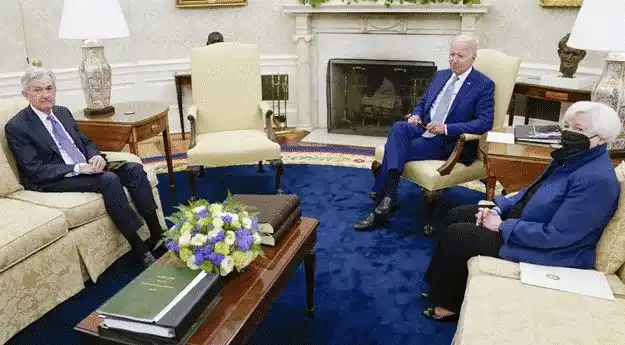
Do you remember this photo from 2022? Our favorite "Ass Kisser" Federal Reserve Chair Powell was then schooled by former President Biden (Slow Joe Biden) and U.S. Treasury Secretary Yellen (Bad Gurl Yellen). Biden explained to his supporters that Powell would crush inflation. Then, needing to boost the financial assets of those who got him into power, he instructed Yellen to undo all of Powell's rate hikes and balance sheet contractions at any cost.
Yellen issued more treasury bills than notes or bonds, from the third quarter of 2022 to the first quarter of 2025, siphoning off $2.5 trillion from the Fed's reverse repo program, thereby pumping up stocks, housing, gold, and cryptocurrency.
For the average voter — and some of the readers here — what I just wrote may be akin to gibberish, and that's precisely the point. The inflation you are experiencing is exactly what that politician who claims to care about easing the burden on the people has caused.
"Buffalo Bill" Benson must perform a similar kind of magic. I am one hundred percent confident he will design a similar outcome. He is one of the historical masters who understands the financial market plumbing and currency transactions.
What Is the Situation
The market setups for the second half of 2023 and 2025 are eerily similar. The debt ceiling battles end in midsummer (June 3, 2023, and July 4, 2025), forcing the Treasury to rebuild the General Account (TGA), thus siphoning liquidity out of the system.
2023:
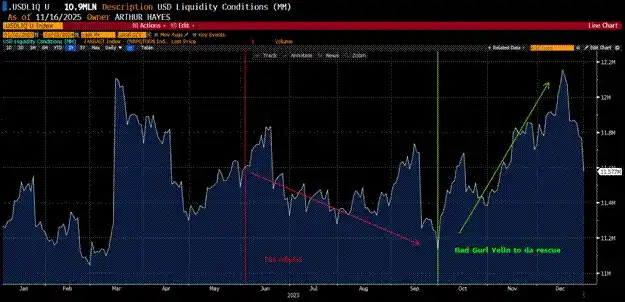
2025:
"Bad Girl" Yellen has pleased her boss. Whether "Buffalo Bill" Benson can find his "BB" and reshape the market by Bismarckian means to have red camp Republicans capture the votes of asset-holding voters in the 2026 midterms.
Whenever politicians listen too closely to the suffering majority under inflation, they verbally constrain the central bankers and Treasury officials who love to print money.
To dispel their idea of allowing credit contraction, the market presents a Hobson's Choice. Once investors realize that money printing is temporarily banned, stock and bond prices plummet swiftly, at which point politicians either print money to save the highly leveraged dirty fiat financial system that supports a more extensive economy, but this would lead to a renewed acceleration of inflation, or they allow credit contraction, which would ruin wealthy asset holders and lead to extensive unemployment as overleveraged businesses must cut output and jobs.
Typically, the latter is more politically palatable, as 1930s-style unemployment and financial distress are always electoral losers, whereas inflation is a silent killer that can be masked through subsidies to the poor funded by money printing.
Just as I have full confidence in Hokkaido's "snow-making machine," I one hundred percent believe that Trump and Bezos want their red camp Republicans to stay in power, so they will find a way to be tough on combating inflation while also printing the necessary money to continue propping up the Keynesian "fractional-reserve banking" scam in the current state of the American and global economy.
On the mountain, arriving too early can sometimes make you slide on mud. In the financial markets, before we return to the "Up Only" phase, as Nelly would say, the market must first "Drop Down and Get Their Eagle On" (kneel down and show posture). (By the way, they don't make music videos like they used to.)
The Bull Case
In contrast to my negative dollar liquidity thesis, the argument is that as the U.S. government resumes operations post-shutdown, the TGA will rapidly decrease by 100 to 150 billion dollars to reach the 850 billion dollar target, which will add liquidity to the system. Additionally, the Fed will stop tapering its balance sheet on December 1st and will promptly resume balance sheet expansion through quantitative easing (QE).
I was initially optimistic about risk assets post-shutdown. However, as I delved into the data, I noticed that approximately 1 trillion dollars of dollar liquidity has evaporated since July based on my index. Adding 150 billion dollars is great, but then what?
While several Fed officials have hinted at the need to resume quantitative easing to rebuild bank reserves and ensure the normal functioning of the money markets, it's just talk. We will only know they are serious when the Fed's "whisperer" - Nick Timiraos of The Wall Street Journal - announces the green light for QE. But we're not there yet. In the meantime, the Standing Repo Facility will be used to print money, in amounts of hundreds of billions of dollars, to ensure the money market can handle the massive issuance of government debt.
In theory, Bezos could bring the TGA down to zero. Unfortunately, because the Treasury must roll over hundreds of billions of dollars of Treasury bills each week, they need to maintain a large cash buffer in case of emergencies. They cannot afford the risk of a Treasury bill default at maturity, ruling out the possibility of immediately injecting the remaining 850 billion dollars into the financial markets.
The privatization of government-sponsored mortgage companies Fannie and Freddie will certainly happen, but not in the upcoming weeks. Banks will also fulfill their "duty" to lend to those manufacturing bombs, nuclear reactors, semiconductors, etc., but this will also occur over a longer time frame, and this credit will not immediately flow into the context of dollar liquidity.
The bull case is sound; over time, the money printer will surely go "brrr."
But first, the market must retrace the gains seen since April to better align with liquidity fundamentals.
Lastly, before I delve into Maelstrom's position, I do not subscribe to the notion that the "four-year cycle" holds true. Bitcoin and certain altcoins only achieve new all-time highs after the market has shaken out enough weak hands to accelerate the printing press.
Maelstrom's Position
Over the weekend, I increased our USD stablecoin exposure in anticipation of a cryptocurrency price drop. In the short term, I believe the only cryptocurrency that can outperform the adverse USD liquidity conditions is Zcash ($ZEC).
With the rise of artificial intelligence, Big Tech, and Big Government, privacy in most realms of the internet has vanished. Zcash and other privacy-centric cryptocurrencies utilizing zero-knowledge proof encryption are humanity's sole bulwark against this new reality. That's why figures like Balaji believe the privacy grand narrative will drive the crypto market for years to come.
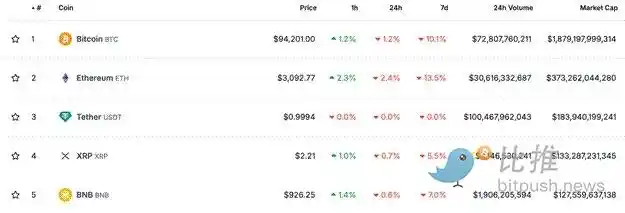
As a Satoshi disciple, the third, fourth, and fifth-largest cryptocurrencies being a USD derivative, a do-nothing coin on an idle chain, and CZ's centralized computer leave me feeling slighted.
If, 15 years from now, these are the largest cryptocurrencies after Bitcoin and Ethereum, what are we even doing?
I harbor no personal animosity towards Paolo, Garlinghouse, and CZ; they are maestros at creating value for their token holders. Founders, please take note. But Zcash or a similar privacy-focused cryptocurrency should rank just below Ethereum.
I believe the grassroots crypto community is awakening to the realization that endowing coins or tokens of this sort with such high valuations, while tacitly supporting something at odds with a decentralized future where we, as flesh-and-blood humans, retain agency against oppressive tech, governmental, and AI behemoths.
Hence, as we await for Powell to regain his printing press rhythm, Zcash or another privacy-focused cryptocurrency will enjoy sustained price appreciation.
Maelstrom is still a long-term bullish outlook for me. If I have to buy back at a higher price (just like I had to do earlier this year), that's okay. I proudly embrace my failures because I have fiat reserves on hand to boldly bet to win, making it truly worthwhile. Having liquidity in hand when the scenario reappears in April 2025 will determine your overall gains and losses more than having to give back your hard-earned small profits to the market due to trading losses.
Bitcoin dropped from $125,000 to a low of $90,000, while the S&P 500 Index and the Nasdaq 100 Index hovered near all-time highs, signaling to me that a credit event is brewing.
As I observe the decline in my USD liquidity index since July, I confirm this view.
If my view is correct, a 10% to 20% stock market correction, coupled with a close to 5% 10-year Treasury yield, will be enough to create a sense of urgency, prompting the Federal Reserve, Treasury Department, or another U.S. government entity to launch some form of money-printing scheme.
During this soft period, Bitcoin could easily fall to $80,000 to $85,000. If a broader risk-off market implosion occurs and the Fed and Treasury accelerate their money-printing shenanigans, Bitcoin could skyrocket to $200,000 or $250,000 by year-end.
I still believe China will reflate its currency. However, China will only pull the trigger once the U.S. ramps up dollar creation. Right or wrong, they want to show strength in the yuan against the dollar, which has prevented a significant increase in broad money supply. The sign is there: the People's Bank of China (PBOC) made a small purchase of government bonds for the first time since January. This is the beginning of China's quantitative easing. The dragon will awaken and splash baijiu onto the raging fire of the 2026 crypto bull market.
Before I set off to tango in beautiful Argentina, a final note about China: Beijing's displeasure with the U.S. "taking" a Chinese citizen suspected of involvement in fraudulent activity's Bitcoin is quite intriguing, isn't it? Apparently, the leadership sees Bitcoin as a valuable asset that should be held and protected by the Chinese nation or its people, not owned by the U.S. government.
If the leaders of the "two largest economic entities" in the world—both believe in the value of Bitcoin, what reason do you have not to be long-term bullish?
You may also like

Token Cannot Compound, Where Is the Real Investment Opportunity?

February 6th Market Key Intelligence, How Much Did You Miss?

China's Central Bank and Eight Other Departments' Latest Regulatory Focus: Key Attention to RWA Tokenized Asset Risk
Foreword: Today, the People's Bank of China's website published the "Notice of the People's Bank of China, National Development and Reform Commission, Ministry of Industry and Information Technology, Ministry of Public Security, State Administration for Market Regulation, China Banking and Insurance Regulatory Commission, China Securities Regulatory Commission, State Administration of Foreign Exchange on Further Preventing and Dealing with Risks Related to Virtual Currency and Others (Yinfa [2026] No. 42)", the latest regulatory requirements from the eight departments including the central bank, which are basically consistent with the regulatory requirements of recent years. The main focus of the regulation is on speculative activities such as virtual currency trading, exchanges, ICOs, overseas platform services, and this time, regulatory oversight of RWA has been added, explicitly prohibiting RWA tokenization, stablecoins (especially those pegged to the RMB). The following is the full text:
To the people's governments of all provinces, autonomous regions, and municipalities directly under the Central Government, the Xinjiang Production and Construction Corps:
Recently, there have been speculative activities related to virtual currency and Real-World Assets (RWA) tokenization, disrupting the economic and financial order and jeopardizing the property security of the people. In order to further prevent and address the risks related to virtual currency and Real-World Assets tokenization, effectively safeguard national security and social stability, in accordance with the "Law of the People's Republic of China on the People's Bank of China," "Law of the People's Republic of China on Commercial Banks," "Securities Law of the People's Republic of China," "Law of the People's Republic of China on Securities Investment Funds," "Law of the People's Republic of China on Futures and Derivatives," "Cybersecurity Law of the People's Republic of China," "Regulations of the People's Republic of China on the Administration of Renminbi," "Regulations on Prevention and Disposal of Illegal Fundraising," "Regulations of the People's Republic of China on Foreign Exchange Administration," "Telecommunications Regulations of the People's Republic of China," and other provisions, after reaching consensus with the Cyberspace Administration of China, the Supreme People's Court, and the Supreme People's Procuratorate, and with the approval of the State Council, the relevant matters are notified as follows:
(I) Virtual currency does not possess the legal status equivalent to fiat currency. Virtual currencies such as Bitcoin, Ether, Tether, etc., have the main characteristics of being issued by non-monetary authorities, using encryption technology and distributed ledger or similar technology, existing in digital form, etc. They do not have legal tender status, should not and cannot be circulated and used as currency in the market.
The business activities related to virtual currency are classified as illegal financial activities. The exchange of fiat currency and virtual currency within the territory, exchange of virtual currencies, acting as a central counterparty in buying and selling virtual currencies, providing information intermediary and pricing services for virtual currency transactions, token issuance financing, and trading of virtual currency-related financial products, etc., fall under illegal financial activities, such as suspected illegal issuance of token vouchers, unauthorized public issuance of securities, illegal operation of securities and futures business, illegal fundraising, etc., are strictly prohibited across the board and resolutely banned in accordance with the law. Overseas entities and individuals are not allowed to provide virtual currency-related services to domestic entities in any form.
A stablecoin pegged to a fiat currency indirectly fulfills some functions of the fiat currency in circulation. Without the consent of relevant authorities in accordance with the law and regulations, any domestic or foreign entity or individual is not allowed to issue a RMB-pegged stablecoin overseas.
(II)Tokenization of Real-World Assets refers to the use of encryption technology and distributed ledger or similar technologies to transform ownership rights, income rights, etc., of assets into tokens (tokens) or other interests or bond certificates with token (token) characteristics, and carry out issuance and trading activities.
Engaging in the tokenization of real-world assets domestically, as well as providing related intermediary, information technology services, etc., which are suspected of illegal issuance of token vouchers, unauthorized public offering of securities, illegal operation of securities and futures business, illegal fundraising, and other illegal financial activities, shall be prohibited; except for relevant business activities carried out with the approval of the competent authorities in accordance with the law and regulations and relying on specific financial infrastructures. Overseas entities and individuals are not allowed to illegally provide services related to the tokenization of real-world assets to domestic entities in any form.
(III) Inter-agency Coordination. The People's Bank of China, together with the National Development and Reform Commission, the Ministry of Industry and Information Technology, the Ministry of Public Security, the State Administration for Market Regulation, the China Banking and Insurance Regulatory Commission, the China Securities Regulatory Commission, the State Administration of Foreign Exchange, and other departments, will improve the work mechanism, strengthen coordination with the Cyberspace Administration of China, the Supreme People's Court, and the Supreme People's Procuratorate, coordinate efforts, and overall guide regions to carry out risk prevention and disposal of virtual currency-related illegal financial activities.
The China Securities Regulatory Commission, together with the National Development and Reform Commission, the Ministry of Industry and Information Technology, the Ministry of Public Security, the People's Bank of China, the State Administration for Market Regulation, the China Banking and Insurance Regulatory Commission, the State Administration of Foreign Exchange, and other departments, will improve the work mechanism, strengthen coordination with the Cyberspace Administration of China, the Supreme People's Court, and the Supreme People's Procuratorate, coordinate efforts, and overall guide regions to carry out risk prevention and disposal of illegal financial activities related to the tokenization of real-world assets.
(IV) Strengthening Local Implementation. The people's governments at the provincial level are overall responsible for the prevention and disposal of risks related to virtual currencies and the tokenization of real-world assets in their respective administrative regions. The specific leading department is the local financial regulatory department, with participation from branches and dispatched institutions of the State Council's financial regulatory department, telecommunications regulators, public security, market supervision, and other departments, in coordination with cyberspace departments, courts, and procuratorates, to improve the normalization of the work mechanism, effectively connect with the relevant work mechanisms of central departments, form a cooperative and coordinated working pattern between central and local governments, effectively prevent and properly handle risks related to virtual currencies and the tokenization of real-world assets, and maintain economic and financial order and social stability.
(5) Enhanced Risk Monitoring. The People's Bank of China, China Securities Regulatory Commission, National Development and Reform Commission, Ministry of Industry and Information Technology, Ministry of Public Security, State Administration of Foreign Exchange, Cyberspace Administration of China, and other departments continue to improve monitoring techniques and system support, enhance cross-departmental data analysis and sharing, establish sound information sharing and cross-validation mechanisms, promptly grasp the risk situation of activities related to virtual currency and real-world asset tokenization. Local governments at all levels give full play to the role of local monitoring and early warning mechanisms. Local financial regulatory authorities, together with branches and agencies of the State Council's financial regulatory authorities, as well as departments of cyberspace and public security, ensure effective connection between online monitoring, offline investigation, and fund tracking, efficiently and accurately identify activities related to virtual currency and real-world asset tokenization, promptly share risk information, improve early warning information dissemination, verification, and rapid response mechanisms.
(6) Strengthened Oversight of Financial Institutions, Intermediaries, and Technology Service Providers. Financial institutions (including non-bank payment institutions) are prohibited from providing account opening, fund transfer, and clearing services for virtual currency-related business activities, issuing and selling financial products related to virtual currency, including virtual currency and related financial products in the scope of collateral, conducting insurance business related to virtual currency, or including virtual currency in the scope of insurance liability. Financial institutions (including non-bank payment institutions) are prohibited from providing custody, clearing, and settlement services for unauthorized real-world asset tokenization-related business and related financial products. Relevant intermediary institutions and information technology service providers are prohibited from providing intermediary, technical, or other services for unauthorized real-world asset tokenization-related businesses and related financial products.
(7) Enhanced Management of Internet Information Content and Access. Internet enterprises are prohibited from providing online business venues, commercial displays, marketing, advertising, or paid traffic diversion services for virtual currency and real-world asset tokenization-related business activities. Upon discovering clues of illegal activities, they should promptly report to relevant departments and provide technical support and assistance for related investigations and inquiries. Based on the clues transferred by the financial regulatory authorities, the cyberspace administration, telecommunications authorities, and public security departments should promptly close and deal with websites, mobile applications (including mini-programs), and public accounts engaged in virtual currency and real-world asset tokenization-related business activities in accordance with the law.
(8) Strengthened Entity Registration and Advertisement Management. Market supervision departments strengthen entity registration and management, and enterprise and individual business registrations must not contain terms such as "virtual currency," "virtual asset," "cryptocurrency," "crypto asset," "stablecoin," "real-world asset tokenization," or "RWA" in their names or business scopes. Market supervision departments, together with financial regulatory authorities, legally enhance the supervision of advertisements related to virtual currency and real-world asset tokenization, promptly investigating and handling relevant illegal advertisements.
(IX) Continued Rectification of Virtual Currency Mining Activities. The National Development and Reform Commission, together with relevant departments, strictly controls virtual currency mining activities, continuously promotes the rectification of virtual currency mining activities. The people's governments of various provinces take overall responsibility for the rectification of "mining" within their respective administrative regions. In accordance with the requirements of the National Development and Reform Commission and other departments in the "Notice on the Rectification of Virtual Currency Mining Activities" (NDRC Energy-saving Building [2021] No. 1283) and the provisions of the "Guidance Catalog for Industrial Structure Adjustment (2024 Edition)," a comprehensive review, investigation, and closure of existing virtual currency mining projects are conducted, new mining projects are strictly prohibited, and mining machine production enterprises are strictly prohibited from providing mining machine sales and other services within the country.
(X) Severe Crackdown on Related Illegal Financial Activities. Upon discovering clues to illegal financial activities related to virtual currency and the tokenization of real-world assets, local financial regulatory authorities, branches of the State Council's financial regulatory authorities, and other relevant departments promptly investigate, determine, and properly handle the issues in accordance with the law, and seriously hold the relevant entities and individuals legally responsible. Those suspected of crimes are transferred to the judicial authorities for processing according to the law.
(XI) Severe Crackdown on Related Illegal and Criminal Activities. The Ministry of Public Security, the People's Bank of China, the State Administration for Market Regulation, the China Banking and Insurance Regulatory Commission, the China Securities Regulatory Commission, as well as judicial and procuratorial organs, in accordance with their respective responsibilities, rigorously crack down on illegal and criminal activities related to virtual currency, the tokenization of real-world assets, such as fraud, money laundering, illegal business operations, pyramid schemes, illegal fundraising, and other illegal and criminal activities carried out under the guise of virtual currency, the tokenization of real-world assets, etc.
(XII) Strengthen Industry Self-discipline. Relevant industry associations should enhance membership management and policy advocacy, based on their own responsibilities, advocate and urge member units to resist illegal financial activities related to virtual currency and the tokenization of real-world assets. Member units that violate regulatory policies and industry self-discipline rules are to be disciplined in accordance with relevant self-regulatory management regulations. By leveraging various industry infrastructure, conduct risk monitoring related to virtual currency, the tokenization of real-world assets, and promptly transfer issue clues to relevant departments.
(XIII) Without the approval of relevant departments in accordance with the law and regulations, domestic entities and foreign entities controlled by them may not issue virtual currency overseas.
(XIV) Domestic entities engaging directly or indirectly in overseas external debt-based tokenization of real-world assets, or conducting asset securitization activities abroad based on domestic ownership rights, income rights, etc. (hereinafter referred to as domestic equity), should be strictly regulated in accordance with the principles of "same business, same risk, same rules." The National Development and Reform Commission, the China Securities Regulatory Commission, the State Administration of Foreign Exchange, and other relevant departments regulate it according to their respective responsibilities. For other forms of overseas real-world asset tokenization activities based on domestic equity by domestic entities, the China Securities Regulatory Commission, together with relevant departments, supervise according to their division of responsibilities. Without the consent and filing of relevant departments, no unit or individual may engage in the above-mentioned business.
(15) Overseas subsidiaries and branches of domestic financial institutions providing Real World Asset Tokenization-related services overseas shall do so legally and prudently. They shall have professional personnel and systems in place to effectively mitigate business risks, strictly implement customer onboarding, suitability management, anti-money laundering requirements, and incorporate them into the domestic financial institutions' compliance and risk management system. Intermediaries and information technology service providers offering Real World Asset Tokenization services abroad based on domestic equity or conducting Real World Asset Tokenization business in the form of overseas debt for domestic entities directly or indirectly venturing abroad must strictly comply with relevant laws and regulations. They should establish and improve relevant compliance and internal control systems in accordance with relevant normative requirements, strengthen business and risk control, and report the business developments to the relevant regulatory authorities for approval or filing.
(16) Strengthen organizational leadership and overall coordination. All departments and regions should attach great importance to the prevention of risks related to virtual currencies and Real World Asset Tokenization, strengthen organizational leadership, clarify work responsibilities, form a long-term effective working mechanism with centralized coordination, local implementation, and shared responsibilities, maintain high pressure, dynamically monitor risks, effectively prevent and mitigate risks in an orderly and efficient manner, legally protect the property security of the people, and make every effort to maintain economic and financial order and social stability.
(17) Widely carry out publicity and education. All departments, regions, and industry associations should make full use of various media and other communication channels to disseminate information through legal and policy interpretation, analysis of typical cases, and education on investment risks, etc. They should promote the illegality and harm of virtual currencies and Real World Asset Tokenization-related businesses and their manifestations, fully alert to potential risks and hidden dangers, and enhance public awareness and identification capabilities for risk prevention.
(18) Engaging in illegal financial activities related to virtual currencies and Real World Asset Tokenization in violation of this notice, as well as providing services for virtual currencies and Real World Asset Tokenization-related businesses, shall be punished in accordance with relevant regulations. If it constitutes a crime, criminal liability shall be pursued according to the law. For domestic entities and individuals who knowingly or should have known that overseas entities illegally provided virtual currency or Real World Asset Tokenization-related services to domestic entities and still assisted them, relevant responsibilities shall be pursued according to the law. If it constitutes a crime, criminal liability shall be pursued according to the law.
(19) If any unit or individual invests in virtual currencies, Real World Asset Tokens, and related financial products against public order and good customs, the relevant civil legal actions shall be invalid, and any resulting losses shall be borne by them. If there are suspicions of disrupting financial order and jeopardizing financial security, the relevant departments shall deal with them according to the law.
This notice shall enter into force upon the date of its issuance. The People's Bank of China and ten other departments' "Notice on Further Preventing and Dealing with the Risks of Virtual Currency Trading Speculation" (Yinfa [2021] No. 237) is hereby repealed.

Former Partner's Perspective on Multicoin: Kyle's Exit, But the Game He Left Behind Just Getting Started

Why Bitcoin Is Falling Now: The Real Reasons Behind BTC's Crash & WEEX's Smart Profit Playbook
Bitcoin's ongoing crash explained: Discover the 5 hidden triggers behind BTC's plunge & how WEEX's Auto Earn and Trade to Earn strategies help traders profit from crypto market volatility.

Wall Street's Hottest Trades See Exodus

Vitalik Discusses Ethereum Scaling Path, Circle Announces Partnership with Polymarket, What's the Overseas Crypto Community Talking About Today?

Believing in the Capital Markets - The Essence and Core Value of Cryptocurrency

Polymarket's 'Weatherman': Predict Temperature, Win Million-Dollar Payout

$15K+ Profits: The 4 AI Trading Secrets WEEX Hackathon Prelim Winners Used to Dominate Volatile Crypto Markets
How WEEX Hackathon's top AI trading strategies made $15K+ in crypto markets: 4 proven rules for ETH/BTC trading, market structure analysis, and risk management in volatile conditions.

A nearly 20% one-day plunge, how long has it been since you last saw a $60,000 Bitcoin?

Raoul Pal: I've seen every single panic, and they are never the end.

Key Market Information Discrepancy on February 6th - A Must-Read! | Alpha Morning Report

2026 Crypto Industry's First Snowfall
The Harsh Reality Behind the $26 Billion Crypto Liquidation: Liquidity Is Killing the Market
Why Is Gold, US Stocks, Bitcoin All Falling?

Key Market Intelligence for February 5th, how much did you miss out on?

Wintermute: By 2026, crypto had gradually become the settlement layer of the Internet economy
Token Cannot Compound, Where Is the Real Investment Opportunity?
February 6th Market Key Intelligence, How Much Did You Miss?
China's Central Bank and Eight Other Departments' Latest Regulatory Focus: Key Attention to RWA Tokenized Asset Risk
Foreword: Today, the People's Bank of China's website published the "Notice of the People's Bank of China, National Development and Reform Commission, Ministry of Industry and Information Technology, Ministry of Public Security, State Administration for Market Regulation, China Banking and Insurance Regulatory Commission, China Securities Regulatory Commission, State Administration of Foreign Exchange on Further Preventing and Dealing with Risks Related to Virtual Currency and Others (Yinfa [2026] No. 42)", the latest regulatory requirements from the eight departments including the central bank, which are basically consistent with the regulatory requirements of recent years. The main focus of the regulation is on speculative activities such as virtual currency trading, exchanges, ICOs, overseas platform services, and this time, regulatory oversight of RWA has been added, explicitly prohibiting RWA tokenization, stablecoins (especially those pegged to the RMB). The following is the full text:
To the people's governments of all provinces, autonomous regions, and municipalities directly under the Central Government, the Xinjiang Production and Construction Corps:
Recently, there have been speculative activities related to virtual currency and Real-World Assets (RWA) tokenization, disrupting the economic and financial order and jeopardizing the property security of the people. In order to further prevent and address the risks related to virtual currency and Real-World Assets tokenization, effectively safeguard national security and social stability, in accordance with the "Law of the People's Republic of China on the People's Bank of China," "Law of the People's Republic of China on Commercial Banks," "Securities Law of the People's Republic of China," "Law of the People's Republic of China on Securities Investment Funds," "Law of the People's Republic of China on Futures and Derivatives," "Cybersecurity Law of the People's Republic of China," "Regulations of the People's Republic of China on the Administration of Renminbi," "Regulations on Prevention and Disposal of Illegal Fundraising," "Regulations of the People's Republic of China on Foreign Exchange Administration," "Telecommunications Regulations of the People's Republic of China," and other provisions, after reaching consensus with the Cyberspace Administration of China, the Supreme People's Court, and the Supreme People's Procuratorate, and with the approval of the State Council, the relevant matters are notified as follows:
(I) Virtual currency does not possess the legal status equivalent to fiat currency. Virtual currencies such as Bitcoin, Ether, Tether, etc., have the main characteristics of being issued by non-monetary authorities, using encryption technology and distributed ledger or similar technology, existing in digital form, etc. They do not have legal tender status, should not and cannot be circulated and used as currency in the market.
The business activities related to virtual currency are classified as illegal financial activities. The exchange of fiat currency and virtual currency within the territory, exchange of virtual currencies, acting as a central counterparty in buying and selling virtual currencies, providing information intermediary and pricing services for virtual currency transactions, token issuance financing, and trading of virtual currency-related financial products, etc., fall under illegal financial activities, such as suspected illegal issuance of token vouchers, unauthorized public issuance of securities, illegal operation of securities and futures business, illegal fundraising, etc., are strictly prohibited across the board and resolutely banned in accordance with the law. Overseas entities and individuals are not allowed to provide virtual currency-related services to domestic entities in any form.
A stablecoin pegged to a fiat currency indirectly fulfills some functions of the fiat currency in circulation. Without the consent of relevant authorities in accordance with the law and regulations, any domestic or foreign entity or individual is not allowed to issue a RMB-pegged stablecoin overseas.
(II)Tokenization of Real-World Assets refers to the use of encryption technology and distributed ledger or similar technologies to transform ownership rights, income rights, etc., of assets into tokens (tokens) or other interests or bond certificates with token (token) characteristics, and carry out issuance and trading activities.
Engaging in the tokenization of real-world assets domestically, as well as providing related intermediary, information technology services, etc., which are suspected of illegal issuance of token vouchers, unauthorized public offering of securities, illegal operation of securities and futures business, illegal fundraising, and other illegal financial activities, shall be prohibited; except for relevant business activities carried out with the approval of the competent authorities in accordance with the law and regulations and relying on specific financial infrastructures. Overseas entities and individuals are not allowed to illegally provide services related to the tokenization of real-world assets to domestic entities in any form.
(III) Inter-agency Coordination. The People's Bank of China, together with the National Development and Reform Commission, the Ministry of Industry and Information Technology, the Ministry of Public Security, the State Administration for Market Regulation, the China Banking and Insurance Regulatory Commission, the China Securities Regulatory Commission, the State Administration of Foreign Exchange, and other departments, will improve the work mechanism, strengthen coordination with the Cyberspace Administration of China, the Supreme People's Court, and the Supreme People's Procuratorate, coordinate efforts, and overall guide regions to carry out risk prevention and disposal of virtual currency-related illegal financial activities.
The China Securities Regulatory Commission, together with the National Development and Reform Commission, the Ministry of Industry and Information Technology, the Ministry of Public Security, the People's Bank of China, the State Administration for Market Regulation, the China Banking and Insurance Regulatory Commission, the State Administration of Foreign Exchange, and other departments, will improve the work mechanism, strengthen coordination with the Cyberspace Administration of China, the Supreme People's Court, and the Supreme People's Procuratorate, coordinate efforts, and overall guide regions to carry out risk prevention and disposal of illegal financial activities related to the tokenization of real-world assets.
(IV) Strengthening Local Implementation. The people's governments at the provincial level are overall responsible for the prevention and disposal of risks related to virtual currencies and the tokenization of real-world assets in their respective administrative regions. The specific leading department is the local financial regulatory department, with participation from branches and dispatched institutions of the State Council's financial regulatory department, telecommunications regulators, public security, market supervision, and other departments, in coordination with cyberspace departments, courts, and procuratorates, to improve the normalization of the work mechanism, effectively connect with the relevant work mechanisms of central departments, form a cooperative and coordinated working pattern between central and local governments, effectively prevent and properly handle risks related to virtual currencies and the tokenization of real-world assets, and maintain economic and financial order and social stability.
(5) Enhanced Risk Monitoring. The People's Bank of China, China Securities Regulatory Commission, National Development and Reform Commission, Ministry of Industry and Information Technology, Ministry of Public Security, State Administration of Foreign Exchange, Cyberspace Administration of China, and other departments continue to improve monitoring techniques and system support, enhance cross-departmental data analysis and sharing, establish sound information sharing and cross-validation mechanisms, promptly grasp the risk situation of activities related to virtual currency and real-world asset tokenization. Local governments at all levels give full play to the role of local monitoring and early warning mechanisms. Local financial regulatory authorities, together with branches and agencies of the State Council's financial regulatory authorities, as well as departments of cyberspace and public security, ensure effective connection between online monitoring, offline investigation, and fund tracking, efficiently and accurately identify activities related to virtual currency and real-world asset tokenization, promptly share risk information, improve early warning information dissemination, verification, and rapid response mechanisms.
(6) Strengthened Oversight of Financial Institutions, Intermediaries, and Technology Service Providers. Financial institutions (including non-bank payment institutions) are prohibited from providing account opening, fund transfer, and clearing services for virtual currency-related business activities, issuing and selling financial products related to virtual currency, including virtual currency and related financial products in the scope of collateral, conducting insurance business related to virtual currency, or including virtual currency in the scope of insurance liability. Financial institutions (including non-bank payment institutions) are prohibited from providing custody, clearing, and settlement services for unauthorized real-world asset tokenization-related business and related financial products. Relevant intermediary institutions and information technology service providers are prohibited from providing intermediary, technical, or other services for unauthorized real-world asset tokenization-related businesses and related financial products.
(7) Enhanced Management of Internet Information Content and Access. Internet enterprises are prohibited from providing online business venues, commercial displays, marketing, advertising, or paid traffic diversion services for virtual currency and real-world asset tokenization-related business activities. Upon discovering clues of illegal activities, they should promptly report to relevant departments and provide technical support and assistance for related investigations and inquiries. Based on the clues transferred by the financial regulatory authorities, the cyberspace administration, telecommunications authorities, and public security departments should promptly close and deal with websites, mobile applications (including mini-programs), and public accounts engaged in virtual currency and real-world asset tokenization-related business activities in accordance with the law.
(8) Strengthened Entity Registration and Advertisement Management. Market supervision departments strengthen entity registration and management, and enterprise and individual business registrations must not contain terms such as "virtual currency," "virtual asset," "cryptocurrency," "crypto asset," "stablecoin," "real-world asset tokenization," or "RWA" in their names or business scopes. Market supervision departments, together with financial regulatory authorities, legally enhance the supervision of advertisements related to virtual currency and real-world asset tokenization, promptly investigating and handling relevant illegal advertisements.
(IX) Continued Rectification of Virtual Currency Mining Activities. The National Development and Reform Commission, together with relevant departments, strictly controls virtual currency mining activities, continuously promotes the rectification of virtual currency mining activities. The people's governments of various provinces take overall responsibility for the rectification of "mining" within their respective administrative regions. In accordance with the requirements of the National Development and Reform Commission and other departments in the "Notice on the Rectification of Virtual Currency Mining Activities" (NDRC Energy-saving Building [2021] No. 1283) and the provisions of the "Guidance Catalog for Industrial Structure Adjustment (2024 Edition)," a comprehensive review, investigation, and closure of existing virtual currency mining projects are conducted, new mining projects are strictly prohibited, and mining machine production enterprises are strictly prohibited from providing mining machine sales and other services within the country.
(X) Severe Crackdown on Related Illegal Financial Activities. Upon discovering clues to illegal financial activities related to virtual currency and the tokenization of real-world assets, local financial regulatory authorities, branches of the State Council's financial regulatory authorities, and other relevant departments promptly investigate, determine, and properly handle the issues in accordance with the law, and seriously hold the relevant entities and individuals legally responsible. Those suspected of crimes are transferred to the judicial authorities for processing according to the law.
(XI) Severe Crackdown on Related Illegal and Criminal Activities. The Ministry of Public Security, the People's Bank of China, the State Administration for Market Regulation, the China Banking and Insurance Regulatory Commission, the China Securities Regulatory Commission, as well as judicial and procuratorial organs, in accordance with their respective responsibilities, rigorously crack down on illegal and criminal activities related to virtual currency, the tokenization of real-world assets, such as fraud, money laundering, illegal business operations, pyramid schemes, illegal fundraising, and other illegal and criminal activities carried out under the guise of virtual currency, the tokenization of real-world assets, etc.
(XII) Strengthen Industry Self-discipline. Relevant industry associations should enhance membership management and policy advocacy, based on their own responsibilities, advocate and urge member units to resist illegal financial activities related to virtual currency and the tokenization of real-world assets. Member units that violate regulatory policies and industry self-discipline rules are to be disciplined in accordance with relevant self-regulatory management regulations. By leveraging various industry infrastructure, conduct risk monitoring related to virtual currency, the tokenization of real-world assets, and promptly transfer issue clues to relevant departments.
(XIII) Without the approval of relevant departments in accordance with the law and regulations, domestic entities and foreign entities controlled by them may not issue virtual currency overseas.
(XIV) Domestic entities engaging directly or indirectly in overseas external debt-based tokenization of real-world assets, or conducting asset securitization activities abroad based on domestic ownership rights, income rights, etc. (hereinafter referred to as domestic equity), should be strictly regulated in accordance with the principles of "same business, same risk, same rules." The National Development and Reform Commission, the China Securities Regulatory Commission, the State Administration of Foreign Exchange, and other relevant departments regulate it according to their respective responsibilities. For other forms of overseas real-world asset tokenization activities based on domestic equity by domestic entities, the China Securities Regulatory Commission, together with relevant departments, supervise according to their division of responsibilities. Without the consent and filing of relevant departments, no unit or individual may engage in the above-mentioned business.
(15) Overseas subsidiaries and branches of domestic financial institutions providing Real World Asset Tokenization-related services overseas shall do so legally and prudently. They shall have professional personnel and systems in place to effectively mitigate business risks, strictly implement customer onboarding, suitability management, anti-money laundering requirements, and incorporate them into the domestic financial institutions' compliance and risk management system. Intermediaries and information technology service providers offering Real World Asset Tokenization services abroad based on domestic equity or conducting Real World Asset Tokenization business in the form of overseas debt for domestic entities directly or indirectly venturing abroad must strictly comply with relevant laws and regulations. They should establish and improve relevant compliance and internal control systems in accordance with relevant normative requirements, strengthen business and risk control, and report the business developments to the relevant regulatory authorities for approval or filing.
(16) Strengthen organizational leadership and overall coordination. All departments and regions should attach great importance to the prevention of risks related to virtual currencies and Real World Asset Tokenization, strengthen organizational leadership, clarify work responsibilities, form a long-term effective working mechanism with centralized coordination, local implementation, and shared responsibilities, maintain high pressure, dynamically monitor risks, effectively prevent and mitigate risks in an orderly and efficient manner, legally protect the property security of the people, and make every effort to maintain economic and financial order and social stability.
(17) Widely carry out publicity and education. All departments, regions, and industry associations should make full use of various media and other communication channels to disseminate information through legal and policy interpretation, analysis of typical cases, and education on investment risks, etc. They should promote the illegality and harm of virtual currencies and Real World Asset Tokenization-related businesses and their manifestations, fully alert to potential risks and hidden dangers, and enhance public awareness and identification capabilities for risk prevention.
(18) Engaging in illegal financial activities related to virtual currencies and Real World Asset Tokenization in violation of this notice, as well as providing services for virtual currencies and Real World Asset Tokenization-related businesses, shall be punished in accordance with relevant regulations. If it constitutes a crime, criminal liability shall be pursued according to the law. For domestic entities and individuals who knowingly or should have known that overseas entities illegally provided virtual currency or Real World Asset Tokenization-related services to domestic entities and still assisted them, relevant responsibilities shall be pursued according to the law. If it constitutes a crime, criminal liability shall be pursued according to the law.
(19) If any unit or individual invests in virtual currencies, Real World Asset Tokens, and related financial products against public order and good customs, the relevant civil legal actions shall be invalid, and any resulting losses shall be borne by them. If there are suspicions of disrupting financial order and jeopardizing financial security, the relevant departments shall deal with them according to the law.
This notice shall enter into force upon the date of its issuance. The People's Bank of China and ten other departments' "Notice on Further Preventing and Dealing with the Risks of Virtual Currency Trading Speculation" (Yinfa [2021] No. 237) is hereby repealed.
Former Partner's Perspective on Multicoin: Kyle's Exit, But the Game He Left Behind Just Getting Started
Why Bitcoin Is Falling Now: The Real Reasons Behind BTC's Crash & WEEX's Smart Profit Playbook
Bitcoin's ongoing crash explained: Discover the 5 hidden triggers behind BTC's plunge & how WEEX's Auto Earn and Trade to Earn strategies help traders profit from crypto market volatility.


 App
App