
After Disassembling a Genuine Ledger, TBC Discusses the True Boundaries of Self-Custody

 Prefer us on Google


A hardware wallet purchased through legitimate channels, with intact packaging and unaltered anti-counterfeiting stickers, powers on and performs self-checks normally. However, it has been implanted with a hidden component designed to capture recovery phrases.
On October 15, 2026, Ledger officially responded to the incident: attackers purchased genuine devices, disassembled them to implant hardware, and then reintroduced them to the market through Southeast Asian distribution channels. Ledger emphasized that the chip, operating system, and servers were not compromised, categorizing it as a localized distribution channel attack rather than a systemic supply chain breach.
On October 14, Tom's Hardware cited a Bloomberg report estimating the losses at approximately $93 million. It should be clarified that this figure comes from third-party media and is not confirmed by Ledger's official statement.
Who the number belongs to is not important. What matters is the issue it exposes.
1. Self-Custody Has Not Eliminated Risk, It Has Just Shifted It
For the past decade, the industry has told a neat story: putting coins on an exchange means handing your fate over to a company; holding private keys in your own hands means freedom.
Half of this story is true.
The risks of exchange custody are centralized and visible: misappropriation, bank runs, bankruptcy, regulatory freezes. After FTX, "Not your keys, not your coins" has been accepted by more users, and the industry has begun to discuss self-custody tools and mnemonic phrase storage more seriously.
But self-custody is not the endpoint of risk; it is a transfer of risk.
It replaces the question of "Will the platform act maliciously?" with a new set of questions: Where did your device come from? Has the firmware been altered? In what environment was the mnemonic phrase generated? Does the content displayed on the screen during signing match the actual transaction being signed? Who has the authority to initiate this transfer?
In this series of questions, any failure at any link results in an outcome indistinguishable from an exchange running away with funds. The $93 million estimate from third parties essentially buys this lesson.
What’s more troublesome is that the nature of these attacks has changed. They do not break cryptography, do not compromise chips, and do not breach consensus algorithms. They attack the seams between the physical world and the trust chain: distribution channels, disassembly processes, re-packaging, and logistics transfers.
Cryptography can prove that a signature is valid, but it cannot prove whether the hand that signed it was coerced, nor can it prove whether that device has quietly sent out the mnemonic phrase when you weren’t looking.
The weakest link in the security model has never been the algorithm; it is the people, devices, and processes.
2. Breaking Down a Single Private Key into Multiple Verifiable Conditions
The true lesson from the Ledger incident is not "Don’t use hardware wallets," but rather: relying solely on the assumption that "the private key is in my hands" is itself a single point of failure.
The correct direction is to require multiple conditions to be met simultaneously for fund transfers, and these conditions should be distributed across different trust domains.
TBC's position on this matter needs to be stated with restraint. It does not claim to eliminate endpoint attacks; no chain can do that. Its value lies in the UTXO native contracts and multi-signature tools that allow projects to break down the risk of a single private key into multiple verifiable conditions.
Specifically, TBC employs SHA256 PoW and the UTXO model, with the node code TBCNODE being publicly verifiable. The inherent characteristic of the UTXO model is that each unspent output can be constrained by independent script conditions, rather than being tied to a global account balance. This means that spending rules can be written on-chain rather than in some backend service.
tbc-contract SDK provides on-chain querying, UTXO retrieval, transaction construction, signing, and broadcasting, and includes MultiSig, NFT, FT, and Pool workflows. The official MultiSig example supports setting a signing threshold of 1 to 6 signatures among 3 to 10 public keys, with documentation providing a 2-of-3 example.
It must be made clear: multi-signature is a configurable risk control tool, not automatic security, and certainly not absolute security.
If someone thinks that having a 2-of-3 setup guarantees everything is fine, that is the same mistake as believing "buying a hardware wallet means you are safe." Multi-signature changes the cost structure of attacks, not the possibility of attacks.
The TBC AMM documentation explains another matter: the SDK constructs, quotes, and signs locally, with broadcasting explicitly initiated by the application; pool status and asset control depend on UTXO and script rules. This forms the basis for non-custodial transactions and permission separation.
It should also be clarified that this does not mean that AMM is free from contract risks, price risks, or frontend risks. Local signing addresses the issue of "the private key not leaving the device," but does not resolve whether "the transaction you signed is what you truly intended to sign."
3. Why Multi-Signature Often Only Represents Formal Distribution
This is the easiest part to overlook and also the most fatal.
If multiple signing keys come from the same mnemonic phrase, are stored on the same device, or are controlled by the same person, multi-signature is merely a formal distribution.
If an attacker obtains one mnemonic phrase, they effectively gain all signing authority. If a device is implanted once, it means all thresholds are simultaneously compromised. This configuration may appear as 3-of-5 on-chain, but in reality, it is 1-of-1.
Therefore, the real question is not "How many signatures do I have?" but rather several harder questions:
- Are the environments in which these keys are generated independent of each other?
- Are they stored on physically isolated different devices?
- Are the individuals initiating the transaction and approving the transaction the same group of people?
- Are there delays and manual reviews for high-risk transfers?
- Have key rotation and recovery processes been practiced?
TBC's UTXO model will not automatically fix stolen private keys. This must be acknowledged. What on-chain rules can do is prevent unauthorized fund transfers when a certain condition is violated; it cannot magically recover assets once a private key has been leaked.
Supporting engineering practices remain indispensable: independent signing devices, key rotation, single transaction and daily limits, time locks, multi-party reviews for high-risk transactions, and executable recovery plans.
There is also a layer that must be candid: TBC itself still needs to continue improving. The usability of multi-signature interactions, compatibility depth with mainstream hardware wallets, out-of-the-box permission templates, independent third-party benchmark testing, and ongoing audits of the SDK, wallets, and AMM components are all ongoing work.
TBCNODE has already undergone versioned security reviews by CertiK and SlowMist. However, audits can only prove that specific versions and specific scopes have been checked; they do not cover hardware terminals, user key management habits, future submitted code, or all application layer logic. Treating audit reports as security certificates is another form of laziness.
-- Price
4. True Self-Custody is an On-Chain Rule
Returning to that disassembled device.
It reminds us that "having the private key in hand" is a necessary condition, not a sufficient condition. The source of the device, the allocation of signing authority, and the on-chain spending rules must all be simultaneously valid for the security structure to hold.
The industry's next changes are likely to be: hardware wallet manufacturers will strengthen channel control and anti-tampering designs, insurance and custody services will reprice physical supply chain risks, and project parties will begin to treat "permission design" as equally important as "code auditing" in engineering topics.
TBC's position in this picture is not "a solution to hardware attacks," but rather providing tools to write permission rules on-chain: UTXO native contracts constrain spending conditions, multi-signatures distribute signing authority across different trust domains, and non-custodial transaction components ensure that private keys do not leave local devices.
True self-custody is not just having one private key; it is ensuring that even after any single point of failure, on-chain rules can still prevent unauthorized fund transfers.
Source Source links: Ledger · Tom's Hardware · TBCNODE · Contract SDK · MultiSig · AMM · CertiK · SlowMist
This content is provided for general informational purposes only and doesn't constitute financial, investment, legal, or tax advice. Any events, rewards, online promotions, or related information mentioned herein should not be considered a recommendation, solicitation, or invitation to purchase, sell, trade, or otherwise deal in any crypto assets. Crypto assets are highly volatile and may result in loss. The availability of WEEX services, products, and related events may vary by region. You are responsible for ensuring that your participation is in accordance with applicable local laws and regulations.
You may also like
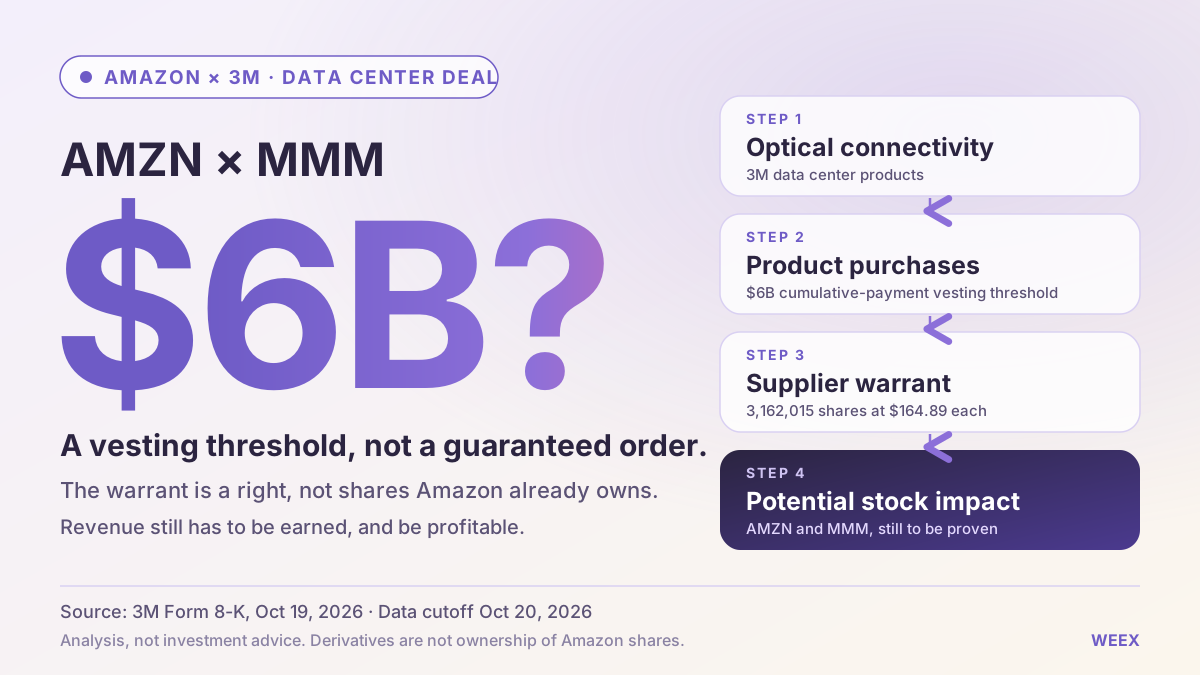
Amazon’s 3M Data Center Deal: What It Means for Amazon (AMZN) and 3M (MMM) Stock
Assess Amazon’s 3M data center deal, the $6 billion warrant threshold, potential dilution, and what the agreement could mean for AMZN and MMM stock.

NDV: Where Did the Money Go? A Review of the 16 Years of Stagflation and Wealth Erosion in the United States

XRP Ledger Bug Fixes to Be Implemented on Friday!

Ethereum: Tom Lee Links Crypto Decline to AI Concerns

Why Is Ethena (ENA) Rising? Price Recovery, USDe Growth and Token Risks

Aero Says Goodbye to ve(3,3) Economic Model After Two Delays and Merges Online

Brooklyn's 'Crypto Hunters': A Cross-National Scam Chase Across Three Time Zones

Bitcoin at $100,000 in 2026: Bitwise Remains Optimistic Despite Inflation

White House Crypto Committee: Four People Departed in 14 Months

Slow Fog Releases DarkSword Trojan Analysis Report: Public Code Weaponized, iOS Crypto Wallets Face Threats
French National Assembly Passes Tax Amendment on Stablecoin Transactions, Effective 2027

Perp DEX Generates $125 Million in Fees Monthly, Who Really Gets Rewarded?

TRON Industry Weekly Report: Stagflation May Lead BTC to Test $80,000 Support Again, Detailed Explanation of Building Chain Abstract Web3 Experience Infrastructure Newton

XRP Ledger bug-fix patch set for Oct. 23 with 29 validators support

Why You Might Be Losing Money on Papertrade?
JUST Completes 5th JST Buyback & Burn: Over 170M Tokens (~$23.53M) Burned Ahead of Major Deflationary Upgrade

SEC approves Cboe to list binary options on Coinbase and MARA metrics
唐华斑竹: GasFree Users Exceed 500,000, Making TRC 20 Token Transfers More Convenient

Stablecoins: Banks Can Curb Their Growth Through Savings

Let the Safest Assets Bear Losses First? A Counterintuitive New Approach to On-Chain Distribution

Bank of America’s Hartnett: Sell Signal Ends, Tech Stocks Return to Focus on Semiconductor Prices

Chainalysis: Tokenized US Debt Holdings in the US Account for 10.5%
Bitcoin: Between inflation and high rates, returns under pressure

Bitcoin: Mining Difficulty Reaches Highest Level in Seven Months
After StandX's Exit, Reviewing 9 Potential "Opportunities" in the Perp DEX Space

Court Blocks Stock Delisting Due to 'Procedural Violations'... Will It Apply to Coins? "It's Just Talk Until the Basic Law Comes Out"
Safe crypto storage: where is the safest place to store cryptocurrency

New whales boost Bitcoin after bear market, says Spanish analyst
Memecoins: 17 Days to Reach the Peak, One Year to Lose 95%!

Unique Wealth Discloses Approximately $10.4 Million Bitcoin Exposure
Amazon’s 3M Data Center Deal: What It Means for Amazon (AMZN) and 3M (MMM) Stock
Assess Amazon’s 3M data center deal, the $6 billion warrant threshold, potential dilution, and what the agreement could mean for AMZN and MMM stock.
NDV: Where Did the Money Go? A Review of the 16 Years of Stagflation and Wealth Erosion in the United States
XRP Ledger Bug Fixes to Be Implemented on Friday!
Ethereum: Tom Lee Links Crypto Decline to AI Concerns
Why Is Ethena (ENA) Rising? Price Recovery, USDe Growth and Token Risks
Aero Says Goodbye to ve(3,3) Economic Model After Two Delays and Merges Online


