
A Decade-Old Crypto Veteran, Zcash Is Facing a Midlife Crisis Too

 Prefer us on Google

Source: TechFlow (Shenchao)
On January 7, Zcash’s entire core development team resigned.
Not one or two people in a dispute—but the whole Electric Coin Company (ECC), around 25 people in total, including the CEO, walked out together.
ECC is the primary developer behind Zcash. Put simply, the people who write the code quit.
The market reacted immediately. ZEC fell more than 20% on the news.
A quick reminder: Zcash is almost ten years old.
It launched on October 28, 2016—earlier than many people even entered crypto. Its original selling point was “privacy transactions”: sender, receiver, and amount fully encrypted, invisible on-chain.
In reality, after nine years, less than 1% of ZEC transactions actually use the privacy feature
The remaining 99% are effectively transparent.
For nine years, usage stagnated while the team kept going. The price collapsed from over USD 3,000 at launch to around USD 15 in July 2024.
Then, at the end of 2025, ZEC suddenly took off.
From hovering around USD 40 earlier in the year, it surged to USD 744 on November 7, pushing market cap above USD 10 billion and back into the top 20.
The long-dormant “privacy coin” narrative suddenly became fashionable again.
And then—the development team left.
It reads like a midlife script: buy a Porsche, then get divorced. Get the year-end bonus, then break up.
When money is scarce, everyone is a comrade. When money arrives, the fight becomes about who decides.
So what was the fight about?
A wallet called Zashi.
Zashi is a mobile wallet launched by ECC in early 2024, designed with privacy enabled by default. It is the most important user gateway in the Zcash ecosystem.
ECC wanted to privatize Zashi, bring in external capital, and turn it into a venture-backed company that could raise funds and iterate quickly.
But ECC is not an independent for-profit company.
In 2020, ECC was placed under a nonprofit entity called Bootstrap, structured as a U.S. 501(c)(3).
In simple terms: this structure is designed for charities and public-interest organizations. The upside is tax exemption. The downside is that profits cannot be distributed internally, and asset decisions are subject to board approval.
At the time, this was done for compliance—to reduce regulatory pressure from the SEC. In the bear market, nobody cared. There was no money to fight over.
Now, the Bootstrap board said no.
Their reasoning was straightforward: as a nonprofit, they have a legal obligation to protect donor interests. Privatizing Zashi could be illegal, invite lawsuits, or trigger political backlash. They pointed to OpenAI as a cautionary example—how many lawsuits followed its attempt to move from nonprofit to for-profit.
Former ECC CEO Josh Swihart strongly disagreed.
On X, he called the board’s actions “malicious governance behavior”, saying it made it “impossible for the team to perform its duties effectively and with dignity.”
He used a legal term: “constructive discharge”—meaning you’re not formally fired, but working conditions are made untenable, effectively forcing you to leave.
In this case, 25 people were forced out together.
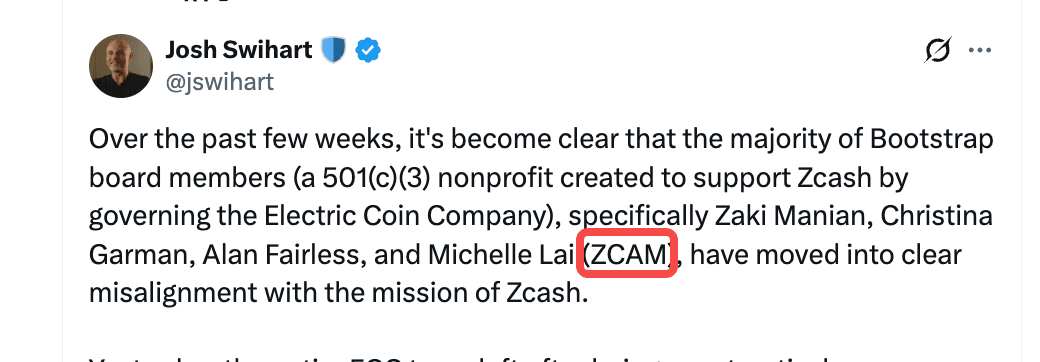
Swihart also publicly named four board members: Zaki, Christina, Alan, and Michelle—and combined their initials into “ZCAM.”
ZCAM.
It sounds a lot like “SCAM.”
Whether intentional or not is unclear.
Among them, Zaki Manian has the most controversial history.
A long-time figure in the Cosmos ecosystem, he was a core member of Tendermint before resigning in 2020 after a public conflict with founder Jae Kwon.
In 2023, the FBI informed him that two developers in a project he oversaw were North Korean agents. He allegedly knew and did not disclose this for 16 months. In October 2024, Jae Kwon publicly accused him of gross negligenceand betraying community trust.
Today, he sits on the Zcash board.
One day after the mass resignation, the former ECC team announced a new company, code-named CashZ.
They said they would use the existing Zashi codebase to launch a new wallet within weeks. Existing Zashi users would be able to migrate seamlessly.
“We are still the same team, with the same mission: to build unstoppable private money.”
No new token. No fork. Just changing the shell and continuing the work.
The most ironic part of this story is the timing.
When ZEC was USD 15, nobody cared who controlled the wallet.
When it hit USD 500, the value of Zashi suddenly became existential.
Money clarifies relationships.
The same nonprofit-versus-startup tension played out very differently elsewhere. At OpenAI, the board lost. At Zcash, the team left.
Who “won” is unclear—but the conflict itself is common across crypto.
On the CashZ website, Swihart wrote why they left:
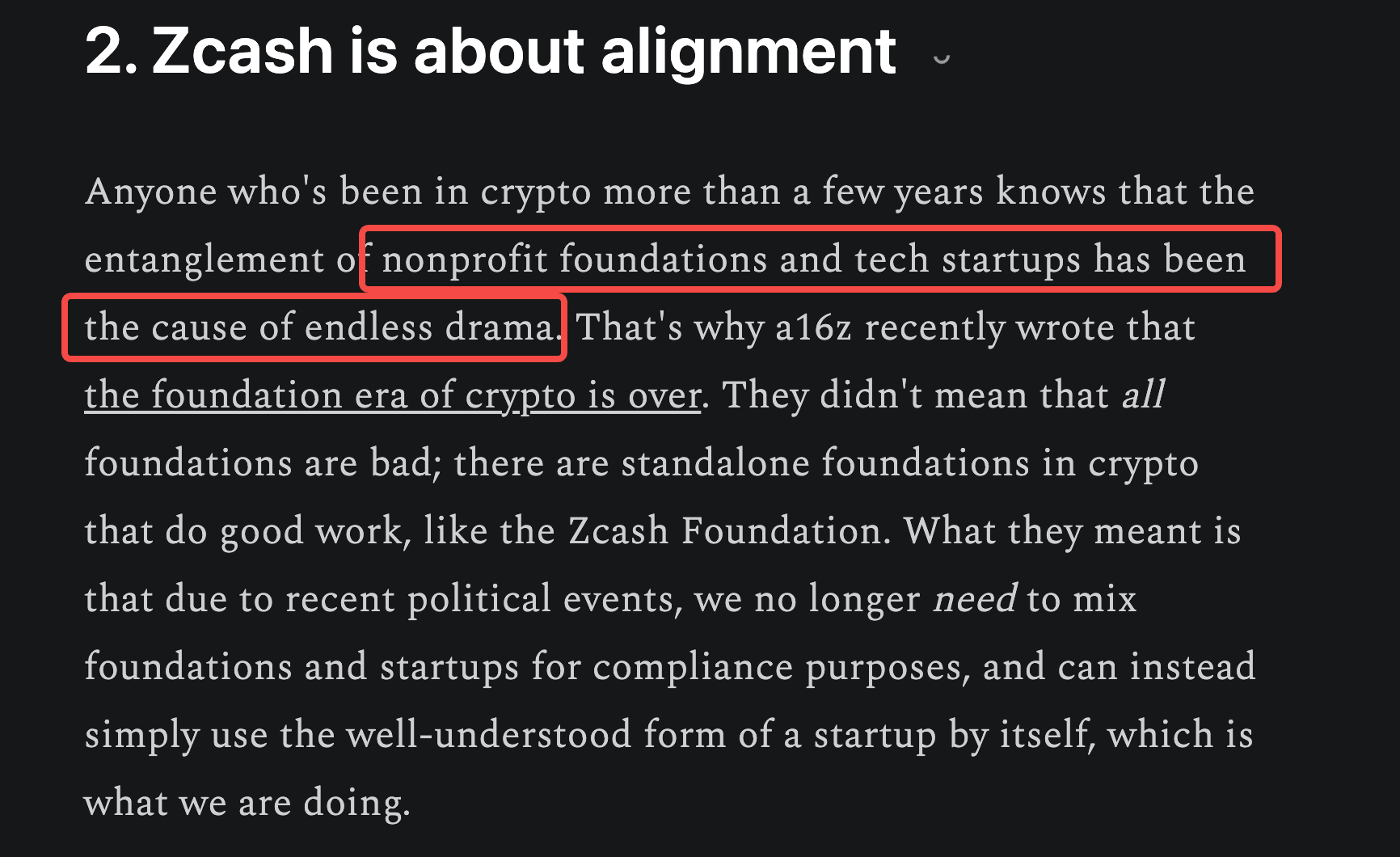
“The nonprofit foundation model is a relic of crypto’s compliance era. Back then, projects needed a ‘regulatory buffer’ to protect themselves. But those buffers bring bureaucracy and strategic deadlock. Startups can scale quickly. Nonprofits cannot.”
He added:
“Anyone who has spent time in crypto knows this: the entanglement between nonprofit foundations and tech startups is an endless source of drama.”
Endless drama indeed.
In 2023, when Zooko stepped down as CEO, rumors already circulated of disagreements with Swihart. In January 2025, Peter Van Valkenburgh, a board member of the Zcash Foundation, also resigned.
After ten years, most of the original figures are gone.
Someone asked on X: Will Zcash die?
The chain is still running.
The code still exists.
Only the people writing it have changed.
But Swihart is likely right: the tension between nonprofits and startups is a structural flaw in crypto governance. Cosmos fought over it. Ethereum fought over it. Solana fought over it too.
The difference is only in intensity and outcome.
Zcash chose the cleanest option of all.
Break up.
-- Price
This content is provided for general informational purposes only and doesn't constitute financial, investment, legal, or tax advice. Any events, rewards, online promotions, or related information mentioned herein should not be considered a recommendation, solicitation, or invitation to purchase, sell, trade, or otherwise deal in any crypto assets. Crypto assets are highly volatile and may result in loss. The availability of WEEX services, products, and related events may vary by region. You are responsible for ensuring that your participation is in accordance with applicable local laws and regulations.
You may also like

Critical Patch for Decred: Those Who Don't Update Risk a Network Fork

Cypherpunk Technologies launches Zcash mining fleet with 33.33 million Winklevoss deal

Zcash Reports $37.8 Million Loss, Winklevoss Turns to Cancer Treatment

Cypherpunk Reports Q2 Net Profit of $39.4 Million
Zcash Community Releases NU7 Development Direction Voting Proposal

Fortitude Mining acquires 12.5 MW facility in Nebraska for net 4.7 million
JetCash Moves 117.6 Billion Won to Ironwood

Zcash Gains 33.1%, Plans for Quantum Resistance

Zcash to Launch Ironwood Update on July 28
Zcash Launches Zakura Node, Aiming to Process 50,000 Transactions Per Second

Placeholder Partner Claims Bitcoin and ZEC Will Reward Patient Investors

NEAR Protocol launches Confidential Intents, supporting developers to integrate confidential execution features

NEAR Protocol Launches Confidential Intents to Support Confidential Execution Features
Data: Garret Jin increased his ZEC position to 14.9 million USD, with a floating loss of 16.38 million on his BTC long position

Data: A certain whale bought 9,663 ZEC on HyperLiquid and withdrew it, amounting to approximately 4.02 million USD

Data: A certain whale deposited 10.12 million USDC into HyperLiquid to open a ZEC long position with 1x leverage
"1011 Insider Whale" closed ZEC and UNI long positions, while BTC long position still has an unrealized loss of over 16.65 million USD

Insider whale Garret Jin lost 5.08 million dollars today, with unrealized losses on BTC long positions reaching 17.2 million dollars

Data: Garret Jin liquidated 184,102 HYPE, making a profit of 2.83 million dollars, while BTC longs are still at a loss of over 10 million

Data: A certain whale deposited 5.5 million dollars into HyperLiquid and opened a 10x HYPE and 3x ZEC long position
Data: Garrett Jin has increased his ZEC long position to over 46,000 coins, with an unrealized loss exceeding 950,000 USD

Garrett Jin has turned to long ZEC, with a position size of 11.9 million USD and an unrealized loss of 812,000 USD
Data: Garrett Jin closed ZEC short position, profiting 11.24 million dollars
Arthur Hayes: Has liquidated WLD

Dragonfly Partners: The Zcash vulnerability incident has been overinterpreted by the market, and most holders will not be affected

Arthur Hayes liquidated all ZEC holdings due to the Orchard Pool vulnerability
Data: "1011 Insider Whale" BTC long position unrealized loss exceeds 17 million USD, ZEC short position unrealized profit exceeds 13.5 million USD
Data: The total network ZEC contract trading saw a liquidation of 107 million USD in 24 hours, with open positions dropping by over 38%
THORChain: Due to the recent disclosure of vulnerabilities in Zcash, the launch time for ZEC will be postponed
Dragonfly partner Haseeb: Even though the Zcash vulnerability has been exploited, the losses are mainly borne by the privacy pool holders
Critical Patch for Decred: Those Who Don't Update Risk a Network Fork
Cypherpunk Technologies launches Zcash mining fleet with 33.33 million Winklevoss deal
Zcash Reports $37.8 Million Loss, Winklevoss Turns to Cancer Treatment
Cypherpunk Reports Q2 Net Profit of $39.4 Million
Zcash Community Releases NU7 Development Direction Voting Proposal
Fortitude Mining acquires 12.5 MW facility in Nebraska for net 4.7 million

Contents
Latest articles


Latest coin listings on WEEX


