
WEEX API Trading Cost: The Full Fee Stack, Not Just Maker-Taker

 Prefer us on Google

Most cost comparisons for automated trading stop at one line: 0.02% maker, 0.08% taker. That number is accurate for WEEX futures, and it is also the smallest part of what a running bot actually pays. WEEX API trading cost is a stack — explicit commission, funding settled three times a day, slippage on every crossed order, and a request budget that quietly caps how tightly you can quote. Strategies die in the gap between the published rate and the realized one.
This piece prices each layer, with the arithmetic shown, so you can decide whether an edge survives contact with the fee schedule.
What Does WEEX API Trading Cost?
Nothing extra. WEEX charges the same maker-taker rates whether an order arrives from the web terminal or from a REST call, and there is no subscription, seat fee, or data charge for API access itself. Your cost is the standard trading fee schedule plus what your execution style does to it.
Here is the published schedule as of July 29, 2026, per WEEX's fee-calculation guide and support documentation:
| Cost line | Rate | Notes |
|---|---|---|
| Futures maker | 0.02% | Charged on notional, not margin |
| Futures taker | 0.08% | Market, IOC and FOK orders always count as taker |
| Futures maker/taker at max discount | 0.006% / 0.024% | Up to 70% off via VIP tier and WXT holdings |
| Spot maker / taker | 0% / 0.10% | 2026 schedule; see the caveat below |
| API access | Free | REST and WebSocket, public and private endpoints |
| Deposits | Free | — |
| Withdrawals | Network-dependent | No fixed rate; varies by chain congestion |
Two mechanics matter more than the numbers. First, futures fees are charged only when you open, close, or reduce a position — unfilled and canceled orders cost nothing, which is why a quoting strategy can churn thousands of orders a day at zero commission. Second, the fee is computed on position value and is unrelated to leverage, using the formula entry price × contract value × quantity × rate. WEEX's spot and futures fee calculation guide sets this out in full.
One caveat worth knowing before you hardcode anything: WEEX's 2026 spot schedule lists 0% maker and 0.10% taker, while the older fee-calculation guide (published March 2025) still shows 0.1% on both sides. Rates change and documentation lags. Read your live tier from the account fee-rate page at runtime rather than baking a constant into the strategy.
Why Fees Hit Harder at 20x Leverage
Because the fee is a percentage of notional and your capital at risk is margin, leverage multiplies the fee's bite on your account — even though it doesn't change the fee itself.
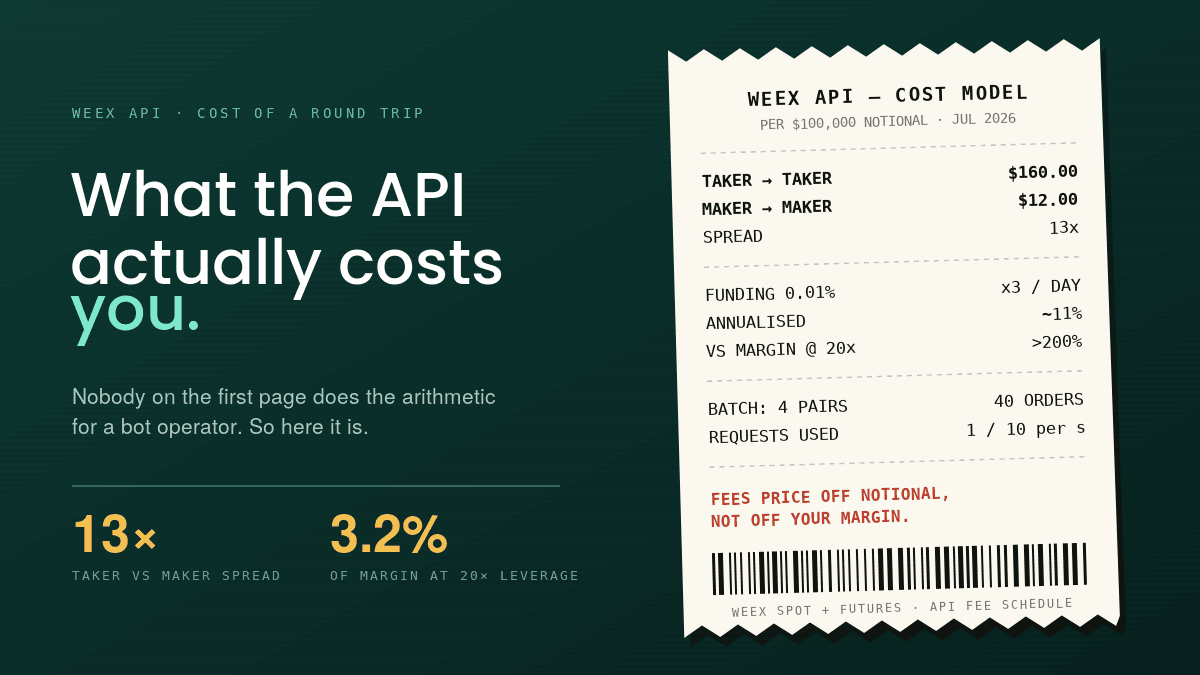
Take $5,000 of margin at 20x. That controls $100,000 notional. A taker-in, taker-out round trip costs 0.16% of $100,000, or $160 — which is 3.2% of your margin, gone before the position has moved a tick. Run that twenty times a day and the strategy needs to earn 64% on margin daily just to break even on commission.
This is the arithmetic that separates a backtest from a live account, and it is why execution style, not the headline rate, is the real variable:
| Execution style | Round-trip rate | Cost per $100k notional | With 70% discount |
|---|---|---|---|
| Taker in, taker out | 0.16% | $160 | $48 |
| Maker in, taker out | 0.10% | $100 | $30 |
| Maker in, maker out | 0.04% | $40 | $12 |
A bot that turns over $1 million of notional a day pays roughly $1,600 daily as a pure taker at base rates — about $584,000 a year. The same turnover, quoted passively at a full VIP discount, costs around $120 a day. That 13x spread is a design decision, not a pricing one.
Funding Is the Cost Most Bots Forget
Funding on WEEX perpetuals settles every eight hours, at 00:00, 08:00 and 16:00 UTC. It is not a fee — it is a payment between longs and shorts — but it lands in your P&L exactly like one, and for any strategy that holds through a settlement it usually dominates commission.
The scale is easy to underestimate. A modest 0.01% funding rate paid three times a day is 0.03% daily, roughly 11% annualized on notional. At 20x leverage that is over 200% a year against margin. Directional bots that happen to sit on the crowded side of the book can bleed out on funding alone while their entry logic looks fine.
Two practical consequences for anyone modeling WEEX API trading cost: pull the funding rate from the market endpoints and treat it as a live input to position sizing, not a footnote; and if a strategy has no view on carry, consider flattening ahead of settlement rather than paying for a directional exposure you never intended to hold.
-- Price
Slippage and Rate Limits: The Unpriced WEEX API Costs
Slippage is the cost line no fee schedule will ever show you. Every taker order walks the book, and the difference between the mid at decision time and your volume-weighted fill is a real expense — frequently larger than the 0.08% commission on thin pairs or during volatility. Log it. A bot that records intended price, fill price and timestamp on every order can compute realized slippage per pair and per hour, and that number belongs in the strategy's cost model next to the commission.
Rate limits are the other unpriced constraint. WEEX's API access restrictions set a default of 10 requests per second, keyed to the API key for authenticated calls and to the IP for public ones, with a 429 returned on breach. Individual endpoints may specify their own limits.
That budget is tighter than it looks for a market maker refreshing quotes across several pairs — until you use batching. WEEX counts a batch order covering four trading pairs with ten orders each as a single request. Rewriting a naive one-order-per-call loop into batch submissions is the highest-leverage optimization most WEEX API integrations have available, and it costs nothing but engineering time.
Handle the failure mode properly too. Exponential backoff on 429s, reconnect logic with sequence-gap detection on WebSocket drops, and idempotent order submission are not polish — a throttled bot that keeps hammering the endpoint during a volatility spike is one that ends up long into a move it meant to fade.
Cutting WEEX API Trading Costs: What Actually Moves the Number
Ranked by how much they change the annual bill:
- Shift from taker to maker. Going from 0.08% to 0.02% on both legs cuts commission by 75%. Use
Maker Only(post-only) so an order that would cross gets rejected rather than silently filling as a taker — a limit order alone does not guarantee maker treatment, and GTC orders can execute either way. - Claim the VIP and WXT discount. Up to 70% off futures fees stacks on top of whatever execution style you run. On a taker-heavy strategy this is the difference between 0.16% and 0.048% per round trip.
- Batch your requests. Four pairs × ten orders per call collapses forty requests into one, freeing headroom under the 10 req/s ceiling to quote more tightly.
- Price funding into position sizing. For anything holding overnight, this line is usually larger than commission.
- Measure slippage per pair. The cheapest fee tier on an illiquid book is still an expensive place to trade size.
Worth noting what does not help: leverage. Because fees are computed on position value, raising leverage does not reduce commission — it only shrinks the margin base the same dollar cost is measured against.
How to Set Up a WEEX API Key Without Adding Risk
Cost and security overlap more than people expect: a compromised key is the most expensive line item there is. WEEX's API key preparation guide documents the controls.
Each account can create up to 10 API key groups, each configurable with Read and/or Trade permissions. New keys default to read-only, so trading permission is an explicit opt-in. Every key issues three credentials — APIKey, SecretKey and a user-defined Passphrase — and the Passphrase cannot be recovered if lost; you have to create a new key.
The controls worth using from day one: bind keys to specific IP addresses, keep separate keys for development and production, scope each to the minimum permission it needs, and rotate on a schedule. WEEX's own documentation flags unrestricted keys with no IP binding as a security risk, and that assessment is correct.
For testing, the futures API includes a Demo Mode, which lets you validate order-lifecycle handling — partial fills, cancel/replace, error codes — without paying live commission or slippage to learn what your error handling does under stress. WEEX's broader API trading overview covers the REST and WebSocket split in more detail.
The Bottom Line on WEEX API Trading Cost
WEEX's published rates are competitive — 0.02% maker and 0.08% taker on futures sit at or below most major venues, and free API access with no data charges removes a fixed cost that some platforms still levy. But the published rate is the input, not the answer. Whether a strategy is viable on WEEX depends on the round-trip cost your execution style produces, the funding you pay to hold, the slippage your order sizing creates, and whether your request budget lets you quote where you want to quote.
Model all four before you size up. Pull your live fee tier and the current funding rate from the API rather than from an article — including this one — and run the numbers against your actual turnover.
FAQ
1. Does WEEX charge extra for API trading?
No. API access is free, and orders submitted through REST or WebSocket pay the same maker-taker rates as orders placed in the web or mobile terminal. There is no subscription or market-data fee.
2. What is the WEEX API rate limit?
The documented default is 10 requests per second, applied per API key for authenticated endpoints and per IP address for public ones. Exceeding it returns HTTP 429. Some endpoints define their own limits, and a batch order covering four pairs with ten orders each counts as one request.
3. Do WEEX futures fees increase with leverage?
No. Fees are calculated on position value, so leverage does not change the dollar commission. It does change what that commission represents as a share of your margin — at 20x, a 0.16% round trip equals 3.2% of margin.
4. How much can WXT and VIP status reduce WEEX API trading cost?
Up to 70% off futures trading fees, depending on VIP level and WXT holdings. At the full discount, the 0.02% maker rate works out to 0.006% and the 0.08% taker rate to 0.024%.
5. Are unfilled or canceled API orders charged?
No. WEEX futures fees are incurred only when a position is opened, closed, or reduced. Orders that never fill, and orders you cancel, cost nothing — which is what makes passive quoting strategies viable on the venue.
Risk Warning
Crypto assets are highly volatile and trading them may result in partial or total loss of capital. Automated trading concentrates that risk: a leveraged position opened by a bot can be liquidated in minutes, and a logic error, stale order book read, or unhandled rate-limit rejection can accumulate losses far faster than manual trading. API keys carry custody risk — a leaked SecretKey with trade permission and no IP binding can be used to drain an account through adverse trades. Perpetual futures also carry funding risk, where holding the crowded side of the market imposes a recurring cost independent of price direction, and liquidity risk, where slippage on thin pairs exceeds any commission saving. Fee schedules, discount tiers, and rate limits described here are current as of July 29, 2026 and may change; verify live figures in your account before trading. Nothing here is investment advice.
This content is provided for general informational purposes only and doesn't constitute financial, investment, legal, or tax advice. Any events, rewards, online promotions, or related information mentioned herein should not be considered a recommendation, solicitation, or invitation to purchase, sell, trade, or otherwise deal in any crypto assets. Crypto assets are highly volatile and may result in loss. The availability of WEEX services, products, and related events may vary by region. You are responsible for ensuring that your participation is in accordance with applicable local laws and regulations.
You may also like
Common P2P Crypto Scams and How to Spot Them
How to Choose a P2P Crypto Merchant on WEEX
How to File a WEEX P2P Appeal: Evidence and Video Requirements
Is WEEX P2P Crypto Trading Safe? Risks and Checks Before You Trade
P2P vs. Spot Trading: Which Does What?
How to Buy USDT with EUR via SEPA Bank Transfer on WEEX
How to Buy Crypto in Europe with EUR on WEEX OTC
How to Buy Crypto in Vietnam with VND on WEEX OTC
How to Buy USDT in Brazil with BRL via PIX on WEEX OTC
How to Buy Bitcoin in Brazil with BRL on WEEX OTC
How to Buy Crypto in Australia with AUD on WEEX
How to Buy Bitcoin in Australia with Apple Pay, Google Pay or Card
How to Buy Crypto in India with INR via UPI on WEEX
How to Buy Crypto in Japan with JPY on WEEX OTC

TOKEN2049 Dubai 2026 Postponed: Singapore or Dubai 2027?
Crypto Events Singapore 2026: Is TOKEN2049 Worth Attending?

How to Use an AI Agent for Trading in the WEEX AI Wars II Hackathon
What Is the WEEX AI Wars II Hackathon? AI vs Human Trading Explained

WEEX Promo Code and Sign-Up Bonus: What You Need to Know

WEEX Welcome Bonus Explained: How New User Rewards Work
WEEX Affiliate Program: How to Join and Track Commission

How to Get WEEX Referral Commission: Rules and Tracking
What Is Proof of Reserves (PoR)? How WEEX Ensures Transparency and User Fund Safety
WEEX Proof of Reserves: Building Unshakable Trust in a Volatile Crypto World

Common P2P Crypto Scams and How to Spot Them
How to Choose a P2P Crypto Merchant on WEEX
How to File a WEEX P2P Appeal: Evidence and Video Requirements
Is WEEX P2P Crypto Trading Safe? Risks and Checks Before You Trade
P2P vs. Spot Trading: Which Does What?
How to Buy USDT with EUR via SEPA Bank Transfer on WEEX


