
Crypto News API for AI Agents: What the WEEX Endpoints Return

 Prefer us on Google

Most crypto news APIs are sold as sentiment engines. They return an article plus a number — a polarity score, a bullish/bearish flag — and let you treat that number as an input to a position. WEEX built the opposite thing. The WEEX News API went live in July 2026 as a structured content feed: articles, metadata, coin mappings, publication timestamps. No sentiment field. No score. No signal.
That distinction matters more than it sounds, and it is the first thing to understand before you wire any crypto news API into an automated system.
What a crypto news API actually returns
A crypto news API is a programmatic feed of published articles and their metadata. You send a GET request with filters — section, coin, date range, language — and you get JSON back: titles, summaries, source links, timestamps, tags, and the coins each item references.
What you do with that is your problem. The API does not tell you the article is good news. It tells you the article exists, when it was published, and which asset it concerns.
The WEEX implementation runs at https://api-spot.weex.com and exposes four content endpoints. Three are open; one is gated.
| Endpoint | Path | What it returns | Access |
|---|---|---|---|
| Get Article List | /api/v3/content/articles/list | Paginated content list, no bodies | Open |
| Get Article List by Coin | /api/v3/content/articles/listByCoin | Same list, filtered by coin symbol or slug | Open |
| Get Article Detail | /api/v3/content/articles/detail | Full HTML body plus articleUrl | Allowlisted UIDs only |
| Get Latest Banner | /api/v3/content/banners/latest | Latest published banner by type | Open |
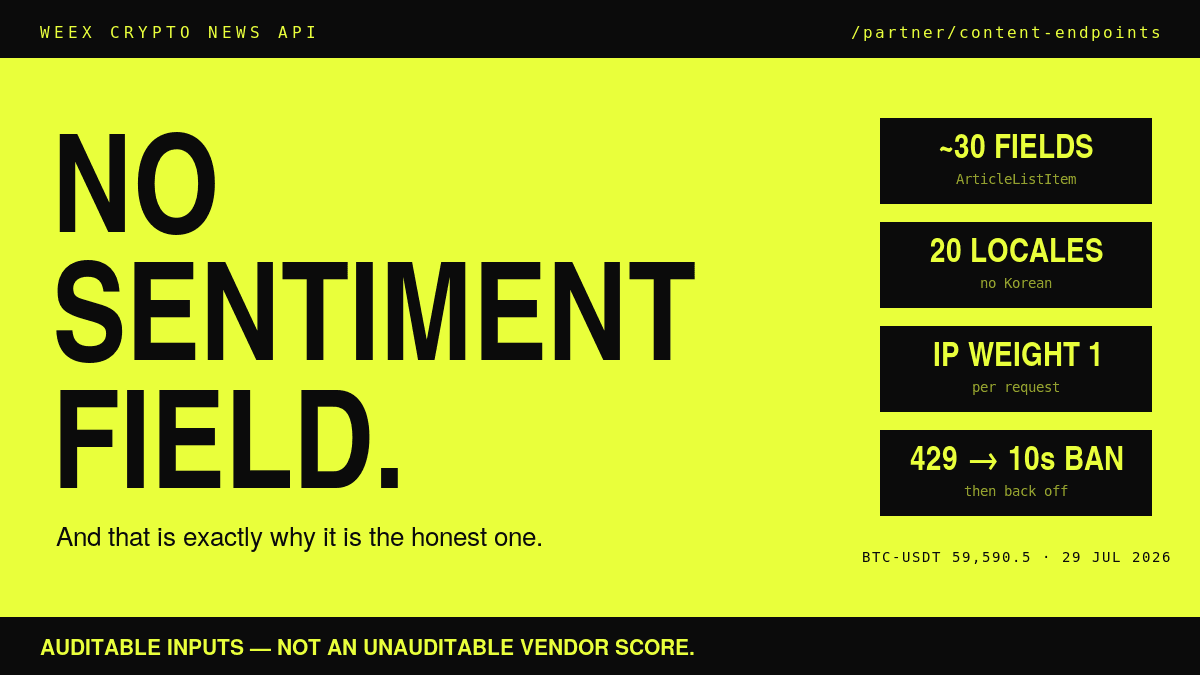
Each carries an IP weight of 1, which is as cheap as WEEX endpoints get. Response headers return X-USED-WEIGHT-1M and X-REMAINING-WEIGHT-1M so you can budget against the limit rather than discover it. Exceed it and you get a 429 plus a 10-second ban — short, but long enough to blow a latency-sensitive loop if you are not backing off. The full rules sit in the WEEX access restrictions documentation.
Why news data is not a trading signal
This is the line most vendors blur, and blurring it is a real risk for anyone shipping an agent to users.
A sentiment score is a derived opinion. When a provider hands you sentiment: 0.82 and your bot goes long on it, you have outsourced a judgment call to a model you cannot audit, trained on a corpus you cannot see, on a scoring scale nobody publishes. If the score is wrong, you still own the fill.
WEEX News API returns none of that. Scan the documented ArticleListItem schema — roughly 30 fields covering IDs, section, title, summary, category, source site, original source URL, publication timestamps, tags, and coin maps — and there is no sentiment, confidence, or recommendation field anywhere in it. The feed gives your model raw material. Your model does the interpretation, and your team owns the logic.
For anyone operating under a compliance review, that separation is easier to defend than "our vendor's black box said buy."
Inside the WEEX News API: four sections, one call
The most useful design choice here is that section is a parameter rather than a separate product. One endpoint, four content types:
section value | Content type | Typical use |
|---|---|---|
news | Market news and news flash | Real-time event monitoring |
wiki | Token explainers, price outlooks | Asset context and enrichment |
learn | Educational content, tiered by level | In-app onboarding, tutorials |
questions | Q&A entries | FAQ surfaces, retrieval augmentation |
news gets extra controls the other sections do not: category and categoryFilter (mutually exclusive — filter in or filter out, never both) and prioritySort for editorially weighted ordering. learn gets level filtering across Beginner, Intermediate, and Advanced. All four support withCount, pagination up to 200 items per page (default 25), and three optional expansions: populateThumbnail, populateTagLists, and populateCoins.
Leave the expansions off by default and they return null. That is deliberate — you pay for the joins you ask for.
The locale header is the underrated part. Twenty locales are supported, from en_US and zh_TW through ar_AR, fa_IR, vi_VN, and pt_BR. If you are building an agent for a non-English market, you are not stuck translating an English feed at inference time and hoping the ticker survives the round trip.
-- Price
How to pull coin-specific news with a time window
listByCoin is where event-driven work actually starts. You pass symbol (for example BTC) or slug (btc), plus startEnableDate and endEnableDate as Unix timestamps in seconds or milliseconds. Both bounds are inclusive. Omit the upper bound and results stop at the current time.
curl "https://api-spot.weex.com/api/v3/content/articles/listByCoin?section=news&symbol=BTC&startEnableDate=1785283200000&page=1&pageSize=50&withCount=true&populateCoins=true" \
  -H "locale: en_US"
Two things make this practical rather than decorative.
First, populateCoins=true returns a coinsMaps array with slug, symbol, name, icon, type, and locale per referenced asset. That is a resolved entity, not a string match — the difference between correctly tagging an article about Ondo and mis-tagging every article containing the word "ondo."
Second, because the window is explicit and bounded, you can replay a historical period against the same endpoint you run live. Aligning a news window to a price window is where most event-study code breaks; here the timestamps are all UTC milliseconds on both sides. On WEEX, BTC-USDT perpetuals were quoted around 59,590.5 on 29 July 2026, and pairing that price series with a listByCoin pull over the same interval is a two-timestamp join, not a data-engineering project.
Article bodies are not in list responses, by design. If you need full text, detail returns an HTML body plus a server-generated articleUrl — but it is restricted to allowlisted UIDs, so you need to go through WEEX BD first. Budget for that in your timeline.
What to check before you commit to a crypto news API
Vendor comparison pages grade on source count and price. Neither predicts whether the integration survives contact with production. These do:
| Check | Question to ask | Why it bites |
|---|---|---|
| Signal separation | Does the feed return scores or facts? | Opaque scores are undefendable in review |
| Entity resolution | Are coins returned as structured objects or inferred from text? | String matching produces false tags at scale |
| Time semantics | Which timestamp is authoritative — publish, enable, or update? | Backtests silently misalign otherwise |
| Rate limit shape | Weight-per-IP or calls-per-key? Ban duration? | Determines your retry and fan-out design |
| Locale coverage | Native localized content or machine translation? | Translated tickers and entity names corrupt parsing |
| Access tiers | Which endpoints need an allowlist? | Discovering this at launch costs weeks |
WEEX publishes an answer for every row above. Note that its schema exposes four separate time fields — enabledDate, publishedAt, createdAt, updatedAt — which is more precision than most feeds give you and, handled carelessly, more ways to be wrong. Pick one as canonical for your pipeline and document the choice.
Where teams get burned
The failure modes are boring and repeatable.
Deduplication is the first. News aggregation means the same event arrives under several IDs from several source sites. The outerId and originalSourceUrl fields exist precisely so you can collapse them — use them, or your agent will read one headline as four independent confirmations and size up accordingly.
The second is treating headline arrival as tradeable timing. By the time an item is enabled in any content system, market makers have usually repriced. News data is far better used as state — regime context, risk-off flags, position vetoes — than as an entry trigger. A rule that says "do not open new leverage in this asset for 30 minutes after a regulatory item lands" tends to survive live trading better than one that fires into the print.
Third: rate-limit design. A 10-second ban is trivial in isolation and expensive if it lands mid-rebalance across a fan-out of coin queries. Read the weight headers on every response and throttle before you hit the wall.
Getting started
The WEEX News API is a structured crypto news API for teams that want to own their own inference. It ships article metadata, resolved coin entities, four content sections, and twenty locales through a REST interface with a documented weight budget — and it stays out of the business of telling you what to trade.
If you are building an AI agent, a quant research pipeline, or a market-context layer for your own product, start with the Get Article List reference and the Get Article List by Coin reference, then create a key from the WEEX API portal. The list endpoints are open; plan ahead for allowlist approval if you need full article bodies.
FAQ
1. Is the WEEX News API a trading signal service?
No. It returns published content and its metadata — titles, summaries, sources, timestamps, tags, and coin mappings. There is no sentiment score, confidence value, or recommendation field in the response schema. Any interpretation is built by you.
2. What does the crypto news API cost in rate limit terms?
Each content endpoint carries an IP weight of 1. Limits are enforced per IP rather than per API key, exceeding them returns HTTP 429, and repeated violations trigger a 10-second ban. Every response includes used and remaining weight headers.
3. Can I get the full article text?
Only through the detail endpoint, which returns an HTML body and an articleUrl. Access is restricted to allowlisted UIDs, so you need to request it through WEEX BD. List endpoints never include bodies.
4. Which languages does the feed support?
Twenty locales via the locale request header, including English, Simplified and Traditional Chinese, Japanese, Arabic, Persian, Azerbaijani, Vietnamese, Indonesian, Russian, Ukrainian, Polish, Italian, German, French, and several Spanish and Portuguese variants. Default is en_US.
5. How do I pull news for one coin over a specific date range?
Call listByCoin with section=news, a symbol or slug, and startEnableDate / endEnableDate as Unix timestamps in seconds or milliseconds. Both bounds are inclusive; omitting the end bound caps results at the current time.
6. How is this different from a general crypto news API?
Most general feeds bundle derived sentiment and stop at English. This one exposes exchange-native structured content across four sections, resolves coins into typed objects rather than text matches, and returns no derived judgment at all.
Risk Warning
Crypto assets are volatile and trading them can result in partial or total loss of capital. A crypto news API supplies information only — it is not investment advice, not a trading signal, and not a prediction of price. Automated systems built on news data carry their own failure modes: feed latency and outages can leave a strategy acting on stale state, duplicate items can be misread as independent confirmation, and rate limiting or API downtime can interrupt a running position at the worst moment. Leverage magnifies all of these. Test any integration against historical data, build explicit fallbacks for missing or delayed content, size positions on your own risk framework rather than on any single data input, and never deploy capital you cannot afford to lose.
This content is provided for general informational purposes only and doesn't constitute financial, investment, legal, or tax advice. Any events, rewards, online promotions, or related information mentioned herein should not be considered a recommendation, solicitation, or invitation to purchase, sell, trade, or otherwise deal in any crypto assets. Crypto assets are highly volatile and may result in loss. The availability of WEEX services, products, and related events may vary by region. You are responsible for ensuring that your participation is in accordance with applicable local laws and regulations.
You may also like
How to Day Trade Crypto for Beginners: The Math Behind One Trade
Trading Psychology for Beginners: Crypto Traps and Hard Rules
What Is a Bitcoin ETF? How Creation, Custody and Fees Work

What Is Blockchain and How Does It Work? One Transaction, Traced
WEEX Convert Fees: What Zero-Fee Conversion Really Costs You
WEEX Convert Quote: How the 8-Second Price Lock Really Works
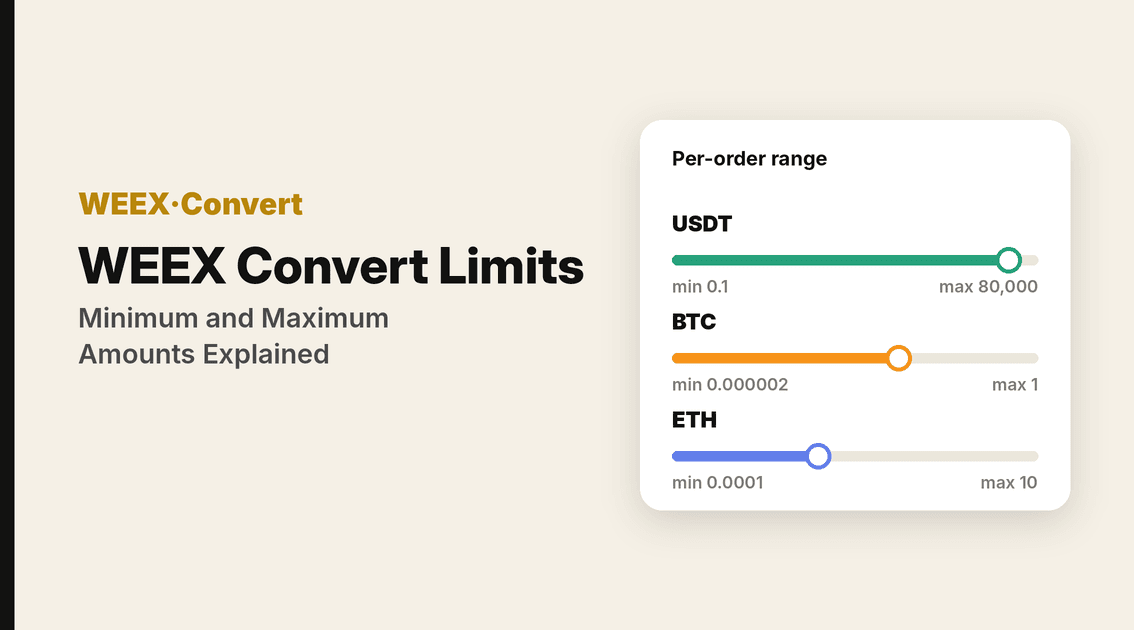
WEEX Convert Limits: Minimum and Maximum Amounts Explained
How to Check a WEEX Convert Order: History, Rate and Status

USDC Significant EMT Status in the EU: What Changes on November 12 Under MiCA
Walrus (WAL) Jumps 30%: Sui Storage Token Rallies on AI Data
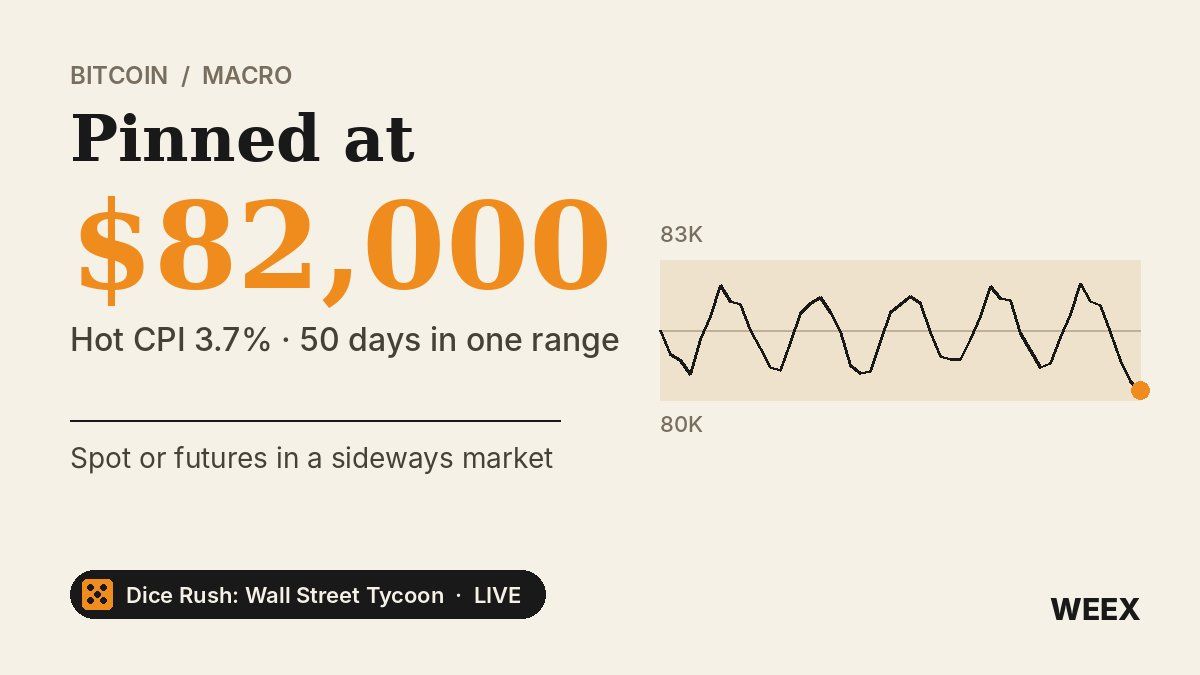
Bitcoin Price After Hot CPI: Why BTC Is Pinned Near $82,000
What Is a Limit Order? How It Works and When to Use It

Best Crypto Miner for Beginners: What to Check on Cost, Power, Hashprice and Profit Before You Buy

Limit Order vs Market Order: Which One to Use When Trading Crypto
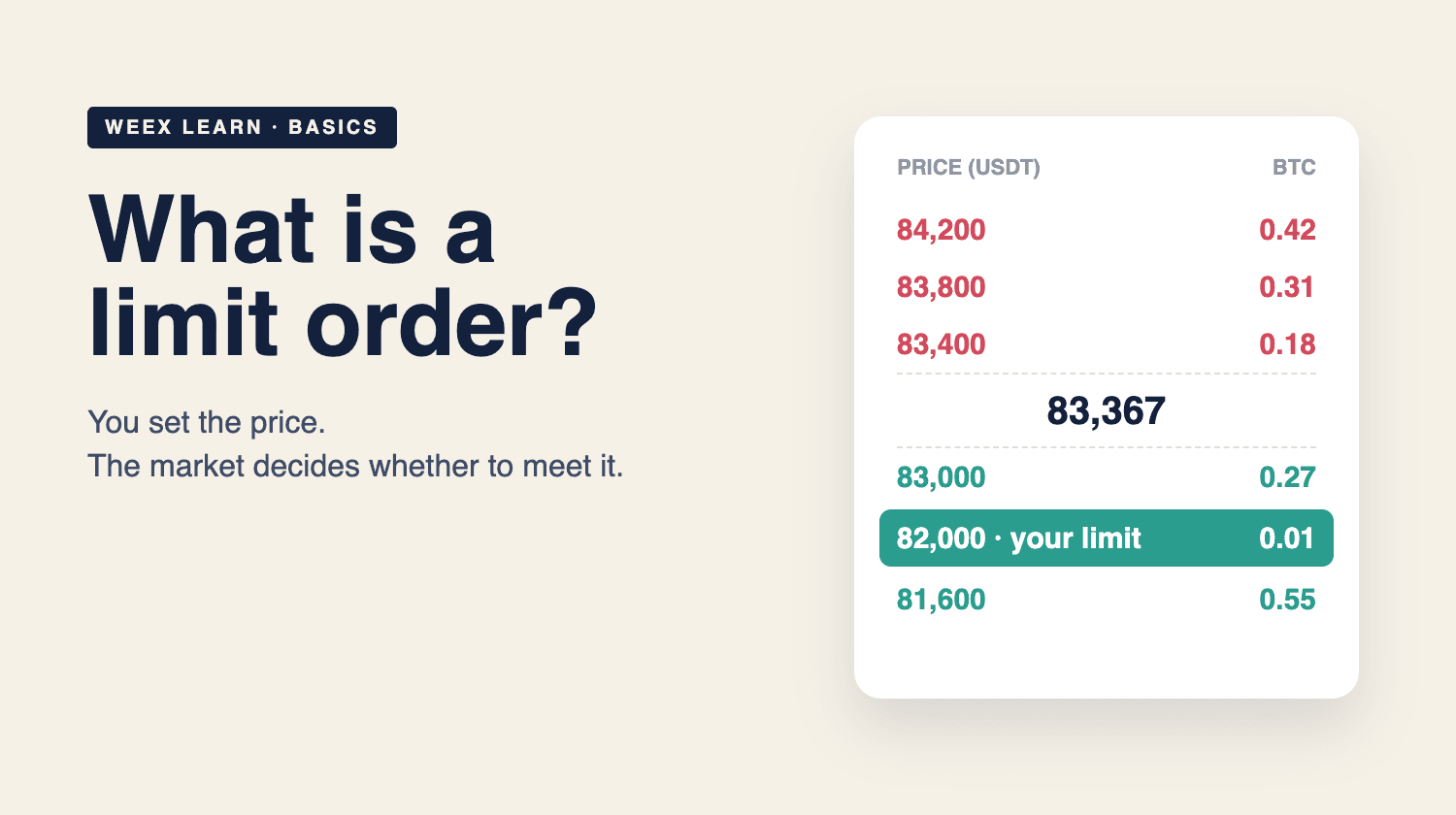
What Is a Limit Order? How It Works in Crypto With BTC Examples
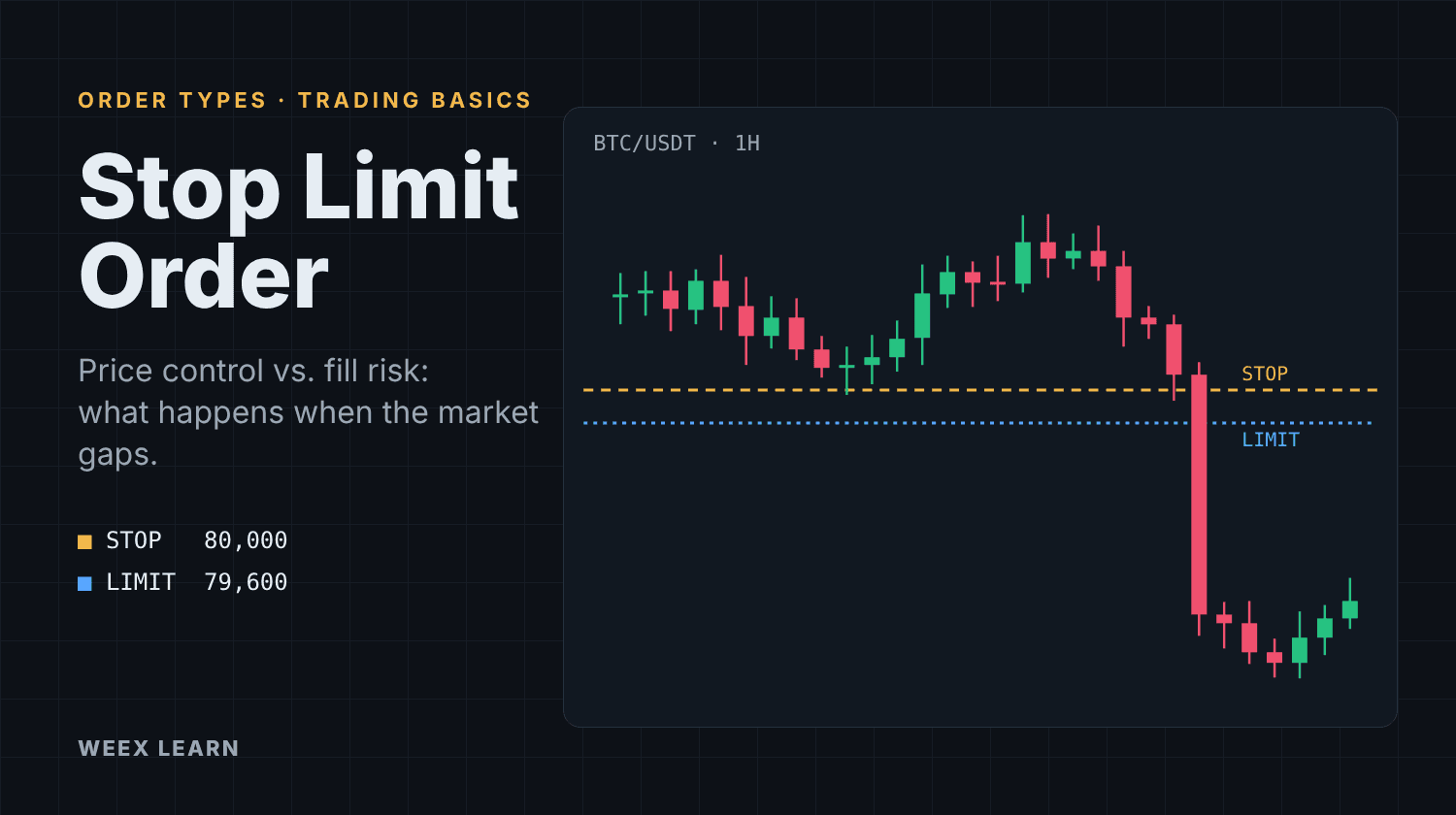
Stop Limit Order: How It Works and Why It Can Fail to Fill
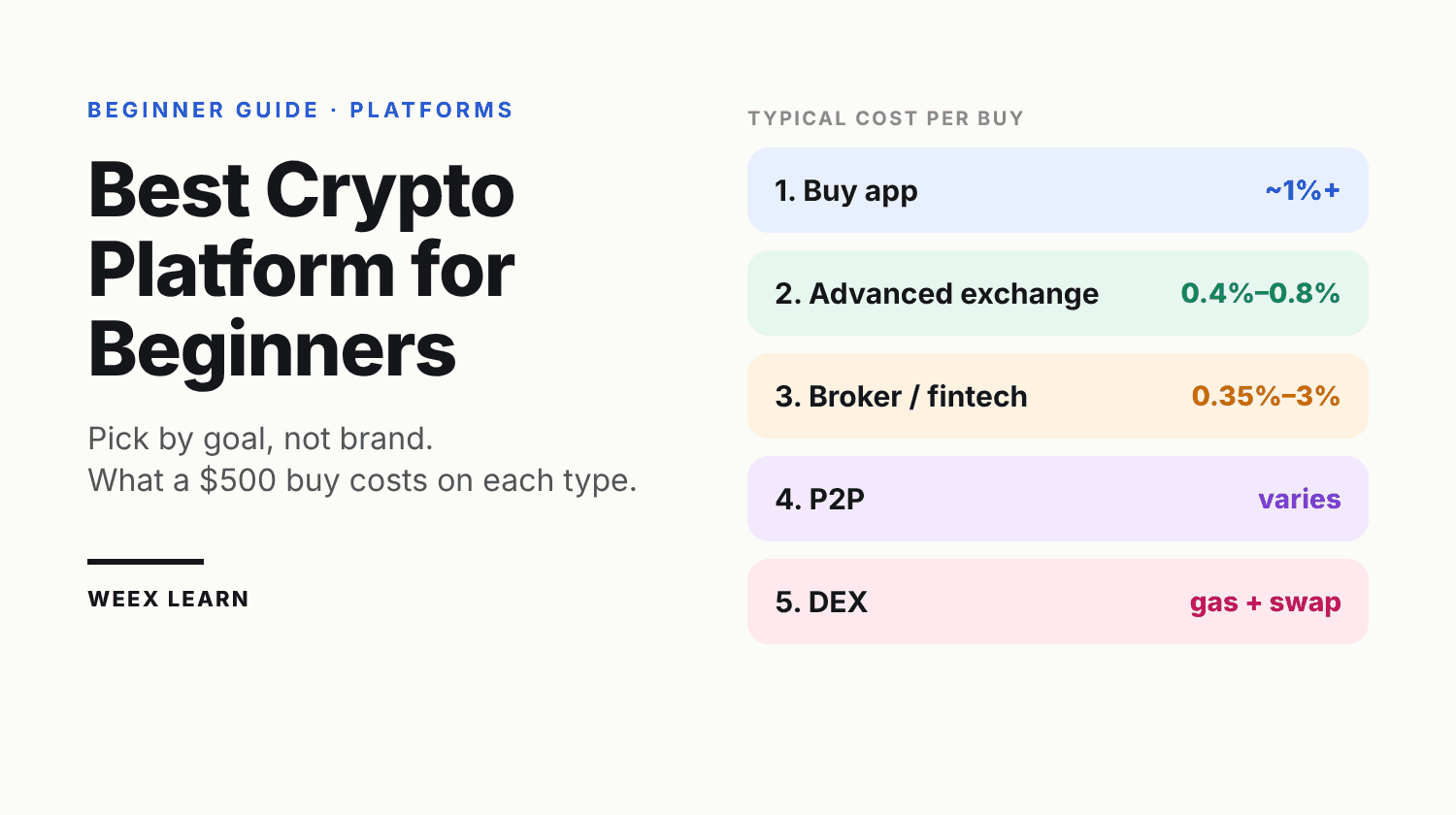
Best Crypto Platform for Beginners: Pick by Goal, Not Brand

Best Crypto Podcasts for Beginners: A 4-Week Listening Plan

How to Buy Crypto Anonymously: 5 Methods, Real Costs and Limits

Will Bitcoin Break $87,000 This Week? CPI, Fed Speakers and ETF Outflows to Watch

Conflux (CFX) Price Jumps on China's National Blockchain Network Plan: Does the Policy Actually Name CFX?
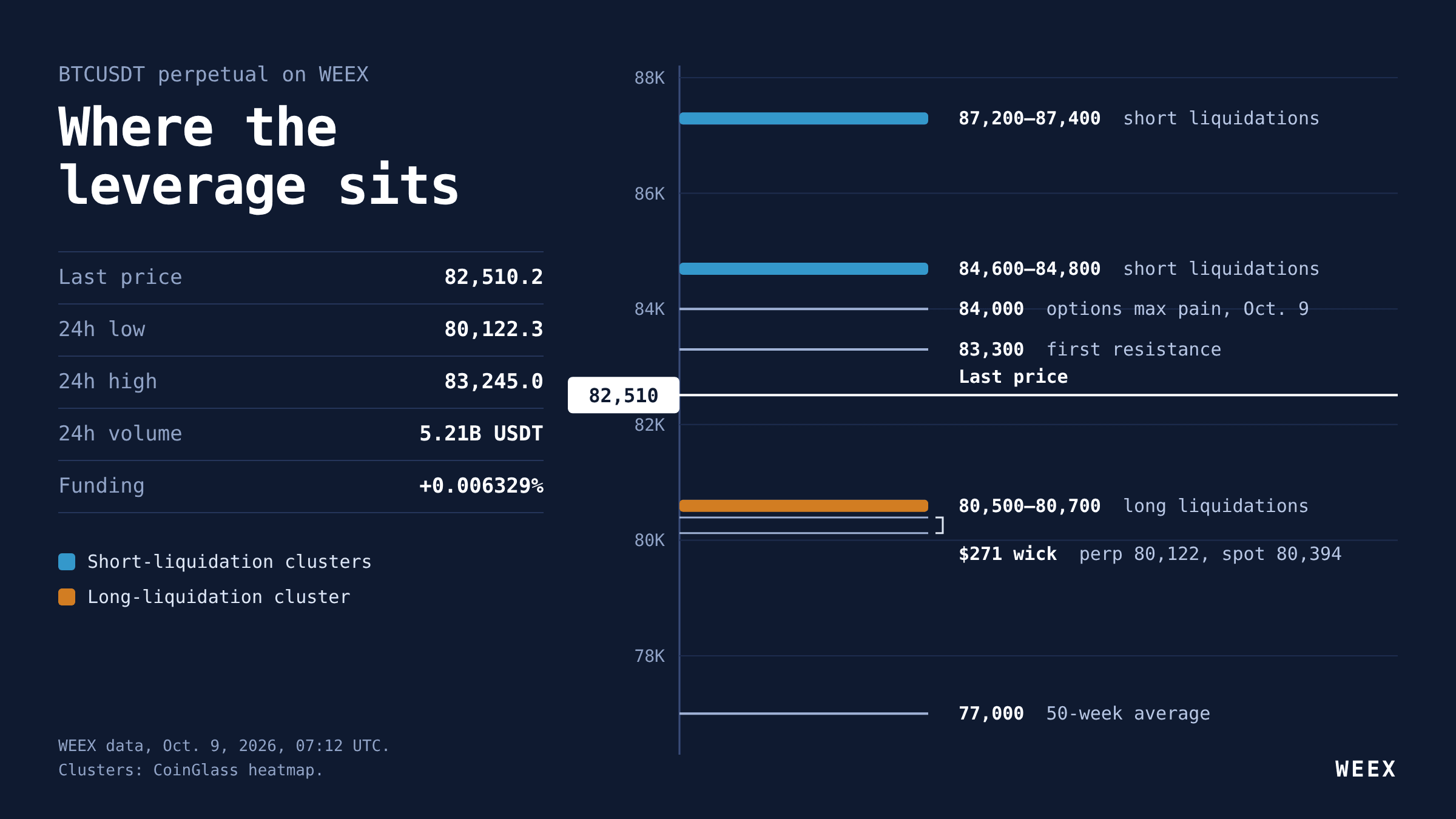
BTC Futures Analysis: $80K Held, but Longs Are Still Paying Up
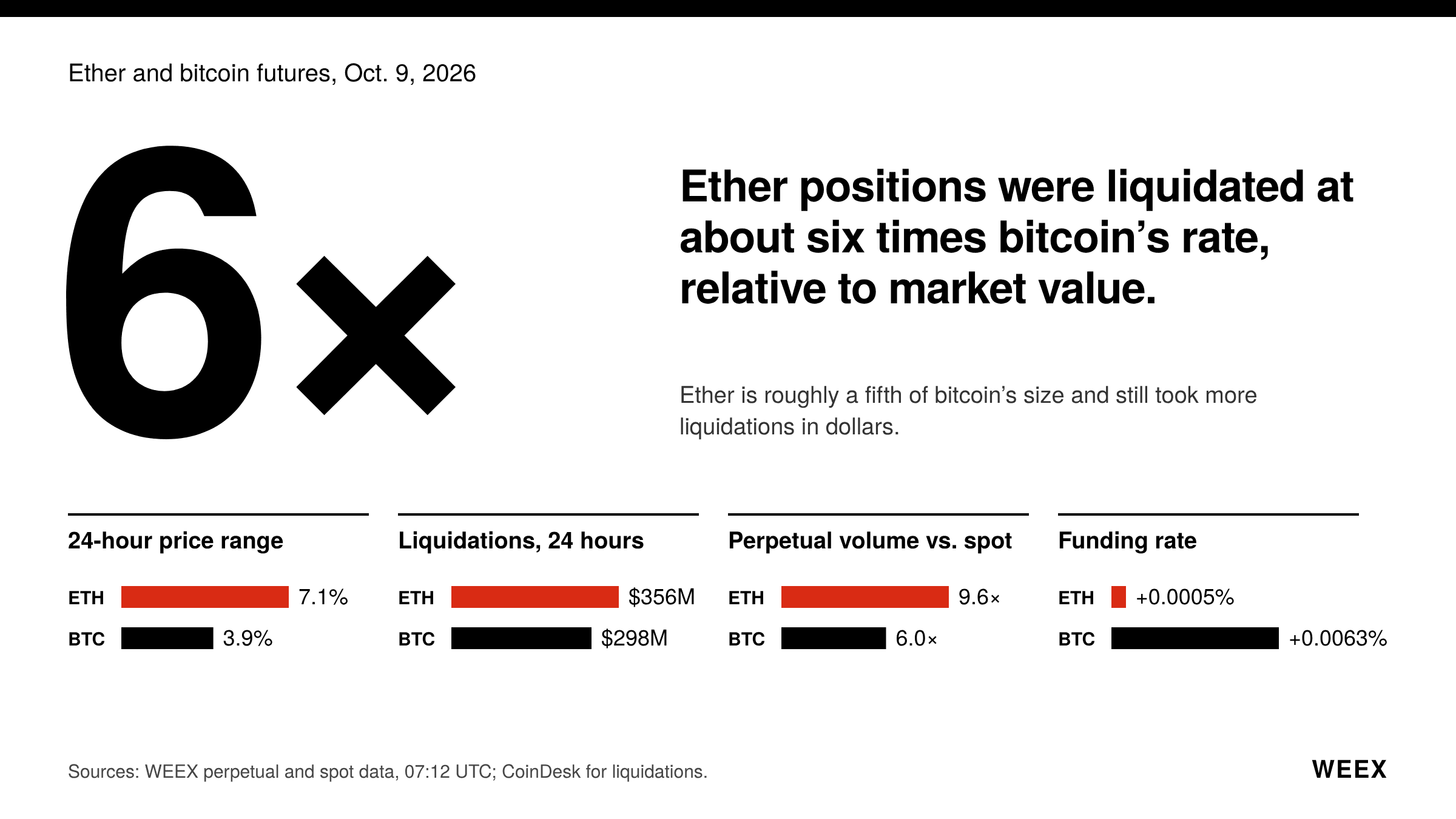
ETH Futures: Why Ether Is Falling Faster Than Bitcoin This Week
ENA Token Price Drops After October 5 Unlock: What Happened to Ethena?
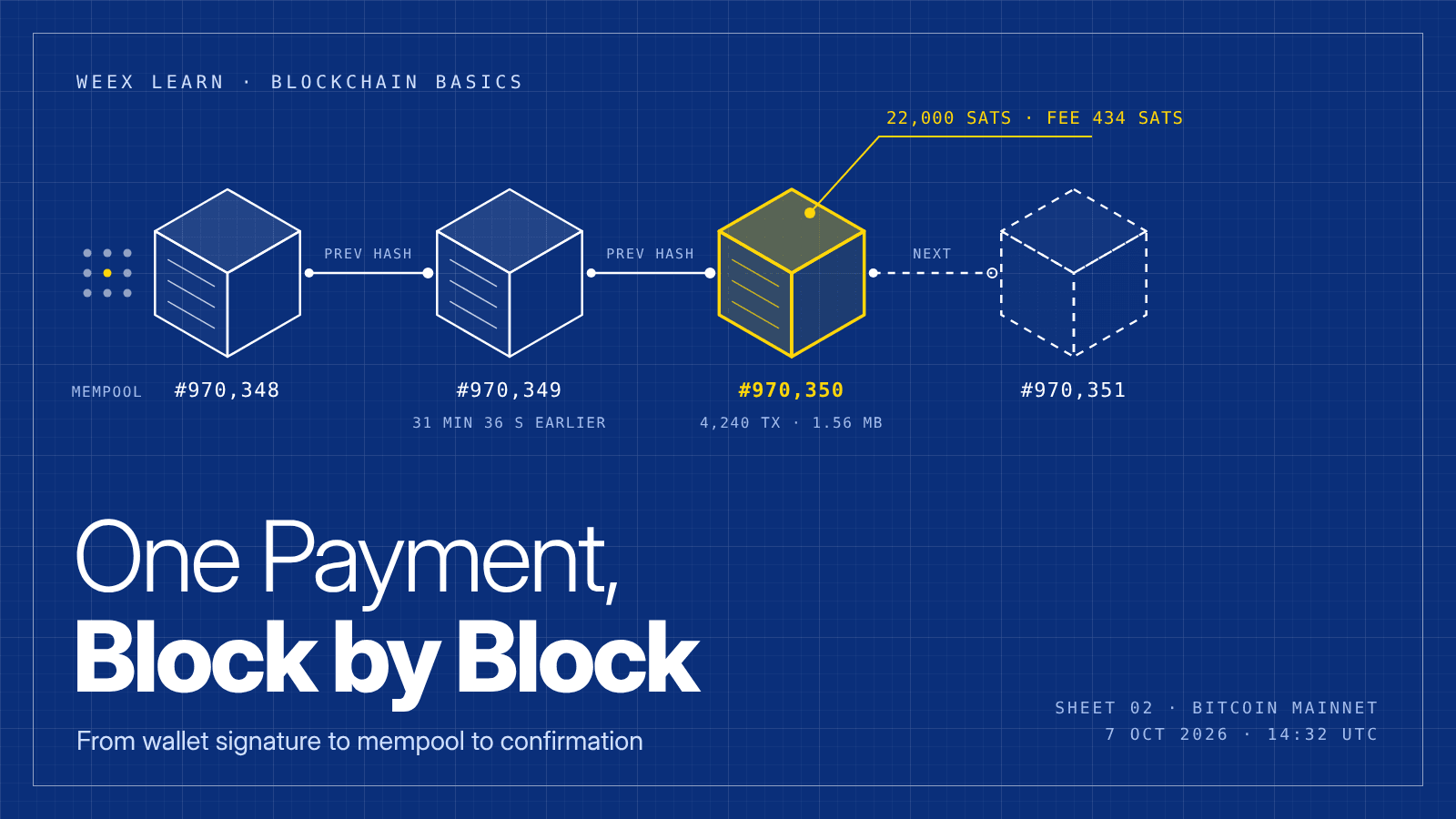
What Is Blockchain and How Does It Work? One Real Payment Traced

How to Buy Crypto With a Prepaid Card: Step-by-Step Guide
Best Crypto Trading Strategies for Beginners: What to Know Before You Trade
LayerZero Unlock October 2026: Can ZRO Hold $2 Amid Whale Inflows?
How to Buy Crypto With Apple Pay in 5 Steps: Why Your Bank May Decline the Payment
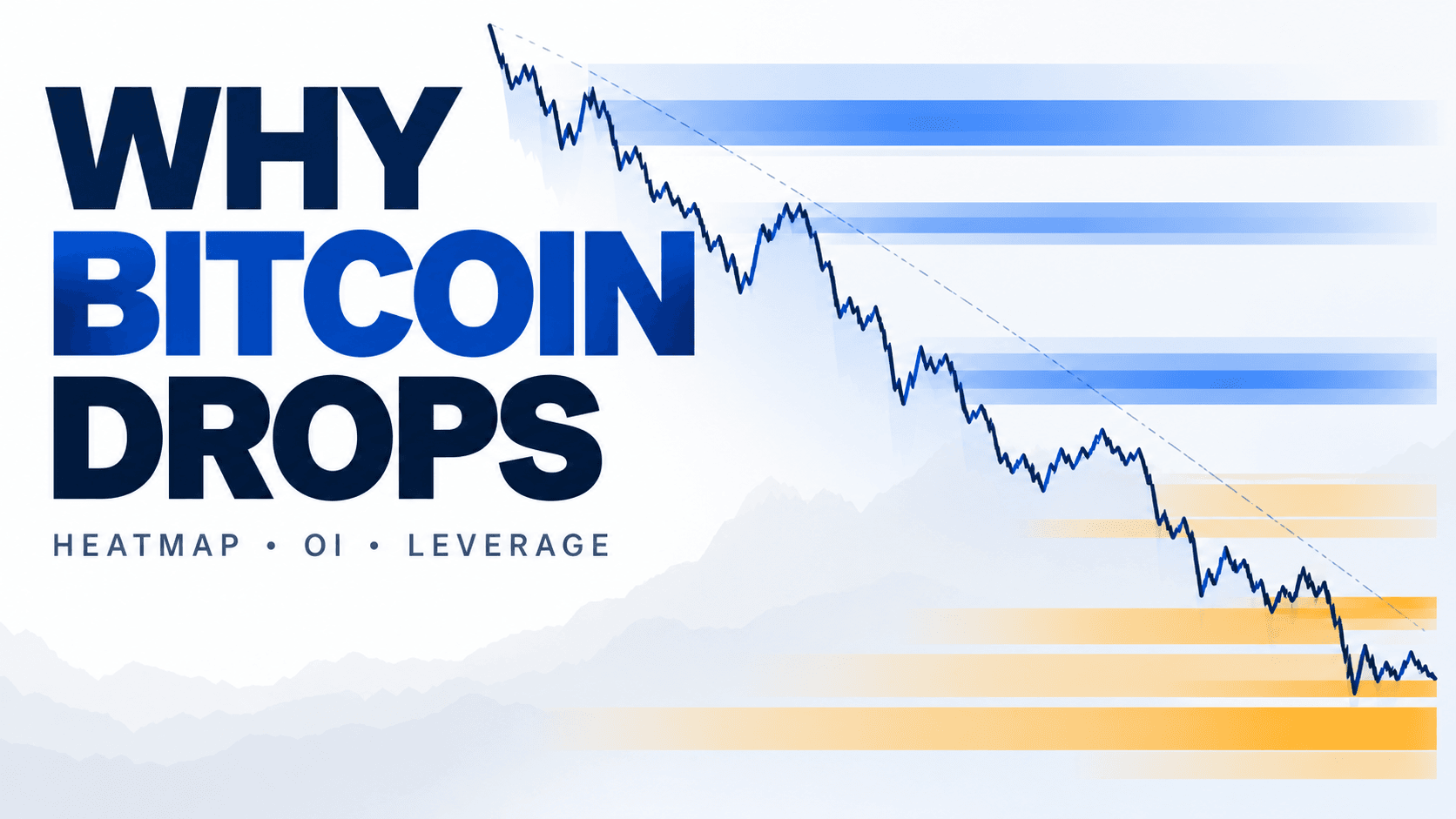
Why Does Bitcoin (BTC) Drop? How to Read a BTC Liquidation Heatmap Without Guessing the Bottom
How to Day Trade Crypto for Beginners: The Math Behind One Trade
Trading Psychology for Beginners: Crypto Traps and Hard Rules
What Is a Bitcoin ETF? How Creation, Custody and Fees Work
What Is Blockchain and How Does It Work? One Transaction, Traced
WEEX Convert Fees: What Zero-Fee Conversion Really Costs You
WEEX Convert Quote: How the 8-Second Price Lock Really Works